Factor in the Scottish prisoners of war

Quakers weren’t the only significant minority along the Piscataqua watershed in the colonial era.

One that doesn’t appear in my book Quaking Dover is the Scottish conscripts who had been defeated by Oliver Cromwell and his Puritan army at the battles of Dunbar in 1650 and Worcester in 1651, with some then showing up in what would become Berwick, Maine, and Oyster River in New Hampshire, now the town of Durham.

The Scots had sided with Charles II as king rather than Cromwell’s commonwealth. Hence, the “Bonnie Charlie” of the folksong lament, “Will yae ne’er come back again?” I now see the song also applying to the sons and brothers lost in the battles.

Despite their shared Calvinist theology, the Puritans took up to 16,000 defeated Presbyterians (Covenanters) as prisoners of war and treated them harshly. Many died in an infamous death march to Durham, England, or of illness later. Of the 3,000 survivors, around 900 of the healthiest were then deported to the American colonies, where they were sold for 20 to 30 pounds apiece (the cost of their passage) into indentured servitude, a form of slavery with freedom after five to eight years of satisfactory labor. The numbers of soldiers, I should caution, vary widely, depending on the source, at least until we get to the passengers on the ship Unity, 150 when it set sail late in 1650, and an additional 272 who reached Boston Harbor aboard the John and Sarah in late 1651.

I had come across passing references to some who had been sent from there to Berwick, Maine, but had not known of the enormity they endured or of their impact on the Piscataqua. One roadside historical marker, as I now understand, sanitizes their history.

~*~

The Old Berwick Historical Society has pursued the story of about 25 Scots who were brought to reconstruct and expand a sawmill on the Great Works river, on a site now on Brattle Street in South Berwick.

For full details, check out their website and its post, The Scottish Prisoners of 1650.

For an idea of the impact of that number, remember that neighboring Dover, the largest town in the region, had about 60 households.

The Puritans in the New World did continue to rub salt in the Scots’ wounds.  Before the town of Berwick was set off from Kittery in 1713, the English often called the settlement Unity, after the first ship that had transported the prisoners.

B. Craig Stinson’s Oyster River Scots, available online at the Scottish Prisoners of War Society’s thorough website, names another 22 who were taken to what was then part of Dover and then examines 18 of them. His list is drawn from the tax list at Oyster River, 1657-1659, most of them arriving on the John and Sarah. These are men who had fulfilled their indenture obligations, been freed, but were still in the settlement. Many of them later moved on to new locations.

~*~

Cultural clashes with the New England Puritans were inevitable. The records tell of Scots being taken to court for using foul language or bold confrontations with militia leaders as well as one husband put in the stocks for kissing his wife on Sunday and a minister being barred from preaching.

Considering the imbalance of European men and women in the New World, I am surprised by the number of Scots who managed to marry after they had paid off their indenture. According to the New England Historical Society, many of the brides were Irish housemaids who had been brought to the region, in this case likely Scots-Irish; a few others were even the daughters of the men’s former bosses. Notably, few of the former prisoners of war returned to Britain. Still, I’ve wondered if any of them had left wives and families behind and somehow reunited with them in New England.

In subsequent generations, I do see some descendants marrying into Quaker surnames, but not many.

One notable exception, told in my book, is Quaker Richard Otis’ third wife, Grizel, the daughter of Scottish POW James Warren of Berwick.

In the devastating 1689 attack on Cochecho Village, her husband and a stepson and stepdaughter were slain, while she, her three-month-old daughter, and other family members were taken captive to Montreal, where she was renamed and remarried to a French-Canadian farmer and had five children. After being widowed again, she returned to Dover without her children and established a prominent public house, or tavern.

The Otis story is part of my book.
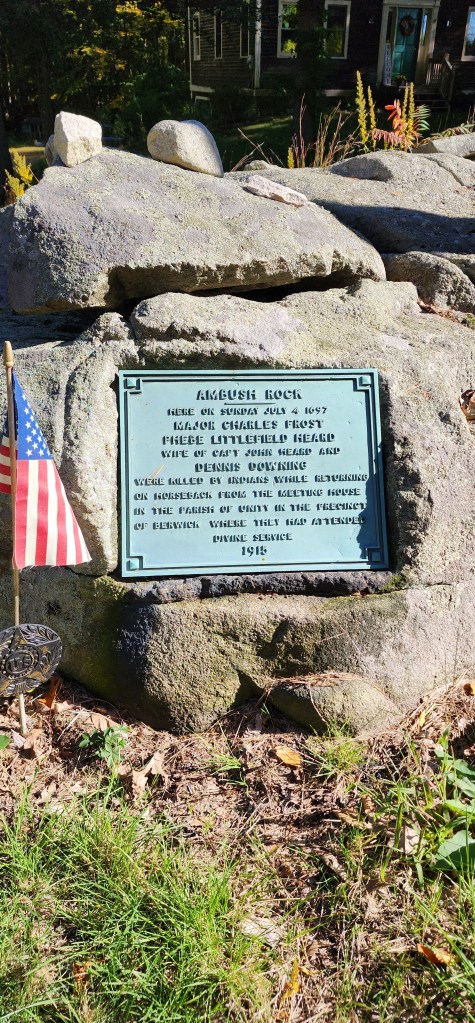
Ambush Rock

What the marker in Eliot, Maine, doesn’t mention is that Major Charles Frost and Dover’s Richard Waldron concocted the mock wargame that led to the hanging of Native men sent to Boston and the sale of about 350 Penacook women and children into slavery in the West Indies.

This was hardly an attack on an innocent party, then. The Natives waited years to extract revenge, and did it at a time and place that spared others.

My history Quaking Dover adds details.

English relations with the Natives were strained from the very beginning

One of the troubling revelations I found in researching my new book Quaking Dover is the depth of the English injustice and violence toward the Indigenous people of what we know as New England. It goes all the way back.

Forget the happy images of that first Thanksgiving feast where the Natives are portrayed as the special, very welcome, guests of the Pilgrims.

Squanto, after all, had been kidnapped, enslaved, and spent five years in England before the first English settlement took hold on Plymouth Bay.

Explorer Martin Pring, who established a fortified camp at Truro on Cape Cod in 1603, fled under attack by enraged Natives after he had set his mastiffs on them and fired his cannon in their direction.

The Pilgrims’ military leader, Myles Standish (not one of their faith, by the way), led the 1623 Wessagussett massacre, prompting Natives to abandon their villages for safer ground.

The Pequot war, 1637, was ultimately a land grab ending with the construction of New England’s first slave ship to trade the Native survivors into slavery in the West Indies in exchange for Africans.

And that’s before King Phillip’s war, with the mock wargame in Dover, or the waves of combat across northern New England until the treaty ending the French and Indian wars in 1763.

The outlook, of course, of “savages” and “heathens” was only part of the problem. The English insisted on addressing legal conflicts only in colonial courts. Not surprisingly, the decisions all seemed to come down against the Natives, with no independent course of appeal.

The pressure finally exploded in 1689 with the devastating raid on Cochecho Village and then Oyster River, both in Dover – hostilities that would continue another seven decades.

Are you ready for a fuller story?

Facing some hard publishing decisions

As a commercial book venture, my Dover history would be considered marginal at best.

Quite simply, short of a breakout, it targets a tiny audience.

The city itself is small – a population of slightly more than 30,000. And while the surrounding area runs around a half-million, that’s still small by book publishing markers.

Additionally, my work focuses on the city’s second-oldest congregation, an even tinier potential readership. While that element opens another market of fellow Quakers around the globe, it’s still small.

As for history buffs? They have their niches.

At the outset, at least, any for-profit book publisher would see this as a high-risk, losing bet.

I am, of course, hoping Dover’s 400th anniversary this year will give it a bounce.

And, as a microcosm of a snarky, contrarian New England history, Quaking Dover just might entertain a wider reception.

I mean, how many people do you think would have been interested in covered bridges in Madison County, Iowa?

~*~

One commercial publisher specializing in local histories did take a look but quickly backed off. The editor didn’t like the first-person voice of my book, for starters, and got spooked by the fact this volume hadn’t been vetted by religious authorities.

A few others were simply looking for an author-subsidized co-publishing deal.

That returned me to the self-publishing world I found in ebooks and then, for paper editions, at Amazon’s Kindle Direct Publishing.

As much as I like ebooks, for reasons I’ve previously discussed here at the Barn, I very much felt this was one that needed to be available primarily in a hands-on physical book form.

While Amazon has no upfront costs for an author in its print-on-demand paperbacks, physical bookstores refuse to carry them because they would have to buy the volumes at retail and then add a markup to the price to cover their own costs. They rightly complain it puts them in an unfair position.

But then came the announcement that my ebook flagship, Smashwords.com, was merging with Draft2Digital, which specializes in producing print-on-demand. Both companies have arrangements with distributors and retailers, and both offer their services to writers for free.

The arrangement also gives me more flexibility in marketing and special sales opportunities.

In short, count me in. I’m truly proud of the result.

Check it out through your favorite bricks-and-mortar bookstore.

Provincial? Richard Waldron was prominent in Boston and beyond, too

Although he is best known for his persecution of the three Quaker women missionaries and his mock war game that captured hundreds of Natives, which led in time to the devastating attacks on Cochecho Village and Oyster River as well as decades of violence ending in 1763 with the French and Indian War, Major Richard Waldron (or Walderne, in its alternative spelling) could easily be the subject of a fat biography of his own, if a very resourceful historian would rise to the challenge.

His influence and power ranged far beyond his mills at the great falls of the Cochecho River. He was Speaker of the Massachusetts General Court, or Assembly, for multiple terms and even owned a substantial house in Boston. His ships ranged the seas, where two of his children died doing commerce. And there are good reasons I call him a perfect villain in my book Quaking Dover.

Through him, though, I sense that Dover had some solid connections with the powers in Boston, rather than existing just an outpost on the frontier. It alters my perception of sparsely settled colonial New England.

Just how did he amass so much wealth, especially? Were his leadership skills mostly along the lines of a bully or did he have some sophisticated means of influence?

It’s fair to ask if anyone else cast such a long shadow over New Hampshire’s course or how he would stack up in comparison to better known Boston figures.

Let me be clearer, he could be the subject of a hot book or movie or maybe a mini-series.

About those taken into captivity

Learning of the length and bloodshed of border warfare between New England and New France comes as a surprise to many Americans.

One of the more startling facets is the tales of English hostages who were taken to Canada by Natives receiving payment for each person they brought north.

Some captives were ransomed by family and returned home, leaving the impression that the French were interested mostly in added revenue. You know, like legal piracy, or a landbound privateering. Maybe even as a kind of generous sympathy on behalf of the captors. Many, as I’m seeing, were wives.

Others, though, never returned, leaving the mysterious impression that they chose to remain, perhaps indulging in a more sensually rich culture than the Puritan world of their past. And perhaps some did.

The French were, however, at a distinct disadvantage in the colonial warfare and settlement. They were outnumbered by the British four to one, by many estimates. Or five to one, from another I’ve encountered.

One way for the French to build up their population was by immediately baptizing the Protestant captives into the Roman Catholic faith. For single women, this could soon be complicated by marriage and childbirth – she would not be allowed to take her children if she was “rescued” or “redeemed” and returned to New England, perhaps as a widow. Becoming a nun was another option.

Yes, further complicating the picture is the fact that some of the captives did in time become Catholic priests or monastics. As a consequence, there would be no place for them in New England without their renouncing that faith.

So far, I’ve come across no indications that the kidnapping ran in the other direction.

~*~

The definitive examination of the cases seems to be Emma Lewis Coleman’s two-volume New England Captives Carried to Canada between 1677 and 1760 during the French and Indian wars (published in 1925).

My book Quaking Dover presents two of the attacks, though there were other serious incidents in the town.

As I was saying about wanting to learn more?

The four original towns of New Hampshire differed from the start

For most of the first century, Dover dominated both New Hampshire and neighboring Maine.

It was the core of population, for one thing, as well as the oldest continuing settlement.

It also had significant water power, unlike Strawbery Banke, the future Portsmouth.

But Portsmouth, in turn, was closer to the Atlantic and had a viable harbor, leading it to become a center for adventure capitalists and merchants plying the ocean for trade at the same time Dover’s fishing focus diminished, in part a consequence of the sawdust in the water from the lumber trade.

Hampton (1636) and Exeter (1638) were both founded by men seeking religious freedom from Massachusetts. How’s that for a turn of affairs as well as a challenge to the argument that the latter was established in a quest for religious liberty while New Hampshire folks were interested only in lucrative gain?

Hampton long remained the most agricultural of the lot. Exeter did have water power for mills both there and in today’s Newmarket, yet it soon aligned with some powerful Puritan families. As did a elite portion of Hampton.

There were even the poor collected off the streets of London and shipped to New England, who may have then drifted northward.

Maine, meanwhile, began to coalesce around York, one town over from Dover.

Today, each of them remains somehow unique, within a New England identity.

Hampton, for instance, has a suburban sprawl feel with colonial touches. Exeter, with its prestigious Phillips Exeter Academy, could easily be one of the old towns abutting Boston but yet isn’t. The novelist John Irving calls it Gravesend. Continuing on, Portsmouth is a magnet for wealthy residents and resembles wealthy port towns all along the New England coast. George Washington, after all, did both sleep and worship there. It definitely has a superiority complex. And Dover, once a major textile mills and railroad center, is taking off as a family-friendly town with a viable, pedestrian-welcoming, downtown. It has, to me, the most practical yet visionary community spirit.

The differences are a subject well worth investigating. In the meantime, I’m keeping my focus on everything touching Dover.

It is, after all, the center of my new book and the city’s 400th anniversary as the oldest of all.

Dover’s prominence in the early province is typically overlooked

Not only is Dover the oldest permanent settlement in New Hampshire, it’s also the largest city in the Seacoast region today, with more than 30,000 residents. The region, however, adds to way more.

An hour northeast of Boston and with proximity to both Atlantic Ocean rugged shoreline and beaches as well as New Hampshire’s White Mountains, Dover has also become the fastest-growing city in the Granite State.

The town originally encompassed what’s now Durham (home of the University of New Hampshire), Barrington, Lee, Madbury, Rollinsford, Somersworth, and parts of Newington and Rochester. It also interacted heavily with the earliest settlements of Maine across the Piscataqua River, back when fishing was a leading business, followed by logging and sawmilling.

Still, there has also been a longstanding rivalry with Portsmouth just downstream, ever since its enterprising merchants rose to the fore. You know, uppity. Well, they do have the Music Hall.

Dover, I’ll insist, has been more modest. I’ll refrain from adding more for now.

For perspective, the region today has more than a half-million residents.

I like to think the center of gravity is shifting back to Dover. We’ll see. In the meantime, there’s that big 400th anniversary to celebrate.

Please stand by, as they used to say on radio.

Considering the play, ‘Mother Whittier’s Meeting’

In timing my book for Quaking Dover for the 400th anniversary of English settlement in town, I gave myself a deadline that ensured it would actually be done. Otherwise, I’d still be researching it.

In some cases, that meant I didn’t simply follow a conventional account but came to my own original conclusions. In others, post-publication findings confirmed in what I’ve deduced. Besides, in a period of Covid restrictions plus my own relocation to the other end of Maine, opportunities in the archives were limited.

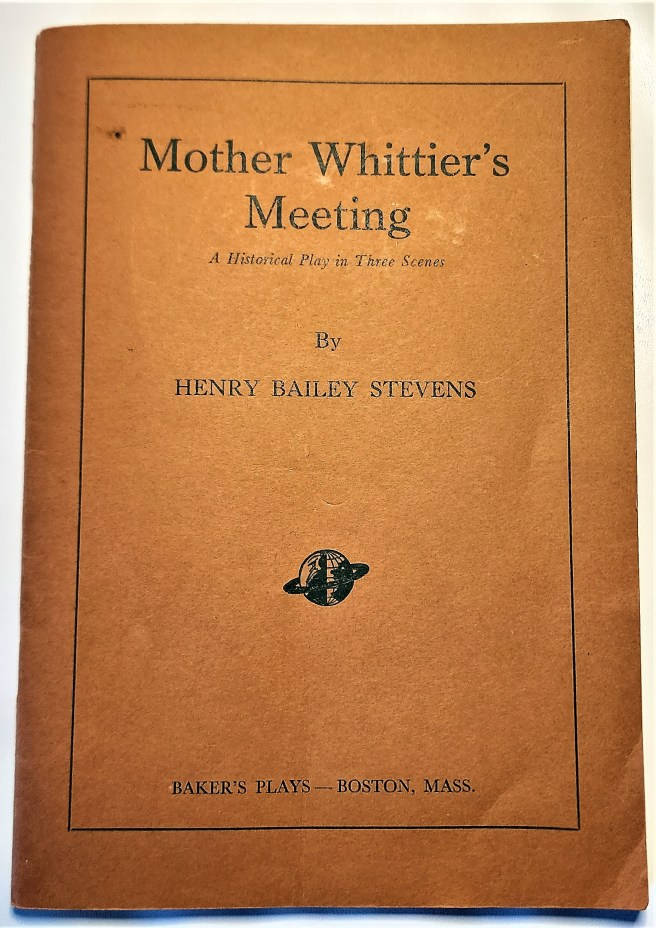
One of the works I’m glad I waited to read until my own work was done is Henry Bailey Stevens’ three-scene play, Mother Whittier’s Meeting. It was premiered outside the Dover Friends meetinghouse on August 17, 1963, to mark what he thought was the 300th anniversary of the Quakers’ presence in town. As I now see, the celebration was four or five years late.

Had I read the play first, I might never have written my own take of the history. He covers the heart of the plot in 200-some fewer pages.

Stevens himself is an interesting character who turned up around the time that the Dover meetinghouse was reopened for regular worship in the 1950s. He was the head of the Cooperative Extension Service at the University of New Hampshire in neighboring Durham but also harbored a deep interest in both history and dramatic literature, as well as an ardent vegetarian and pacifist. He even penned a series of Quaker family profiles for Dover’s daily newspaper.

The play itself is what we’d call “talky” – more dialogue than action. There’s no dancing or sword-fight scenes, as it were. The central focus shifts between Meeting as the community and as the house itself, or even turns to Abigail Hussey Whittier herself. Not that you really notice as you follow along.

There are points I’d heatedly contest. The first meetinghouse, for instance, was most likely not a log cabin.

But then I feel like cheering when Annie Pinkham shows up as a character. Her mimeographed brief history contained tidbits that would otherwise be lost to oblivion. She had every reason to believe she’d be the last Quaker in town once she locked the meetinghouse door.

Not so, as things turned out.

As for Stevens? His play, published by Baker’s Plays in Boston, isn’t his only significant book-length publication. Finding those, though, can be a challenge.


For tiny Dover, why all the hoopla?

As improbable as it would seem now, Dover was a throbbing center of dissidents and misfits in its early years, at least from the perspective of the Puritan authorities to the south in Boston.

Nor would I have expected a settlement inland from the ocean to be the one that took root, rather than the companion complex facing the ocean, but the Dutch trading post at Albany, New York, was even further up a river and survived.

There are good reasons that Dover became the center of action north of Salem, Massachusetts, and of Boston further south, not that you were taught any of that in your history classes.

I have to admit, it’s taken a while for the fact to sink in. Dover was the heart of the New Hampshire province, not that we see that today. Still, the roots remain.

My book, Quaking Dover, looks at the history from a minority viewpoint that leaves most of the last 200 years pretty wide open. Yes, there’s so much more to examine and include in the full picture leading to the rebirth of the community in recent years.

But what I’ve found is still pretty remarkable.

To think, it was such a humble and audacious start 400 years ago and counting.

It’s gonna be a big year!