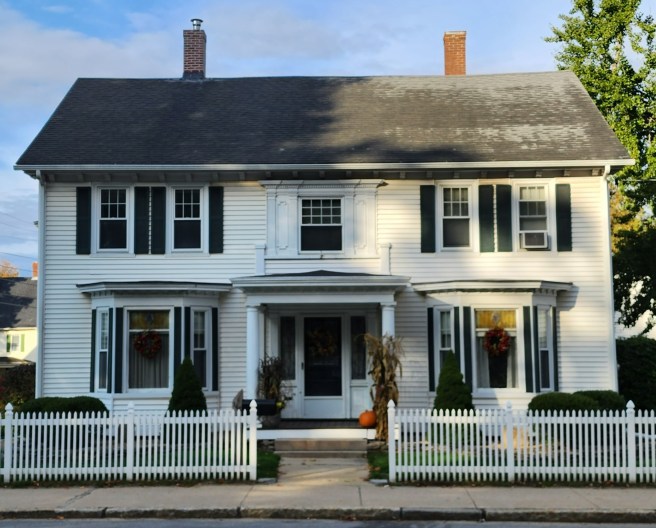
Of note across the street from Dover’s Quaker meetinghouse

The home Isaac Wendell built by 1827 sits across Central Avenue from the Quaker meetinghouse.

I often parked next to it on the side street and admired the bird boxes and woodworking details on the ample barn and house additions.

He’s most noted as the cofounder with John Williams of the Dover Cotton Factory, the forerunner of the big mills downtown, but of interest to my story, he had married Anna Whittier, a close cousin of the celebrated poet John Greenleaf Whittier.

We can assume Greenleaf was a welcome guest there on his many visits to Dover.

Let me add, the relatively humane working conditions in the mills deteriorated drastically after Williams and Wendell lost control to new investors, leading to the first labor strike by women in America in 1828.

Wendell also shows up in the founding of the Sawyer Mills, which I discussed a week ago, as well as a foundry.

Sawyer Mills usually get overlooked

The town’s textile mills don’t get a lot of attention in my book Quaking Dover, in part because I haven’t found a lot of interaction between the emerging industry and the town’s Friends. Indeed, the Quaker Meeting was seriously aging about the same time the thriving mills transformed the town into an industrial power.

Dover’s conventional histories, on the other hand, have good reason to focus on the big brick mills along the Cochecho River, world famous for the quality of their calico and their stunning print designs and execution.

You might be surprised to learn, though, that they were in operation much earlier than the legendary cotton mills at Lowell, Lawrence, and Manchester on the mighty Merrimac River.

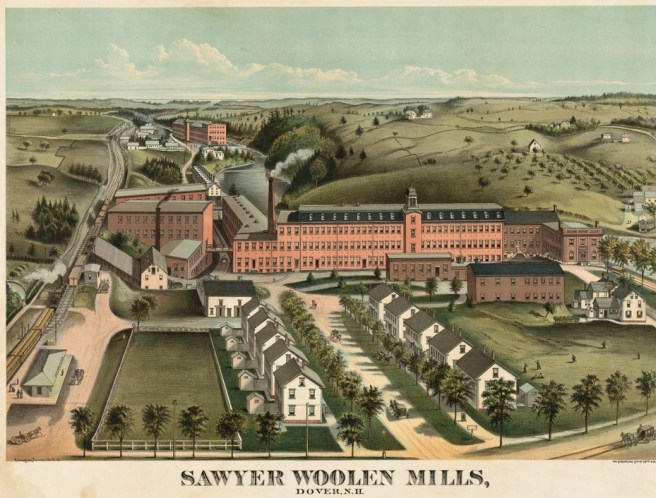
Largely overlooked, as one Friend reminds me, are the woolen mills on the Bellamy River south of Dover’s downtown and only a few blocks from the Quaker meetinghouse. These operated from 1824 to 1899 and were often innovative, employing up to 600 workers before being sold and continuing till 1954.

They were renowned especially for their flannel and were, at stretch, the largest woolen mills in the Granite State.

Today the mills and their historic housing have emerged as a charming residential district.

While there were some Sawyers in the Meeting, I’ve not yet found any connection to those owning the mills.

Based on the naming of some of their children, those were apparently Methodist.

My range didn’t expand to the whole state

Statehood for New Hampshire was accompanied by growth in the Merrimac Valley and western side of the state, including Quaker Meetings.

Weare, especially, became a Friends center, with two large meetinghouses in town and another in neighboring Henniker. There was also the Clinton Grove academy.

Much of that growth, however, came from Massachusetts, not Dover, and so it fell outside the focus of my Quaking Dover story. They were even in a different Quarterly Meeting than the one encompassing the communities emanating from Dover.

Just in case anyone was wondering.

As for a broad history of New England Quakers?

It would be an ambitious project, and I’m not sure quite how one would structure it, spanning six states and many subjects as it would from early colonial times to today.

Dover Friend Silas Weeks’ book of meetinghouses and burial grounds remains my go-to volume, but it’s mostly about buildings rather than people.

I’m still surprised to hear Rhode Island Yearly Meeting as the body’s early name, rather than New England Yearly Meeting. When did it change officially?

Well, I have seen some genealogies that get impossible to follow after, say, the third generation.

I even feel something like that in Dover, once the textile mills take over.

Still, the conventional histories of Quakers in America focus on Philadelphia, overlooking or slighting the unique challenges and characters of New England, North Carolina, Ohio, and more.

For now, my Quaking Dover is a microcosm of the bigger picture. I’m hoping it will prompt more.

The passing of my last aunt marks a generational change

News of the death of my dad’s youngest sister was not unexpected but a jolt all the same.

For years, she had been something of a cypher in my awareness, originally when she came home from college or later in her visits from California, far from our Ohio.

Mom’s family, apart from her stepmother, was largely non-existent, except for a few encounters in Indianapolis, central Illinois, and Missouri. And she had her differences when it came to Dad’s clan, which did filter my perceptions.

I really didn’t understand the array of uncles, aunts, and cousins until I got heavily into genealogy. Before that, I was rather amazed at (and baffled by) the connectedness of one girlfriend’s Jewish family, which seemed to have cousins everywhere. Just what was a second cousin, anyway, much less removed a degree or two?

When Dad died, though, after a decline to Alzheimer’s, his last remaining sister insisted on flying out to the funeral, along with her husband.

And that’s when I finally got to know them – personally rather than abstractly. Thankfully.

The revelation began when she and her spouse, my Uncle John, came down the gateway at the airport and he swept our youngest up in a big bear hug while proclaiming, “It’s so good to have another Democrat in the family!”

The kid had no time to be appalled. He was instantly high on her list of rare approvals.

It was an effusive side of him I’d never seen. He was, after all, a retired University of Southern California dean and an ordained Presbyterian minister. And he was a warm, fun-loving guy. Who’d a thought?

It was the beginning of many other revelations over the next several days.

Slowly, I realized that his wife, that baby sister my dad called T.J. rather than Thelma, stood halfway in age between my dad and me – much more in my direction, that is, than I had thought. And it also dawned on me that she was the last person who might be able to answer many of the questions I had accumulated regarding my grandparents. Except, that is, she was equally in the dark on many of the answers.

In the months after the funeral, that questioning led to a fascinating round of correspondence between her and me and, at her insistence, our cousin Wilma, six months Dad’s junior.

It was an extraordinary research project, actually, one you can read as the Dayton’s Leading Republican Plumber sequence on my Orphan George blog.

At last, I came to know my grandparents for who they were rather than what they were supposed to be or weren’t. But I also came to know and appreciate T.J. and John and Wilma, too, and so much of what I had been missing.

As I learned, only Dad called his sister T.J., so I felt a responsibility for keeping the moniker alive, especially for some of the reasons she expressed.

~*~

Leap ahead, then, to a letter I had from her a few months ago relating that Uncle John had died of cancer – and that she, too, now faced a terminal prognosis. She agreed to chemo only to buy time, as she said.

That led to a long, difficult letter from my end and then, to my surprise, two phone calls – we had never talked on the phone, for whatever reasons. These two, of course, were strong exceptions.

On the second call, I shared the news that Wilma had passed over after Christmas, having reached the 100-year-old milestone. T.J. was glad I had included her.

And then, a few weeks later, a first cousin reached me by email using an address he was uncertain still worked – I’m not sure we had ever communicated that way. Usually, it was the annual Christmas card and letter exchange.

He had the sad news, as he said, that T.J. had died after a week in hospice, her body weakened but her mind still alert.

~*~

Thus, within a few months, the last three of the generation before me in our family have died, and that places me next to the top in the senior generation that emerges. Or the oldest male, if that matters. Not that I’ve heard from most of the others in years.

What strikes me, though, is a sense of exposure or vulnerability, like having a roof or an umbrella blown away overhead. Like it or not, I’ve moved into that elders edge that they filled. No longer do I have those more experienced to turn to, and I’ve been feeling how inadequate I am in comparison to the best of them.

Not just in the family, either, but within my religious circles, too. I’m now the oldest surviving former clerk of Dover Meeting, for instance, with all of the institutional memory that’s supposed to embody, even as I now reside 300 miles away.

What I have to also observe, with gratitude, is that through them, I’ve also known blessings and perhaps even wisdom. May I pass those along, too.
As for Happy Hampton?

In New Hampshire, Hampton is often touted as Happy Hampton, at least in summer, reflecting its long, broad, honky-tonk ocean beach and the rock concerts at the casino. Let me warn you it can be pretty crowded this time of year. Inland a bit, it’s also known for the Hampton Tolls on Interstate 95, which can be a major travel delay.

In the colonial era, Hampton was renowned for its saltmarsh hay and related agriculture.

It was also the center of the colony’s other Quaker Meeting, one at least as old as Dover’s, as far as I can tell.

As I was researching my book, Quaking Dover, I kept wondering what happened to the Hampton Friends over time. And then I discovered that, like Dover, Hampton had small, neighborhood worship groups, or “preparative meetings,” that came together once a month to address their joint affairs and personal conduct. The monthly sessions rotated among the meetinghouses under the Monthly Meeting’s care, in Hampton’s case including Amesbury, Massachusetts, which became home to the celebrated poet John Greenleaf Whittier.

Amesbury continues, while Hampton fell away long ago.

Since the boundary line between New Hampshire and Massachusetts kept shifting in the colonial era, sometimes reaching down to the Merrimack River – or Merrimac, as Massachusetts insisted – I feel safe in saying New Hampshire had two Monthly Meetings, while the Bay colony had only one, at Salem.

Either way, it could be a rich story in the telling.

Dover and Hampton were largely overlooked in Quaker histories

In the conventional telling of the early Quaker movement in New England, the focus soon centers on Rhode Island and Cape Cod. One was an independent colony; the other, in Plymouth, slightly less harsh than Massachusetts Bay to their north.

In contrast, the three northern Meetings – Salem, Hampton, and Dover – are largely overlooked or dismissed as agricultural and poor.

Well, a historian goes where the records are, and those three northern Meetings were largely underground before 1680, when religious toleration came to Massachusetts-governed districts.

Arthur J. Worrell’s Quakers in the Colonial Northeast is slim pickings when it comes to those three Meetings, and Carla Gardina Pestana’s Quakers and Baptists in Colonial Massachusetts helps rectify that with her concentration on Salem, but her references to Hampton and Dover are few and often cryptically sketched as “New Hampshire and Maine.”

Well, Dover served both sides of the New Hampshire-Maine line, and for decades, it was the only Quaker presence in Maine.

As I keep calling out: Hello!

Hey, Travis!

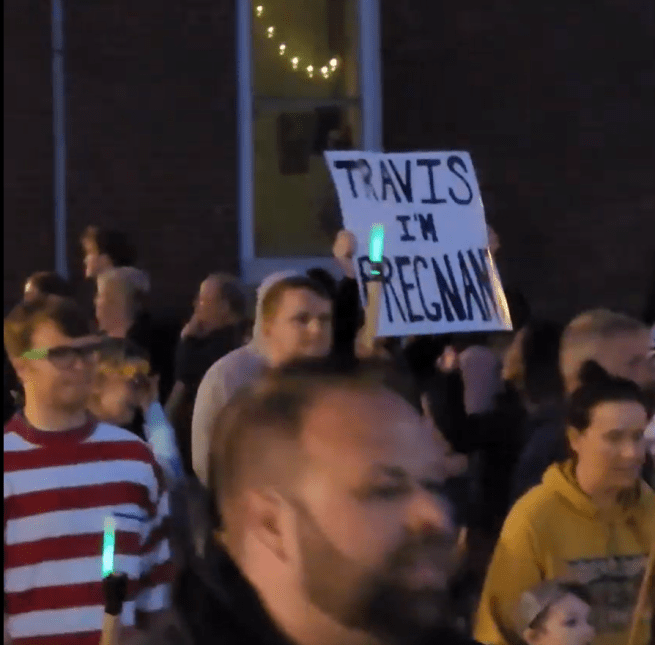
The annual torchlight parade is largely children, some accompanied by adults. It’s brief, but lots of smiles.

This year included a young woman carrying a big sign, and it still has me curious.

The words elicited an immediate laugh, and an assumption that they’re good news. She certainly seems happy, and we want to be happy for her.

At that point, though, I feel a writing prompt kick in.

Who is Travis? What’s the status of their relationship? Is he even somewhere in the crowd? Is she one of the Navy wives who came to town for the Fourth of July celebration and then joined their spouses for the cruise back to home port? Could this even be an attempt at shaming or is it instead her way of sharing the good news with family and friends, too?

What am I overlooking?

What’s your take? And which storyline would you develop?


The shipwreck of Angel Gabriel had a Dover angle

A monument at Colonial Pemaquid acknowledging to the 1635 tragic sinking of a ship caught me up short. I had forgotten the vessel’s impact on Dover.

As background, the ship had been commissioned for Sir Walter Raleigh’s last expedition to America in 1617 and in several subsequent incarnations been involved in some high seas adventures, staving off repeated boarding by pirates and beating off three Spanish ships. Not that I knew that in my initial research.

As the monument at the Maine historical site proclaims, the Angel Gabriel was a 250-ton galleon carrying settlers to new lives in New England in August 1635 when it anchored at the village of Pemaquid. Most of the passengers and crew got off the ship before nightfall to rest on land as guests of the villagers. That night, August 14-15, a storm later known as “The Great Colonial Hurricane” struck the area and the Angel Gabriel was torn from her anchors and destroyed.

Or maybe it had happened earlier and the ship had limped into harbor. Still, I’m quoting there, from an account that continues: “In the mid 1970s, efforts were made to locate the wreck in Pemaquid Harbor with divers and a magnatometer and sideccan sonar but no artifacts form the ship were ever located.”

For context, “The Angel Gabriel was very similar to the Mayflower but 18 feet longer and bearing four more gun ports per side.”

I am now curious to see whether the small museum displays a trunk that went down with the ship and was found floating the next day. It belonged to a passenger named John Cogswell and his descendant of the same name agreed to lend the trunk for display.

This marker, though, stirred up some memories of a section that got cut from the final version of my book Quaking Dover.

Here’s what I had:

Three Dover Combination signers shared a tragic introduction to the New World when their ship, the Angel Gabriel, broke up in the August 14 “Great Colonial Hurricane of 1635,” either in the harbor at Pemaquid, Maine, or at the Isles of Shoals.

[Note the clarification in the site of the disaster in the bronze monument.]

Twenty-one-year-old William Furber settled next to his brother-in-law, John Bickford, at Oyster River and later relocated to Bloody Point, opposite Hilton Point on Great Bay. He married Elizabeth Clarke, daughter of William Clarke and Elizabeth Quick, in 1642 in Dover.

(The Bickford family, meanwhile, has John landing at Dover in 1623 and marrying Temperance Furber in 1624 in New Hampshire. If these dates and locations can be supported, they would significantly change the early history of the Piscataqua settlement. Their son, John, though, was born in 1625 in Devon, England.)

Samuel Haines was an indentured servant or apprentice to John Cogswell, who was also aboard and survived. They were bound for Ipswich  [Massachusetts], where Haines finished his obligations the following year and may have moved at that time to Northam, as Dover was also called.

He did, however, return to England in 1638 and married Ellenor Neate within a few weeks after his arrival, suggesting they were engaged before his coming to America.

After a year-and-a-half, they set sail and established their home in Northam/Dover, where he had ten acres of land near the meetinghouse. Later, he had twenty acres on the Back River, where his neighbors were fellow Angel Gabriel survivors William Furber and John Tuttle.

He was taxed in Dover in 1648 and 1649.

In 1650 he leased Captain Francis Champernown’s Green Land farm for two years, and then secured ninety-one acres adjoining it, where he built a permanent home, and another ten acres where he eventually owned a mill. In 1653 he was one of the petitioners successfully asking the Massachusetts General Court to change the town name from Strawbery Banke to Portsmouth. That year he began the first of ten successive years as a town selectman. In 1666 he helped run the town line between Portsmouth and Hampton.

He was also the first deacon at the formal organization of the first church in Portsmouth in 1671.

At much of this time, the population of what now constitutes New Castle, Portsmouth, Greenland, and Newington was only fifty to sixty families.

Much less is known about survivor John Tuttle, who was about seventeen years old at the time of the disaster. After their rescue, he arrived in Chebasco (in Essex or Ispwich, Massachusetts). His age and destination suggest his situation may have been similar to Haines’. By 1638 Tuttle settled in Dover, where he was known as Shipwreck John and had a farm on today’s Bellamy River – one that grew into what was long known as America’s oldest family-owned and operated enterprise. (Never mind that Thomas Roberts’ heirs nearby would have a longer claim.) Tuttle’s son Thomas was killed by a falling tree while still a young teenager, leaving John Jr. to continue the family name.

~*~

Successive Tuttles became prominent Quakers. And, as I inserted, the monument is more specific about the scene of the disaster than I’d previously found.