My genealogical research experience was a plus

In my mid-30s, a decade after I started worshiping in the Society of Friends, I heard that my great-grandfather had been a Quaker who moved from North Carolina to Ohio after the Civil War.

I’d no clue and was shell-shocked, in a good way.

That soon got me into genealogical research with another, older, cousin, which in turn led me to others through correspondence. Many of the results can be found on my Orphan George blog.

Central to that research were Quaker Meeting minutes and learning to interpret those records. For family data, they can provide some of the best information before the census of 1850, the first to name everyone in a family, along with ages and some other facts.

Serving as clerk of Meeting and in other roles also deepened my understanding of the faith and practice.

While I gained some skill navigating this field, other researchers specialized in public records, such as wills, tax filings, and property maps.

Admittedly, working as a census taker in 2020, I did develop a sympathy for lapses and errors in the federal population documents.

When it came to researching Quaking Dover, I found myself returning to others’ genealogical summaries, where one version differed from another, as well as other records. I knew to treat what I saw there as tenuous but still helpful.

Somehow, though, it felt familiar.

Losing a reclusive neighbor we never really met

Moving to a new community three years ago meant meeting new neighbors, and Eastport, as we’ve found, can be a friendly place, even for us who are “from away.”

But one of our abutting neighbors was very-hard-of-hearing, as my wife discovered in attempting to talk to her, and ignored my attempts of waving in greeting. In many ways, she resembled my late asocial mother-in-law, not only physically but also in a heavy cigarette habit. Don’t know if she rolled her own, though. Still, she seemed to relish her independence and had a support system that included a few handymen I could approach with problems to address. Which they did.

We did worry about her occasional drives to the grocery or doctor or wherever. She could barely see over the steering wheel while puffing away, for one thing. And her backing out of the driveway did appear questionable. Still, she eventually returned home, apparently unscathed. I did see her one day in the IGA parking lot receiving a lot of help packing her trunk with her purchases.

I did wonder about her living in a big house all by herself, though that’s not uncommon in a town that’s largely elderly.

So flash forward to a day before what was left of Hurricane Lee was to hit town and I looked out the kitchen-sink window to see a police officer nosing about, checking her car, knocking on her door (and receiving no answer). No surprise there, her lawn-mowing and snow-removing crews got much the same.

Still, he was persistent, making repeated calls from his cruiser after trying all doors and walking around the house.

The next thing I knew, an hour or two later, was a white glove through her apple trees and the black SUV before the blanketed gurney came into focus.

Even before the obituary, an online search gleaned details that she had been born in Eastport to the manager of the local Newberry’s store and, when it closed, moved by stages to Upstate New York, and then, after college, to San Francisco before the Summer of Love and a career in banking.

And then, in retirement, she returned to her roots – from the City on the Bay, as we say, to the City in the Bay.

Her maternal side ran back to a family of Loyalists who fled to St. Andrews, a neighboring community in New Brunswick, before relocating to Eastport early on, while her paternal line was Pennsylvania Dutch by way of Virginia.

The family’s eventual obituary adds details.

~*~

In the aftermath, masked family and friends have been working steadily over two weeks to collect bags of trash and purge the house, including a colony or two of rats. (The rodents, it turns out, are well established in our end of town today – one more challenge to address.)

This also raises the question of just how much I leave to others after my own passing, and how much I need to clear out before then.

In the meantime, other questions loom, including the meaning of life for each of us.

We do wonder who will be living there next – hopefully not one more Airbnb but a real family with kids.

Onward! As I like to say.

Not that I wouldn’t love hearing the rest of her life story.

There’s much more to Salem than witch hysteria

Through much of the colonial era, Salem was one of America’s ten biggest cities. In addition, it was closer than Boston to Dover, and like Dover it was settled by West Country English fishermen before the Puritan migration flooded into New England.

Salem’s first Quakers suffered some of the most intense persecution for their faith found anywhere, and they were instrumental in bringing that faith to Dover.

What I didn’t realize was that Salem was long the only Quaker Meeting in the Massachusetts Bay colony. The other early Meetings in today’s Massachusetts were actually in the Plymouth colony.

Details on Salem Meeting’s existence were scarce until I was pointed to Carla Gardina Pestana’s Quakers and Baptists in Colonial Massachusetts.

Her study breaks off before the Salem Meeting shifts to Lynn, where it was once the largest or second largest Friends congregation in New England. And then that, too, faded from sight early in the 20th century.

Pestana’s sensitive telling of Friends through the period includes her sense of Quakers as family oriented, communal, even what she calls tribal. I would still like to see the story of what happened to Salem Friends in the industrial era, but she provided consolation for my own conclusions in Quaking Dover.

As for Salem, its unique Peabody-Essex Museum ranks in many categories in the top ten art institutions in America. It’s definitely one of our favorite destinations. Its grounds even include a reproduction of Salem’s first Quaker meetinghouse, built about the same time as Dover’s.

Older than it seems

Dover: where New Hampshire started. Leading to the second-oldest state in New England.

And then? Dover was already 200 years old when the textile mills took over the town.

Note, too, that Dover’s mills predate the more celebrated ones at Lowell, Lawrence, and Manchester on the Merrimac River.

It was hardly a fringe settlement in terms of action.

Next door to the Dover Quaker meetinghouse

When I first became active in Dover Friends Meeting in the late 1980s, a group of members and attenders seriously explored the possibilities of creating a  cohousing project. Their minutes filed in the meetinghouse could provide the foundation for a fascinating master’s degree exposition, but the wide range of differences in the participants’ needs and dreams proved to be too diverse to accommodate into joint action. Perhaps economic resource differences also came into play. On my end, I was single but had to consider what might happen if I met the ultimate partner and she had six kids. Ahem.

As it was, when I finally met and wed the almost perfect woman, she came with two marvelous daughters and a German mother-in-law, plus she needed or at least dreamed of and deeply desired space for a large garden. My ultimate party obviously would have required much more than a single bedroom with kitchen privileges.

Still, when I looked at what was then the Stringfellow house next to the Dover Quaker meetinghouse, I mused about how it might have evolved as the Friends shared housing project.

Maybe, as I’ve later learned, I wasn’t that far off target.

Better known as the Osborne-Cartland house, this was built by one prominent Dover Quaker and later owned by others with Friends’ connections.

In fact, it’s one more place the celebrated poet John Greenleaf Whittier likely stayed in his many visits to Dover, thanks to his Cartland cousins.

And it had carved off a slice of the original meetinghouse property.

Yes, it plays into my new book, Quaking Dover.

By the way, I should note that it suggests a Quaker neighborhood around the meetinghouse.

Between it and the Isaac Wendell home I recently posted about across Central Avenue was the Stephen Hanson house where Saint Joseph Roman Catholic edifice now stands. Hanson was somehow prominent in introducing manufacturing to Dover and built the house with his wife, Lydia Brown, after razing two smaller dwellings.

Wish I could show you what they, too, built.

Where were the schoolhouse and horse sheds?

Or maybe a large outhouse, as one map indicates.

I keep wondering if the Pine Hill school, at the fringe of the city cemetery, was originally one of Dover Friends early schoolhouses.

The Meeting apparently had a second one in Maine.

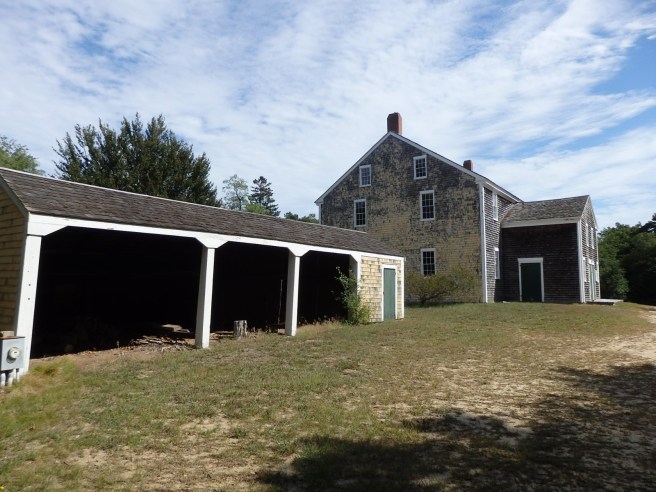
But horse sheds were also common around Quaker meetinghouses.

East Sandwich on Cape Cod, which has a lot more

Not that I’ve found any evidence of these now.


I’m rather glad I waited to read the First Parish history

As a parent, you really try to keep your kids from a lot of painful encounters but they never listen to your advice, as far as you can tell, which seems to be futile no matter how hard you try, and then the next thing you hear is crying.

Maybe that’s a good thing, if from their experience they learn more than you knew.

There are several books that fall into that model. Had I read them before completing Quaker Dover, I might have overlooked some fresh insights. But now that my book’s out, I really appreciate what else I’m finding.

Donald R. Bryant’s History of the First Parish Church is one of them. The 160-page volume, first published in 1970 and enlarged in 2002, offers another side of my argument of the Quaker invasion in town, for one thing, while relating other parts of the early years with, well, perhaps more discretion. And, my, I do admire his resources and tenacity.

One of my favorite sections is the profile of John Williams that Bryant works into the narrative. Williams, a member of the parish, was, as he says “a visionary, a leader in bringing textile manufacturing to America,” and a cofounder of what became the big millworks in today’s downtown.

But he also became part of the faction of 26 male members who announced in 1828 they were leaving the church to join the Unitarian Society in establishing a new congregation. The split among the heirs of the Puritans into Unitarian or Trinitarian Congregational at the time paralleled a similar one among American Quakers into Orthodox and Hicksite. New England somehow remained Orthodox, as far as Friends went.

The plot within First Parish further thickens over the kind of minister it needed along with the construction of a new, and present, house of worship. What follows in the parish history is a turmoil that includes the changing economics of the town I haven’t yet found in the Quaker Meeting.

Bryant’s history then turns largely to the successive ministers rather than the congregation’s members and their influence in the community.

Still, I appreciate the comments by David Slater at the end of the book. He was First Parish pastor when I first came to Dover and quite engaging. He offered a checklist on how church life was changing that remains relevant, though nothing hit me more than this:

“Christianity is becoming more and more counter-cultural.”

That takes me back to the Quaker invasion into Dover, back in the mid-1600s.

As for the city’s other congregations? I’m anxious to hear more.

Gratitude to the public library

Dover’s public library has been quite proactive in developing an online presentation of the city’s historical profiles and images. I’ve found those resources to be very useful for fast checks when drafting these posts and related material, for certain.

Its dark-hued historical room upstairs is a treasure chest of local lore, as I discovered decades ago chancing upon Dover’s Quaker family records serialized in the fat volumes of the New Hampshire Genealogical Record, 1903-1909. They’ve since been keyboarded and made available online, if you Google, though I’m still relying on my photocopies.

In time, as a library cardholder, I even had online access to U.S. Census records from home in the wee hours. What a privilege!

If it weren’t for the Covid restrictions and my relocation to far eastern Maine, I’d like still be digging around on the top floor there. I certainly encourage others to do so.


As for Underground Railroad connections?

While Quakers were active in the Underground Railroad for fugitive slaves, the practice wasn’t universally embraced within the Society of Friends. In fact, much of the illegal action across the North was undertaken by evangelical Protestants who even created the altar call at revivals to enlist fellow workers.

Yes, it’s one more story in the American experience that needs to be better known, in all of its gritty reality.

As I describe in Quaking Dover, the Cartland family farm in Lee is believed to have been a stop on one of those lines to freedom. While documentation of such participation is rare, escaped slaved turned abolitionist Frederick Douglass was a frequent visitor to the farm, and like also its small Quaker meetinghouse and school.

The bigger question would be how did the fugitives get that far and where did the route head from there? Not everyone along the way was sympathetic, after all. Newburyport, Massachusetts, for one, was downright hostile and thus an unlikely place to jump ship. As for Portsmouth or Dover?

Establishing reliable yet invisible connections every ten or 20 miles would have been quite an accomplishment. What prompted households to risk everything to the moral cause? They were, after all, a threat to a vast economic system and its wealth.

It’s one more another interesting twist to develop in future research through New Hampshire.