Turning to real estate

As the growing village took shape, John senior had his tract surveyed by Benjamin R. Jones, resulting in Shackford’s Plan of lots. A copy of that would help make sense of the wheeling and dealing that followed. Many of the purchasers were by John’s own children, individually or in combinations of partnership often formalizing land they had already “improved” and buildings they had constructed or sites where they would. Others went to Eastport’s new merchants and tradesmen. In all, I find 73 transactions, most of them as a grantor, or seller, recorded at the Washington County courthouse in Machias. I’ve probably missed a few, so take that as a rough figure.

It wasn’t just housing lots, either. Captain John’s waterfront properties were valuable sites for wharves, docks, and storehouses. He was even selling sites between the high and low tide lines. I’ll spare you the tensions between low tide mark claims today.

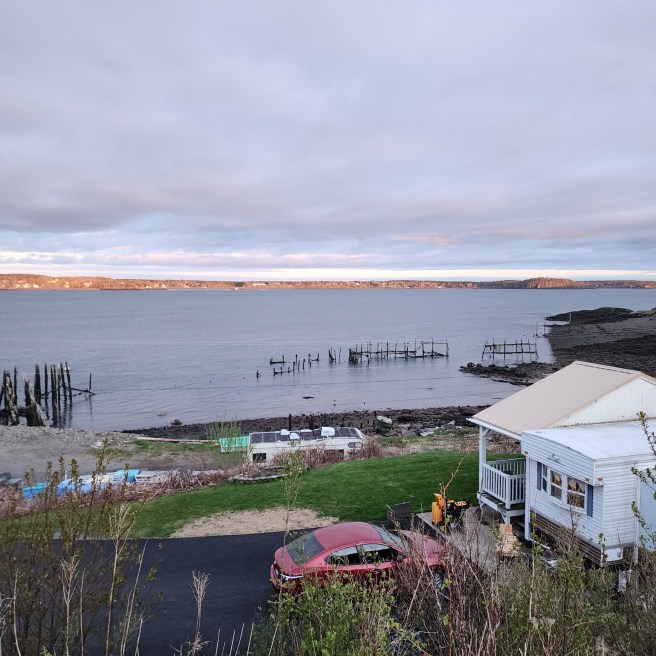
This is how some of the shoreline below our house looks today.

The one transaction I haven’t been able to track down is his title to Shackford Head. Was it simply overlooked by the indexers?

A significant deal took place on April 14, 1826, when his surviving offspring, all in adulthood, paid him $3,000 for the land between High (also known as Back) Street and County Road. And here I thought he had given it to them. Where did I get that idea? That was a huge figure for the time, by the way.

Was he a Scrooge with his offspring? Or merely cunning?

He still had plenty of lots left to sell.

Esther died on June 21, 1830, age 76.

All of it, of course, has relevance on the house we bought.
 

Another taste of the shipmaster role

Among the many vessels in Eastport by the 1820s, according to historian Jonathan D. Weston, John Shackford senior was one of possibly two residents owning ships of “suitable size and equipment to perform voyages at a distance.”

Captain John’s schooner was the Delesdernier, named after an Eastport family owning the tract just south of his own.

Lewis Frederick Delesdernier was the town’s first customs officer, in fact, and Weston’s grandfather. Note the “D” for the middle name.

Was the naming of the ship an inside joke? I’ll take it that way. He may have also been an investor in shares, another common practice.

The remaining ships of note in Eastport, incidentally, were “owned by inhabitants of other parts of the country.”

All of it, of course, has relevance on the house we bought.

Our house as an early landmark

While Eastport had a twisting trail into the village, the first real road was Water Street, laid out in October 1803, “from Mr. Todd’s house to Mr. Shackford’s.”

The Todd house, most recently known as a bed and breakfast inn, is believed to be the oldest surviving dwelling in Eastport. It was built around 1781 — some say as early as 1775 as a cabin – by John C. Todd and has early additions. Unlike ours, it had a large central chimney with multiple fireplaces, a colonial New England architectural signature. Ours had two smaller chimneys, including a precariously collapsing brick arch in the cellar when we bid on the place. That had to go before the rest of the bricks caved in.

When I began this investigation, I didn’t feel our house goes back quite that far, though I’m now convinced that Captain John had some residence on our lot by the time Water Street came along. For now, let me simply say the plot has thickened. No pun intended.

As historian Jonathan D. Weston describes,

“Water Street was laid out, 24 feet wide, after opposition by those who contended that 18 feet was ample width as it would allow two wheel-barrows to get by each other with room to spare, and, at the suggestion that it would be too narrow for horses and carriages to pass, scouted the idea that the idea that strange curiosities would ever be seen on Moose Island.”

That does explain the traffic congestion downtown today, long after horses and carriages yielded to automobiles and delivery trucks.

Key Street, bordering Shackford’s northern property line, came along in 1805, and then Shackford Street. Third, meanwhile, appears to the third east-west street in the Shackford tract. It is the only numeral street in the city.

Do note that Water Street was interrupted by gates and bars until 1808, when the town ordered their removal.

Up to 1820, as Weston observed, the town had only four public ways and no suitable places of worship. The annual town meeting was conducted in a small meetinghouse on today’s Clark Street..

The 1855 and 1879 Eastport maps show the main section of the house situated as ours is on this property. In the 1855 map, above, there were two ells but only one, larger than the current mudroom, in the 1879 map. Thus, for a time, a small courtyard existed, a common feature of the period. We have no way of knowing their use, for now. Sheds for horses or firewood are possibilities, as are a kitchen and common room.

The cellar, though, has thick stone walls, a serious undertaking.

As our renovations work has confirmed, the house is timber framed — what you may think of as post and beam, except that pegs were used rather than metal brackets and bolts. The nails, by the way, were hand cut.

That rules out Weston’s mention of the second framed house in town being built shortly after 1812 by John Shackford but removed shortly before 1888, perhaps the one John junior had a block further south on Water Street. (It may have been moved across the street sometime after 1835, if we go by the maps.)

Other evidence of an early origin of the house are the hand-split oak lathing, found in the ceiling. and the hand-cut nails. Those lathes disappeared from common usage by 1830, or so we were told.

All of it, of course, has relevance on the house we bought.

As for the windmill?

Once the war was over and Eastport returned to the United States in 1818, the Shackford family thrived anew.

The heart of his activity seems to have been an old log store built at what would become Steamboat Wharf. Described as being at the foot of Shackford Street, it would more accurately be placed right below our house. When the store was constructed, the Customs Office was south of Shackford Cove, rather than to the north of the eventual downtown and its docks. That first store was standing as late as 1840 but being used as a stable.

Its replacement, the so-called Red Store, was removed from the waterfront around 1833 by John Shackford junior and still exists within the main part of the residence at the south-west corner of Third and Middle streets, an elaborate mansard house best known as master shipbuilder Caleb S. Huston’s residence.

Another portion of the old building went into a small, two-story frame house, “situated on the windmill lot” on Water Street, at the foot of Third Street — diagonally across the corner intersection from us. I’m told that the windmill foundation sits in the cellar of that house.

Windmill, you ask?

Windmill painting by Mrs. Bradish. Our Cape is at the upper left, though the artist omitted two windows on the front.  Note that there are no dormers.

Captain John junior is also credited with building a windmill upon the bluff at the entrance of Shackford’s Cove, one that “proved faulty in construction and was of no practical value, but remained standing on the bluff for many years as a conspicuous landmark.”

The small Cape at the left in the painting would be our house.

In the Kilby history, Samuel Shackford recalled, “The windmill which stood upon the bluff at the entrance of Shackford’s Cove for a generation or more was built for him,” John Shackford junior, “but, on account of location or fault of construction, proved a failure. In a moderate breeze, like a balky horse, it would not go, and in a gale of wind nothing could stop it until the wind abated. The old mill, after it had become dilapidated by wind and weather, was a picturesque object in approaching the town from the sea. It was taken down by its owner about forty years ago, much to the regret of the public.”

That is, dismantled around 1848.

~*~

But that leaps ahead.

All of it, of course, has relevance on the house we bought.

The War of 1812 impacted the Shackfords personally

Eastport fell under British control in 1814 and was then attached to Canada for four years. Not that it went quite that easily.

As the conventional story proclaims, Captain John “commanded the first militia company organized in Eastport, his uniform consisting of an old Continental three-cornered hat, and he wore an old sword. His company was made up largely of veteran soldiers of the revolution, a wild set of fellows whom their captain found it difficult to control.”

More descriptively, in William Henry Kilby’s history volume, as Shackford’s grandson Samuel contended, “His men were of a sturdy, wild set of fellows, who appeared to think that the first duty of a soldier on training days was to drink toddy; and their captain had a hard enough time to control them. Many of them, having served half-clothed and half-fed in the Continental Army, doubtless felt that they had earned the right to an occasional frolic.”

I won’t question his sources, but he neglects to mention that Fort Sullivan and its commanding officer surrendered without firing a shot, as did Castine, Machias, and a fourth Downeast town. Still, continuing the Shackford account,

“When the British fleet captured the island and the commodore came on shore to take possession of the island, Captain Shackford met him at the shore, carrying a goad stick in his hand,” not the old sword, mind you, “and addressed him thus: ‘Well, sir! What brought you here? I am King of this island, and these are my subjects. If you behave yourself, you can come on shore. If not, you had better be gone.’ The commodore politely assured him that he had called on business, and trusted that he should conduct himself in a manner becoming a gentleman and to the satisfaction of his Majesty.”

Goad stick? Like for cattle? Captain John apparently had a flair for drama, as the next incident illustrates.

“After the English had taken possession of the town, all of the inhabitants were ordered to swear fidelity to the King, or leave the town and have their property confiscated. But the old soldier, when summoned to appear and take the oath, replied to the officer that he had fought under General Washington; that he might take four horses and draw him in quarters, but never would he swear allegiance to the King of England. It was probably on account of his eccentricity and boldness that the old gentleman was excused from taking the oath and allowed to retain his property.”

Follow that? Who would you nominate to portray Captain John in the movie? And, for that matter, the Brit? It’s still a great scene.

Beyond that, Lorenzo Sabine, editor of the Eastport Sentinel, later contended, “No privateer was owned here,” though Eastport was subject to heavy privateering (state-sanctioned piracy) during the War of 1812. The British cruiser Breame took prize of the Delesdernier with master John Shackford junior and Samuel Wheeler, an owner on board as a passenger. They paid ransom for their property and were released.

Another ship, commanded by Captain John’s son William and sailing from Eastport in early 1812 with a cargo of rice and flour, was captured 25 miles from the port of Cadiz, Spain, by three French privateers. He and his mate and cook were left destitute.

Another prize was a chebacco boat with Captain John’s sons Samuel and Jacob Shackford, who paid a stipulated sum and were given up. The chebacco design, by the way, was a little two-masted boat, popular among New England’s inshore fishery, originating during the Revolutionary War. They were built by the hundreds and averaged from 24 to 48 feet in length, had two masts and no bowsprit. They were usually a flush-deck vessel with several cockpits, or “standing rooms” in which the fishermen stood to fish. A middle hatch gave access to the fish hold. They were also almost always built near the dwelling of the builder and sometimes no more than a few yards from the front door. Shackford Cove, then?

The third time John junior was taken prisoner was when the Delesdernier was captured off Cape Ann, Massachusetts. He and companion brother Samuel were taken to Halifax, Nova Scotia, where he was left without a hat and, one dollar excepted, entirely destitute in the streets.

Captain John’s son-in-law Darius Pearce/Pierce, in command of the schooner Sally, better known as Old Sal, was taken by the frigate Spartan and taken to St. John, New Brunswick.

Quite simply, the War of 1812 hit the Shackford family heavily. At one time, John and Samuel Shackford and Darius Pierce were all held captive by Lieutenant Blythe, who then released them.

All of it, of course, has relevance on the house we bought, as you’ll see.

Back to Benedict Arnold

After the close of the Revolutionary War, and by then disgraced as a traitor, Benedict Arnold took refuge among the Loyalists in neighboring St. John, New Brunswick, where he emerged as a merchant and shipowner. Once, he personally directed the work as Captain John Shackford and presumably a crew loaded a vessel at Campobello Island.

Shackford later recalled,

“I did not make myself known to him, but frequently, as I sat on the ship’s deck, watched the movements of my old commander, who had carried us through everything, and for whose skill and courage I retained my former admiration, despite his treason. But, when I thought of what he had been, and the despised man he then was, tears would come and I could not help it.”

The Loyalist impact on Eastport, as I’m seeing in this project, was immense. Neighboring St. Andrews, New Brunswick, and St. John further up the coast were both founded in 1784 by Loyalist families exiled after the American Revolution. Many of them later filtered back into Eastport, including some lines that owned our house.

All of it, of course, has relevance on the house we bought.

There’s still a feast awaiting on this plate

As the calendar year ends, it’s fair to ask What’s Left in your own life as you move on for the next round.

In my novel, the big question is stirred by a personal tragedy, leaving a bereft daughter struggling to make sense of her unconventional household and her close-knit extended Greek family.

In the wider picture, she’s faced with issues that are both universal and personal.

For me, it’s somehow fitting that my most recent work of fiction returns to Indiana, the place where my first novel originated before spinning off into big city subways. The state is also home to more Hodsons than anyplace else in the world, as far as I can see, not that I’ve been back in ages.

What’s Left is one of five novels I’m making available to you for free during Smashword’s annual end-of-the-year sale, which ends January First.

Get yours in the digital platform of your choice, and enter the New Year right.

For details, go to the book at Smashwords.com.


Making it legal

Eastport’s growing community’s land claims needed to be clarified.

As Jonathan D. Weston notes in Kilby’s history, the Massachusetts legislature on June 17, 1791, authorized the survey of Moose Island, or Eastport, “the inhabitants prior to that time being simply ‘squatters,’ without titles to the land they occupied. The effects of this shiftless, temporary condition of affairs lingered for some time afterward.” Solomon Cushing then assigned lots to the occupants in 1791, according to Kilby. At the time, Eastport and Lubec, as Plantation 8 or Township 8, had a population of 244 people.

The deed John Shackford received from the Commonwealth of Massachusetts opens with the date June 18, 1791, and describes the committee appointed to “survey and lay out the [plan] of the settlers within said township one hundred acres of land to each settler to include his improvements,” as well as additional public lands to support a church and a school. Each settler who arrived before January 7, 1784, would pay the state five dollars for their property, while those who came later would be charged ten dollars. The purchasers would be exempt from any state taxes for five years.

Fitting “a plan of that part of said township called Moose Island with the several lots delineated thereon that Captain John Shackford a settler,” received lot No. 3, one hundred acres. The agreement was dated August 14, 1793, and recorded in Boston September 20.

His brother-in-law, Caleb Boynton senior, received lot No. 4, also one hundred acres. While his document was also dated June 18, 1791, it was not recorded until August 30, 1804.

Lot No. 17, 50 acres, went to Caleb Boynton junior in 1804.

The Shackford property would stretch along the waterfront from the middle of Shackford Cove to what would become Key Street and then back to County Road. Boynton’s stretched from Key Street to Washington Street. Together, their holdings would encompass about half of the business and residential lots of the eventual village.

The 1790 Census had a single Shackford household, John’s, with one free white male over 16, four under 16, and one free white female. This was recorded next to Caleb Boynton, with two white males over 16 and four females. Further down the list, Caleb junior had one white male over age 16, one under, and two females.

Curiously, in 1800, it was only one Boynton, Caleb senior.

You will find holes in the Census data.

Among non-family dwelling with Shackford around then was an unmarried Englishman, James Carter, in 1789. Quarters must have been tight.

With the deeds, the occupants became landowners rather than remaining squatters. Five dollars, do note, was a substantial amount at the time. Whether it was “reasonable” can be left to debate.

Thus, in 1793 Shackford gained clear ownership of one hundred acres at Shackford Cove, being lot No. 3 — and within that, the plot that includes our house. How much earlier he had built here becomes the question. By 1783, as his fee would indicate? Not all of this land went to farming, and he obviously augmented his holdings over time. If he was building ships, he definitely needed timber, which might explain the Shackford Head connection.

While I’ve been unable to find the deed of Shackford Head, it’s clear that Captain John acquired a hundred acres there, too. There are tales of the box of unsorted early documents at the courthouse.

The transactions I’ve found do undermine a story about a sheriff arriving from Massachusetts in 1797 with an armed party to seek payment for the lands. Remember, Maine was a district of Massachusetts until 1820. After being roughed up, and with what may have been a revised approach, the sheriff offered deeds from the state at a reasonable cost plus a five-year tax exemption.

Of Captain John and Esther’s children who survived to maturity, all four sons became ship captains, and two of their three daughters married likewise. Many of the grandsons continued that legacy.

Can you imagine the life in this house at the time?

Settling on Moose Island 

John Shackford senior definitely explored what would become Eastport in 1782, and, as one account expressed the encounter, “determined to remain and make provisions for the safety and comfort of his wife and children preparatory to permanent settlement.”

The early years of Eastport and its Moose Island are generally fuzzy. Legally, the pioneer white inhabitants were squatters. Captain John initially settled at Broad Cove at the neck of what became known as Shackford’s Head, and soon afterward built a mile-and-a-half away, at the edge of today’s downtown and what was soon known as Shackford’s Cove.

In one version,

“The Shackford family originally settled on Shackford Head, where Revolutionary War veteran Captain John Shackford began a homestead in 1783. … He built accommodations for curing the fish he hired caught by the Indians and some white fishermen … He also erected a strong storehouse of logs, where he kept and sold such merchandise as met the requirements of the fishermen and Indians; the fishery and storehouse were in full operation, and he set about building a dwelling house and planting part of his farming lands. Everything being ready in 1784, he set out in his small sailing vessel, the Industry, for Newbury, and brought to their new home his wife and two children, John and William Shackford.”

The Indians, mind you, were Passamaquoddy, who are still vital component of the community.

In the other version, “In 1787, having built a dwelling-house near the shore, at the foot of Shackford Street, he brought his family, consisting of wife, sons John and William, to their new home in the wilderness …” Not only is the date different, but also their address or its equivalent.

As I said about fuzzy? The consensus for the Shackfords’ arrival seems to be 1783/1784, the end of the Revolutionary War.

Jonathan D. Weston’s recollections had the Shackfords as one of the first six white families in town, arriving in the spring of 1784. Five years later, Weston calculates, the number of households had increased to 22 or 24, “the heads of one-half of these families were either men of English birth or those who had adhered to the royal cause of the war.” Either way,

“John’s little craft was the first vessel owned in the place, as the fishing business up to that time had been done in open boats. Among the vessels subsequently owned by him were Delight, Hannah, Sally, and Patty,” two of them apparently named for his daughters. Patty, meanwhile, “plied between Eastport, Portland and Boston, and was the first freight and passenger boat employed on this route. She was commanded by his son, John.”

While that jumps ahead in our chronology, it does reflect the family’s identity as shipmasters and perhaps also shipbuilders. Shackford Cove wound up with four shipyards along its short shore.

From the start, even before being named Eastport, the small frontier community on Moose Island comprised of a handful of families gained a reputation for “sheltering and sharing the gains of adventurers, smugglers, and gamblers.” Not to cast a shadow over the Shackford family integrity, right? Or making a nice profit?

Welcome to America’s Wild East.

Revolutionary War veteran John Shackford senior

John Shackford was a Revolutionary War veteran who brought his young family to Eastport at the end of the war, making them one of just six households on Moose Island. For the next half century and a bit more, they were influential figures and then faded entirely from the scene by the turn of the 20th century. It was a pattern I’m seeing in seafaring families in coastal communities in American genealogy.

His ancestry in America goes back to Dover, New Hampshire, where I lived for 21 years before moving on to Eastport. His father, Samuel, was a mariner who resettled at the mouth of the Merrimack River in Massachusetts, where John was born in 1753 in Newbury, a decade before the port was set off as a separate town, Newburyport.

Among the other children of Samuel and his wife, Mary Coombs, were Mary, who married Caleb Boynton, for whom Boynton Street and Boynton School in Eastport were named; Captain Samuel Shackford, who died in Newburyport; Levi; and William.

As a sailor, John may have visited Eastport as early as 1763, age 10 or so. (As one version goes, “He was brought up a sailor and while so employed his ship visited Eastport, Maine, as early as 1763.”)

Around here, “captain,” as you may be noting, more often referred to a shipmaster than an army rank.

As a soldier in the newly formed Continental Army in its second major military operation, John enlisted in the strenuous march in September and October 1775 through the wilderness of Maine under the command of General Benedict Arnold. Serving in a Captain Ward’s company, Shackford was one of 1,100 men in the arduous trek that saw 300 soldiers turn back and another 200 die en route The surviving troops were left starving and lacking in many supplies and equipment assigned to attack Quebec City.

Joined by General Richard Montgomery’s forces after their capture of Montreal, the Americans attacked Quebec City in a snowstorm on the last day of the year. They were roundly defeated.  Montgomery was killed and Arnold’s leg was shattered.

Shackford was taken prisoner and confined for nine months, six weeks of the time in irons — that is, chained.

After his release, he broke his promise to his captors not to engage in battle. In early 1780 he and instead served under George Washington at Kingsbridge, in Westchester County, New York.

During the Revolution, John’s brother Levi was wounded at the battle of Bunker Hill. More extensive was the service of brother William. First, he was captured on the privateer “Dalton” and confined in the Old Mill Prison in Plymouth, Devonshire, England, for three years; and then, on being released, he served under John Paul Jones and was either killed in action or died from hardships endured in the war — he never returned.

On the other hand, as a veteran, Private John Shackford returned to Massachusetts and married, on November 26, 1780, Esther, daughter of Captain Gideon and Hannah Woodwell. Her father was an extensive shipbuilder at Newburyport.