What do we make of a trio of evil great-aunts?

OK, I’ll have to admit they’re cardboard characters. I do little to develop her three great-aunts in my novel What’s Left, the ones Cassia and her brothers and cousins simply refer to as the Erinyes. Unlike the classic Greek marble statues, these have no redeeming qualities from the perspective of the story. They’re out-and-out evil forces, having fled the family rather than staying put where they’re needed. But they have enough influence to wreck everything, given a chance. And, yes, I’m still startled by Sandra’s outburst in my final revision. Let me know what you think when you get to that part.

As an author, I rather like the way they might simply dance across the stage as a trio arm-in-arm. And then back. Like a storm cloud, even.

I also like the way they serve as a foil to Cassia’s father and the others who voluntarily join the family the Erinyes had so readily fled at the earliest opportunity. Should I say abandoned?

Could it be they’re cardboard characters with a marble veneer? Do we even need to name them, individually?

I even delight in the weasel home-breaker who appears in their place further along in the plot — the one who aligns herself with their monetary claims. Oh, but that’s such an insult to weasels.

~*~

Here was one consideration I cut from an earlier draft:

What if the Erinyes had married into Baba’s side — something like it, out in Iowa or Salt Lake City?

And then moved on to Orlando or Orange County? No, they were bound for big cities. Which is where your Baba expected to thrive.

~*~

I dunno, but I’d guess they’d wear globs of makeup and tons of jewelry and loud stretch pants and perhaps even vote for Trump.

As an author, I can’t even forgive them for the way they treated Bella when she began working in the family restaurant, much less their threatening actions in the years when Cassia fights to preserve something for her own generation.

They have me thinking of the phrase “bad eggs.” I’ve seen more than a few in my own time … in my own life, actually.

Have you ever seen someone break up a relationship, a home, or a business? Anywhere else? What was the cause? What did they do? What could others do in response? What was your experience?

~*~

In the family, Cassia may have had food like these beet roots, photographed at Mario Restaurant in Monolithos. (Photo by Klearchos Kapoutsis via Wikimedia Commons.)

~*~


Sustaining the teaching — and the teacher

Until the next-to-the-last chapter of my novel What’s Left, the resident Tibetan Buddhist master, Rinpoche, stays largely in the background.

He’s a stabilizing influence of Cassia’s family, all the same.

As she realizes, in earlier drafts of the novel:

I am impressed by Baba and Tito’s roles — the entire family’s role, in reality — in establishing the Buddhist institute. Our charitable foundation was established as a vehicle to support Baba’s research time as well as the institute and the new Pan Orthodox church — along with college scholarships for family children as well as those of many who’d worked for us. The foundation, then, was another enterprise from Dimitri’s socialist cognizance as it blended with our growing spirituality.

The family’s financial security was especially important in supporting her own parents through some transformative years:

For my parents, it provided enough income for them to pursue their dreams, even before we kids came along. Manoula’s share of the dividends and, I’m inclined to think, a consulting stipend from the company itself also allow Baba to focus on establishing the Tibetan institute here. For the first year, the Tibetan research operates out of their apartment, along with our publishing setup. And then, with Rinpoche in place, the institute settles into a small house more or less in the middle of Mount Olympus, where the guru can live in proximity to selected students the way Baba had.

But over the years, their individual practice wavered. With Barney, for instance, as Rinpoche explained:

More and more, we argued. Your Baba could still converse with him about these matters, but Barney kept quoting another teacher, far more permissive than me. What he allowed, we wouldn’t. But a few years ago, that guru died of complications of his wild lifestyle. It was scandalous.

As for her aunt Pia?

Rinpoche tells me she attended the weekly sessions with Theos Barney and the rest of the family, but her heart remained with the church.

And then Cassia has more pressing matters:

Pain? You say it’s an illusion, not real.

Oh, I’ve had some long discussions with your priest about that! From a Buddhist point of view, pain’s not real the way material things aren’t real. That doesn’t mean they don’t get in the way. You just have to learn to see through them. You can’t refuse to directly examine an obstacle, though, and expect to be liberated from it. You just have to remember what’s beyond it.

The mountain?

There’s no avoiding it.

~*~

In Cassia’s family her father finds much more than a circle of faith. He gives and receives support in everything he values.

How do you support others? Is there one place you feel is especially important? What causes or organizations do you help?

~*~

Tibetan Buddhist double-dorje emblem. To me, it looks almost Greek Orthodox.

~*~

How Cassia herself evolved in the revisions

No matter how much my novel What’s Left is framed by the ending of my first published novel, most of its characters and action are entirely new.

Well, if you can call going a few more generations “new,” they’re fresh characters in my fiction, filled with color all their own.

Cassia herself and her brothers and cousins and aunts Pia and Yin are certainly original to this story. And yes, a lot has happened in the 50 years since her father joined in with the family.

As one now-deleted line admitted:

Your very presence alters the vibe. There’s the whole nonconformist groove.

This was a description of what her parents’ generation was doing to the restaurant immediately after the fatal car crash, but it could fit much more widely.

In each revision of the novel, Cassia took another step forward. She’s always started her quest at age 11, but most of it was told as a young adult recalling her string of discoveries. Now, however, much of it emerges when she’s 13 and moving up through her teens. For contrast, the final section comes a decade later, after she’s ranged the wider world.

Crucially, in the final revision, she’s speaking directly to her father throughout, rather speaking about him. And, as noted, much of the action has moved forward into her early teen years.

Somewhere along the way, her quest took a flip. It became more about her discovering just who she is and her role in the action. And that’s when she started dictating passages to me, the author.

When I selected her name, Acacia, I didn’t realize how prominent it is in the Bible. In the King James translation, it’s rendered as shittim — what an ugly word! — but Moses was very fond of the extremely hardy wood, and it’s mentioned more than 30 times, often as a required material for holy construction. Americans are most likely to encounter it as the fragrant black locust tree, thorns and all. (OK, officially that’s considered false acacia, but still … close enough for me.) Its flowers are quite fragrant.

~*~

Well, an author can’t include all the details.

What do you think Cassia’s favorite food would be? (Don’t you dare say the Streetcar!)

~*~

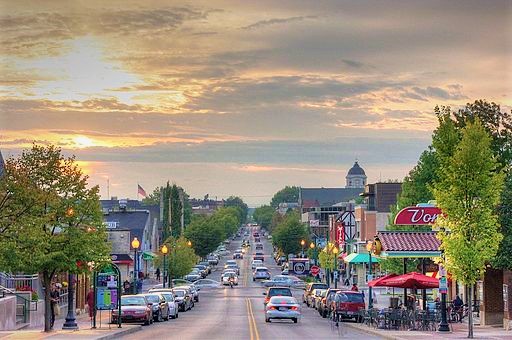
Kirkwood Avenue in Bloomington, Indiana, a town that inspired much of the novel. Cassia’s family compound and restaurant would have been off to the left.

~*~

Maybe this is backwards, but the cover can change the story

This self-publishing field means an author is typically deeply involved in all parts of the project rather than just the writing itself.

In my Smashwords releases, I initially hired a book designer to do the covers, but my current releases have all been created by me. (Someday, I really would like to have an artist design the front, but for now, I’m sticking to photos or existing stock artwork. We’re on a strict budget.)

Still, finding an appropriate image can be a challenge.

Has anyone else had this experience? You come across a picture that clicks and select it – and then you go back into your manuscript to make the visual fit better with the text?

For me, that happened with the portrait I settled on for Promise – the model gave me a clearer vision of my character Jaya. (That novel’s now part of Nearly Canaan.)

More recently, with Yoga Bootcamp, the handstand dog reminded me to keep the story lighthearted and humorous in my final revision. Did my decision to nickname the swami Big Pumpkin and Elvis come after the pooch was on board? I don’t recall now, but it certainly wouldn’t surprise me.

Do tell me about your favorite book cover. Does it influence how you see the story? If you’re a writer, has the art on your book led to revisions?

~*~

By the way, I do hate it when the character on the cover is shown, say, as a blonde but is described in the story as a brunette. That sort of thing.

And don’t forget: You better be good to toads!

Missing from his photographic evidence

As Cassia discovers in my novel What’s Left, her father’s photographic record includes some serious gaps.

One involves a side of the hippie era, especially his experiences going underground in New York City.

As Cassia comments in an earlier draft of the story:

From his photos, I have little to go on regarding the hitchhiking, much less the subways. Not that there aren’t images — they just don’t reveal anything. Maybe it was largely in his mind. Maybe mostly a pipe dream. Entertaining, all the same. And one or the other landed him here.

~*~

Looking back on the era, I wonder how I’d react seeing photos of the people I was with or the experiences we shared. The nude group swimming at the remote lake in the summer? Not nearly as sensuous as I remember? Former lovers? Half of the places I lived have been torn down, as I see from satellite maps. You get the idea.

The time seemed so full of promise.

Tell me about the biggest disappointment you’ve ever had.

~*~

~*~


How personal should a character get with the reader?

In the final revision of my novel What’s Left, I’d take a passage like this and have her speak directly to him, rather than about him. It makes a world of difference. Think it would work here?

~*~

I could say it was always gentle and kind, rather than laced with frustrations and sharp clashes. I wish, well, who is any of us, in the end? Maybe I need to ask our Orthodox priest more about the Book of Life or the Book of Judgment and all that?

~*~

Do you hear her asking her father if he was always gentle and kind? Or if she should ask the priest about the rest? Do you, too, feel that line needs to be inserted?

We can easily create a shopping list of what we desire in those dearest to us — or, if we’re more ambitious, what we can offer to others. So let’s fire.

What quality would you most want in the person who’s closest to you?

~*~

Cassia’s roots included inspiration like this. Greek Orthodox icon at Mount Athos created by Father Vasileios Pavlatos in Kefalonia, Greece using the technique of Pyrography. (Via Wikimedia Commons.)

~*~


One way to get inside the publishing scene

As I revised my novel What’s Left, I compressed the details regarding her mother’s book-publishing venture. Here’s how it stood in an early draft:

As her dream of establishing a small-press also takes shape, the family council decides not to include it outright among our Five-Spokes enterprises but rather to extend a ten-year microloan to allow her to retain full control of its success or failure. Her game plan anticipates a modest start, essentially continuing the annual calendar and the greeting cards featuring local photographs by Baba, as well as the release of the first volume of Nita’s collected columns. These are things Baba can shepherd along while Manoula finishes her degree. From there, a cookbook would be a no-brainer in the lineup, something Barney can begin putting together immediately. We know he’ll be fussy and irritable, miss deadlines, do the whole prima donna bit. Besides, he’s not a writer, so there will be extensive editing and revision. After that, Baba can worry about the photos. He says shooting food’s a specialty all to itself. You can bet, though, the results will be worth it. And all that’s before Manoula gets to anything like poetry or fiction. 

~*~

This is so far from the snippy colloquial vibe the novel has since taken. Think of it more as a memo to the author in conceiving a plausible pathway to independent business success for Cassia’s mother. Or possibly just an old dream of my own, way back when, along with memories of a few difficult collaborators.

One struggle in shaping What’s Left was the matter of determining just how much of her family’s business side to include. Passages like this one ran the danger of turning the story into a case study for marketing or investment classes, rather than focusing on Cassia’s yearning for emotional healing.

Was I right in deleting the passage as too much “insider” insight for the novel? Or does it add to your understanding of Cassia, her mother, and her family? Do you ever dream of doing something the way her mother does?

~*~

In the family, Cassia may have had food like Spanakorizo, a common Greek dish prepared with spinach and rice and flavored with herbs such as dill and/or fennel. Photo by Katerina Strak via Wikimedia Commons.

~*~


One more throwaway line

I still like the line, even though I cut it from my novel What’s Left:

Manoula, in the end, would become Penelope awaiting Baba’s return.

~*~

Do you think a teenager would have uttered a sentence like that? Do you catch its classical reference? Or would you need to have it explained?

~*~

Cassia’s roots included inspiration like this. Stairs in Patras, Greece, with view of Varasova mountain across the Gulf of Corinth. Photo by Jerome via Wikimedia Commons.

~*~


Roads not taken on the way to earning a living

In my novel What’s Left, Cassia ponders her father’s career. In an earlier draft, she noted:

At the least, he might take a position on a magazine or major metropolitan daily, based on the portfolio he’s amassed.

Even so, about the time he moves in with her family:

He replies honestly. He’s living hand-to-mouth as it is, thanks to his full-time professional calling.

~*~

I’ve known more than a few people with great talent and great potential. Somewhere, though, they failed to leap the gap. I could point to big changes in society that increased the distance, but even so, I mourn that we’ve lost much.

Step back and look at your situation now. In the movie version, where would you find glamour? And what would come across as funky? Give it a title, if you will, as part of your pitch. Let’s live fully, where we are!

~*~

Don’t forget: You better be good to toads!

How divinely appropriate

In my novel What’s Left, her mother inherits a name whose attributes suit her well. The chaste Roman goddess Diana (or Artemis in Greek) rules the hunt, the moon, childbirth, and nature. In the story, she’s calm and faithful, with a spark of fire that infuses her music-making and likely much more. I even have her evolving into much more of a night-person than her early-rising husband, though I hadn’t thought about that connection till now.

~*~

As I wrote earlier:

The real hunt had begun. With practice, within this lifetime, however long or brief, a remarkable enlightenment might yet blossom into wisdom. From flowers and bees, the harvest comes.

“Come, Dhyana, let us sit together. Let us ride in unison. That is all.” He accepted fully, “The female energy is my Shakti power.”

~*~

Given the urgency of her father’s Buddhist practice, it’s entirely fitting that his wife — Cassia’s mother — would share in the experience. Here he also recognizes an Eastern perception of a uniquely feminine spiritual energy that would complement his own nature — in a way also honoring the goddess essence of Diana’s own name.

By the way, if you’re interested in the origin, meaning, and pronunciation of my name Jnana, visit the Bio page here at the Red Barn. Think it fits me?

Do you know anyone whose first name perfectly suits their personality? Or how about someone who’s the exact opposite of what you’d expect?

~*~

Roman goddess Diana

~*~