Maybe it’s a fair question, asking where an author stands in the story. Sometimes it’s pretty autobiographical. With my novel What’s Left, I can safely say I’m nothing like the narrator, Cassia. We don’t even like the same music.
And let’s say her father’s been a much better parent than me. Add to that the fact he’s traveled widely, has mountaineering skills, can translate Tibetan, finds true love not long after college, is able to call one place home the rest of his life. Well, let me add he shares a lot good traits with one very talented photojournalist I worked alongside all too many years ago now.
I will admit a flash of envy seeing the warm guidance he receives in the development of his talent and the freedom he has in pursuing it.
So there’s my disclaimer.
As for Cassia? I’m beginning to think of her as a daughter. She might even fit in with one of my own, though I think there’d be friction with at least one of the others.
~*~
Well, thinking of where we stand in a story, how about this?
What do you see in your baby pictures?
~*~
Who on earth can eat just one “stick” of souvlaki? Besides, where’s the salad or Greek potatoes? Besides, kabobs remind me of winter camp outs as a Boy Scout, cooking in the snow and using green twigs for skewers, long before I’d ever tasted lamb. Oh, my!
Cassia’s conversations with Rinpoche lead her to crucial new understandings of her father.
In earlier drafts of my novel What’s Left, I considered these possibilities, but rejected them as, well, too wordy, esoteric, or preachy:
Your Baba was on the cusp of some original thinking about Christ as Light, Rinpoche tells me. He was connecting that with an ancient line of Greek philosophy about a term known as Logos. It was all very, very exciting. He was seeing Christ as much more than the historic person of Jesus, much as we see Buddha as something much more than a historic person — you know, Gautama — too.
Well, that happens to be a hobbyhorse I ride. Let’s give her father a break!
Rimpoche continues. Your Baba had scorn for those who claim a personal spirituality without any disciplined tradition. He wanted to encourage people to delve into a practice — not that they’re all equal, but they have their own unique wisdom to impart — and that led to his organizing some fascinating ecumenical dialogues, ones that included your Orthodox priest, plus a rabbi, a Sufi or yogi, an evangelical, and so on.
Maybe we’d better leave all that for a later discussion? Cassia has more pressing questions, many of them regarding his photographs and family.
Throughout his monastic studies and labors, he’s pressed to concentrate totally on what’s happening in the moment. Even while sleeping. Looking through a lens would, according to Manoula, place a filter between full experience of that timeless breath and himself. It would place a mask across his face when he most needs to be fully naked, as it were. Who knows what he wears in the monastery, for that matter. We can guess from the photos he took later, on his return visits — and his portraits of his teacher and fellow practitioners. For now, he needs to see not just with his eyes — and his Third Eye — but also with his nose, tongue, lips, ears, and especially his fingers and extended skin. And from there, to embrace the eternal realities rather than the ephemeral illusions flickering and dashing around him. Through this stretch, he heeds fellow monks who create beautiful colored-sand mandalas and then scatter them to the wind rather than preserve their work. This emphasis on the present while pursuing eternal truth may seem to be a paradox, but he submits to the instruction and its flowing current.
So that, too, was filtered out of the final revisions. As was this:
Baba and Rinpoche had grown close when they were both residents in the monastery. Rinpoche was then just another of the aspirants, albeit a Tibetan refuge with a lineage. Their teacher blessed their venturing into the Heartland to establish the institute here, and Rinpoche, with his mastery of Himalayan languages, took up an offer to teach academic courses at the university while leading a spiritual community from the house.
~*~
Like Rinpoche, Cassia’s father was in many ways a teacher. In their case, they were dealing with ancient Buddhist lore. Good teachers, as you know, are rare.
Tell us about your favorite teacher.
~*~
Orthodox Christian iconography can be out of this world. Just look at this church ceiling!
Many days when I enter the Red Barn, I find myself amazed at the amount of work I’ve created. I can get dizzy just touching on the places I’ve lived and loved, or the friendships that have blessed me in those many moves. Or all of the painful losses as well.
Even though I was employed full-time in other pursuits, I set aside time for writing, revising, and submission to literary journals and publishers. These days I keep asking, How did I do it? Or more accurately, just what else did I fail to do?
Still, for perspective, a new poem a week for 50 years comes out to 2,500 pieces. And some poets consider themselves satisfied with a lifetime collection of 400 to 500 poems. Perhaps they’ve lived a more fruitful and balanced life than I have. You’d have to ask the people around them, though, for their perspective.
~*~
On a related note, I’m wondering if those who invaded my journals and expressed disappointment were expecting juicy gossip. In all of the upheaval and daily scheduling, I was usually pressed simply trying to record a trail of where I’d been and what had been happening. Without that, forget the emotions or gossip. Those just might fall into place later, perhaps prompted by the notation that the event had even happened.
My, it’s been a long trail!
~*~
So here we are. My novels are available at the Apple Store, Barnes & Noble’s Nook, Scribd, Smashwords, Sony’s Kobo, and other fine ebook distributors and at Amazon in both Kindle and paperback. Let me suggest starting with Cassia.
One challenge in a large multi-generational story like What’s Left comes in managing first names. Many families customarily name babies in honor of grandparents, aunts, uncles, cousins, even the parents, but even with nicknames, that’s bound to create additional confusion for readers.
I skirt the issue by introducing names independent of any mention of family connection, perhaps justified with the break from the old country at the outset of their arrival in America and perhaps as a reflection of adapting new customs as well.
Pressed on the point I might respond that Stavros’ three sisters, who remain unnamed in the text, repeated earlier names. And then I wondered about Nicky, a generation later.
Does your family have naming traditions? What’s the pattern? Which names are most popular?
In my Freakin’ Free Spirits novels, Cassia’s father is a professional photographer who views the world in a unique spirit.
Now that digital technology has made taking pictures so easy and ubiquitous, everybody always seems to be holding their cell phones up for another shot.
Does anyone else miss the sound of the clicking shutter?
How do you find capturing photographic images affects the way you see events around you?
Growing up in the middle of America, I had little awareness of the extent of immigrant Greek influence in the New World, much less in my own hometown. These days, though, I see how pervasive — yet nearly invisible — it’s been, now or then.
My decision to have my first novel close with Cassia’s future father marrying into a Greek-American family was, in part, predicated on a desire to have his immersion in one ancient culture from Asia, Tibetan Buddhism, be countered by another from Western civilization, and thus Greece , blending both classical glories and some New Testament threads, which seemed appropriately symbolic.
It’s up to you to weigh in on how well it works in my novel What’s Left.
In the past decade, though, perhaps prompted by the annual community-wide festival our local Greek Orthodox church presents every Labor Day weekend, I’ve been connecting the dots and discovering how many Greek-Americans I’ve known over the years and how much the recent encounters have been enriching my own outlook.
As I wrote to one friend:
One thing that’s greatly surprised me is how little literature exists that relates the Greek-American experience. You’re too numerous to be so invisible. What’s up? Just look on your impact in Dover alone. Perhaps the best overall portrayal comes in Jeffrey Eugenides’ Middlesex (a masterpiece, by the way), although the work is acclaimed mostly for its exploration of hermaphroditic genetics and identity. Along the way, he also does a knock-out job of nailing the Midwest where I grew up, another strand of literature that’s otherwise anemic. I am glad I’d finished the first draft of my new work before encountering his novel — he won the National Book Award and Oprah’s endorsement for good reasons. It could be too intimidating. Well, if he could go on to do such an insightful job with Quaker Meeting, as he does in his third novel, The Marriage Plot, maybe I’m not so out of line in venturing into yours. I hope. Oh, yes, I’m also glad I finished the draft before getting to connect the dots of your own family. You’d be ideal for the movie version.
~*~
Look around at the people you know. Tell us something (good, we hope) about someone of Greek descent.
~*~
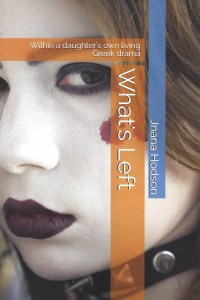
I think she looks a lot like the young woman on the cover of the book, apart from Cassia’s Goth garb and makeup. Aphrodite, anyone?




 Jnana's Red Barn