In my novel What’s Left, Cassia’s grandmother and her sister marry two brothers. One is named Pericles.
Does the idea of siblings in one family marrying siblings in another bother you? Or does it seem like a natural possibility?
You never know what we'll churn up in cleaning a stall
In my novel What’s Left, Cassia’s grandmother and her sister marry two brothers. One is named Pericles.
Does the idea of siblings in one family marrying siblings in another bother you? Or does it seem like a natural possibility?
For a writer, nothing is more magical than when a character begins dictating the story. Sometimes, you can’t type fast enough to keep up with her.
As I was saying about the “zipper” that sometimes appears while revising a work? This one, I’d say, is the most satisfying.
~*~
Now that I’ve confessed, it’s your turn.
Do you ever hear “voices” while doing something? Do they help or hinder your action?
~*~
My novel’s available at the Apple Store, Barnes & Noble’s Nook, Scribd, Smashwords, Sony’s Kobo, and other fine ebook distributors and at Amazon in both Kindle and paperback.
Cassia’s father grew up in a conventional middle-class family in the middle of the country. It was much, much different from her mother’s upbringing not that many miles away.
As they say, opposites attract. So, from your experience, how about an example?
~*~

As a reader, you probably don’t pay much attention to the bones of a book — the number of chapters it has or how many sections they fall into. For a writer, of course, these can be central considerations. Ideally, there’s a beginning, middle, and end for each chapter and each section as well as the entire book itself.
In my psyche, one ideal structure is the symphony — typically, but not always, four movements, each one different, having an underlying unity that ends in an exciting climax. (Oh, there are some gems that do end quietly — so much for expectations!) A typical novel, on the other hand, may be twenty to thirty chapters of roughly 20 pages apiece running in chronological order, not that I’ve ever stuck with that convention.
In What’s Left, my novel I set out hoping you could start or end in any chapter, yet in some way they’d join to build the tension and resolution of the whole. The model that inspired me appeared to use chapters as mosaics or panels that could be moved around independently, if the reader desired.
I can’t quite see doing that in the final version my work, though a reader might leap over a chapter or two, if needed, and still pick up on some action — if, that is, the chapters are complete enough in their own right. Think of a string of short stories.
~*~
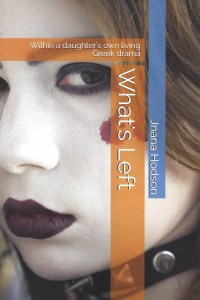
If you’ve had a chance to read What’s Left, give me your feedback.
Does this structure work for you? Would you rather I’d broken the novel out into two, three, or four shorter books as a series? Did you skip over any parts? Would rearranging any parts work better?
~*~

The hippie movement opened Cassia’s father’s horizons. He wound up trekking through the Himalayas. Many others hitchhiked through Europe.
What’s the most exotic place you’ve been?
Nita didn’t tell him much about her family. She knew he’d like her younger sister.
Have you ever been thrown into a social situation you knew little about – but that changed your life? The kind where the door just opened for you?
~*~

In my novel What’s Left, Cassia’s extended family revolves around a big Victorian house, one that’s undergone extensive restoration.
Do you ever dream of living in a big old house? What most attracts you?
~*~

As a genealogist, I’m not alone in facing situations where key questions are unlikely to ever be answered. If only we could go back in history and ask the individuals themselves, hoping they might know. (Dealing with more recent situations, I’ve found three different people often have quite different recollections. Take that as a caveat.) And that’s presuming we could even understand each other, considering the differences in dialect and customs.
So, back to the ancestors. They had to be dead before I was born, right?
~*~
How about you and your roots?
The hippie movement brought tensions to the family before Cassia’s future father showed up on the scene. He had no idea he never would have been welcomed by everyone even a year or two earlier, much less encouraged to stay.
Have you ever been welcomed in a situation where timing was everything?
In my novel What’s Left, they aren’t a typical Greek-American family. Not exactly. But they’re not like Cassia’s classmates’ homes, either.
How would you say yours differs from a “normal” family?
~*~

 Jnana's Red Barn