
I really do love the deep blue of the North Atlantic on a morning like this.
You never know what we'll churn up in cleaning a stall
I really do love the deep blue of the North Atlantic on a morning like this.
Eastport has an active energy committee, which is good considering how many times we get hit with electrical outages. We live at the edge of the grid, after all, as well as on an island subject to some wild weather.
So while lunching at their Earth Day set of presentations, the man opposite me was asking about our house renovations. This is a small-town, after all, and everybody knows everything – or will.
As I explained the history of our place and some of its makeshift, even shocking, carpentry over the centuries, he interrupted me with an account of a father and son working on a project.
I thought he was talking about John Shackford senior and junior building our place.
As the two were working on the rafters, the son questioned his dad, “That’s six inches off, let me fix it.”
Naw, came the reply: “Just nail it!”
~*~
Sadly, I’m having to admit my realization of how often in my life that’s been the case.
And also, in our home project, how grateful I am that our contractor Adam would never settle for such sloppiness.
We fully intend for this house to last another 239 years.

Across the Western Passage of Passamaquoddy Bay from Eastport, Maine, this small beacon flashes red at night. It’s also a warning of proximity to the Old Sow, the biggest whirlpool in the Western Hemisphere, and mostly on the Canadian side of the channel, as you can see here in one of its calmer phases.
To explore related free photo albums, visit my Thistle Finch blog.
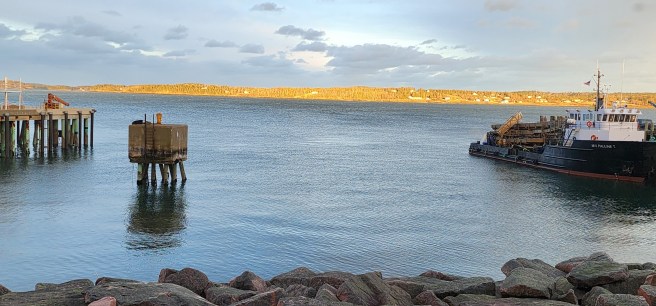
Time the view right and you may see Campobello Island, New Brunswick, turn buttery in the late afternoon sun. As an added touch, a few house windows suddenly burst into bright reflections. Here they’re simply vivid white boxes.
When the scaffolding around the front and side of the house came down after more than a year, the public could finally see what we had intended.
The result actually took off in some tweaks that left it looking, well, we hope for the better – things like the double windows upstairs, which I’ve discussed in previous posts.
In a small community like ours, people were bound to gawk and talk, and so far all we’ve heard has been admiration.

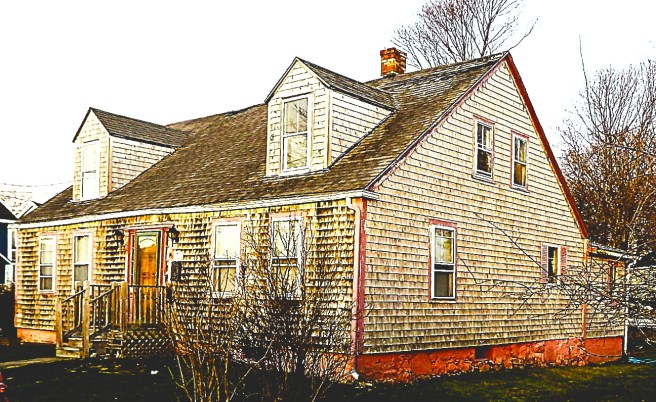
When we embarked on this project, I quipped that old-house fixes took three times the estimated time and budget, and ours (alas) has been no exception on both fronts.
Actually, more, or maybe less, if you consider the Covid whammy and inflation. Besides, we got into a great deal more than adding space overhead: many of the extra costs addressed items in our home inspection report, things like rot, wiring issues, plumbing, masonry. Oh my, it was a long list in addition to the more pressing roofing situation that concerned our insurance policy.
So much of what we paid for would be unseen: the aforesaid rewiring (throughout the house, cellar to roof), sculptural work to allow the new farming to sit atop the old (how this structure ever survived before this is a miracle), spray-foam insulation, caulking. The interior storage lofts weren’t as simple as promised but they add for architectural drama (and the name of our architect, mainly us and Adam), nor were some of the exterior efforts to preserve the Cape image as seen from the street while drastically altering the reality.
But then, when our new cedar shingling was finally finished and the construction scaffolds were removed after more than a year, how handsome, as one of the coconspirators put it. Or, from my perspective, dramatic.
I’m hoping both Anna Baskerville and Captain John Shackford, as previous residents, would approve. As well as the list of others who have left their imprint here.
Frankly, we treasure all of it.

The big pink mansard a block from our house was owned by noted shipbuilder and designer Caleb Stetson Huston from the mid-1850s until his death in 1887. He also served two terms in the state legislature.
My question remains, how was it pronounced: Huss-tun, Who-stun, or Hugh-stun?
After running across his name repeatedly while researching the history of our old house, I decided to look him up. Lorenzo Sabine turns out to have been a remarkable character. Best known today for his two-volume, provocative 1864 book Loyalists of the American Revolution, his adulthood included an influential span in Eastport.
Here are some highlights.

A longstanding highlight of Eastport’s annual Old Home Week and Fourth of July festivities is a U.S. naval ship visit. Here is the destroyer DDG 98 Forrest Sherman from last year’s edition as illuminated in glowing late-afternoon sunlight.
To explore related free photo albums, visit my Thistle Finch blog.
Real estate transactions did use the lot at the corner of Water and Third streets as a referent for other lots. We’ve already seen examples of John senior’s mention of “land owned by me” and the like. Later, we encounter “the homestead of my late father John Shackford” and “the old homestead of my father the late John Shackford.”
Yes, homestead.

After considering the 1806 Samuel Wheeler house at 9 Washington Street and the Federal-style 1805 Hayden (the oldest two-story dwelling in town), the circa 1807 Lewis Frederick Delesdernier on Franklin Street, the 1810 Jonathan Weston, 1820 Daniel Kilby, and 1821-1822 Stetson-Starboard houses on Boynton Street as well as an 1812 Cape on Washington Street, the 1816-1818 Dr. Micajah C. Hawkes on Shackford Street, 1819 Jonathan Venzim-E.E. Shead on Middle Street, and 1821 William Bucknam and Captain Joseph Livermore houses on Key Street, I’m confident that ours predates them and may indeed be older than 1803, as the routing of Water Street route proposed.
I’m willing to venture 1780s. Feel free to argue otherwise.

As for time? An Eastport Sentinel article on the Wheeler house, March 29, 1882, mentioned that under the ownership of Bion Bradbury, the home “was changed by the substitution of a pitch roof,” among other modernizations. I hadn’t really considered the pitch of our roof until this but now realize it is lower (or was, before our own modernizations) than many of the later structures in town. The Federal-style houses, of course, are an exception.
 Jnana's Red Barn