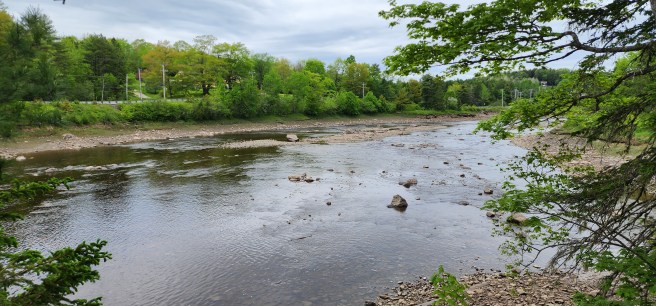
 I just missed a shot of two eagles. A week later, with the water higher, I watched two harbor seals at play. Cobscook Bay is less than a mile downstream.
Tag: Downeast
So much past under one roof
I never suspected our humble cottage would hold so many stories and twists. A sea captain’s home should have a widow’s watch, right?
Ours, as you’ve noticed, doesn’t.
Still, a single house like ours can be a miniature version of the whole island’s history.
There are still so many unanswered questions to work around in this puzzle, along with points that will require clarification and correction. Consider this, like the house itself, a work in progress.
Besides, we’re living out the next chapter, including the renovations and restructuring that’s occurring as I write this.
Pocket beach on Eastport’s north end

Our rocky shoreline includes sporadic pocket beaches, too. This one faces tiny Dog Island, shown below.

The helm

It’s rather modest, actually, but so classy all the same, befitting the schooner Louis R. French. It was at the top of the ladder from my quarters below.
For more schooner sailing experiences, take a look at my Under Sail photo album at Thistle Finch editions.
Regarding Samuel Shackford and son Samuel
Captain John senior and Esther had one other son, Samuel, who died in South America in 1820. His wife, Elizabeth Lincoln, had been born in Hingham, Massachusetts, and died in 1884 in Eastport, age 90.
The only child, Samuel, became a ship captain and, in 1851 in Eastport, married Mary Tinkham. He was also the one who provided the Shackford family profile in William Henry Kilby’s 1888 Eastport history volume.
Samuel junior turns out to be a remarkable figure in his own right.
As the 1895 Album of Genealogy and Biography, Cook County, Illinois with Portraits detailed, “He was, like his father, a shipmaster, which calling he followed until he came to Chicago, in November, 1853. Immediately on reaching this city, he engaged in the commission produce business, an enterprise which he carried on until the great Chicago fire, after which he removed to Winnetka.
“While living in Chicago, he was one of the early members of the Board of Trade, and served two terms in the city council during Mayor Rice’s administration. For five years he was a member of the Cook County board of supervisors, serving on several important committees, and for a time was chairman of the finance committee. During the Civil War, over two-and a-half million of dollars of soldiers’ bounties passed through the hands of this committee. He served about four years as a member of the Chicago board of education. … For many years he was a trustee of Rev. Robert Collyer’s church in Chicago, and was an exemplary churchman, never noted for extreme piety, but highly respected for his practical ideas of Christianity. He has been for years a trustee of the village of Winnetka …”
In addition, “Mr. Shackford has always been highly esteemed as a public-spirited and useful citizen. Before the Great Fire he had, perhaps, the finest and most complete records of city and county affairs ever in the possession of any one person, and his excellent memory aided him in the recollection of important transactions, which made all very valuable to the citizens. The people seemed to feel, and often expressed themselves in saying, that if he was chairman of a committee, that committee would do its full duty in advancing the interests of the city. He was indefatigable in looking after the affairs of the public in general, nor was he negligent of his own business.
“He has the best genealogical record of the Shackford family, and more interesting family records and mementoes than any other man in the state. Members of the old Shackford family are related to the first families in New England, proof of which he has in his possession. Mr. Shackford has written and left to posterity many valuable genealogical records, which have been, from time to time published. Notable among these, because of national interest, is ‘The Lineage of President Abraham Lincoln,’ as published in the New England Historical and Genealogical Register for April 1887, in which the writer, whose mother was a Lincoln, proves beyond a reasonable doubt that the brothers Mordecai and Abraham Lincoln, sons of Mordecai and Sarah (Jones) Lincoln, of Scituate, Massachusetts, were the ancestors of the Lincoln families of Pennsylvania, and that Abraham Lincoln, the Martyr President, was descended from the brother Mordecai …”
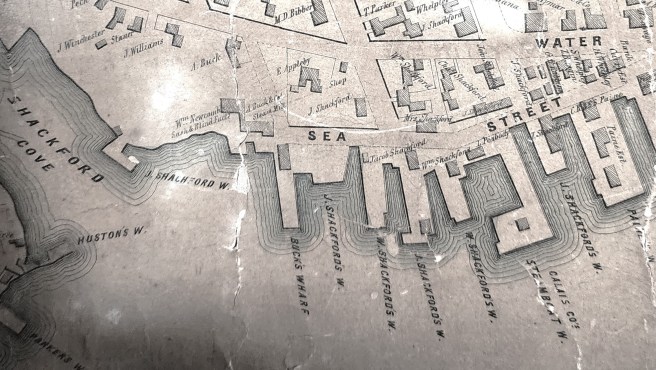
The 1855 Eastport map, produced shortly after Samuel had relocated to Chicago, illustrates how much the family had flourished. At least 13 buildings are labeled Shackford — most of them along Water and Sea Street just below our house. Many of the latter were likely warehouses and offices related to the six Shackford wharves and piers flanking the Calais Co.’s Steamboat Wharf, at the time owned by John junior.
The 1850 Census had eight Shackford households in Eastport. The 1860 Census had ten. And soon there were none.
So much for the Shackfords who grew up in the house we now own and their descendants.
Easternmost lighthouse
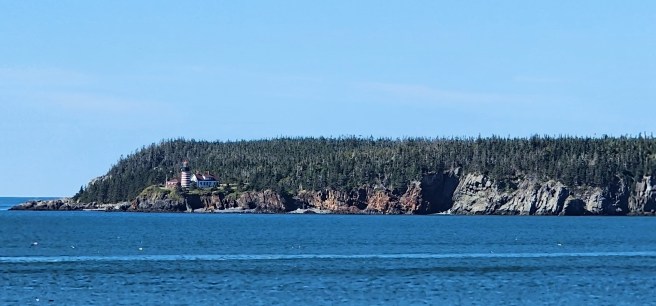
The distinctive peppermint-stick tower of the West Quoddy lighthouse is viewed from the tip of Roosevelt-Campobello International Park in New Brunswick, Canada. You’re looking at the easternmost point in the continental United States.
For more lighthouse images, take a look at my Beacons Above the Water photo album at Thistle Finch editions.
Now for a touch of scandal in the family
The house at the corner of Water and Key streets came into the ownership of Jacob’s nephew, John Lincoln Shackford, who had married Elizabeth S. Clark in 1838 and, following the occupation of his father and siblings, became a mariner.
In 1847 Captain John Lincoln Shackford he was advertising freight and passage aboard the brig Carryl, traveling for Saint Marks and Newport and from Pennsylvania to the Isle of Lobos and Havana. He also was reported as rescuing members of the crew of the bark Cambria and conveying them back to New York.
The 1850 Census recorded him living in Eastport with his parents, his wife Elizabeth, and three children. In 1860, they were with her parents and two children, presumably while he was at sea. Shortly after that, the family moved to New York, where he was recorded in Brooklyn at 111 Adelphi. In 1863 he was listed on the Brooklyn Civil War draft registration, and in 1864, he was at Hamilton north of Fulton Avenue.
Among their children was Abby, who died at age seven in Cuba — suggesting that Elizabeth and the children had accompanied him on his voyages as a captain — and her twin Esther, who died in Brooklyn at 21, and sister Fanny, who died as an infant.
Shortly before February 1871, John’s wife returned to Eastport, where she filed for divorce, dower, and alimony, asking for all right title and interest in any and all real estate he had in the County of Washington, Maine. Before the case was settled, he died, December 20, in the Virgin Islands.
As the case was submitted, “To the Honorable the Justices of the Supreme Judicial Court next to be Holden at Calais, within and for the County of Washington in said state on the fourth Tuesday of April AD 1871.
“Elizabeth S. Shackford of Eastport in said County, respectfully represents that she was married to John L. Shackford now of St. Thomas, at Eastport in said County on the tenth day of December AD 1838 and had by him two children now living to wit; Joshua C. Shackford & Regina T. Shackford. That after her said marriage she cohabits with said Shackford in said State of Maine, and always conducted herself as a true and faithful wife.
“That the said John L Shackford unmindful of his marriage vows and covenants, and the duty affection and respect he owed her, deserted her more than three years ago, and has not supported her for the last three years.
“That he has been living with another woman to your Libelland Unknown in St. Thomas.
“That he has been married to said woman as he has declared in letters to others.
“That he has a daughter by said woman and committed adultery with said woman.
“Wherefore, because a divorce from her said bonds of matrimony would be reasonable and proper, conducive to domestic harmony and consistent with the peace and morality of society, she humbly prays your Honors such divorce accordingly …”
Additional documents listed John L. Shackford’s estate value at five thousand dollars (the number is crossed out and rewritten). The court ordered payment to Elizabeth and ensured that the United States Consul to St. Thomas delivered a copy of the document to John L. Shackford (misspelled Schackford on the document). The court then allowed Elizabeth to sell land to include property at the corner of Water and Key streets (formerly Greenwich Street), land on the northerly side of Shackford’s Cove, along with other property valued at $1,471.02.
Curiously, widow Elizabeth returned to New York, where she died in 1882.
The Eastport Sentinel reported, October 2, 1889, “Mr. T.M. Bibber moved last week from the Shackford house at the corner of Water and Key Streets to the Chapman house on Boynton St.” The Bibber connection may have been thicker than I’ve uncovered so far.
Obviously, Shackford descendants were ranging far from Eastport, never to return.
If you’re dreaming of a vacation in Maine, please consider …
The weather can be iffy, even in summer. Your week by the beach may be mostly rain and or fog. Plan accordingly. There’s nothing wrong with hunkering down with a good novel when you’re away from everyday distractions.
Where I live the ocean is too cold for swimming. Period. Even before factoring for the currents. Further south and west, this can be iffy.
Black flies. They’re early summer, to mid-July. Inland, especially. You’ve been warned. They’re even worse than swarms of mosquitoes.
As for your expectations? A more laid-back lifestyle perhaps with antiquing is one thing. If you have kids in tow? That’s another. Hope they enjoy the outdoors.
If you go for a whale-watch anywhere, what you wind up seeing is what you are given that day. The best part may be simply the cruise out and back from the prime ocean. There are no other guarantees.
In many destination locations, retailers are faced with a six-week business model. Restaurants, lodgings, and stores have to cover most of their year’s expenses in those few intense weeks and then hold on through the rest of the year, if they stay open at all. Prices will be higher than you might like.
Nightlife may very well mean looking at stars.
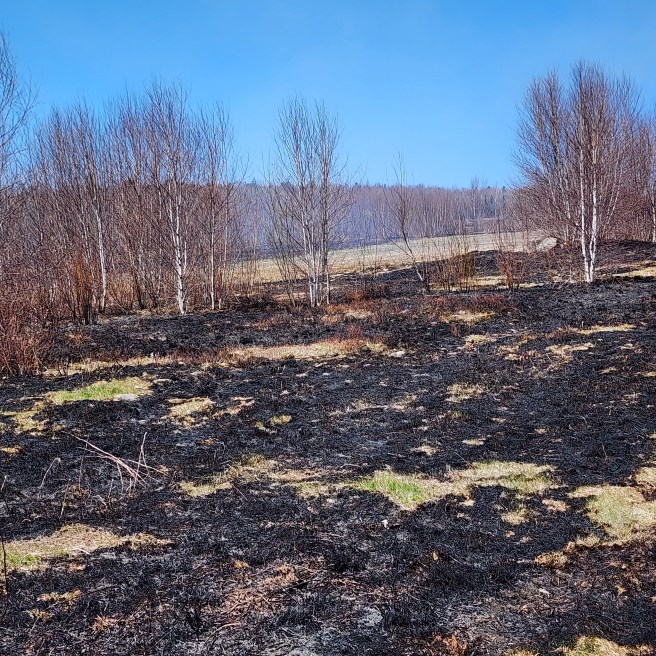
Deliberate fire nurtured along
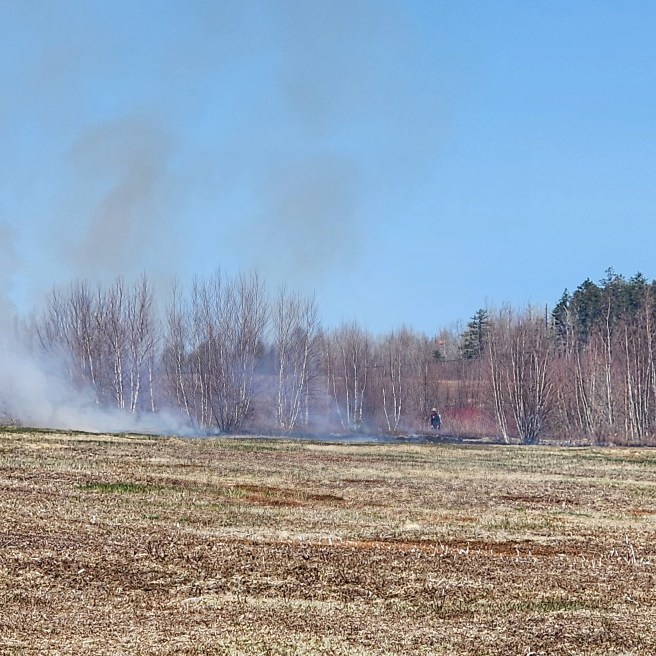
Lowbush blueberries are classified a wild crop, but the barrens where they grow do require tending. One practice involves burning the fields every few years to discourage weeds, shrubs, and trees from taking over.
A feel for the water and wind
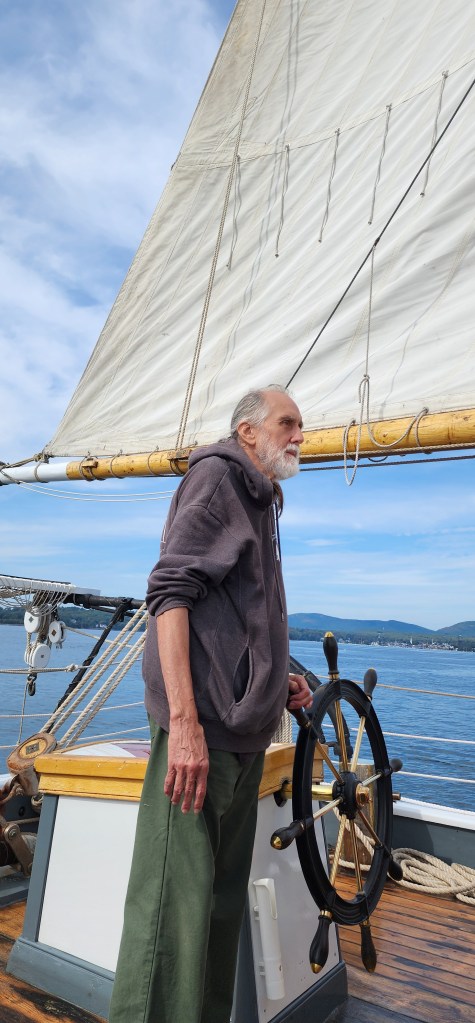
On cruises aboard the historic schooner Louis R. French, passengers get opportunities to pitch in with the work. We help raise the anchor and the sails in the morning and we wash our own dishes. Sometimes, when the water’s calm, we even get a spell at the wheel, where you do get a feel for the interaction of the wind and water as well as the delay in the boat’s response to a change in the course. Here I am at the end of last summer.
For poems related to the sea, check out my collection Ocean Motion at Smashwords.com.
 Jnana's Red Barn