It’s a common topic of conversation this time of year in New England.
How’s the foliage shaping up?
Are drought or wetness, heat or cold, or any number of other factors impacting it negatively?
Or is it going to be another banner month across the six-state region?
Vermont and New Hampshire tourism tries to capitalize the most from the colorful outburst, but they’re hardly alone in sometimes dazzling displays. New York and Pennsylvania can also be memorable.
So here we are, trying to make the most of the outdoors before winter cold sets in all too soon.
One of the factors in our decision to relocate to Eastport was the quality of the local newspaper, which appears every second and fourth Friday of the month.
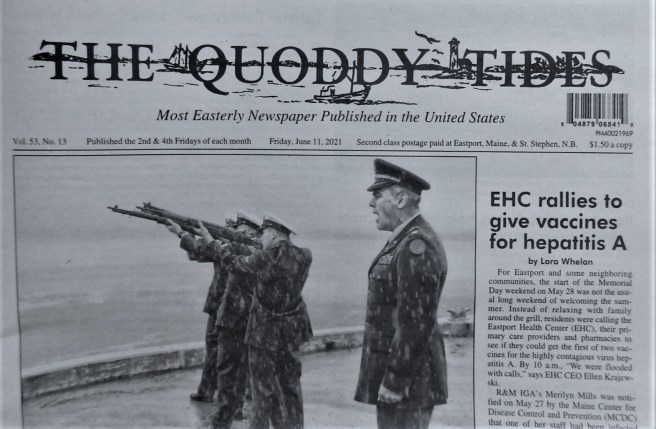
Typical front pages.
There’s nothing flashy about its tabloid-format editions, but everything I see strikes me as solid, even compelling, community journalism.
The quirky – and unique – use of Tides rather than Times in its name is not just humorous but altogether appropriate. The paper reports on all of the communities the tides touch on in Washington County, Maine, as well as many in neighboring Charlotte County, New Brunswick.
One of my ongoing criticisms of American newspapers over the past half-century is that very few of them give you a feel for the place they serve. Ownership by out-of-state corporations is only part of the problem. Continuing cutbacks in coverage is another. (I play with those and other factors in my novel Hometown News.)
For most dailies and weeklies, there’s a generic look and taste in the stories. Everybody has city-council and school-board meetings, for heaven’s sake, and most car crashes are just as boring.
Somehow, though, that’s not the case with the Quoddy Tides.
Consider the lead on a report of the start of the important commercial scallop harvest, a story that was presented on Page 2 but teased from the front page by a dramatic black-and-white photo of a fishing boat plowing through rough seas:
“Winds gusting over 50 knots did not deter many Cobscook Bay area scallop fishermen from going out on the first day of the season on December 1. About three-quarters of the fleet of over 20 draggers based in Eastport and about 10 boats from Lubec headed out that day.”
Remember, it’s not just windy with choppy surf. This is December, blowing icy water. As for a feel of the place, just listen to the quotes in the next sentence:
“Lubec fisherman Milton Chute observes, ‘The tops were blowing off the water like it was pouring,’ and Earl Small of Eastport says that while it was ‘sloppy steaming back and forth,’ once the boats were on the lee shore either off Lubec or down in South Bay, it wasn’t bad towing out of the wind. ‘It’s not as dangerous as people think,’ says another Eastport fisherman, Butch Harris, noting that two or three boats will fish together in case anyone gets in trouble. ‘It was a rough ride out, but once you’re there fishing it’s not that bad.’ Harris points out that scallop fishermen have only so many days that they’re allowed to fish. ‘If you don’t go, you lose it,’ he notes.”
Much of their quotes, I’ll venture, is pure poetry. And off the cuff, at that.
The rest of the story fills out the page, detail after detail. I bet you’ll think of some of this dedicated labor, too, next time you eat seafood.
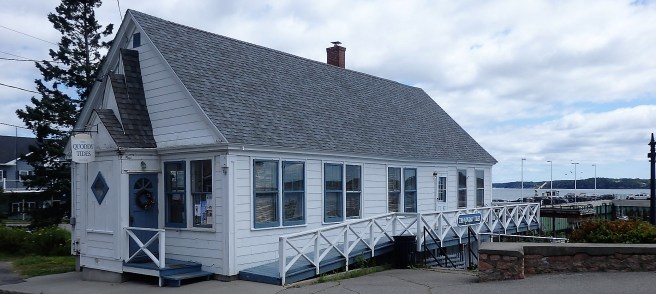
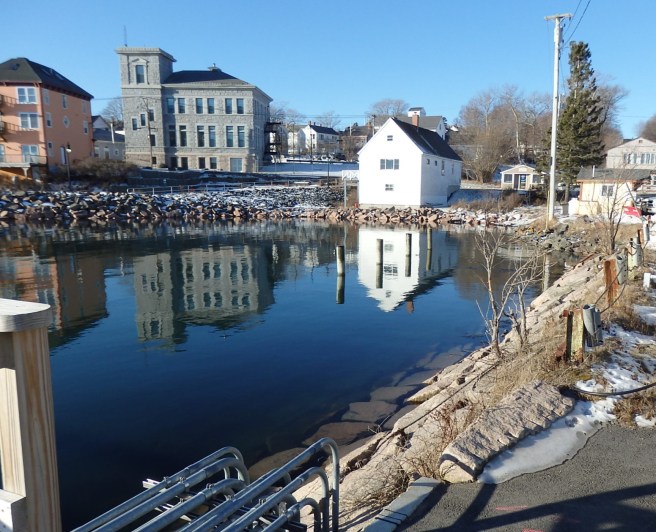
The newspaper offices occupy the 1917 Booth Fisheries headquarters downtown, once part of a sardine cannery.The building sits right on the harbor. The post office and former customs office stands to the left.
The Tides was founded in 1968 by Winifred B. French, the wife of Dr. Rowland Barnes French, M.D., and mother of five. They moved to Maine from Arizona in 1953 so he could help found the Eastport Health Center, itself a remarkable story in community medicine.
Winifred had no background in journalism, but she saw a need, studied hard, and ventured forth in launching and editing a small-town paper with a regional outlook. In 1979, for good reason, she was named Maine Journalist of the Year. Remember, the Tides isn’t a daily or even weekly newspaper, it’s every two or sometimes three weeks.
Reporters attend public meetings rather than chasing afterward by phone, correspondents provide meat-and-potatoes servings of neighborhood interest, Don Dunbar contributes top-drawer photography, and local columnists all weigh in for what becomes must-read pages throughout the area. The mix skirts the glib boosterism and doom-and-gloom morbidity too prevalent elsewhere.
Winifred died in 1995, but son Edward French and his wife, Lora Whelan, continue on her model. (Another son, Hugh, heads the Tides Institute and Museum – note that Winifred’s sense of “tides” continues there, too.)
I like the fact that the stories don’t carry datelines. Nope, the reader doesn’t get a chance to turn off on the basis of a single word. The region is closely interlinked by people living in one place and working in another or having family elsewhere, so it’s all of interest or should be – both sides of the U.S.-Canadian border.
I also like the fact that headlines come in just two sizes, with a serif face used for a touch of variety. There’s no need to scream to draw attention. Instead, we get an orderly and fair-minded sensibility.
So that’s an introduction. I could go on and on.
In some ways, it reminds me of Annie Proulx’ novel The Shipping News, without the dreariness and grimness.
Nothing flashy or sensationalized. Fits the character of the place.
One thing I would tweak is the nameplate, which goes back to the first edition. That shoreline still seems to strike out the paper’s name.
Still, it’s a joy to be retired and not have to be in the midst of producing all this. These days I do delight in being able to sit back and simply enjoy what I’m reading – even if I do on occasion feel an urge to “fix” something on the page.
What – or whom – do you look forward to reading the most? On a regular basis. (Apart from this humble scribe.)
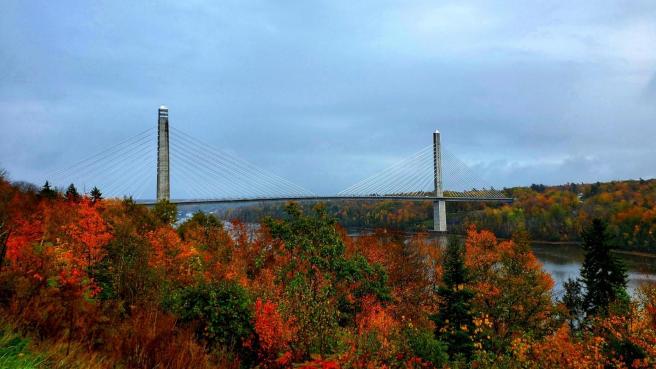
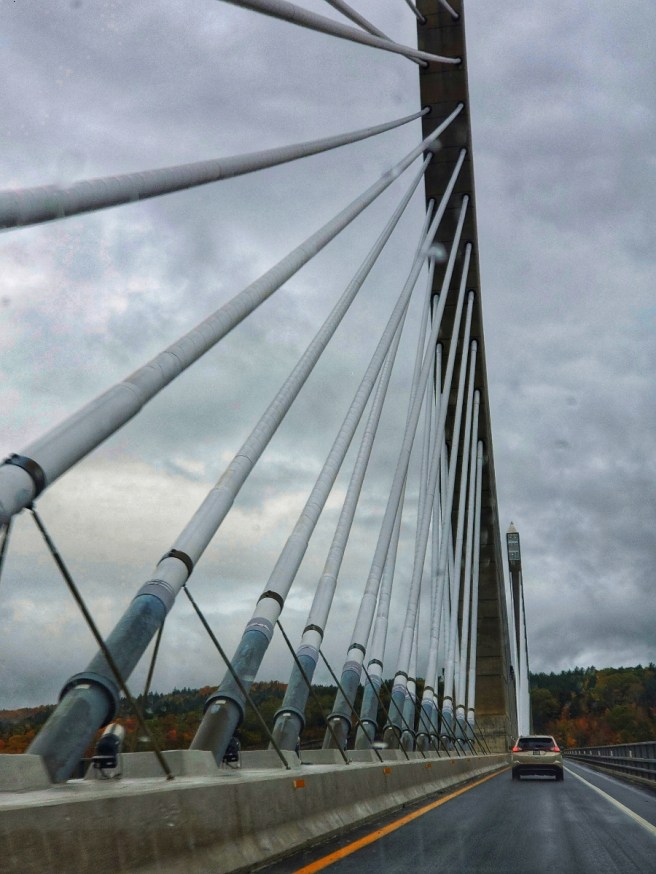
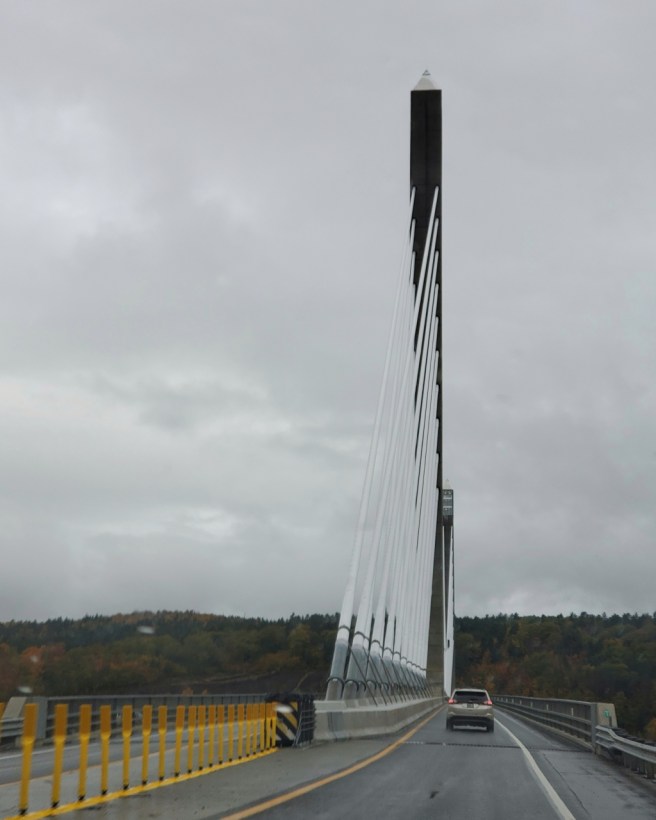
For many people, the dramatic wishbone bridge at Fort Knox, Maine, is the welcome to Downeast Maine, the portion of the Pine Tree State that sits east of Penobscot Bay and its river.
The big span carries the major highway to Acadia National Park, for one thing, and allows shipping to continue upstream to Bangor and Brewer. It’s also the slighter slower of the two routes from our home to the rest of America.
The glass pyramid atop the one pillar covers a public observation deck. It’s on our to-visit list.
The indicators started showing up by the last week of August but are inescapable now. Eastport’s locking up for the winter.
As evidence?
The passenger ferry to Lubec has already been hauled out of the water and is up on props in the boatyard for annual maintenance.
The Tides Institute Museum is closed for the season, with the Eastport Art Gallery set to do likewise at the end of the month.
I trot down to Horn Run Brewing and find it closed today. Gotta check the new schedule. Not that I expected its popular deck to be open all year. And other restaurants have curbed back as well.
Nobody’s out on the Breakwater.
Rosie’s hot dog stand is closed and its sign thanks us for a good summer.
I haven’t seen a super yacht for a month, much less tied up at the dock.
Most of the out-of-state license plates are gone, along with the luxury car models. It’s mostly Maine and New Hampshire now, and soon it will be about all Maine.
Well, there is a sole convertible stubbornly zipping about – but just one, with its driver bundled up.
There just aren’t as many folks around, period. At least the dog walkers are holding up their end.
There’s an uptick in the number of houses for sale as some Summer People realize they can’t keep up with another year. And the places are staying on the market longer.
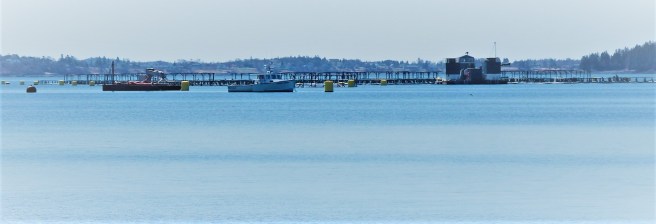
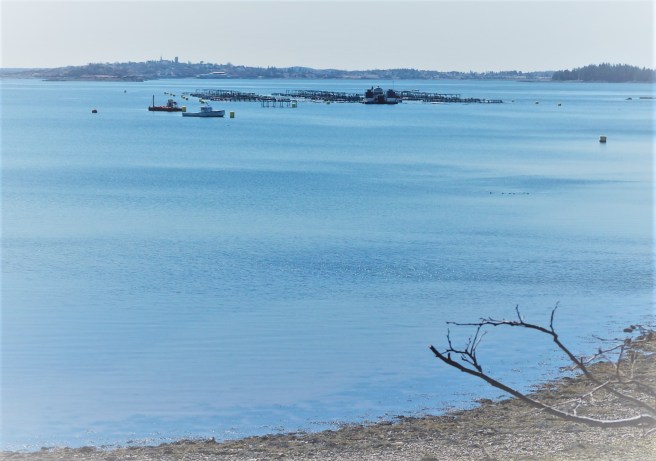
As many fish stocks dwindle precariously, salmon farming and related aquaculture are hailed as a viable alternative.
Salmon pens at Broad Cove.
Young salmon are placed in the circular enclosures when they’re about six inches long, where they leap and splash under netting that protects them from eagles, osprey, cormorants, and gulls. In about two years, they grow to a harvestable size of about two feet and ten pounds. A specially designed vessel sucks the mature fish from their pens and its conveyor stream immediately cleans and guts them.
Lubec rises in the distance.
Cooke Aquaculture, based in Blacks Harbour, New Brunswick, manages 15 pens in Deep Cove and Broad Cove, operating from a former fertilizer plant on Estes Head. A feeding barge sits amid the pens, which house about 450,000 salmon. About one-third of the pens are left fallow at any time.
A pen like this can hold 25,000 fish. The netting protects the salmon from osprey, eagles, and other predators.
From our upstairs windows, we can see other salmon farms at Campobello Island across the channel.
Geographically, Sunrise County is one of the largest in New England – the county line is an hour-and-a-half drive away from where I live, unless you’re going to Canada – but there are a lot of things we don’t have.
There are only three traffic lights, for instance – all in Calais en route to the busy international border crossing.
So I was wondering, just in case, where the closest dry cleaner is. We have two laundromats, but say, what if I wanted to send my dress shirts out to be washed and pressed, as I did back when working in an office?



 Jnana's Red Barn