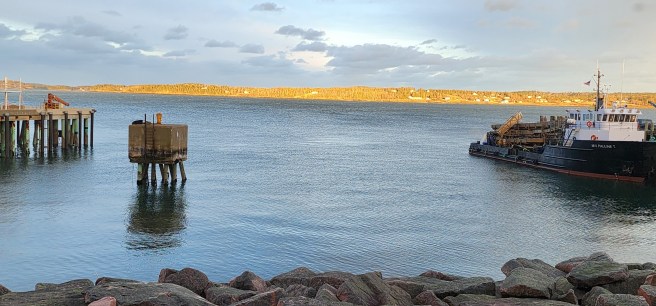
Time the view right and you may see Campobello Island, New Brunswick, turn buttery in the late afternoon sun. As an added touch, a few house windows suddenly burst into bright reflections. Here they’re simply vivid white boxes.
You never know what we'll churn up in cleaning a stall
Time the view right and you may see Campobello Island, New Brunswick, turn buttery in the late afternoon sun. As an added touch, a few house windows suddenly burst into bright reflections. Here they’re simply vivid white boxes.

The first French attempt to colonize North America took place in 1604 on this island in the St. Croix River but ended disastrously. The historic site is now an international park between Maine, USA, and New Brunswick, Canada.
Access to the island itself appears to be problematic.
Here it is seen from Ganong Nature Park (east of St. Stephen, New Brunswick) at the confluence of Pagans Cove, Oak Bay, and the Waweig River while the St Croix River veers off to the west and quickly narrows before continuing the international border.
When the scaffolding around the front and side of the house came down after more than a year, the public could finally see what we had intended.
The result actually took off in some tweaks that left it looking, well, we hope for the better – things like the double windows upstairs, which I’ve discussed in previous posts.
In a small community like ours, people were bound to gawk and talk, and so far all we’ve heard has been admiration.

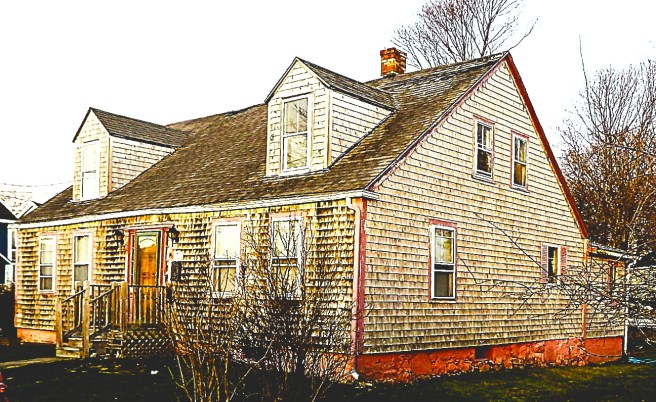
When we embarked on this project, I quipped that old-house fixes took three times the estimated time and budget, and ours (alas) has been no exception on both fronts.
Actually, more, or maybe less, if you consider the Covid whammy and inflation. Besides, we got into a great deal more than adding space overhead: many of the extra costs addressed items in our home inspection report, things like rot, wiring issues, plumbing, masonry. Oh my, it was a long list in addition to the more pressing roofing situation that concerned our insurance policy.
So much of what we paid for would be unseen: the aforesaid rewiring (throughout the house, cellar to roof), sculptural work to allow the new farming to sit atop the old (how this structure ever survived before this is a miracle), spray-foam insulation, caulking. The interior storage lofts weren’t as simple as promised but they add for architectural drama (and the name of our architect, mainly us and Adam), nor were some of the exterior efforts to preserve the Cape image as seen from the street while drastically altering the reality.
But then, when our new cedar shingling was finally finished and the construction scaffolds were removed after more than a year, how handsome, as one of the coconspirators put it. Or, from my perspective, dramatic.
I’m hoping both Anna Baskerville and Captain John Shackford, as previous residents, would approve. As well as the list of others who have left their imprint here.
Frankly, we treasure all of it.

Many of the lighthouses on our end of the Maine coast are hard to see, if at all, from the land. The Libby Island Light is a good case, glimpsed here from Bucks Harbor.
Should the opportunity to do a lighthouse cruise come along, I’m definitely game.
To explore related free photo albums, visit my Thistle Finch blog.

Garth Wells is the man in the pink hat aboard the Angelique as the Louis R. French comes into dock at the end of a cruise.
He owned and operated the French before passing the duty to young Captain Becky Seawright. He even officiated at her wedding.
For more schooner sailing experiences, take a look at my Under Sail photo album at Thistle Finch editions.
 A Penobscot Bay windjammer cruise typically includes a lobster bake, though technically the crustaceans are boiled or steamed with corn on the cob. The event takes place on any of a number of uninhabited islands along the way.
It does mean going ashore, of course.

For the record, last summer I ate 3½ lobsters – hey, they were small chix – but a shipmate managed 6½, just shy of the Louis R. French record of seven. Had she known, I would have cheered her on.
For those of a more squeamish nature, hot dogs and other hot goodies are offered, along with gooey s’mores, as long as the wood fire continues.
For more schooner sailing experiences, take a look at my Under Sail photo album at Thistle Finch editions.
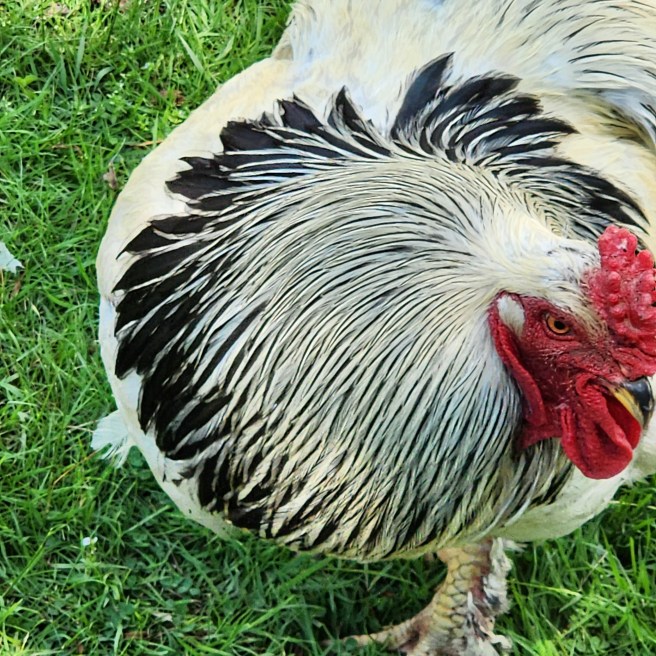
He doesn’t know who’s the true boss. That would be the Chicken Farmer in our family, and, yes, I still love her. She really does tend to some gorgeous chickens and their colorful eggs.

Not everybody on North Haven island has a basement, as we saw on a jaunt ashore. Think of it as local color, as seen from a cruise aboard the historic schooner Louis R. French last summer.
For more schooner sailing experiences, take a look at my Under Sail photo album at Thistle Finch editions.

Much of Way Downeast Maine stirs up echoes of the American Far West, at least in the eyes of some, and that includes impressions of ghost towns.
The downtown of Lubec has some prime examples, including this imposing waterfront emporium that was the headquarters for R.J. Peacock company’s wide-ranging sardine operations.
I think the structure has a slight resemblance to the long-gone steamship wharf that once welcomed passengers just below our house in Eastport. This one is still standing.
To explore related free photo albums, visit my Thistle Finch blog.

As seen from a cruise aboard the historic schooner Louis R. French last summer.
For more schooner sailing experiences, take a look at my Under Sail photo album at Thistle Finch editions.
 Jnana's Red Barn