We have four principal towns in Way DownEast Maine

They’re Calais, Eastport, Lubec, and Machias. Or the other way around, depending on how you’re driving or sailing.

Like pearls on a string, one that hugs the coastline of vast Washington County.

The image of four anchors arrayed along a map makes sense, each one with its own distinctive attraction.

Their combined population comes to barely eight thousand.

The terrain around here is much more real than Acadia, for sure, if you’re the least bit interested in the Real Maine.

Our annual salmon festival has me thinking of sardines

The American Can Company factory, now a hulk out over the water, had a daily output of more than a half-million cans for sardines. It employed 300 people. It was at the end of the line for the railroad, too.

In the adjacent canneries, sardine-packing women had hands moving so fast in cold water you saw only a blur, according to a friend who was a teen at the time and couldn’t begin to keep pace when he worked there.

I still have no desire to eat a sardine, though. Consider that the statement is coming from someone who’s learned to appreciate anchovies in his old age.

The Salmon Festival always takes place over the Labor Day weekend. 

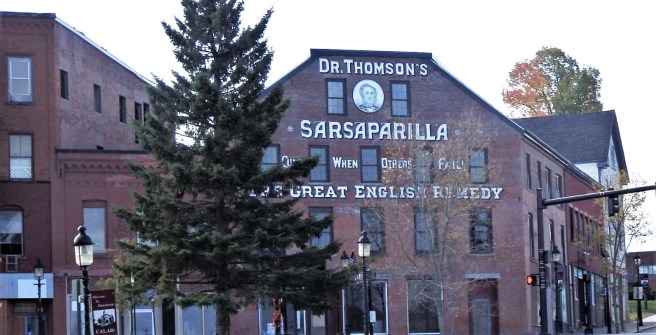
Calais, the one just north of us

The biggest municipality in sprawling Washington County is the city of Calais, pronounced CAL-us, like hardened skin, rather than the French Cal-LAY, its namesake port on the English Channel.

Set north of Eastport and having a population of slightly more than 3,000, it’s the retail hub of the county and neighboring Canada and the principal international border crossing for traffic to and from the industrial port city of Saint John, New Brunswick, and other coastal points.

With that in mind, here are a few more facts.

  1. Thanks to the border traffic, much of it as Sunbury tractor-trailer rigs, Calais has all of the permanent traffic lights in the county. Three, make that four, if I’m counting right. Yup, pay attention.
  2. It’s the eastern terminus for the Airline Highway, a section of State Route 9 that connects those trucks to Interstate 95 in Bangor and all points south and west in the U.S.
  3. Calais abuts Saint Stephen in Canada, which has both a candy museum and manufacturer and the best health fitness center in our region. The Saint Croix river separates them before continuing upstream as the international boundary.
  4. Calais has the only new auto dealership in the county, as well as the only Walmart.
  5. It’s home to the community college.
  6. The first European to explore the place was Samuel de Champlain in 1604.
  7. That year he was one of two leaders in settling on an island in the tidal stretch of the river. That effort was abandoned the following spring after a brutal winter in which more than half of the colonists perished. Had the venture succeeded, it’s possible we’d all be speaking French here. Today the site of this first French settlement in New France is commemorated at the Saint Croix international historical park.
  8. While its name honors French assistance to the American Revolution, I should also point out that the original had also sometimes been part of England.
  9. It was first settled by Daniel David Hill of York County, Maine. He was likely a descendant from an old Quaker family affiliated with Dover, New Hampshire.
  10. In summer, it’s often much hotter than Eastport. In winter, it’s typically colder.

Oh, yes, there’s even a tiny movie theater we want to check out.


Refreshing our salmon pens

Sunrise County – more formally, Washington County, Maine – and neighboring Charlotte County, on the facing waters in New Brunswick, are the center of some serious salmon farming. Cooke Aquaculture, a pioneer in the field, is a major employer in both places.

Without getting into the surrounding controversies, millions of salmon are shipped to market from these farms and are one reason the protein-rich anti-oxidant species is no longer a luxury item for most people. It’s a surprisingly healthy option, if you’re so inclined to investigate.

The local enterprise has even spawned Eastport’s annual Salmon Festival over the Labor Day weekend, which includes narrated boat trips to farms in our coves, typically clusters of 16 pens, and explanations of their care. Some locals describe the event as drawing an NPR kind of crowd, in contrast to our Pirate Festival the following weekend, which may be seen as more of a NASCAR following or its biker equivalent. (Please stay tuned.)

What I’ve found fascinating this summer is the flock of working boats busy around two of the farms in our fair city. The pens have been vanishing!

The reason, I’ve been told, is that every few years, the pens and their nets need to cleaned and repaired. And then they also lay fallow for a season or two.

Don’t know about you, but I’m impressed. Each pen starts out with a million and a half baby salmon. Maybe more.

And the filets we get do make for some impressive sashimi – raw fish that are a favorite in Japan, expensive in restaurants, and surprisingly easy to make at home. If you’re interested, check out some recipes online. My between-the-lines improvised sauces remain delightful, at least as far as me and my sons-in-law are concerned. (Pardon the English there, I’m yielding to their generation. Those boys really can skin a fish, by the way.)

From here, we’re most curious to see about how Cooke’s efforts at oyster and mussel harvests from our waters are also progressing.

The advice to eat local remains a spiritual discipline, as far as I’m concerned, not that it’s always practical where I’ve lived.

Now, what’s on your plate tonight?
As I said in a recent letter to the editor …  

One of the more baffling things I’m finding in living here is the reluctance of folks in one town to participate in something in a neighboring town, as if they were worlds away.

It’s not just a matter of coming in to the Eastport Arts Center, either, or watching a movie in a little theater in Calais.

Pembroke’s renovated library has been hosting a series of free chantey sings by maritime historian Stephen Sanfilippo, and those would welcome (and do deserve) more participants. His well-researched programs usually include much than work songs, despite the title. A recent one that dug into clams and oysters would be a fine eye-opening example.

The most recent event included an illustrated talk by Susan Sanfilippo, drawing on the town’s historical society’s archives. She discussed ships built along the local tidal banks and then showed images of the resulting vessels as they sat in faraway places like Cuba, China, San Francisco, or Hawaii.

Stephen then used the varied destinations of the Pembroke ships as the basis for songs we all joined in singing later, often including nonsense verses while we looked at slides of the vessels. A calypso, anyone?

I should say it was all delightful and enlightening.

Besides, it was a sampling of what happened all along our Quoddy coast. I could image launchings from Shackford Cove in Eastport that then made similar extraordinary voyages.

Who says there’s nothing to do around here? Please look again and expand your horizon.