
That’s Moose Island Contras Etc., a very fine traditional country dance band with a very fine caller. We do have fun around here.
You never know what we'll churn up in cleaning a stall
That’s Moose Island Contras Etc., a very fine traditional country dance band with a very fine caller. We do have fun around here.
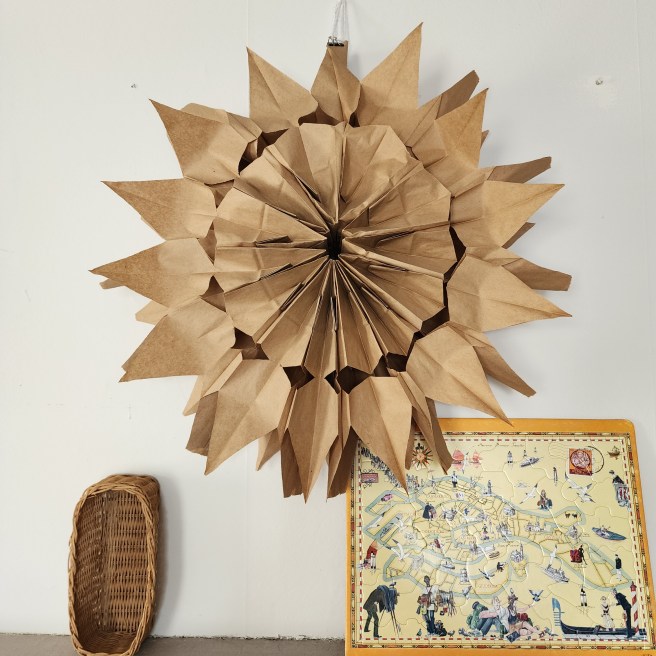
Those were lunch bags.
It’s like camping, with the canvas over your head rather than a tent.
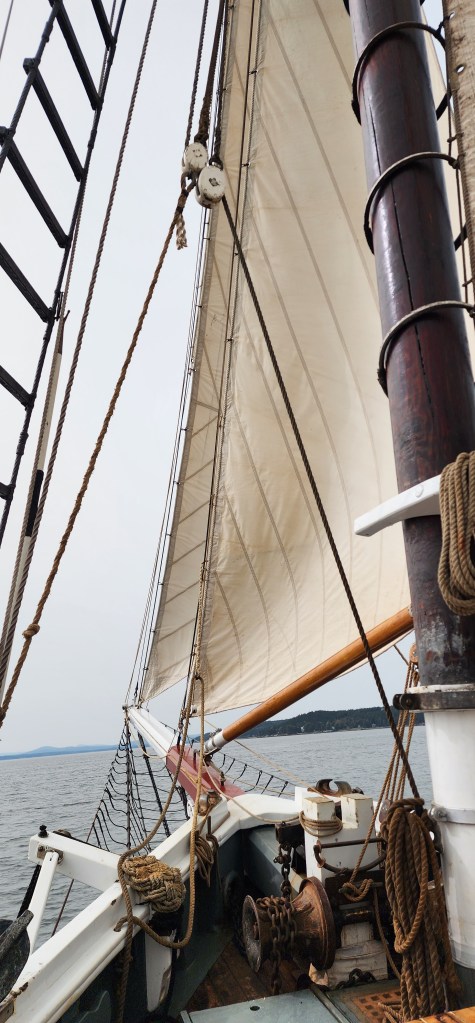
Peter tried to brace me for the, uh, unique quarters. And the pause when I mentioned taking a shower.
I had a snug berth, as you’ll see later. The only electricity on board came from some strong batteries and a small solar array.
Rather than a floating night club and hotel of a typical cruise ship, a Maine windjammer is small and laid-back. You even have to wash your own dishes.
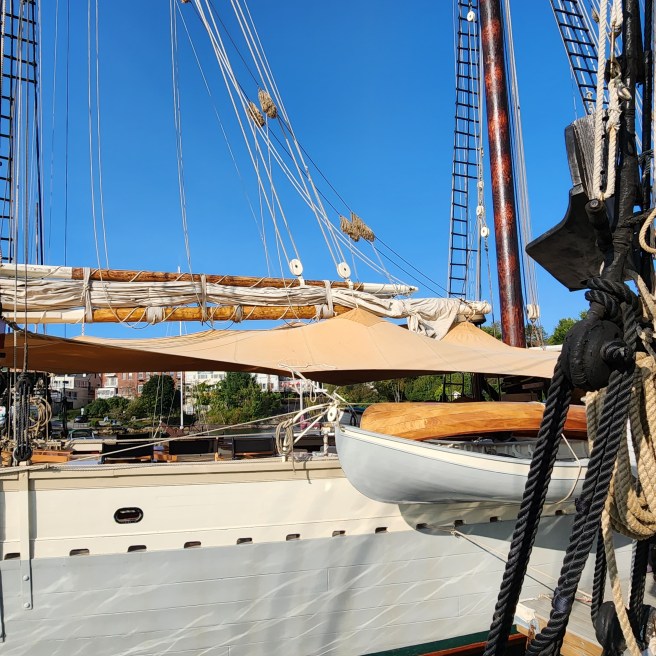
As the windjammers’ association brochure says:
Unlike large cruise ships, windjammers have bunks and cozy cabins, not monster staterooms and 24-hour buffets. Windjammers are woody and compact below decks. Crew and guests live and work in close quarters. The ship’s galley and dining areas are like your kitchen at home – everybody mingles there.
The Maine experience dates from 1936, when Captain Frank Swift started offering adventurous passengers sailing opportunities formerly only available to private yacht owners.
Last summer I got to be one of them. It really was memorable.

Once quintessential and now mostly obsolete, collected along the shoreline. What one observer has dubbed an outdoor closet on a neighbor’s deck.
If you’ve been following my Red Barn, you know about the 400th anniversary celebrations of Dover, New Hampshire, as the third oldest permanent European settlement in New England and the seventh oldest in the continental USA.
That history does underpin my book Quaking Dover, after all.
As I point out, that “permanent” adjective can become a real ringer, in contrast to “earliest.” “Oldest,” for both the town and its Quaker Meeting, can also be defined as “continuous.”
Don’t be surprised to hear me admit that I keep learning a lot more after researching and writing the book. Some of my newer findings will be posted here at the blog later this year. I’ve already shared the experience of visiting the Pemaquid village site in Bristol, Maine, a settlement that interacted with Dover’s early years.
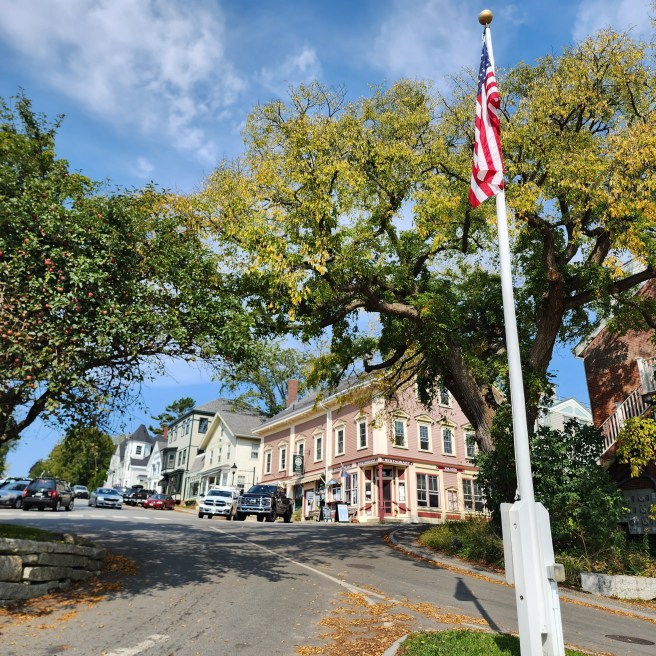
The Castine development at hand arose while killing time between the Common Ground Fair in Unity, Maine, and my setting sail a day later. Or, more accurately, boarding ship with a buddy from Vermont for our first overnight in the vessel before casting off and hoisting the sails the next morning. Literally. Peter joined up with us for a night at the Airbnb before he and I ventured off together. That left us with a day to fill. On a whim, I suggested a land excursion as an alternative to the Farnsworth American art gallery or the transportation museum down the coast. Peter was game, and besides, he knew the town and accompanying waters.
Our destination was the town of Castine, which I had heard of as the home of the respected Maine Maritime Academy and as one of the eastern Maine towns that surrendered without a shot during the War of 1812, along with Eastport and Machias.
He drove, freeing me to observe the winding scenery on the eastern side of Penobscot Bay. It was less upscale and less developed than the U.S. 1 corridor linking Searsport, Belfast, Camden, Rockland, and Rockport – more “real” Maine, if you will.
Coming into Castine, however, a sign jolted me: Founded 1613.
What I read soon after that pointed out that Castine was settled before the Plymouth Bay colonists we know as Pilgrims started building in 1620. (Remember, they never called themselves that, but rather Separatists and the like.)
The claims made it sound like Castine was the oldest European settlement in New England.
Still, it didn’t show up on the lists I examined nor on those that Dover’s celebration committee referenced. The problem is just how many, if any, settlers remained in Castine between the many invasions and changing of flags from French and British to Dutch and American over the years.
Still, looking at the murky history prompted me to revise some of my thinking about Maine’s past.
For one, Castine was occupied by the French during the years of fighting when English settlement was erased all the way down the state to a toehold at Wells and York and on to New Hampshire.
That also had me looking at the French and Indian wars through Canadian lenses. That point of view presented the village of Norridgewock along the Kennebeck River as a French settlement, the headquarters of Jesuit priest Sebastien Rale, including a church he erected in 1698. The English, on the other hand, considered it a Native encampment.
Rale worked to ensure French control of the region, with events escalating into what is known as Father Rale’s War, at least in English versions where he is sometimes presented as the commanding officer in the attacks. Native accounts take more credit for their own leadership and skill.
The conflict culminated in the destruction of Norridgewock in 1724, including the death of Rale, a chief, and nearly two dozen women and children. French control of much of Maine faded in the aftermath, much earlier than I had believed. English settlement did, in fact, resume much earlier than the 1763 Treaty of Paris that ended the final French and Indian War.
At that point, Castine – named for Baron Jean-Vincent d’Abbadie de Saint-Castin, a 1667 arrival – was turned over to the British. And how!

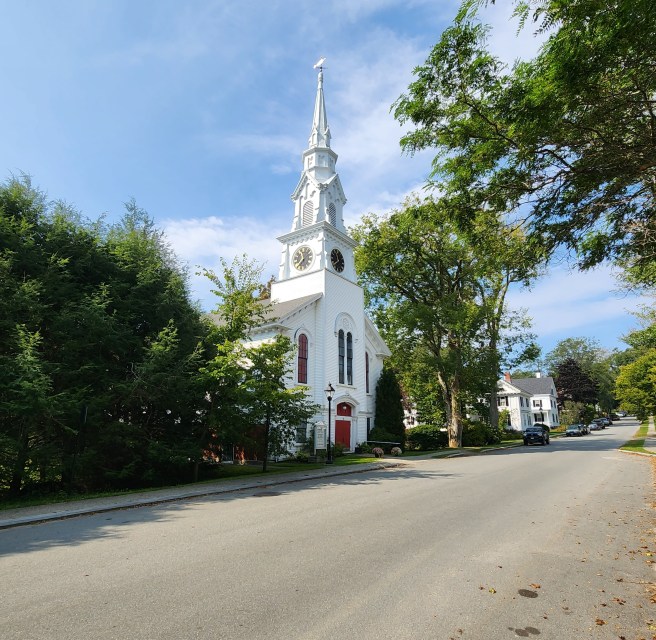


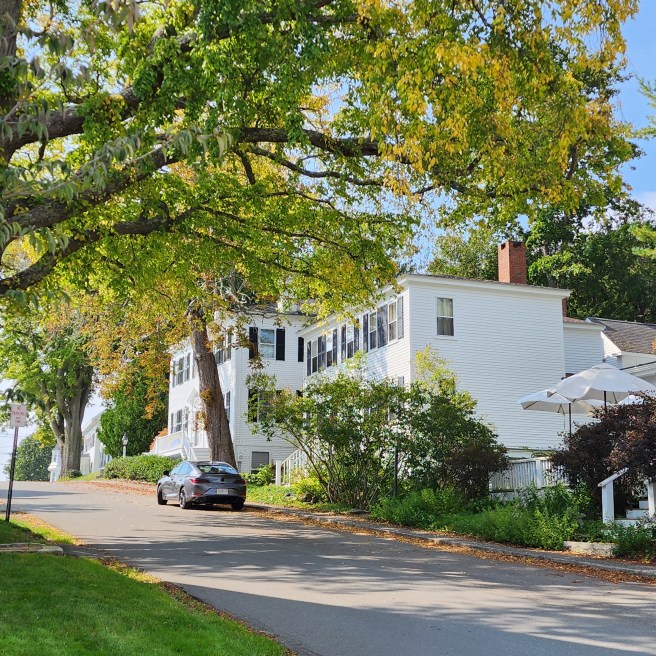
An influx of Massachusetts colonists of Puritan and Pilgrim cast gave the town a distinctly Yankee character that remains, perhaps more than anywhere else in Maine.

I love the town
with its Yankee Puritan flavor unspoiled
contrary to old-money haven Bar Harbor
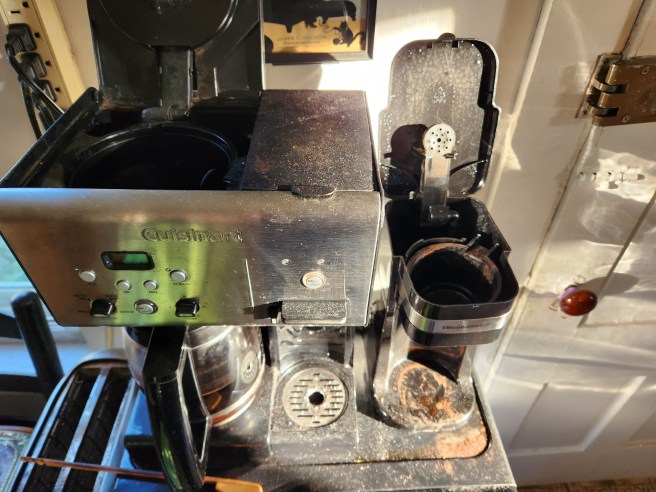
It’s something that will get an improved setting once we tackle the kitchen renovations.
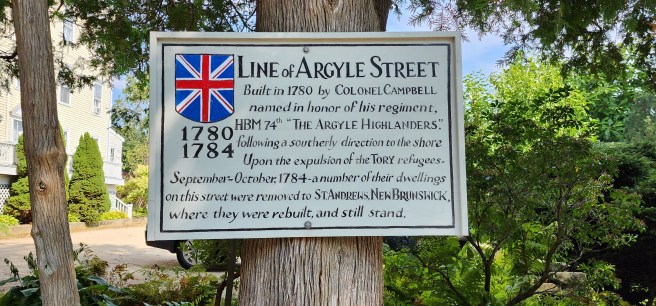
This marker in Castine, Maine, reflects an often overlooked side of the American Revolution. Some residents who had opposed the revolt were forced to leave the new country.
Many of these Loyalists packed up their houses, walls and all, and rebuilt them in settlements in New Brunswick, Canada, near where I now live. Their descendants are active on both sides of the border, as I’m learning.
Ships come in all sizes and shapes, and people aware of the differences see vessels that float quite differently than the rest of the population. Well, it’s like looking at birds and then birders.
Living beside the ocean I had learned to differentiate a sloop from a schooner, or so I thought. Both have triangular sails, with sloops having just one mast and schooners, two or more.
Not to be confused with square-riggers, the kind of tall-mast ships most people envision from history. Or so I once did. You know, Old Ironsides, the USS Constitution, or even the Mayflower, however much smaller.
As for triangular sails, like those on sailboats. Not quite accurate when it comes to schooners. There’s something called a gaff … creating the hip-roof look of a schooner’s sails.
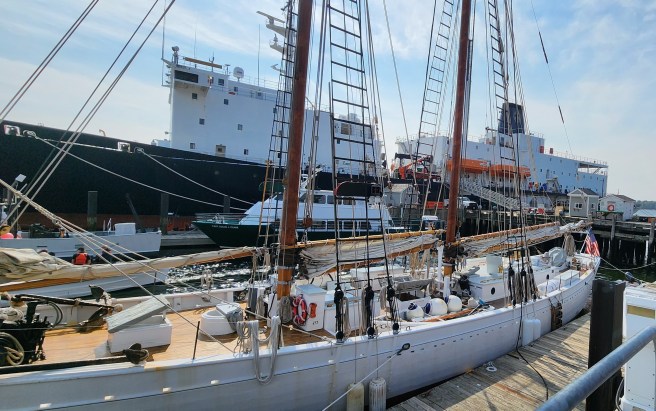
My closeup introduction to a schooner came in a side trip earlier in the day I would step aboard one for my virgin voyage that will inform later posts. To kill time, so I thought, my buddy and I headed off to Castine, then a hole in my inner map of Maine, apart from references by friends.
And that’s where I was introduced to the Bowdoin, now named for the college of the same name but more importantly a historic vessel used by Donald Baxter MacMillan in his Arctic expeditions. Quite simply, she was designed to withstand incredible freezing – and did. I’m now wondering how the crew did, under those conditions.
That said, she was a schooner. I had seen one docked in Eastport, but this time I had a curator at hand to explain the distinctive parts.
Emphatically, it is not a square-rigger.
Schooner, as Dutch, it’s not SHOONER, after all, as my New Amsterdam Dutch-descendant Peter could easily point out, yet from deference, hasn’t. (Do I get points for noticing?)
Typically, a crew of 2½
two men and a boy
no cook?
an average life of 25 years
for a wooden ship
(owned in shares
spread the risk and profits)
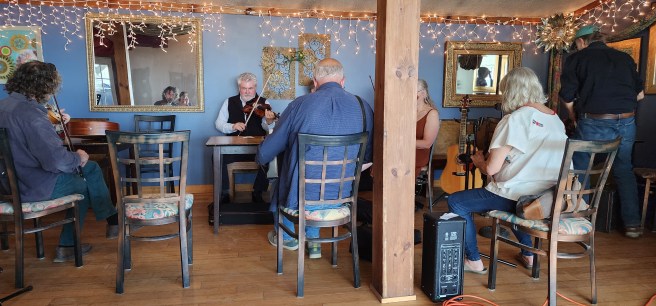
The second-Saturdays afternoon event at a local tavern is already full of fine memories, including a visiting famed Irish fiddler shown here. Its core is MICE, the Moose Island Contradance ensemble. That space was soon filled with other players.
 Winter snow makes the crest of Katahdin, Maine’s tallest mountain, visible from 90 miles away in Wesley, Maine. A clear sky helps, of course.
The view is from State Route 192 just off the heavily traveled S.R. 9.

Maybe you can still pick it out with less zoom and a little more context.
 Jnana's Red Barn