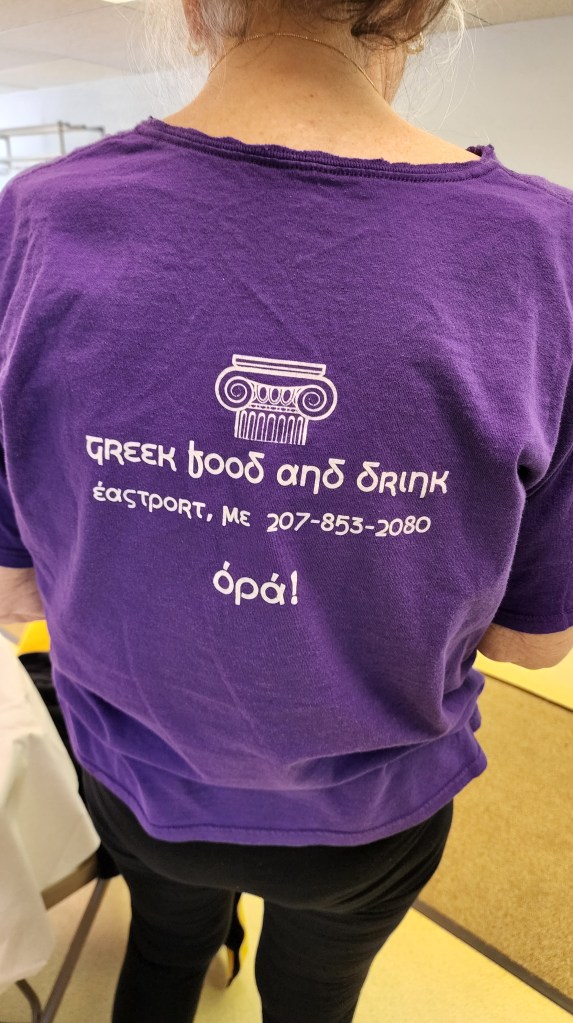
When I saw this tee-shirt, I started drooling

Where, for heaven’s sake, would this place be? We don’t have a lot of options in our remote rim of Maine.

And then I was told the restaurant was a late and lamented site a block from my home, now reincarnated as an echo of the grill and bar next door. Only, perchance, a shade better.

Well, as a reaction, I did have an appropriate Greek slang expression I’d found earlier when researching background for my novel What’s Left, not that I’ll quote it here.

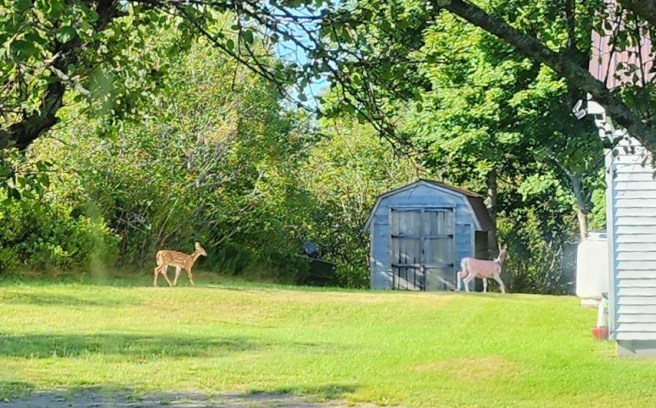
Our white deer and a fawn

Eastport, as you may have gleaned from this blog, can be overrun with deer. They do make gardening a challenge.

The encounters become more lively when mention of an albino deer arises. We’re discovering that Moose Island, where we live, has had a series of white deer, including fawns with the gene.

For the record, they’re probably not albino but leucistic, and as I saw in this case, mostly pink. Defining piebald has its own set of technicalities.

This encounter was on a Sunday morning while I was heading out of town on my way to Quaker Meeting for worship. I passed what I thought was lawn decoration and then realized it wasn’t. When I whipped back, this was the best I could capture before lowering the car’s window, and by then they had slipped behind the house. Wily critters they can be.

The deer in question, by the way, is on the right in the photo.

Searsport, famed for sea captains

Hard to believe, driving on U.S. Route 1 along Penobscot Bay, that one rather quaint village was once a thriving maritime center of significance.

These days, Searsport, population 2,649, is eclipsed by Belfast, Camden, and Rockland on the waters to the south

But it is worth a second look. Here’s why.
  1. A taste of the past. Settled in the 1670s, Searsport retains the federal-style brick downtown of a century-and-a-half ago as well as magnificent sea captain’s mansions now operated as bed-and-breakfast inns.
  2. Penobscot Marine Museum. Anchoring the downtown in its 13 historic and modern buildings, the museum displays treasures from the region’s seafaring riches, including a large collection of boats, in addition to displays reflecting Penobscot life over the years. For researchers, its library and archives offer historic and genealogical depth.
  3. Historic harbor. Maine’s second largest deep-water port once had 17 shipyards that constructed 200 ships.
  4. Rail connection. The waterfront further flourished when the Bangor and Aroostook Railroad opened a terminus in 1905, bypassing the Central Maine Railroad for shipping potatoes, timber, and ice by water and importing coal for its locomotives and points north.
  5. Shipmasters. At one point, one-tenth of the U.S. merchant marine deep-water captains were from Searsport, nearly 300 in all, many of them sailing as far as India and China. The majority came from just two extended families, or so I’ve heard.  
  6. Joanna Colcord. Among the prized possessions of the marine museum are nearly 700 glass and cellulose photographic negatives taken by the daughter of a famed Searsport sea captain. Joanna Colcord was born in 1882 in the South Seas aboard the bark Charlotte A. Littlefield. She grew up mostly at sea on the ships her father commanded, but was well educated, earning a Master’s in chemistry was she had moved ashore. The museum also has an annotated scrapbook and postcards she sent from abroad. In addition, she’s valued as an essential collector of historic chanteys and other seafaring songs.
  7. Lincoln Colcord: Her father had married a year before her birth. On his wedding night, his bride, Jane, set sail with him for China. Having captain’s wives and children accompany long voyages was not uncommon, as his daughter documented. Also born on the journey was son Lincoln, who would become a prolific author. The Colcord family had deep roots in northern New England’s coast, going back to Edward Colcord, a signer of the Dover Combination in 1640 in New Hampshire. (I finally connected the surname to my research for Quaking Dover – yay!) From what I see looking at the genealogies, it produced a preponderance of males who wound up in Searsport.
  8. Phineas Banning Blanchard. Here’s another example of an old Searsport family that produced generations of sea captains. Phineas Blanchard was born in 1879 aboard the bark the Wealthy Pendleton, which at the time was grounded on a mud flat in southern California. He grew up to become one of the last masters of tall ships. His first command came when he was just 19. His final voyage aboard a masted ship was with the Bangalore in 1906, made with his newlywed wife, Georgia Maria Gilkey, which was chronicled in several books and articles. As I was saying about wives at sea? He was also a master woodworker who created dozens of fine model ships. And he became wealthy, spending most of his adult years in New York City.
  9. John C. Blanchard. As a further taste of the museum’s archives and the town’s prominence of sea captains across generations of families, I’ll cite the surviving letters of Captain John Clifford Blanchard, 1811-1887, reflecting his voyages, family, and business interests. He emerged as prominent in the lucrative sugar trade from Cuba. The letters detail many of the hardships, including illnesses, that plagued the captains and their crews. Among the subjects tagged in these letters, ship captains’ spouses fuels further interest.
  10. The antique capital of Maine. Or so the town claims. Who am I to argue? Maybe it all started with the estates of those wealthy seafarers.