
Serving fresh scallops quickly became a Christmas Day tradition in our household once we moved to Eastport. The fishermen set forth before sunrise on each of their preciously allocated days, and only the worst weather can convince them otherwise.
You never know what we'll churn up in cleaning a stall
Serving fresh scallops quickly became a Christmas Day tradition in our household once we moved to Eastport. The fishermen set forth before sunrise on each of their preciously allocated days, and only the worst weather can convince them otherwise.
 Climatic change is bringing more frequent and fiercer storms to Way Downeast. Last winter felled many trees in the region. Here’s what of those did to a riverside rental cabin in Calais.

The member ships of the Maine Windjammer Association are independently owned and operated, and apart from setting firm departure and return dates, each of them ventures at the will of its skipper and the elements each day.
Watching the others in the course of a cruise is almost a game, and sometimes two or three wind up spending the night in the same cove, as happened here on Islesboro. We had the Heritage, above on one side, and the Angelique on the other, and the atmosphere was festive.
For more schooner sailing experiences, take a look at my Under Sail photo album at Thistle Finch editions.

The range of wildlife found in a healthy flowage like this can be quite impressive. Wetlands and open waters comprise about a fifth of Washington County’s landscape.

Somehow, the sea looks metallic here. Just what would you call that range of colors?
Well, it does remind me that the Greeks lacked a word for blue. So did many other ancient civilizations, but let’s not get into a discussion of why.
For more schooner sailing experiences, take a look at my Under Sail photo album at Thistle Finch editions.
This pause in our renovations seems like an ideal time to reflect on the ways this project builds on much earlier dreams and becomes, perhaps by default, their culmination.
My junior high art teacher instilled in me a love of 20th century contemporary architecture as well as Japanese and Scandinavian art and culture. That dovetailed into Shaker traditions that had once existed just down the street from us and a county or two south as well. Plainness, exemplified by Quaker, Mennonite, and Brethren history is in my blood and bones, as I’ve learned digging into genealogy.
Add to that an appreciation for William Morris’ arts and crafts movement, which infused the bungalow I eventually owned in the Rust Belt, and my exposure to historic New England styles, including Queen Ann.
And then a sense of neighborhood, too.
Had you asked me at the outset where I wanted to live, I would have responded central city, perhaps in a high rise, or out in the wilderness, perhaps beside a mountain lake or stream. What was clear that suburban was nowhere in my preference.
So here I am in a historic sea captain’s home a block from the Atlantic yet at the edge of a funky downtown and arts scene and – utterly amazing, to me – within minutes of forest, lakes, and streams.
When I sit in our second-floor rooms, the heart of our renovation project, I have moments of feeling the best of both worlds. In following the new roofline for our ceilings, we’ve avoided creating boxes as the rooms. One criticism of so much architecture objects to “boxes with holes cut in them.” Rather than boxiness, sometimes I’m reminded of the contours within a ship’s hull or a sail overhead.
This time of year, I’m reminded, too, of the flurry of work just before the previous two Christmas celebrations. It got chaotic, up to six tradesmen at one time. We were tripping over ourselves as the rest of the family started showing up.
Throughout it all, we had the ongoing Viking Lumber deliveries, mostly with Tim driving. And our wonder at having the right contractor after all of the delays.
So here we are with the continuing surprise of the historical significance of the house, not just that it was 80 years older than it had been claimed, but that it had been so central to what has evolved here.
As our mason once asked, “How much is enough?”
For now, let’s leave it at that.
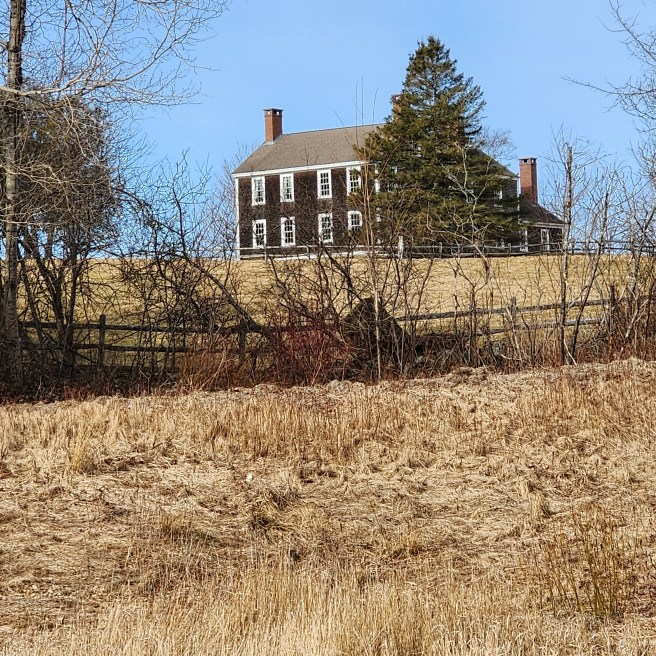
The Dr. Albert Lincoln homestead along U.S. 1 in Dennysville presents an iconic image from the Civil War era, if you catch a view while driving past. Today the well-maintained second home is also a working cattle farm.

When you think of a tall-masted sailing ship, it’s probably like this, one with squared masts and rectangular sails. This one does have a gaff aft sail, resembling the sails on a schooner.
Square-rigged ships did require larger crews than did schooners and sloops, and they weren’t as agile in the wind, but they could carry more cargo.
As for the bird in the nest atop the rock outcropping? I think it’s an osprey.
Welcome to Rockland Harbor.
Mine is a family of booklovers, which means we need bookshelves everywhere in our renovated home. Make that two homes, considering the younger daughter and son-in-law, too, in their new purchase in suburban Boston. To that let me add one friend, a famed author, who had so many volumes stored in his Maine barn that one corner collapsed, according to the New York Times Sunday magazine. I’m not prepared for that possibility here in our historic house.
Still, this gets painful as we prepare for triage. What volumes must each of us keep, which ones become optional, and where will all of the remainder go?
On my end, after much culling, I’m finding my eyeballs no longer support the small type in many paperbacks, many of them with binding that is crumbling.
Gee, I’d never thought it would come to this. Take a deep sigh before they are trashed.
The other partners in this move will have to explain for themselves.

The Orange River in Whiting is becoming a prime wilderness water trail for canoeists and kayakers. The nature preserve, with holdings from several different organizations, is accessible principally by water.
 Jnana's Red Barn