We’re becoming a destination for cruise ships

As Bar Harbor, at the gateway to Acadia National Park, tries to limit the number of cruise ships coming to town, tiny Eastport has been reaping benefits.

For the past two autumns, as some of the ships have ventured our way, we’ve welcomed their arrival at our downtown Breakwater pier. As I’ve previously posted, they’ve extended our brief retailing season and brought delighted walkers to our byways, shops, eateries, and galleries.

Supporters point out that these guests and supporting staff don’t add traffic congestion to our narrow roadways, and their arrivals can be spaced to avoid times of busy events. The town is also limiting arrivals to one ship per day, unlike Bar Harbor or Portland.

It’s still early in the planning for the upcoming travel season, and things can change rapidly, but here’s what’s already slated.

At his point, we’re expecting ten ships to come calling, 23 arrivals in all and up to 55,000 day-visitors. A few are spread out over the summer, too.

  • Azamara Quest: 593-foot length / 702 passengers / October 2
  • Brilliant Lady: 908 / 2,800 / September 18 and 27, October 9
  • Le Boreal: 466 / 264 / October 17
  • Le Champlain: 431 / 184 / October 19
  • Majestic Princess: 1,082 / 4,450 / August 24
  • Norwegian Getaway: 1,068 / 4,028 / August 21 and 28, September 4, 11, and 25, October 16 and 23
  • Pearl Mist: 324 / 210 / November 2
  • Viking Neptune: 749 / 954 / April 27
  • Volendam: 780 / 1,432 / June 14, July 13, September 5 and 20, October 4
  • Zuiderdam: 936 / 1,916 / June 16, August 25

Three of them are too long to dock at the pier. Instead, they’ll anchor in the channel and relay passengers and crew to and from the dock.

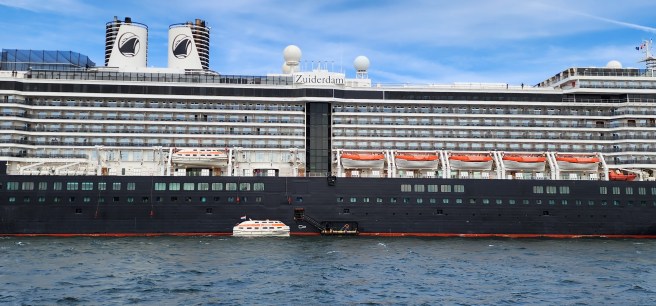
The Zuiderdam, seen here in Rockland Harbor last year, will be making two visits. You can see one of its tenders in the water, conveying passengers to the town and back.

As for the windmill?

Once the war was over and Eastport returned to the United States in 1818, the Shackford family thrived anew.

The heart of his activity seems to have been an old log store built at what would become Steamboat Wharf. Described as being at the foot of Shackford Street, it would more accurately be placed right below our house. When the store was constructed, the Customs Office was south of Shackford Cove, rather than to the north of the eventual downtown and its docks. That first store was standing as late as 1840 but being used as a stable.

Its replacement, the so-called Red Store, was removed from the waterfront around 1833 by John Shackford junior and still exists within the main part of the residence at the south-west corner of Third and Middle streets, an elaborate mansard house best known as master shipbuilder Caleb S. Huston’s residence.

Another portion of the old building went into a small, two-story frame house, “situated on the windmill lot” on Water Street, at the foot of Third Street — diagonally across the corner intersection from us. I’m told that the windmill foundation sits in the cellar of that house.

Windmill, you ask?

Windmill painting by Mrs. Bradish. Our Cape is at the upper left, though the artist omitted two windows on the front.  Note that there are no dormers.

Captain John junior is also credited with building a windmill upon the bluff at the entrance of Shackford’s Cove, one that “proved faulty in construction and was of no practical value, but remained standing on the bluff for many years as a conspicuous landmark.”

The small Cape at the left in the painting would be our house.

In the Kilby history, Samuel Shackford recalled, “The windmill which stood upon the bluff at the entrance of Shackford’s Cove for a generation or more was built for him,” John Shackford junior, “but, on account of location or fault of construction, proved a failure. In a moderate breeze, like a balky horse, it would not go, and in a gale of wind nothing could stop it until the wind abated. The old mill, after it had become dilapidated by wind and weather, was a picturesque object in approaching the town from the sea. It was taken down by its owner about forty years ago, much to the regret of the public.”

That is, dismantled around 1848.

~*~

But that leaps ahead.

All of it, of course, has relevance on the house we bought.

Big Pink in real life

It’s not quite like the Victorian mansion with the witch-hat tower that I envisioned in my novel What’s Left. This one sits along U.S. 1 in Milbridge, Maine, rather than near the university campus in the fictional town of Daffodil, Indiana.

Dig back in the archives on this blog and you’ll find dozens of other examples, usually in other colors, unlike Big Pink in the book.

I didn’t ask if a multigenerational Greek-American family lives here.

The War of 1812 impacted the Shackfords personally

Eastport fell under British control in 1814 and was then attached to Canada for four years. Not that it went quite that easily.

As the conventional story proclaims, Captain John “commanded the first militia company organized in Eastport, his uniform consisting of an old Continental three-cornered hat, and he wore an old sword. His company was made up largely of veteran soldiers of the revolution, a wild set of fellows whom their captain found it difficult to control.”

More descriptively, in William Henry Kilby’s history volume, as Shackford’s grandson Samuel contended, “His men were of a sturdy, wild set of fellows, who appeared to think that the first duty of a soldier on training days was to drink toddy; and their captain had a hard enough time to control them. Many of them, having served half-clothed and half-fed in the Continental Army, doubtless felt that they had earned the right to an occasional frolic.”

I won’t question his sources, but he neglects to mention that Fort Sullivan and its commanding officer surrendered without firing a shot, as did Castine, Machias, and a fourth Downeast town. Still, continuing the Shackford account,

“When the British fleet captured the island and the commodore came on shore to take possession of the island, Captain Shackford met him at the shore, carrying a goad stick in his hand,” not the old sword, mind you, “and addressed him thus: ‘Well, sir! What brought you here? I am King of this island, and these are my subjects. If you behave yourself, you can come on shore. If not, you had better be gone.’ The commodore politely assured him that he had called on business, and trusted that he should conduct himself in a manner becoming a gentleman and to the satisfaction of his Majesty.”

Goad stick? Like for cattle? Captain John apparently had a flair for drama, as the next incident illustrates.

“After the English had taken possession of the town, all of the inhabitants were ordered to swear fidelity to the King, or leave the town and have their property confiscated. But the old soldier, when summoned to appear and take the oath, replied to the officer that he had fought under General Washington; that he might take four horses and draw him in quarters, but never would he swear allegiance to the King of England. It was probably on account of his eccentricity and boldness that the old gentleman was excused from taking the oath and allowed to retain his property.”

Follow that? Who would you nominate to portray Captain John in the movie? And, for that matter, the Brit? It’s still a great scene.

Beyond that, Lorenzo Sabine, editor of the Eastport Sentinel, later contended, “No privateer was owned here,” though Eastport was subject to heavy privateering (state-sanctioned piracy) during the War of 1812. The British cruiser Breame took prize of the Delesdernier with master John Shackford junior and Samuel Wheeler, an owner on board as a passenger. They paid ransom for their property and were released.

Another ship, commanded by Captain John’s son William and sailing from Eastport in early 1812 with a cargo of rice and flour, was captured 25 miles from the port of Cadiz, Spain, by three French privateers. He and his mate and cook were left destitute.

Another prize was a chebacco boat with Captain John’s sons Samuel and Jacob Shackford, who paid a stipulated sum and were given up. The chebacco design, by the way, was a little two-masted boat, popular among New England’s inshore fishery, originating during the Revolutionary War. They were built by the hundreds and averaged from 24 to 48 feet in length, had two masts and no bowsprit. They were usually a flush-deck vessel with several cockpits, or “standing rooms” in which the fishermen stood to fish. A middle hatch gave access to the fish hold. They were also almost always built near the dwelling of the builder and sometimes no more than a few yards from the front door. Shackford Cove, then?

The third time John junior was taken prisoner was when the Delesdernier was captured off Cape Ann, Massachusetts. He and companion brother Samuel were taken to Halifax, Nova Scotia, where he was left without a hat and, one dollar excepted, entirely destitute in the streets.

Captain John’s son-in-law Darius Pearce/Pierce, in command of the schooner Sally, better known as Old Sal, was taken by the frigate Spartan and taken to St. John, New Brunswick.

Quite simply, the War of 1812 hit the Shackford family heavily. At one time, John and Samuel Shackford and Darius Pierce were all held captive by Lieutenant Blythe, who then released them.

All of it, of course, has relevance on the house we bought, as you’ll see.

Aurora borealis watch

A first attempt to photograph the northern lights using my cell phone. It does look like a sunrise except in the north. Next up is time-length exposures using a tripod and remote shutter. That’s when much fantastic color that isn’t seen at the time by the naked eye is detected.

I’ve even bookmarked the two-day forecast to keep me posted.

Back to Benedict Arnold

After the close of the Revolutionary War, and by then disgraced as a traitor, Benedict Arnold took refuge among the Loyalists in neighboring St. John, New Brunswick, where he emerged as a merchant and shipowner. Once, he personally directed the work as Captain John Shackford and presumably a crew loaded a vessel at Campobello Island.

Shackford later recalled,

“I did not make myself known to him, but frequently, as I sat on the ship’s deck, watched the movements of my old commander, who had carried us through everything, and for whose skill and courage I retained my former admiration, despite his treason. But, when I thought of what he had been, and the despised man he then was, tears would come and I could not help it.”

The Loyalist impact on Eastport, as I’m seeing in this project, was immense. Neighboring St. Andrews, New Brunswick, and St. John further up the coast were both founded in 1784 by Loyalist families exiled after the American Revolution. Many of them later filtered back into Eastport, including some lines that owned our house.

All of it, of course, has relevance on the house we bought.

Zeal

Carved in stone in Trout Brook cemetery, Weston, Maine, this portion of the deceased’s name makes its own statement. Can we adapt this as a motto for the New Year, with a sense of zest?

I do suspect that gravestones can be a great source of first or last names when it comes to writing fiction, not that I did that in crafting my existing novels.