Here’s how the organizers of tomorrow night’s program are touting the event:
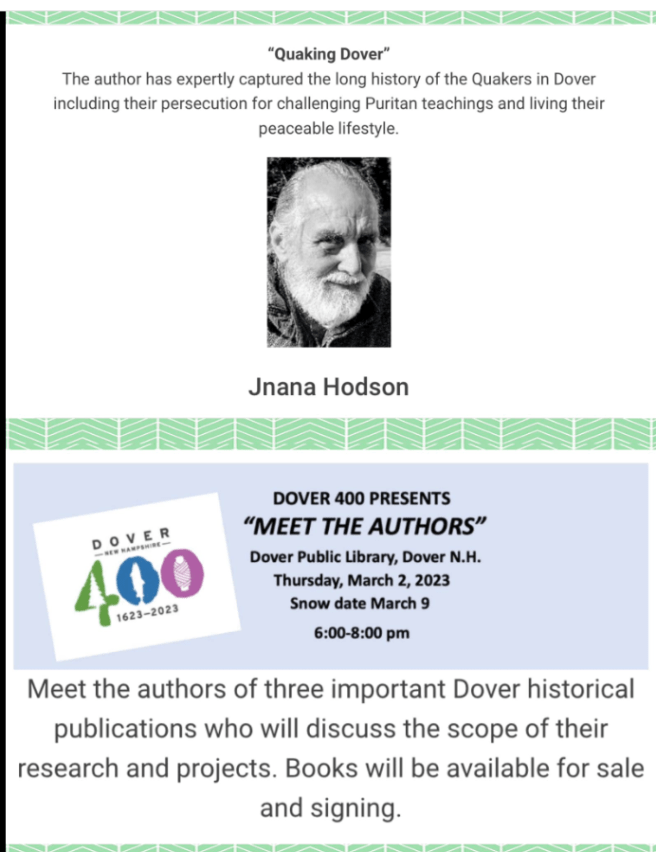
I’m so psyched!
You never know what we'll churn up in cleaning a stall
Here’s how the organizers of tomorrow night’s program are touting the event:
I’m so psyched!
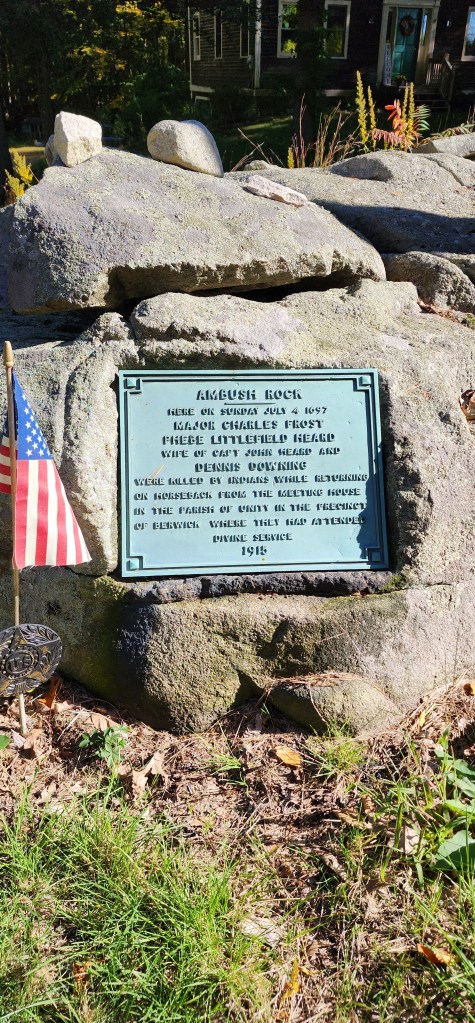
What the marker in Eliot, Maine, doesn’t mention is that Major Charles Frost and Dover’s Richard Waldron concocted the mock wargame that led to the hanging of Native men sent to Boston and the sale of about 350 Penacook women and children into slavery in the West Indies.
This was hardly an attack on an innocent party, then. The Natives waited years to extract revenge, and did it at a time and place that spared others.
My history Quaking Dover adds details.
A program Thursday night at the Dover Public Library promises to be lively fun.
Hosted by Dover 400, the folks behind the year-long celebration of the town’s settlement 400 years ago, I’ll be one of three authors of new books about the community’s past. Each of us brings something different to the table, and I’m really looking forward to meeting the others, as well as an audience full of additional insights and angles.
The program will allow each of us to address some prepared questions and briefly discuss our book before turning into wider discussion and an audience Q-and-A.
Retired librarian Cathy Beaudoin, the unofficial (and unrivaled) Dover historian, will be moderating. As an aside, I do wish she’d write the big volume about the city’s textile mills and the ways they transformed the community. She’s already curated a comprehensive lode of entries you’ll find on the public library’s website.
As a handy book you can follow around town, J. Andy Galt contributes an updated set of neighborhood walks that were originally conducted by the Dover Heritage Group. As I’ve previously posted, the city is pedestrian-friendly and has quite a range of architectural styles. In many neighborhoods, every house you pass seems to possess a history, if you stop, look, and have a few tidbits of info in hand. From the directions to one of those walks, Dover Friends Meeting finally learned where our second meetinghouse, from 1720, had been moved and now sits as a private residence.
Former Woodman Institute trustee Tony McManus brings a newly published, wide-ranging collection of newspaper columns he’s written on local history, especially the people involved.
And I’ll be there looking at the early developments from the perspective of the Quakers, for decades the town’s biggest minority.
As a grand finale, there will be an opportunity to sign books we’ll have for sale and meet one-on-one with readers. I couldn’t do that with ebooks.
(The snow date is March 9.)
One of the troubling revelations I found in researching my new book Quaking Dover is the depth of the English injustice and violence toward the Indigenous people of what we know as New England. It goes all the way back.
Forget the happy images of that first Thanksgiving feast where the Natives are portrayed as the special, very welcome, guests of the Pilgrims.
Squanto, after all, had been kidnapped, enslaved, and spent five years in England before the first English settlement took hold on Plymouth Bay.
Explorer Martin Pring, who established a fortified camp at Truro on Cape Cod in 1603, fled under attack by enraged Natives after he had set his mastiffs on them and fired his cannon in their direction.
The Pilgrims’ military leader, Myles Standish (not one of their faith, by the way), led the 1623 Wessagussett massacre, prompting Natives to abandon their villages for safer ground.
The Pequot war, 1637, was ultimately a land grab ending with the construction of New England’s first slave ship to trade the Native survivors into slavery in the West Indies in exchange for Africans.
And that’s before King Phillip’s war, with the mock wargame in Dover, or the waves of combat across northern New England until the treaty ending the French and Indian wars in 1763.
The outlook, of course, of “savages” and “heathens” was only part of the problem. The English insisted on addressing legal conflicts only in colonial courts. Not surprisingly, the decisions all seemed to come down against the Natives, with no independent course of appeal.
The pressure finally exploded in 1689 with the devastating raid on Cochecho Village and then Oyster River, both in Dover – hostilities that would continue another seven decades.
Are you ready for a fuller story?
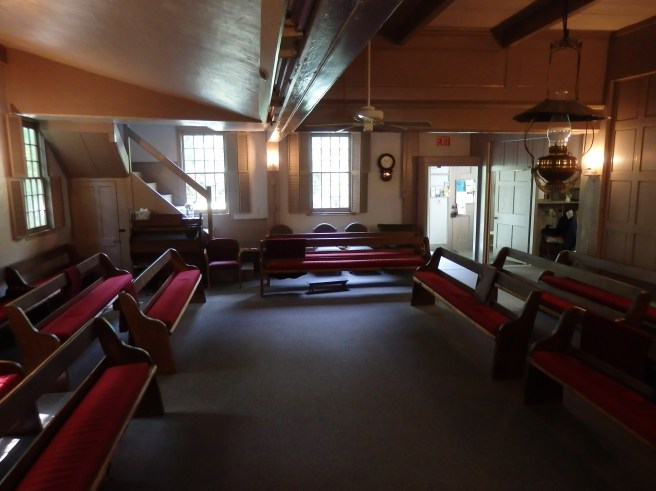
Way back before the Zoom camera appeared.
One of the many surprises I encountered in researching my book Quaking Dover was the fact that the Puritan authorities in Boston were ready for revolution from the git-go, way before Paul Revere.
I’d like to see more of their history presented from that riotous side.
There were the cannons they set up on Boston Harbor in 1634 to fire on Royal Navy vessels, should they come to follow up on the king’s voiding their charter. As things developed, Charlie the First got distracted from his problems over here and thus those volleys were never fired.
For another example, we can look to the coins John Hull produced from 1652 plus others for the next 30 years, even though the new king, Chuck Two, soon declared the practice treasonous.
Yes, treason. Off with your head or mere imprisonment in the Tower of London, that sort of thing.

Leap ahead, I’m wondering how he would have handled credit cards and their depths of debt and to me, at least, usurious rates.
Looking at some of those figures today, is anyone ready to say “Off with their heads?”
Maybe ancient history isn’t so far back there after all.
On top of it, the colonists had no representation in Parliament. That had to chafe on their identity as Englishmen through and through.
That was compounded by the costs London imposed on the Americans in defending themselves from the attacks by the French and their Native allies in the decades of warfare prompted by petty European royal succession and alliances. The New Englanders were definitely on their own.
A big question is what made the ruling Virginia Cavaliers turn from Loyalist to revolutionaries? Plus, why did it take so long?
There were no banks and you couldn’t write checks.
Were dried fish and lumber so valuable in Britain and the Continent that you could still make a fat profit shipping them across the ocean? Furs, I can understand, as well as the hunger for gold and silver, which may have fueled speculators who were inevitably disappointed. Plus fish, likely dried.
As for paying your workers? A daily portion of rum or the like was apparently often part of the deal.
By the way, Quakers were in the forefront of developing banks and insurance and even packet shipping in time.
The early colonies had layers of ownership, starting with those demanding annual quitrents for the land you would clear and build on or have “purchased” with any improvements. Then there were the chartered investors, like Lord Saye and Sele and Lord Brooke in New Hampshire’s case, who somehow expected to make a profit overseeing the place. They still had obligations to other investors, like the Council for New England. I’m really unclear how all of that worked in practice or what they got from “selling” their charter to Massachusetts.
The best I can come up with is that it was a kind of private enterprise tax, though I’m not sure what was offered in return. Like Mafia “protection” or layers of graft?
And that’s even before getting to England’s heavy mercantile system that hampered American entrepreneurial opportunities. The colonists were expected to provide raw materials for manufacture in England before being sold at hefty markups in the New World, too.
How did the colonists ever thrive, all their hard work aside?
I’m thinking it’s almost as vaporous as bitcoins.
Yeah, I know about the adage, “Write about what you know,” but I’ve come to see that advice needs to be balanced by “write about what you want to know.”
What we might call a creative tension. If you’re a writer, I hope that helps.
My latest book, which started out as a humble and brief profile of Dover’s Quaker Meeting but turned into a contrarian New England history, could be presented as one example.
I mean, Dover is still seen as a shadow to neighboring Portsmouth, which is much smaller and more uppity. Get real!
Back to the book at hand and the research that’s gone into it. Here are some things that surprised me.
Order your copy of Quaking Dover at your favorite bookstore. Or request it at your public library.
As a commercial book venture, my Dover history would be considered marginal at best.
Quite simply, short of a breakout, it targets a tiny audience.
The city itself is small – a population of slightly more than 30,000. And while the surrounding area runs around a half-million, that’s still small by book publishing markers.
Additionally, my work focuses on the city’s second-oldest congregation, an even tinier potential readership. While that element opens another market of fellow Quakers around the globe, it’s still small.
As for history buffs? They have their niches.
At the outset, at least, any for-profit book publisher would see this as a high-risk, losing bet.
I am, of course, hoping Dover’s 400th anniversary this year will give it a bounce.
And, as a microcosm of a snarky, contrarian New England history, Quaking Dover just might entertain a wider reception.
I mean, how many people do you think would have been interested in covered bridges in Madison County, Iowa?
~*~
One commercial publisher specializing in local histories did take a look but quickly backed off. The editor didn’t like the first-person voice of my book, for starters, and got spooked by the fact this volume hadn’t been vetted by religious authorities.
A few others were simply looking for an author-subsidized co-publishing deal.
That returned me to the self-publishing world I found in ebooks and then, for paper editions, at Amazon’s Kindle Direct Publishing.
As much as I like ebooks, for reasons I’ve previously discussed here at the Barn, I very much felt this was one that needed to be available primarily in a hands-on physical book form.
While Amazon has no upfront costs for an author in its print-on-demand paperbacks, physical bookstores refuse to carry them because they would have to buy the volumes at retail and then add a markup to the price to cover their own costs. They rightly complain it puts them in an unfair position.
But then came the announcement that my ebook flagship, Smashwords.com, was merging with Draft2Digital, which specializes in producing print-on-demand. Both companies have arrangements with distributors and retailers, and both offer their services to writers for free.
The arrangement also gives me more flexibility in marketing and special sales opportunities.
In short, count me in. I’m truly proud of the result.

Although he is best known for his persecution of the three Quaker women missionaries and his mock war game that captured hundreds of Natives, which led in time to the devastating attacks on Cochecho Village and Oyster River as well as decades of violence ending in 1763 with the French and Indian War, Major Richard Waldron (or Walderne, in its alternative spelling) could easily be the subject of a fat biography of his own, if a very resourceful historian would rise to the challenge.
His influence and power ranged far beyond his mills at the great falls of the Cochecho River. He was Speaker of the Massachusetts General Court, or Assembly, for multiple terms and even owned a substantial house in Boston. His ships ranged the seas, where two of his children died doing commerce. And there are good reasons I call him a perfect villain in my book Quaking Dover.
Through him, though, I sense that Dover had some solid connections with the powers in Boston, rather than existing just an outpost on the frontier. It alters my perception of sparsely settled colonial New England.
Just how did he amass so much wealth, especially? Were his leadership skills mostly along the lines of a bully or did he have some sophisticated means of influence?
It’s fair to ask if anyone else cast such a long shadow over New Hampshire’s course or how he would stack up in comparison to better known Boston figures.
Let me be clearer, he could be the subject of a hot book or movie or maybe a mini-series.
 Jnana's Red Barn