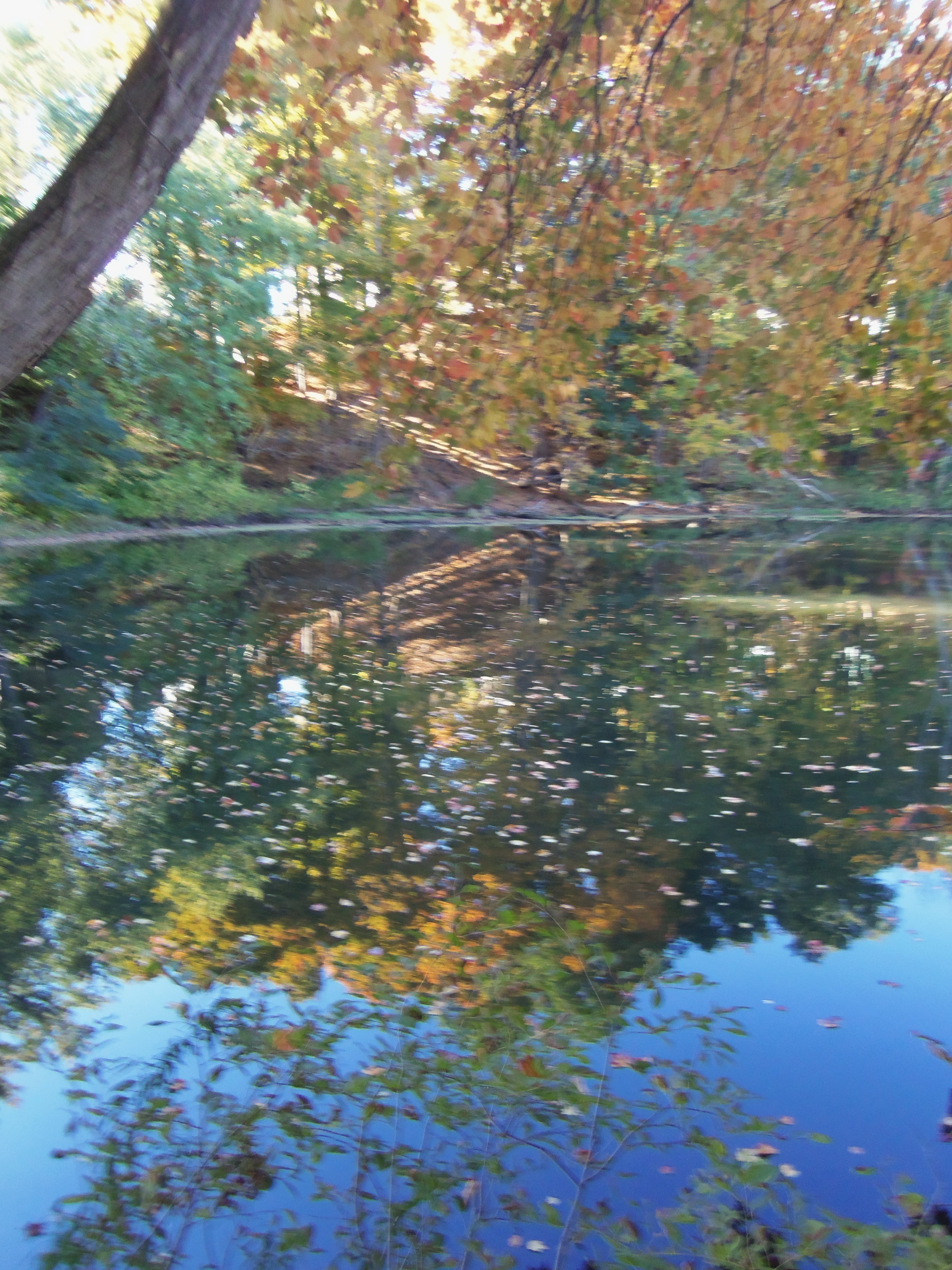
AUTUMN IN THE WATER
You never know what we'll churn up in cleaning a stall
We could be considering writing or painting and drawing as much as the photography that prompts today’s line of thinking. Specifically, I’m reflecting on the tension between trying to capture everything I see everywhere versus the reality that one needs limits.
For starters, I reach a point in shooting where I begin to weary. Push hard enough and everyone hits a wall. When it comes to photography, I just stop seeing images of interest. When I’m writing, my words go flat. Folks in other endeavors can relate their own versions.
A second fact of life comes in trying to arrange and manage what I already have. Accumulate too much and I’ll never find anything when I want or need it.
I find a similar tension in a writing project, where I can hope for a tightly focused, crystalline work even as it begins to expand into a complex baroque construction. Or the other way around.
As I’ve been shooting over the course of the Red Barn, I’ve found myself increasingly resisting an urge to range more widely from my base in Dover. I’m sticking more and more to what’s at hand here and in a few other familiar places like Sandwich, to the north, and Fort Foster in Kittery Point, Maine. We’ll see how that evolves in the future.
For now, what fascinates is seeing how much new keeps appearing to me in our yard or while I’m walking to meeting for worship on Sunday. Perhaps that’s why working on pieces in a series hold so much appeal as more and more keeps surfacing from the depths.
The other aspect of the series is the desire that somewhere in there is the one iconic piece that rises above the rest, can stand on its own, deserves its own place.
Oh, what would Monet say to all this? Or Matisse? Or any of a host of others!

Dover, where I live, is proclaimed as the oldest permanent settlement in New Hampshire and the seventh oldest in the United States.
Counting gets tricky, because there were earlier settlements that were abandoned. As best as I can determine, then, here’s the list the counts to seven:
While I found Weymouth, Massachusetts, as Wessagussett, 1622, the town itself notes 1630 as its settlement. And Taos, New Mexico, 1615, was abandoned by its Spanish missionaries in 1640. As I said, counting gets tricky.
The amount of wildlife in our yard continually impresses me, especially compared to my childhood home. The abundance of squirrels, of course, and (yuck!) the winter rats we occasionally see but also skunks, opossums, the groundhog (woodchuck) can be added in, plus garden snakes and a rainbow of insects. We must be doing something right, or just be in the right location. (Once, a fox trotted atop my ladder stored over snow, right here in the city.)
A first: amid a throng of blue jays chasing a crow, a mockingbird: was its nest raided or threatened?
But remember, never mock a mockingbird. Like the one singing lustily from our neighbors’ when I’d drive in from work at midnight. They’re quite remarkable musicians.
 ~*~
~*~
The influence of the animal kingdom shapes my newest collection of poems, In a Heartbeat, on tap at Barometric Pressures.
There are some things we’ve decided not to grow. Sweet corn, for example, requires more space than we’re willing to allocate.
Part of our decision reflects the reality that we have some fine farm markets nearby, and we welcome the exchange of a local economy. The same-day butter-and-sugar or all white ears are unbeatable, especially when accompanied by our own tomatoes. Who says a feast has to be expensive?
A pick-your-own orchard presents another example. We have fond memories of family journeys to Butternut Farm in Meaderboro for peaches and apples. For me, of course, the visit reminds me of living in the orchard in Washington state’s Yakima Valley, so many years ago, now, though I welcome its many varieties other than Delicious. A Gala, anyone?
The annual trek to a Christmas tree farm here in the city feels related – first, to pick out our choice, and then, a few days before Christmas Eve, to harvest it and somehow fit it into the car. We still treasure the bird nests we’ve found in ours some years.
One of the most popular services at our local library is a small cart in the hallway where patrons leave magazines they subscribe to. The periodicals become free for the taking.
Considering the cutbacks in the library’s own subscriptions (accompanying the cuts in the hours the building’s staffed and open), it’s a major service.
We feel good leaving our now-read copies, and feel grateful when we pick up others for perusal.
It’s quite an impressive array still coming in the mail. Hip, hip, hooray!
One of the downsides of owning an old house is an awareness of just how expensive any repair is. (And it’s always more than you’ve planned.) Add to that just how many repairs are needed. (Remember, most of them are for things you don’t even see.) And that’s before we get to any upgrades.
The awareness has also afflicted many of my dream-house observations, especially when I’m nearing the ocean. Where I would have admired a stone retaining wall under construction or a long pier from a private boathouse or deck to the mooring, what I now see is dollar signs. Often, more than I would have made in a year. It’s crushing.
It can make you wonder what people do for that kind of income. Or what kind of wealth they were born into. Or how long it will last.
One thing I know is that fishermen used to live in some of these coastal communities. But not anymore. Not by a long shot. Some of them live closer to me.
Much in our Quaker practice seems quaint, none more than our practice of minuting. It’s not the same as taking minutes of a company board meeting or city council session, but has a dimension all its own. Originating in the recording of persecutions in the initial decades of the Quaker movement, and in the subsequent petitions for redress and justice, our earliest minutes tell of “sufferings for Truth’s sake” and soon lead into the efforts of determining just what it means to live as a people of conscience.
Sometimes today we find the practice burdensome or unnecessary. Friends who follow the Old Ways in this matter will draft and read aloud the record on that part of the agenda, moving ahead only after that minute has been revised to satisfaction and approved. It’s slow and tedious, but it does focus the deliberations.
Here, the concept of clerking – especially for the recording clerk – has a meaning related to “clerk of court,” where the official records decisions from the bench above. In our case, Friends traditionally feel the high judge as Christ, and the meeting gathered as witnesses who would voice the sense of the resolution. I suppose we might see Friends attending our business sessions as a jury, then. If it were only as simple as guilty or not guilty!
Revisiting historic minutes, as I’ve done as a genealogist in the archives at Swarthmore and Guilford colleges, opens an appreciation for the practice as an art form. Perhaps no other records in America before the 1850 Census offer as much genealogical information as ours do. Even so, one discovers how faulty even the best efforts become. A individual simply fades from sight, a family moving away is recorded simply as “Robert and Sarah and children,” rather than naming them individually, as another clerk might have done, or the records might be lost to a house fire, as Centre, North Carolina’s, were, or simply lost altogether, as the first half-century of Dover’s were or West Epping’s were in our own lifetime. You might see an erasure, from first cousin to second, or a misspelling – and suddenly, you find yourself sitting with that clerk, somewhere in our history. This becomes something other than quaint, but personal engagement.
 Jnana's Red Barn