As for a broad history of New England Quakers?

It would be an ambitious project, and I’m not sure quite how one would structure it, spanning six states and many subjects as it would from early colonial times to today.

Dover Friend Silas Weeks’ book of meetinghouses and burial grounds remains my go-to volume, but it’s mostly about buildings rather than people.

I’m still surprised to hear Rhode Island Yearly Meeting as the body’s early name, rather than New England Yearly Meeting. When did it change officially?

Well, I have seen some genealogies that get impossible to follow after, say, the third generation.

I even feel something like that in Dover, once the textile mills take over.

Still, the conventional histories of Quakers in America focus on Philadelphia, overlooking or slighting the unique challenges and characters of New England, North Carolina, Ohio, and more.

For now, my Quaking Dover is a microcosm of the bigger picture. I’m hoping it will prompt more.

So where were the Baptists in New Hampshire?

Dover’s third minister, Hanserd Knollys, no doubt laid a foundation for the Quaker message two decades after his brief tenure in the town pulpit. He was beset by controversy and even a physical skirmish or two, but he organized the church as a Congregational society even as his own theology was evolving into Particular Baptist.

Some of New Hampshire’s early Baptists did relocate to New Jersey, where they named a town Piscataway, in honor of Dover’s Piscataqua River. And Knollys himself became the pastor of London’s first Baptist church, once he had fled New Hampshire and the New World.

By the way, the number of colonists who returned to England from America still amazes me. How could they even afford it, much less the time involved?

Some of his challenges to conventional Christianity, like rejecting the baptism of infants, opened the way for Quakers to build on, once they arrived.

Still, I couldn’t get a clear picture of the existence of the Baptists as New England’s other dissident denomination in the colonial era. Was it all down in Rhode Island, where they contended with the Quakers over the governance of the colony?

My own book, Quaking Dover, concentrates on Dover Friends Meeting and its families, once they’re established, but the Baptists seem to be largely invisible until the Revolutionary War or so.

Carla Gardina Pestana’s Quakers and Baptists in Colonial Massachusetts now provides an understanding of the faith north of Rhode Island. Essentially, it was long comprised of one church in Boston, and its members were scattered across the region, rather like a network of solitary souls. The church underwent an evolution over the years, from lay ministry to ordained pastors, and ultimately presented less of a threat to the Puritans/Congregationalists than did the Friends.

Still, their insistence on a separation of church and state and their view of a church being comprised of fellow adult believers rather than a place one had to attend regardless of one’s heart and thinking were liberal and revolutionary.

Pestana’s description of the impact of the Great Awakening on the Baptist movement gives me a clearer understanding of why so many of its churches appeared in and around Dover – and the rest of New England – in the early 1800s.

As for Happy Hampton?

In New Hampshire, Hampton is often touted as Happy Hampton, at least in summer, reflecting its long, broad, honky-tonk ocean beach and the rock concerts at the casino. Let me warn you it can be pretty crowded this time of year. Inland a bit, it’s also known for the Hampton Tolls on Interstate 95, which can be a major travel delay.

In the colonial era, Hampton was renowned for its saltmarsh hay and related agriculture.

It was also the center of the colony’s other Quaker Meeting, one at least as old as Dover’s, as far as I can tell.

As I was researching my book, Quaking Dover, I kept wondering what happened to the Hampton Friends over time. And then I discovered that, like Dover, Hampton had small, neighborhood worship groups, or “preparative meetings,” that came together once a month to address their joint affairs and personal conduct. The monthly sessions rotated among the meetinghouses under the Monthly Meeting’s care, in Hampton’s case including Amesbury, Massachusetts, which became home to the celebrated poet John Greenleaf Whittier.

Amesbury continues, while Hampton fell away long ago.

Since the boundary line between New Hampshire and Massachusetts kept shifting in the colonial era, sometimes reaching down to the Merrimack River – or Merrimac, as Massachusetts insisted – I feel safe in saying New Hampshire had two Monthly Meetings, while the Bay colony had only one, at Salem.

Either way, it could be a rich story in the telling.

Dover and Hampton were largely overlooked in Quaker histories

In the conventional telling of the early Quaker movement in New England, the focus soon centers on Rhode Island and Cape Cod. One was an independent colony; the other, in Plymouth, slightly less harsh than Massachusetts Bay to their north.

In contrast, the three northern Meetings – Salem, Hampton, and Dover – are largely overlooked or dismissed as agricultural and poor.

Well, a historian goes where the records are, and those three northern Meetings were largely underground before 1680, when religious toleration came to Massachusetts-governed districts.

Arthur J. Worrell’s Quakers in the Colonial Northeast is slim pickings when it comes to those three Meetings, and Carla Gardina Pestana’s Quakers and Baptists in Colonial Massachusetts helps rectify that with her concentration on Salem, but her references to Hampton and Dover are few and often cryptically sketched as “New Hampshire and Maine.”

Well, Dover served both sides of the New Hampshire-Maine line, and for decades, it was the only Quaker presence in Maine.

As I keep calling out: Hello!

Massachusetts was primed for Revolution long before Paul Revere’s midnight ride

Quite simply, Britain betrayed the settlers in her colonies, from Ireland onward. The American plaint, “Taxation without representation,” reflected that all too succinctly. Where were the colonies’ representatives in Parliament or the House of Lords? What voice did they have?

The colonists identified as English but must have seen they were definitely second-class citizens. Or maybe third.

As I note in my book Quaking Dover, the Massachusetts Bay colony’s Calvinist intransigence had been at odds with the Crown from its inception. The first shot heard ‘round the world could have erupted at any point.

My pivotal question is just what turned the Loyalists in Virginia so far as to reject the monarchy as well and then join in taking up arms in the revolutionary cause by 1776?

The other colonies moved somewhere in between.

Not that all of this falls much within the scope of my little 400-year history volume as I try to keep a focus.

As for another taste of scandal?

Dover’s second minister, the Rev. George Burdet, made a quick exit from town amid scandals, quickly followed by more in York, Maine. He had even briefly been “governor,” or the agent in charge of the New Hampshire province, making him in charge of both its religion and politics. Or, as historian George Wadleigh quipped, a wannabe pope.

Beyond that, as I observed in Quaking Dover, Burdet “was obviously on a downward spiral, as Thomas Gorges wrote to John Winthrop in 1641, noting that Burdet was at Pemaquid and ‘is grown to that height of sin that it is to [be] feared he is given over. His time he spends in drinking, dancing, singing scurrilous songs, and for his companions he selects the wretchedest people of the country. At the spring I hear he is for England.’ Later that year, the younger Gorges added of Burdet, ‘the dishonor of his profession and monster of nature, is now gone for England by way of Spain.’ That description of drinking, dancing, and singing rather seals the Robert Dover connection for me, even if Merrymount’s Thomas Morton, the more obvious reveling partner, wouldn’t return to Maine for another year or two.”

I do have to wonder where the wild tavern sat in the early Maine settlement here.

So here’s where he spent that wild binge – 110 miles or so from Dover, or a two-hour drive away today.

Recent research has come up with a site for the jail. I do have to wonder if the Rev. Burdet ever served time therein.

As for Robert Dover, who gave Burdet the inspiration for naming the New Hampshire settlement? He was an anti-Puritan wit and attorney. That, in contrast to the South English port famed for its white cliffs.

Reports of the cleric’s subsequent movements vary, possibly ending in Ireland, “where he was named chancellor and dean of a diocese. He died in Ireland in 1671, ‘after founding a much respected county family.’ Had he reunited with the wife and children he’d left behind?” As I say in my book, “Or was he, in fact, a bigamist? Also, there’s no mention of prison.”

Turn to Quaking Dover for the details.

What my Pemaquid visit made me realize is how little history of early Maine I had encountered in drafting my book, and how tenuous so much of it I’ve found since remains. Yes, the early settlements, including Pemaquid, were obliterated and abandoned during the decades of warfare with the French and their Native allies, but there had been significant settlement before that, something that kept getting swept away.


The shipwreck of Angel Gabriel had a Dover angle

A monument at Colonial Pemaquid acknowledging to the 1635 tragic sinking of a ship caught me up short. I had forgotten the vessel’s impact on Dover.

As background, the ship had been commissioned for Sir Walter Raleigh’s last expedition to America in 1617 and in several subsequent incarnations been involved in some high seas adventures, staving off repeated boarding by pirates and beating off three Spanish ships. Not that I knew that in my initial research.

As the monument at the Maine historical site proclaims, the Angel Gabriel was a 250-ton galleon carrying settlers to new lives in New England in August 1635 when it anchored at the village of Pemaquid. Most of the passengers and crew got off the ship before nightfall to rest on land as guests of the villagers. That night, August 14-15, a storm later known as “The Great Colonial Hurricane” struck the area and the Angel Gabriel was torn from her anchors and destroyed.

Or maybe it had happened earlier and the ship had limped into harbor. Still, I’m quoting there, from an account that continues: “In the mid 1970s, efforts were made to locate the wreck in Pemaquid Harbor with divers and a magnatometer and sideccan sonar but no artifacts form the ship were ever located.”

For context, “The Angel Gabriel was very similar to the Mayflower but 18 feet longer and bearing four more gun ports per side.”

I am now curious to see whether the small museum displays a trunk that went down with the ship and was found floating the next day. It belonged to a passenger named John Cogswell and his descendant of the same name agreed to lend the trunk for display.

This marker, though, stirred up some memories of a section that got cut from the final version of my book Quaking Dover.

Here’s what I had:

Three Dover Combination signers shared a tragic introduction to the New World when their ship, the Angel Gabriel, broke up in the August 14 “Great Colonial Hurricane of 1635,” either in the harbor at Pemaquid, Maine, or at the Isles of Shoals.

[Note the clarification in the site of the disaster in the bronze monument.]

Twenty-one-year-old William Furber settled next to his brother-in-law, John Bickford, at Oyster River and later relocated to Bloody Point, opposite Hilton Point on Great Bay. He married Elizabeth Clarke, daughter of William Clarke and Elizabeth Quick, in 1642 in Dover.

(The Bickford family, meanwhile, has John landing at Dover in 1623 and marrying Temperance Furber in 1624 in New Hampshire. If these dates and locations can be supported, they would significantly change the early history of the Piscataqua settlement. Their son, John, though, was born in 1625 in Devon, England.)

Samuel Haines was an indentured servant or apprentice to John Cogswell, who was also aboard and survived. They were bound for Ipswich  [Massachusetts], where Haines finished his obligations the following year and may have moved at that time to Northam, as Dover was also called.

He did, however, return to England in 1638 and married Ellenor Neate within a few weeks after his arrival, suggesting they were engaged before his coming to America.

After a year-and-a-half, they set sail and established their home in Northam/Dover, where he had ten acres of land near the meetinghouse. Later, he had twenty acres on the Back River, where his neighbors were fellow Angel Gabriel survivors William Furber and John Tuttle.

He was taxed in Dover in 1648 and 1649.

In 1650 he leased Captain Francis Champernown’s Green Land farm for two years, and then secured ninety-one acres adjoining it, where he built a permanent home, and another ten acres where he eventually owned a mill. In 1653 he was one of the petitioners successfully asking the Massachusetts General Court to change the town name from Strawbery Banke to Portsmouth. That year he began the first of ten successive years as a town selectman. In 1666 he helped run the town line between Portsmouth and Hampton.

He was also the first deacon at the formal organization of the first church in Portsmouth in 1671.

At much of this time, the population of what now constitutes New Castle, Portsmouth, Greenland, and Newington was only fifty to sixty families.

Much less is known about survivor John Tuttle, who was about seventeen years old at the time of the disaster. After their rescue, he arrived in Chebasco (in Essex or Ispwich, Massachusetts). His age and destination suggest his situation may have been similar to Haines’. By 1638 Tuttle settled in Dover, where he was known as Shipwreck John and had a farm on today’s Bellamy River – one that grew into what was long known as America’s oldest family-owned and operated enterprise. (Never mind that Thomas Roberts’ heirs nearby would have a longer claim.) Tuttle’s son Thomas was killed by a falling tree while still a young teenager, leaving John Jr. to continue the family name.

~*~

Successive Tuttles became prominent Quakers. And, as I inserted, the monument is more specific about the scene of the disaster than I’d previously found.

Now for a word from Friends Journal magazine

A classy magazine published 11 times a year in Philadelphia and having a readership in all 50 states and 43 foreign countries has reviewed my book Quaking Dover. Yay!

As Friends Journal critic Marty Grundy asks, “What was it about Dover, N.H., on the Piscataqua River separating it from Maine, that enabled early Friends ministers to establish first a toehold and then to gather a third of the populace into the meeting, in spite of New England’s violent opposition to Quakers?”

Dover, I might venture, is way off the radar of the usual Quaker heritage addicts.

For answers, she notes, “This book offers an alternative history to the usual Puritan-centric stories,” a volume where “history is not just the result of the larger, impersonal scope of folkways, economic and political forces, or social class. It is lived by individuals who are part of families, individuals who make personal choices and influence those with whom they live. So Hodson also traces family connections showing that both a bold embrace of Quakerism and bitter persecution of the disturbers of the status quo tended to run in families.”

Yes, it is about people.

As Grundy also observes, “The book is an artifact of COVID in that it was created using what is available on the web, including secondary sources, much older published accounts, and summaries of meeting minutes … As anyone knows who has tried to do historical research recently, there is a gratifyingly wide variety of materials available electronically. Hodson has done a good job of mining; juxtaposing; and, as he says, ‘connecting the dots’ to produce a somewhat speculative but eminently well-argued and documented account,” one “also filled with verbal asides as the author comments on what he is discovering and sharing with the reader. He offers various versions of events and cheerfully acknowledges when he can’t find facts to fill in gaps.”

For the full review, see the magazine’s March issue.

My, and this was in a periodical going back only to 1827.

So this is how Dover’s early houses looked?

Some historical accounts contend that the first housing in Dover was log cabins, as opposed to the thatched roof houses of Plimoth Plantation we can visit down in Massachusetts on our way down south of Boston to Cape Cod. (Go there, if you get the opportunity, by the way. It’s truly enlightening. And you won’t have to eat turkey or cranberry, not that I would object. Anyway, did those Pilgrims have mashed potatoes or sweet potatoes on that big event menu?)

Let me emphasize, log-style construction is often claimed for both the Hiltons’ settlement at Dover Point and the growing settlement’s first meetinghouse, which sat on what’s now roughly under a toll plaza on the Spaulding Turnpike.

Alas, both Dover sites represent lost opportunities for historical research.

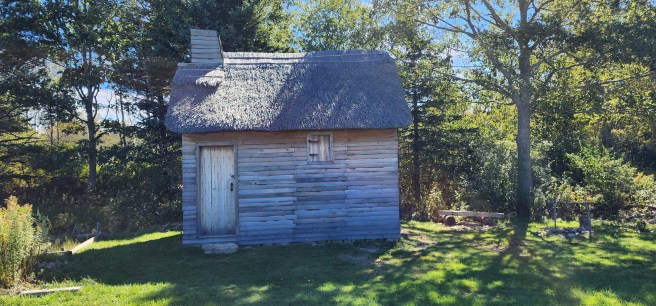
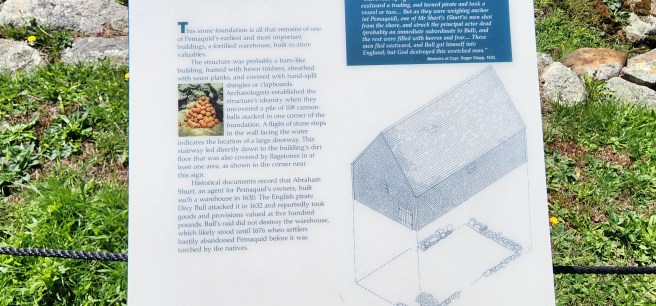
In contrast, Colonial Pemaquid, Maine, from the same era, has been subject to extensive archeological work. This reproduction is a typical West Country fisherman’s family structure for the period, based on those findings.

Yes, that’s right. A whole family would fit in one.

Notably, the earliest residents there and in Dover were from the West Country of England – especially Devonshire. And from nearby Bristol, a name that’s been applied to both.

An extended conversation with one of the dedicated volunteer caretakers convinced me on this style, unlike log cabins, which were apparently brought to America by Scandinavians to Delaware a few years later.

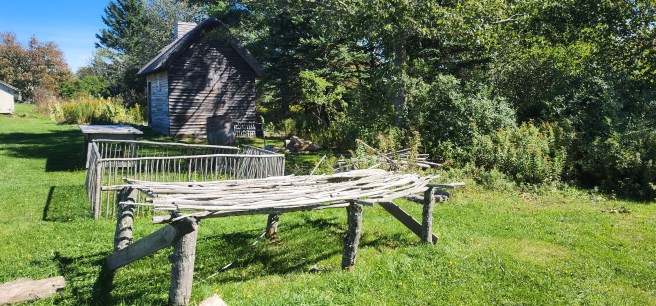
Fish-drying racks would have been important.

In a related conversation, close to where I now live, I was surprised to hear that the French settlers on St. Croix Island in 1604 arrived with pre-fab housing and set it up, rather than constructing their village and fortifications from scratch. When the survivors abandoned the site in the spring of 1605, they readily dismantled these and took them to their new site, Port-Royal, Nova Scotia.

That had me wondering how all of that would fit into a ship, but then I started thinking of it as the cargo coming in one direction, replaced with fish, fresh timber, and pelts on the return. Maybe it was bigger than a bunch of U-Hauls. You’d be surprised how much we’ve shoved into a few of those.

So might something similar gone on when the English sailed up the Piscataqua? It would make a plausible alternative to the log cabin assumption.

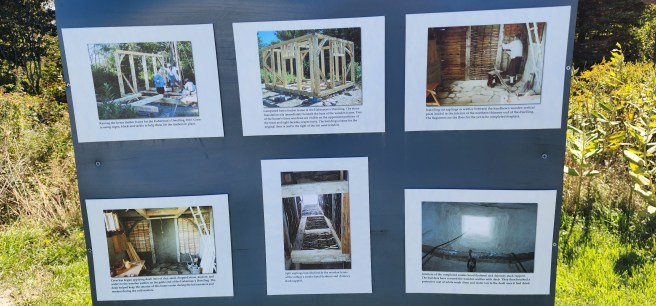
The Maine historical site adds details to the reasoning behind their reconstruction.

By the way, the Borderlands region of England had a structure known as a cowpen (sounds like cabin), reflecting the reality of a somewhat temporary house that would be destroyed by fighting within 50 years. Or maybe even a wild party.

I’ve never been quite comfortable with the traditional log cabin description of Hilton Point’s early settlement. Point made?

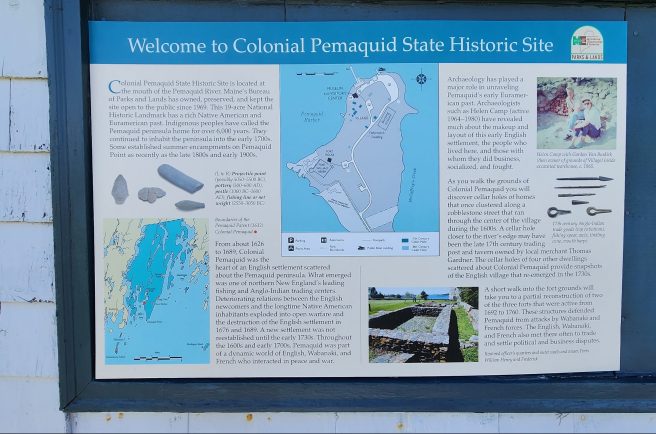
Pemaquid, out beyond the Piscataqua frontier

Call it a serendipitous trip.

My stopping off at the Colonial Pemaquid historical site in Maine during a weekend at the Common Ground Country Fair last year was an impromptu decision. I’d made a side trip to visit the iconic lighthouse down on Pemaquid Point in midcoast Maine and saw a roadside sign and thought, what the heck, on my drive back.

After all, the settlement had some connections to early Dover, as I note in my new book, but simply setting foot there gave me a more substantial sense of the place than as a footnote vaguely out there somewhere up the coastline.

At first, the state-managed site appears rather modest. Its small museum and nearby seafood restaurant were both closed, this being the shoulder season. But nosing around revealed much, much more, as I’ll explain here and in some upcoming posts.

It was settled by West Country fishermen, like those who were pivotal in early Dover, shortly after Edward Hilton and Thomas Roberts set up shop along the Piscataqua, so they would have shared a common culture. Notably, both sites were established before the great Puritan migration into Massachusetts Bay, bringing a much different English culture into New England.

Unlike Dover, the Pemaquid village was destroyed repeatedly in attacks from the French and their Native allies in the decades from King Phillip’s war on.

In short, English settlement was erased from Maine all the way down to Wells and York, close to Dover. I have to admit that caused me to give lesser attention to settlement much to the east of the Piscataqua River.

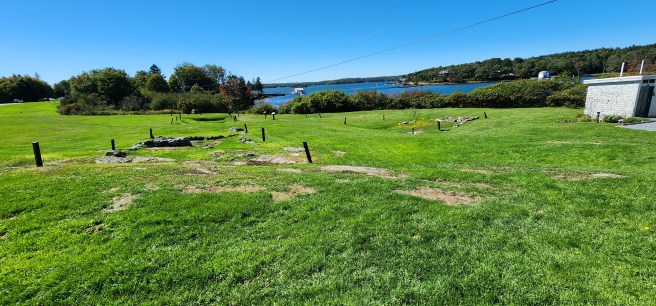
Still, the Pemaquid site, now in the town of Bristol, was left relatively undisturbed after the late 1700s. In the 1990s, though, extensive archeological excavations determined the shape of the village and a gave a clearer understanding of its economy and lifestyle. Today, the stone foundations and interpretative signage present some of their findings.

In those, as I’m excited to see, I got a clearer sense of how early Dover may have also emerged along High Street – today’s Dover Point Road.