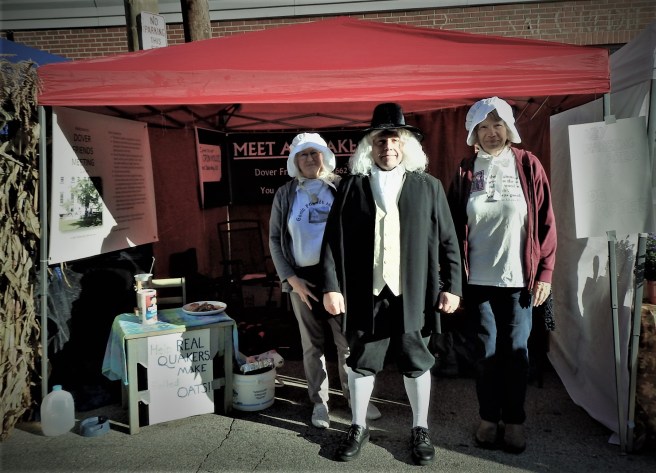
Meet a Quaker
You never know what we'll churn up in cleaning a stall
One of the delights of my small city is the waterfall at the heart of the downtown. It has powered mills since 1642, and with the addition of the dam atop the cataract, ran the textiles looms that made Cocheco calico world-famous.

The river – seen here resting at the end of summer – rages in the springtime, with snowmelt and heavy rains, and plunges into the tides that fluctuate eight to ten feet every six hours. Hence, the fish ladder for salmon, herring, and migrating eels.
With the retraining wall on the south side of the site in danger, a new wall was installed during the summer – a major construction project that tied up traffic for months.

When the old wall and the ground behind it were being removed earlier in the year, the excavation suggested that a much different design was in the works. Getting a clear view of the falling water has been difficult. The old walkway was charming, but you really wanted to get down lower and closer to the water. I envisioned a set of small terraces stepping downward beside the fish ladder.


Alas, that’s not what happened. We don’t even have the charming walkway anymore.
I’m hoping the new wall weathers quickly. Right now, it strikes me as an eyesore.

It took Trader Joe’s forever to get to New Hampshire. Now the other half of the Albrecht corporate identity in America has finally arrived, with a new store in Dover.
The nearest TJ’s, for the record, is in Newington, one town to the south of us, with its mall, cineplex, power plant, big industrial park and airfield, and a slew of retailers serving both Dover and Portsmouth.
If you’re familiar with the German-based Aldi discount supermarket chain, you know it’s spartan about low prices, boasting that it undercuts Walmart. Rather than a choice of brand-name products, the shelves present mainly storebrand items – still in the cardboard shipping box. You put a deposit on a grocery cart, if you need one, and you have to pay for a grocery bag, if you didn’t bring your own. And, despite the frugality or stinginess, there are customers who rave about its specialty chocolate and coffee. And those who complain.
The name Aldi stands for AL-brecht DI-scount. And, oh, yes, the owners, Germany’s richest family, have been feuding, providing plenty of gossip. By the way, the cart rental means you take it back to the store for your quarter, saving the company the expense of hiring someone to retrieve it from the parking lot.
The local Aldi doesn’t sell alcohol, tobacco, or lottery tickets.
~*~
The grocery business has always been competitive, with thin profit margins. Success has depended on volume, for the most part, and niche loyalty, where possible. There’s little room for error.
Regionally, the Market Basket chain dominates. It has the lowest prices overall, wide variety, locally responsive product selection, fierce customer and employee loyalty, and a 1950s’ New England identity. We’re grateful it survived its own Greek family feud and continues with its enlightened leadership.
Meanwhile, the other two players in town pitch themselves toward stylish, but they’re almost never crowded. You might stop there if you don’t want to face the crowd at Market Basket or prefer closer parking, but there’s definitely a sense that they’re not where the action is, despite the corporate decor.
Scarborough, Maine-based Hannaford is owned by the Ahold Dehaize group in the Netherlands, which also operates the Giant, Food Lion, and Stop & Shop chains in the U.S. It feels sterile.
Shaw’s Market operates jointly with Star Market out of West Bridgeport, Massachusetts, and is owned by Boise, Idaho-based Albertson’s. Its tone is somehow greener or more intimately lighted. Do we really care if it’s the official grocer of the Boston Red Sox?
In Dover, Hannaford and Shaw’s sit side by side north of the hospital.
Intriguingly, Aldi chose to tuck its new store in across the street. Rather than building, it could have taken over the former Staple’s site a bit up the street, closer to both the freeway and to Market Basket. We’re curious about the corporate thinking here.
Our guess is that Aldi figures it can pick off at least one of the two rivals that share its traffic lights. Hannaford has a satisfactory pharmacy, one that my health plan pointed me to. Shaw’s turns out some fine baguettes and the tortilla chips are superb. So we’d miss either one.
For perspective, the Shaw’s in Newington recently folded, unable to keep up with its neighboring Market Basket and TJ’s.
Aldi is closer to downtown Dover than Market Basket, and for some prices, it’s coming in lower. But is that enough to cut significantly into No. 1?
We’ll see.
~*~
For now, I’m viewing it more as a convenience store with low prices. A gallon of milk is a dime or two cheaper than anywhere else … for now.

I know where I’m getting the candy rocks and gummy fish to decorate my gingerbread lighthouse this Christmas. And it’s also a great place for guys to find great little gifts for the significant other in their life, something that usually confounds us. It’s even a fun place to take her on a stroll around town. (Think cheap date.) You can sit in air-conditioned comfort while savoring the yummy ice cream. Or even keep a bunch of kids happy.
We’re hoping Lickees & Chewies Candies & Creamery catches on. It seems to have its act together, blending several types of economically marginal stores into one.
Key to everything is its location, across from the Children’s Museum of New Hampshire and above Noggin’s toys on the ground floor of the historic Cocheco Millworks downtown. The one drawback is that the entry is on the other side of the building, away from those two kid magnets.
But once you’re inside, you’ve entered a whole different world. It smells richly mysterious, largely from the chocolate bakery. There are maps with pushpins where customers indicate where they’ve visited from, and there are metal rings on strings you can swing toward hooks in the wall if you’re feeling playful.
There are more classic games in the sitting area, which includes a large round table suitable for a birthday party, actually. Or just resting or looking at the views out the window.
So one part of the operation is the ice cream counter, with an emphasis on creamery. But remember, this place is loaded with candy, as in toppings.
Then there’s the old-fashioned candy store itself, with about every brand you can imagine. The entrepreneurs don’t proclaim their organization or knowledge of the field, but it’s there – Southern candies in this part, German in that – even before you get to the saltwater taffies. Many of the smaller wrapped bits haven’t been a penny apiece for sometime, but that’s its groove anyway. After all, the idea is to fill your own bag.
Yet another part is the fine chocolatier. This is where to find a gift to impress, maybe even a new client. And there’s plenty of room to grow to the side.
They make the most of the historic textile mill space. The ceilings are tall, with bare wood posts. The lighting is warm, tasteful, with some German Black Forest kinds of surprises befitting a fairy-tale atmosphere in the evening.
It’s been here a year already, but I’ve just discovered it. I’m definitely anticipating getting back before Christmas.


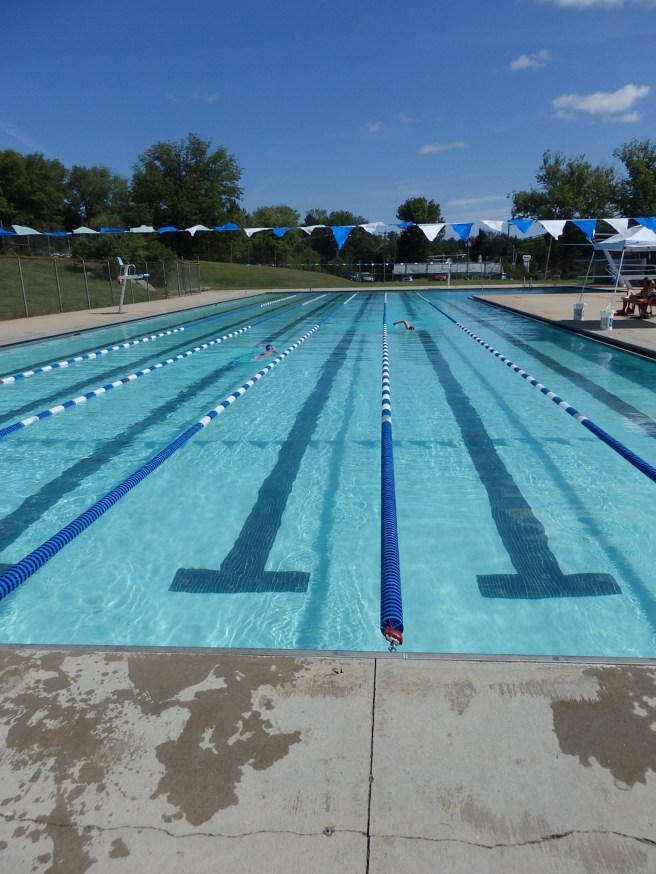
Since my indoor pool pass is good year-’round, I don’t spring for an extra pass to use the city’s outdoor pool each summer. Instead, I get to go there for free during the final two weeks of the season, when the indoor pool is closed for annual maintenance and upgrades.
The outdoor pool, though, can be a glorious experience. Here are ten points to consider.
Downtown Dover grew around the falls on the Cocheco River, where the mills could channel the current to produce world-famous calico and much more.
Below the falls and the dam atop them, tides from the Atlantic Ocean downstream rise and fall eight to ten feet every six hours or so. Boats from the ocean made their way the 14 miles upstream to pick up or deliver goods.
As pollution in the river has been cleaned up and the city itself become more of a center of the Seacoast Region, planners have been looking to develop an open stretch of unpaved parking lot and weeds across the water from downtown.
For years, the site was the public works yard – not the best use of potentially valuable real estate. That has since been relocated elsewhere. I’m guessing it was tannery and warehouses before that.
A proposal to build anew there fell through in the real estate collapse of the great recession at the end of the George W. Bush administration but now, a decade later, it’s emerging in new form.
Key to the design is the extension of Henry Law park along the river as a walkway with added attractions such as kayak and canoe landings. A hillside has already been carved back to allow moving an existing street away from the river to open the space for more pleasant picnicking or the strolling public.
Further on there will be room for new housing and small stores or offices. Done right, it should be quite welcoming and attractive.
Just as important, in my eyes, is the way this will open up access to an existing city park at the top of the hill. Rather than running into a dead end as it does now, Washington Street will rise up the slope to become the entrance to Maglaras Park. It will be an easy walk from downtown, rather than the convoluted route it’s replacing. Even for drivers, it’s a huge improvement.
Continue reading “Dover’s new riverfront appearance and hilltop park access”
My small city is the seventh oldest settlement in the continental United States, not that there’s a lot left from its first century, when the place was largely on the sometimes troubled frontier of English dominion.
As a working-class mill town, it developed more modestly than more prosperous harbor towns like Portsmouth to the south or Portland to the northeast or Newburyport to the southwest.
Our downtown is catching up, though. A small but significant building boom is under way.
Not all of the development around our downtown is aimed at luxury housing.
Back in the sixties and seventies, apartments for subsidized renters were erected along the river and a steep slope on Central Avenue. A few years ago, the Woodbury Mills transformed a boarded-up warehouse into a lovely affordable housing apartment a few blocks from where I live, and a mill along the Bellamy River also underwent similar rebirth.
More recently, the three Roman Catholic churches in town were merged into one parish headed by a single priest, and one of the houses of worship, St. Charles, was facing serious structural water damage. It was sold and demolished, making room for the newest entry, Bradley Commons, about six blocks from the waterfalls downtown.


 Jnana's Red Barn