As the story goes, he’s a perfect villain

The three Quaker women who come to Dover in 1662 and 1663 are tormented principally by Major Richard Waldron. He and his brother William arrived from a staunchly Puritan family in Warwickshire in 1635, and after returning to England to marry a woman against her family’s wishes, Richard returns to Dover. History does not record her name, only his second wife’s. In 1642 he buys up rights around the dramatic waterfalls of the Cochecho River about five miles north of Hilton Point.

In building mills there and establishing a village, Richard consolidates power and wealth. He has, for one thing, obtained a monopoly on fur trade with the Natives and, for another, rises to head the colony’s militia, a politically powerful position. In addition, he serves 22 years as a deputy of the General Court of Massachusetts, its assembly, seven of them as its Speaker. He votes to impose the anti-Quaker acts of 1656 and 1657.
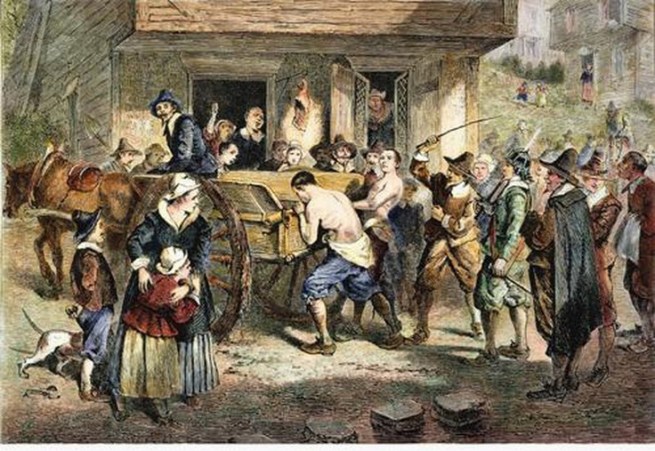
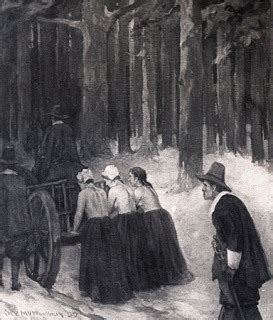
Richard Waldron was influential in the passage of the anti-Quaker Cart and Whip act and other punishments.

Dover is not his only residence – at least three of his children are born in Boston and he has ships on the sea. He’s also the magistrate who imposes the Cart and Whip sentence on the Quaker women who come to Dover – in effect, a death sentence if constables in towns down the road follow through on his order. Even his wife is appalled by his cruelty.

He’s also the mastermind behind the invitation to the Natives to participate in a mock war game and festivities in 1676. After the 20 armed Natives fire their weapons, they are surrounded and arrested, along with 350 or more, mostly women and children. Seven or eight of the leaders are sent to Boston and executed. The rest are sold into slavery in the Barbados or West Indies.

Major Richard Waldron masterminded the sham war game that led to the captivity of local Natives who came in peace.

The Natives do not forget Waldron’s deceit and cunning. Knowing they cannot trust the English, they form an alliance with France. Many of them convert to Catholicism under French priests.

In 1689, they take their revenge, attacking and burning garrisons at Cochecho village, killing 23 and taking 29 captive to Canada. Quakers are not spared. Waldron, however, is singled out for torture and death.

The early morning raid is the beginning of devastating violence large and small across northern New England that does not end until the end of the French and Indian Wars in 1763.

Every family in Dover would suffer losses. They were far from the only ones.
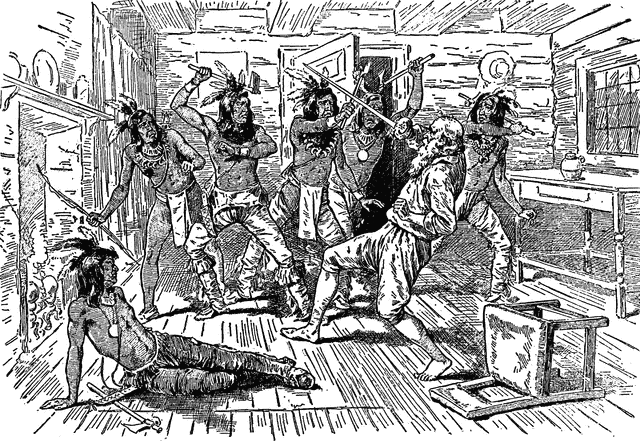
Major Waldron was singled out in revenge.

Behind the scenes, an ominous shift in the settlement’s character had been occurring, centered on Waldron. The sixth son of a well-off Puritan family, he was “immensely able, forceful, and ambitious,” arriving with his oldest brother in 1635, when he was barely twenty. In 1637, he returned to England, married a young gentlewoman despite her parents’ opposition, and brought her to Dover. Her name and dates are unknown. He then married Anne Scammon and had eleven children.

By 1642, he had accumulated the rights to land around the falls in today’s downtown Dover and erected his first sawmill. Emerging as the town’s central figure, he eventually controlled much of the Native trade and amassed large land holdings. In pressing for Dover to submit to Massachusetts jurisdiction, Waldron placed himself in opposition to Thomas Roberts, who then lost office when the Dover province was subsumed by the Massachusetts Bay colony.

Waldron, in contrast, became a deputy to the Massachusetts General Court, or legislature, in 1654, where he served for the next twenty-two years, seven of them as its general speaker, one of the most powerful political posts in New England. How much time was he spending in Boston during this period, and how much in Dover? At least three of his children – Elnathon, Esther, and Mary – were born in Boston.

Brother William also held public office and eventually purchased a part of the Shrewsbury Patent in today’s town of Stratham. He was, according to Massachusetts governor John Winthrop, “a good clerk and a subtle man,” one who “had an inclination toward drink and contention,” which leaves me wondering about Richard as well. While crossing a small river at Kennebunk on his way back from Saco, Maine, in 1646, William drowned. Whatever his skills as a public official, his business dealings left him in debt to many creditors. Like the Hilton brothers, we have a case where the younger brother fared more successfully than his elder.

After his death, another brother, George, showed up in Dover after 1650, when he was a chandler in London. From 1659 through 1677, he was taxed as a resident of Dover. His domestic life, however, was strained. In June 1661, he was in court for being absent from his wife, and again in the fall of 1662, when she was reported dead twelve months. In June 1680, he petitioned the court to be rid of his son, “who instead of holding me hath rather destroyed me and what I had in drinking.” Impoverished, elderly, and nearly blind, he appealed for a guardian. Mrs. Richard Waldron took him in until her husband’s return.

Richard, on the other hand, flourished, not just in politics. He traded widely, as is seen in the death in Algiers around 1669 of his son, Paul, “probably on board one of his father’s vessels.” Another son, Timothy, died while a student at Harvard. Daughter Esther died on the Isle of Jersey. Quite simply, his family wasn’t stuck on the banks of the Cochecho or Piscataqua rivers.
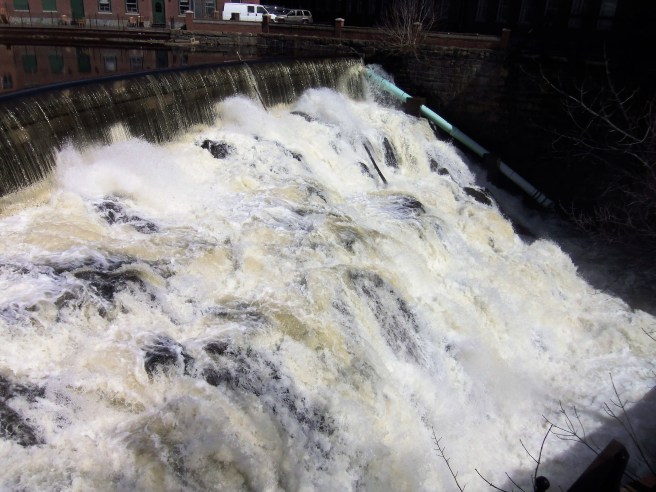
The Cochecho Falls and the village that grew up around them were part of Richard Waldron’s power base.

As Jere Daniell observed, “By the 1670s the portion of Dover known as Cochecho had become something like Waldron’s personal fiefdom, and citizens in the other areas of settlement rarely challenged his social authority.”

A man like that had to have enemies and a capacity for revenge.

From everything I’ve seen, he was quite unlike Nicholas Shapleigh just across the river.

~*~

Welcome to Dover’s upcoming 400th anniversary.


The Quaker presence in Dover is even older than we’ve thought

Massachusetts Bay authorities are in an anti-Quaker frenzy even before two small groups of Friends set forth for Boston in 1656. Fifteen in all, they meet a harsh reception from the Puritan leadership, even banishment on pain of death, but return anyway, some after having an ear cut off. Their one haven is in Rhode Island, a colony founded by Roger Williams and augmented by Anne Hutchinson’s followers, who had almost ousted the Puritans from their governance of Massachusetts only two decades earlier.

Some of the most intense persecution comes down in Salem, north of Boston, already the second largest city in the English colonies, where a small circle of newly converted Quakers boldly holds firm. By 1658, their influence seeps into New Hampshire at Hampton and Dover and across the Piscataqua River into today’s Eliot, Maine. In 1659, a Dover court fines 15 residents for non-attendance at the Puritan services, and one of them is specifically convicted of having attended a Quaker meeting. Six of the surnames are among those active in the earliest surviving Dover Friends records four decades later. Most prominent among them is Thomas Roberts, one of the town’s first two settlers and later the colony’s governor.

This occurs before Quaker missionaries William Robinson and Marmaduke Stephenson are arrested three weeks after visiting Piscataqua. It’s possible that William Leddra and William Brend were here the previous year, before their apprehension in Salem on their way back to Boston, or perhaps Christopher Holder and John Copeland, before that, in 1657 – that would be a plausible reason for some Dover residents to be worshiping “after the manner of Friends” by early 1659.

Three of the four Quakers hanged in Boston had visited Dover. Mary Dyer was the exception.

Early Friends activity along the Piscataqua is confirmed in early 1660 when Anthony Emory, an innkeeper and ferryman at Sturgeon Creek in Eliot/Kittery, was fined and disenfranchised on charges of “entertaining” Quakers. His ferry route connected to Bloody Point (Newington) and Hilton Point across the Piscataqua River. Whether Emory had merely transported the Quakers as passengers or allowed them to stay at the inn or been more active in welcoming them is unclear, but his independent streak was well established. He was a signer of the Dover Combination before moving to Eliot/Kittery in 1649, where he was fined five pounds in 1656 for “mutinous courage” in challenging the authority of the town’s court. The disenfranchisement was too much. He sold the property on May 12, 1660, to his son and relocated with his wife to the Quaker stronghold of Portsmouth, Rhode Island.

The earlier controversies over the ministry of the town’s church had no doubt left dissenting locals, joined by eccentrics, whom the itinerant Quakers then galvanize into an assembly. Quite simply, Dover is out on the frontier of English settlement and relatively far from the Puritan mainstream.

Significantly, Robinson, Stephenson, and Leddra are among the four Quakers hanged in Boston in the years before three women arrive in Dover in 1662 and are whipped out of town, an event that has long been considered the start of Dover Friends Meeting. Traditional histories even say there was no Quaker presence in town before that. Instead, I’m certain the women and two male companions arrived to nurture a previously gathered circle.

Three Quaker women are whipped out of town, December 1662.

~*~

How dangerous are they? Here’s a brief life story Stevenson wrote a week before his execution – that is, just days after being in Dover.

 In the beginning of the year 1655, I was at the plough in the east parts of Yorkshire in Old England, near the place where my outward being was; and, as I walked after the plough, I was filled with the love and presence of the living God, which did ravish my heart when I felt it, for it did increase and abound in me like a living stream, so did the life and love of God run through me like precious ointment giving a pleasant smell, which mad me to stand still. And, as I stood a little still, with my heart and mind stayed upon the Lord, the word of the Lord came to me in a still, small voice, which I did hear perfectly, saying to me in the secret of my heart and conscience, “I have have ordained thee a prophet unto the nations,” and, at the hearing of the word of the Lord, I was put to a stand, seeing that I was but a child for such a weighty matter. So, at the time appointed, Barbados was set before me, unto which I was required of the Lord to go and leave my dear and loving wife and tender children; for the Lord said unto me, immediately by HIs Spirit, that He would be as an husband to my wife and as a father to my children, and they should not want in my absence, for He would provide for them when I was gone. And I believed the Lord would perform what He had spoken, because I was made willing to give up myself to His work and service, to leave all and follow Him, whose presence and life is with me, where I rest in peace and quietness of spirit, with my dear brother [William Robinson] under the shadow of His wings, who hath made us willing to lay down our lives for His name’s sake, if unmerciful men be suffered to take them from us. And, if they do, we know we shall have rest and peace with the Lord for ever in His holy habitation, when they shall have torment night and day.

So, in obedience to the living God, I made preparation to pass to Barbados in the Fourth month [June] 1658. So, after some time that I had been on the said island in the service of God, I heard that New England had made a law to put the servants of the living God to death if they returned after they were sentenced away, which did come near me at that time; and, as I considered the thing and pondered it in my heart, immediately came to word of the Lord unto me, saying, “Thou knowest not but that thou mayst go thither.”

But I kept this word in my heart and did not declare it to any until the time appointed, so, after that, a vessel was made ready for Rhode Island, which I passed in. So, after a little time that I had been there, visiting the seed which the Lord had blessed, the word of the Lord came to me saying, “Go to Boston with thy brother William Robinson,” and at His command I was obedient and gave up to His will, that so His work and service may be accomplished. for He had said unto me that He had a great work for me to do, which is now come to pass. And, for yielding obedience to and for obeying the voice and command of the everlasting God, which created heaven and earth and the foundations of waters, do I, with my dear brother, suffer outward bonds near unto death. 

And this is given forth to be upon record, that all people may know who hear it, that we came not in our own will but in the will of God.

Given forth by me, whom am know to men by the name of MARMADUKE STEVENSON, but have a new name given me, which the world knows not of, written in the book of life.

~*~

His tone and content are quite different than that of the leading Puritans of the time.

Welcome to Dover’s upcoming 400th anniversary.
The settlement isn’t named for a town with white cliffs

The name of the settlement kept bouncing around.

Cochecho or Piscataqua plantation, for a while Bristol or Bristow, and even Northam, but the one that stuck was Dover.

Just as the names Hilton Point and Dover Point keep bouncing around, for the same place, though the latter has also largely replaced Dover Neck.

Neighboring Strawbery Banke did get renamed Portsmouth, after the harbor town in Devonshire, but Dover was never named for the village with the famed white cliffs in Kent.

No, the inspiration’s better than that.

The name comes through Dover’s second minister, George Burdet, who was more Anglican than Puritan, though apparently not outwardly. The proprietors of the colony at the time, Lord Saye and Lord Brooke, are both staunch Puritans, and the cleric works for them. In fact, he even manages to become the colony’s governor, or agent – a dual role forbidden to ministers in Massachusetts. Some even see him as trying to become a little pope in his power.

In calling the settlement Dover, Burdet pays honor to the anti-Puritan wit and attorney Robert Dover, who created the Cotswold Olympick Games near Cambridge in the heart of the Puritans’ East Anglia.

Meet Robert Dover.

As my upcoming book details, there’s a long list of reasons the neighboring Puritan landlords forbid their servants from attending the pagan festivities. Besides, Dover was likely a secret Roman Catholic while openly ridiculing the Puritans. We can imagine what he would have said of Quakers.

Burdet, however, winds up fleeing Dover amid sexual scandal, only to generate more where he lands in Maine. Yes, the plot keeps thickening.

As for, “Roll over, Dover,” if we put it up for a vote, which inspiration would you chose? The picturesque cliffs or the scoundrel in the pulpit?

Welcome to Dover’s upcoming 400th anniversary.
 

Don’t think of them as poor or marginalized

A fair number of the Piscataqua’s early settlers were from prosperous, even well-connected, families.

The question is just what prompted them to relocate to the primitive, even harsh, conditions along the Piscataqua River.

David Thomson, the son of a Scottish minister, has the King’s ear and a debt of gratitude.

The Hiltons are part of an extensive and prosperous fishmonger clan.

Thomas Roberts’ father, by some accounts, becomes a baron. Even if he didn’t, Thomas still becomes a member of the powerful fishmonger guild.

The Hilton brothers weren’t exactly out of the loop, either.

~*~

Powerful? Take Francis Champernowne, a 1640 signer of the Dover Combination, a remarkable document stating the residents’ desire to be freed from being subjected to company-town decisions being made in England. While I see scant evidence that Francis actually resided in today’s Dover, he did have extensive landholdings in New Hampshire, including the current towns of Greenland – named for his Green Land farm – and Madbury, then part of Dover and named after his ancestral home, Modbury, in Devon, England.

His father, Sir Arthur Champernowne, owned at least eight merchant ships or privateers and had fished New England since 1622. In 1635, Sir Arthur financed a settlement under his son, Francis – likely the southern part of Kittery, Maine, which became known as Champernowne’s Island, today’s Cutt’s or Gerrish islands – as well as another on Braveboat Harbor in York. Francis may have also lived at Strawbery Banke (today’s Portsmouth) until 1640.

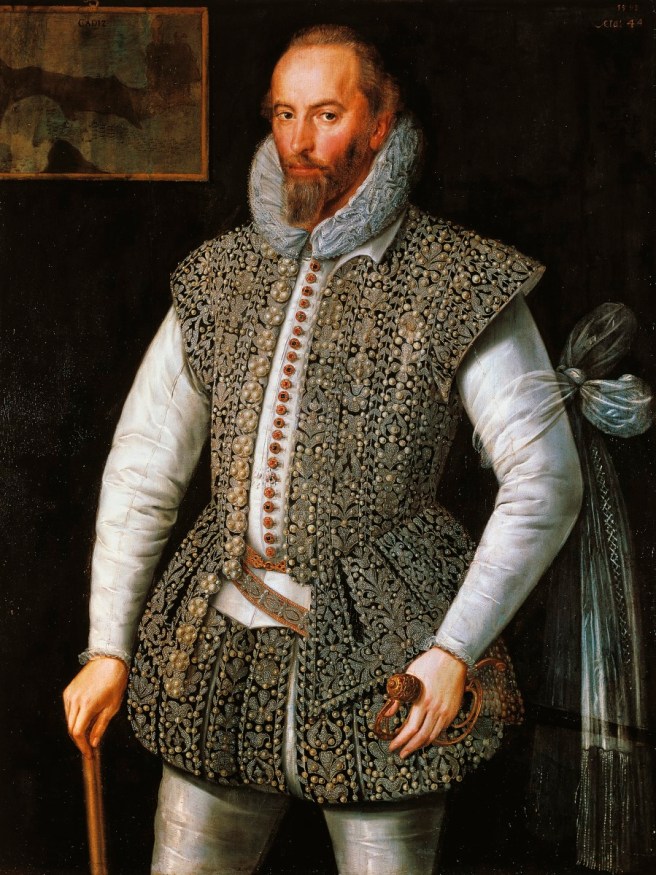
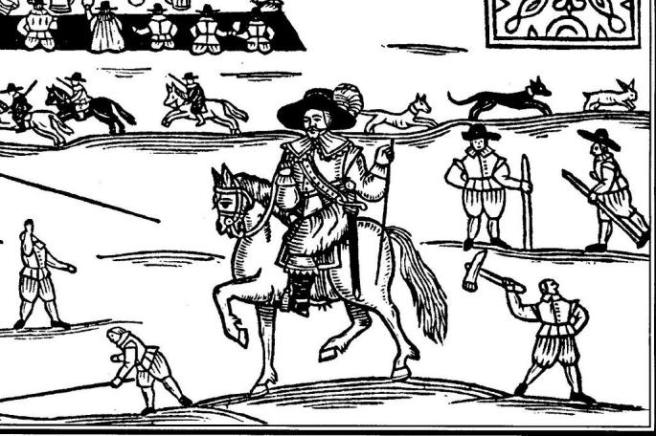
Sir Walter Raleigh. His nephew was a big settler along the Piscataqua, Did he dress anything like this?

Captain Francis was well-placed. His great-aunt Catherine was the mother of both Sir Walter Raleigh and Sir Ralegh/Raleigh Gilbert, an important explorer and adventurer of the New England and Canadian coastline. Captain Francis was also a “beloved” nephew of Sir Ferdinando Gorges, proprietor of Maine and unofficial godfather of New England itself.

Francis was often at sea, to England and Barbados, especially. During the early part of the English civil war, his Royalist leanings led him to join King Charles I’s fleet under the Earl of Marlborough. Returning to Dover by 1646, he left for the Caribbean in 1649 but returned to Maine in the early 1650s, where he later became a commissioner and justice under Charles II.  In April of 1678, he signed the articles of peace with the Abenaki at Casco. He was an ardent Anglican and died in Kittery.

It’s enough to make me think living conditions back in merry old England weren’t that great, either.

~*~

The Waldron family that soon comes to dominate the growth around the Lower Falls, or today’s downtown Dover, came from wealth in Warwickshire, England. William drowns, but brother Richard turns Dover into something of a personal fiefdom while rising to become Speaker of the Assembly once New Hampshire is under Massachusetts rule. He builds the first saw mill and grist mill at the falls, has extensive shipping connections, dominates the fur trade with the native Pennacooks. He didn’t exactly start from scratch.

You’ll be hearing a lot more about him. Man, will you.


I would love to know more of the ways Devonshire influenced the settlement  

One of my key insights into Dover’s early character came after noticing that the majority of its early residents came from Devonshire – or Devon – rather than the East Anglia shires of Norfolk, Suffolk, Essex, and Cambridge that dominated New England’s Puritan migration, construction, and social order.

And that holds for even the Puritans who take over Dover in 1633 (or so).

In his groundbreaking Albion’s Seed: Four British Folkways in America (Oxford University Press, 1989), David Hackett Fischer elaborates on what he calls the various folkways of four distinctly different regions of Britain, which in turn gave Colonial Massachusetts, Virginia, the Delaware Valley, and the Backcountry their unique natures – divergences that continue, to various degrees, today.

I had already observed that Dover and, for that matter, New Hampshire’s only other towns of the first 70 years – Hampton, Exeter, and Portsmouth – weren’t built around a definitive town square with its church, town hall, and common, as were typical towns in Massachusetts. It’s a hint that the differences run much deeper.

While Fischer goes into great detail on East Anglia’s impact on Massachusetts, he does not in turn examine Devon. At most, he touches on it as he turns to a larger and vaguer area that provided the Cavalier migration into Virginia, one with a center more in South England rather than the South West of Devon. And much of his presentation focuses on the ways they evolved in Virginia, contrasting life in Massachusetts.

Still, he points to differences that go back into antiquity. The language and laws of Devon and its neighboring shires for example, were shaped by West Saxons to the east and Celts to the north and west. In contrast, East Anglia’s are rooted in its Danish occupation.

From the little I’ve been able to glean thus far comes statements that Devon was regarded as backward by many, a repository of the “old England” of superstition and legend. It was a place of seafaring, with Plymouth as a principal port and Bristol just to the north, and of large manors with their landed gentry.

The merchants of Devon sent ships far on the sea. It was in their blood.

There are also suggestions of crucial ways its social manners and religious affinities deviated, affecting how Dover residents interacted with the itinerant Quakers.

No, the English weren’t all alike, not by a long shot. Often, they couldn’t even understand the dialect from another part of Britain.

I would love to see a comprehensive study of those Devon folkways along the lines of Fischer’s earlier work. It would no doubt give us a much more detailed picture of life along the Piscataqua in those seminal decades of settlement. How they cooked and dressed, for instance, or raised their children or treated illnesses or buried their dead, as starters.

Still, my upcoming book shares what I’ve found so far.

The Puritans came to establish a utopia, not religious chaos

The conventional explanation that the Puritans migrated to New England for religious freedom misses the obvious.

When the Puritans first arrive in 1629, followed the next year with the beginning of their great flood of migration, theirs is a well-orchestrated and well-financed scheme to establish a utopia, one based on their Calvinist Protestant worldview. In many ways, it ranges well beyond the confines of religion.

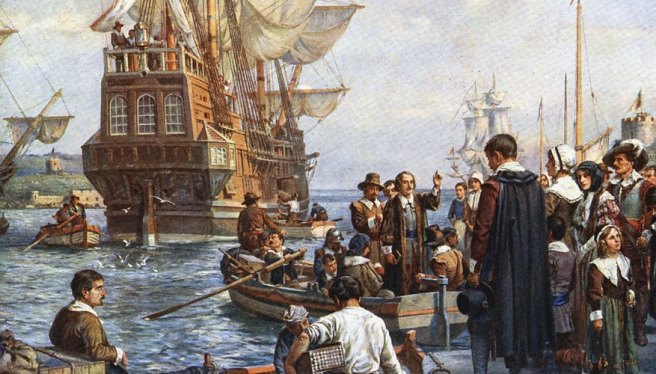
They set forth in droves.

Crucially, sensing that their mission could be corrupted by false teachings and practices, they squelch unorthodoxy and dissent early on. Within the first decade of their arrival along Massachusetts Bay, they banish Samuel Gorton, Roger Williams, and Anne Hutchinson, who find refuge in Williams’ new colony of Rhode Island. Early Quaker history turns its focus there and neighboring Cape Cod, for good reason, though much also happens north of Boston in Salem, Hampton, and Dover.

Hutchinson’s brother-in-law, the Reverend John Wheelwright, also takes flight and founds the town of Exeter, on the other end of Great Bay from Dover, in New Hampshire.

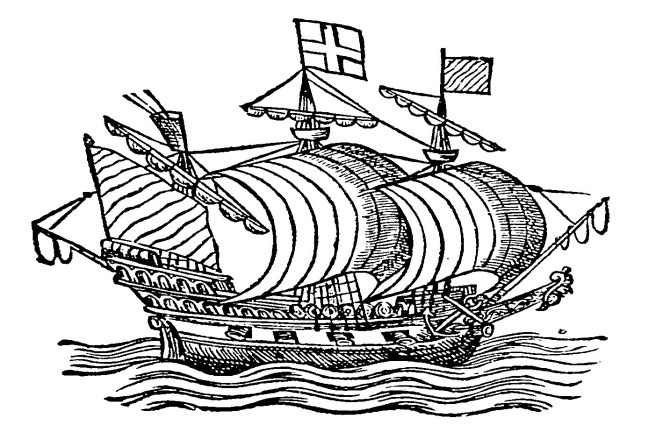
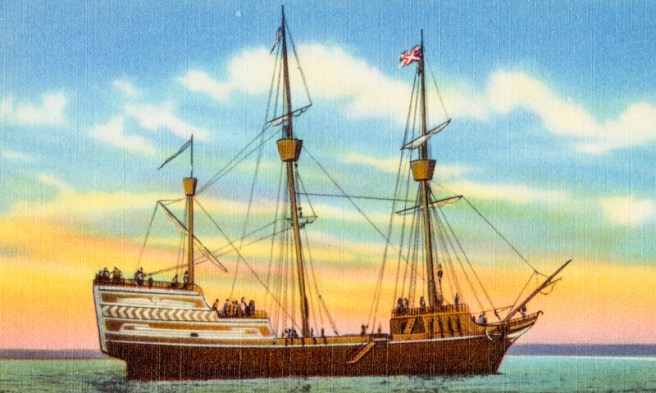
The Arabella, one of the Puritan fleet. Imagine spending two months confined to a vessel like this in often turbulent waters.

Others head more or less straight to Dover. Among them is Hansard Knollys, a minister whose evolving theology will lead him to being a founder of the Baptist denomination when he returns to England. He’s not quite there yet when he formally organizes the church in Dover as a congregational society just six years after its first services. Had he been a bit clearer in his theological evolution, Dover could have established the first Baptist church in America, a year before Williams in Providence. Oh, well.

But that does leave an opening for the Quakers a decade later.

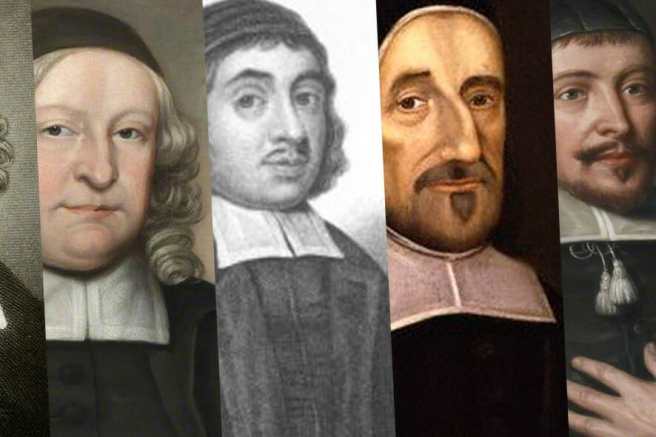
Yes, Puritans. They do look like a smug, judgmental lot. Of course, that’s a judgmental view on my part. I’d hate to get in an argument with them. Ahem.

All the more, I sense that Knollys leaves enough nonconformist thought in his wake to lead some independent spirits in Dover to privately question the ongoing Puritan preaching. As my new book will note, there are hints of that in the town records – supposedly subversive thinking that has to await the arrival of the itinerant Quakers for confirmation and action.

As we’ll see, it’s a volatile mix awaiting the spark for explosion.

Merrymaking at Mare Mount

Speaking of juicy.

Sandwiched in between the arrival of Pilgrims at Plymouth and the Puritans at the Massachusetts Bay colony, we have the libertine plantation at Mare Mount, or Merrymount, on Boston’s South Shore. It’s a provocative whiff of how New England life could have turned, had Thomas Morton successfully warded off the rival raiders.

The very name “merry” at the time was often a synonym for sexual trysting. As for Merry-Mount? It couldn’t have been more graphic.

Unlike Plymouth, this settlement was prospering and welcoming misfits.

Think of hippie. Maybe even commune. Dancing naked with Natives around a giant maypole, one that’s flagrantly phallic. Not just pagan but also reflecting some lingering Devonshire traditions taken to an extreme. (Significantly, for comparison, most of early Dover’s settlers came from Devon, not the East Anglia of Puritan culture.)

Thomas Morton, founder of Merrymount and a thorn in the Puritans’ side

That’s the short version, though there’s much more sketched out in my upcoming book.

And after Merrymount comes crashing down, its founder finds shelter in Sir Ferdinando Gorge’s Maine, not far from Dover.

No, early New England wasn’t all stern Puritans, not by a long shot, no matter how much they tried to keep a lid on.

Nearly two decades later, facing the Quaker outbreak, did Puritan authorities fear the Friends movement might trigger another Merrymount in their midst? As I’ll show, Quakers were anything but quaint and respectable when they show up, though I can assure you they stayed sober rather than make merry. Ahem.

But they were still an alternative to the Puritan rigidity.


Brother William takes a roundabout route

When Edward Hilton settles on Dover Point, his brother William is dwelling in the Plymouth Bay colony. It’s one more suggestion, in fact, that Edward knew about the Piscataqua watershed before setting forth himself.

William arrives on the second ship to the Pilgrim plantation, followed by his wife and family on the next. They definitely aren’t Pilgrims (the term wasn’t even in use then – Separatists was more accurate). And, for that matter, despite sharing a basic Calvinist theology, the Separatists hold some sharp differences from the Puritans who show up later.

Critically, roughly half of the settlers at new Plymouth aren’t members of the Separatist faith. And that includes the only ordained minister in the colony.

Thus, when William and his wife arrange for a secret Anglican (that is, Episcopal) baptism for their infant, a scandal erupts that sends them scurrying northward and brings to light the sordid background of the now disgraced minister who is promptly banished. (No spoiler here – but you’ll still have to read the book.) These events do present a grittier alternative to the Thanksgiving scenario we usually trot out about the Pilgrim experience.

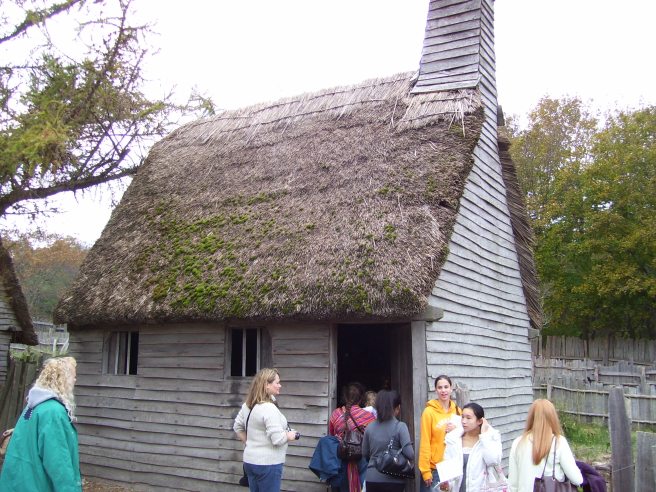
I wonder how much early Dover resembled the 1630 village at the Pilmoth Plantation living history museum. These houses were dark and drafty, at best. Photo by Swampyank via Wikimedia Commons.

William winds up in New Hampshire, settling at the Pannaway plantation at the mouth of the Piscataqua River, where he’s soon making salt to be used for preserving fish for shipment.

And then, in the demise of Pannaway, he’s finally at Dover Point.

This isn’t the way his arrival in Dover is commonly painted. Quite simply, he isn’t one of the first two settlers. Thomas Roberts, Edward’s apprentice, earns that honor.

Still, like his brother, William is both a member of the powerful fishmonger guild in London and literate. And things get a bit rowdy when he moves on from Dover to live on the Maine side of the river.

Yeah, if you’re looking for gossip, there’s some juicy stuff on his part, especially when we meet his last wife. She’s definitely not holier-than-thou.

No, the settlers don’t own the land – they can merely hold it and pay rents

It’s hard for modern Americans to understand a basic reality of European colonies in the New World.

None of the players in the story own the land they’re dealing with.

Not the settlers, even though they’re clearing it and building on it.

Nor the proprietors or investors, either. They’re more like developers who offer leasing opportunities. Think of rental agents.

Nor the Indigenous tribes, surprisingly, even though many of the settlers also negotiate a payment to them for their land. The use of their land, more accurately. Admittedly, the payments are largely symbolic – a bushel of corn a year, for example.

No, quite simply, all land “belongs” to the king, and he allocates the privilege of using it as a means of leveraging his own prestige and power.

Under the feudal system, that would mean grants to barons and other lords in return for their fealty.

They, in turn, could dole some out to knights, who then become wealthy, as well.

Add to that the gentlemen farmers, living off the rents to their estates.

And then yeomen, who are still free on their own tenants, as their small holdings were called.

And husbandmen.

And, somewhere below that, the serfs who are bound to the land and its holder. Well, by this point in time, they’d been freed but were still at the bottom of the ladder.

King James I

~*~

THIS IS THE MODEL OF LANDHOLDING – not landownership – up through the American Revolution.

Its assumptions are quite different from those of modern Americans. What do you mean? I don’t own the ground under my house and barn?

No, you don’t. And you still have to pay rent on it.

~*~

AS A FURTHER COMPLICATION, charters could be revoked or rewritten.

Falling out of the king’s favor would have costly and dire consequences.

As my upcoming book describes, this land arrangement affected Dover and the rest of New England through a series of realignments and controversies and attempted evictions.

In fact, it almost leads to a rebellion in Boston Harbor against the king a century-and-a-half before Paul Revere’s midnight ride. Well, that’s one aside I don’t develop. There’s too much else going on along the Piscataqua.


The Piscataqua’s first European settlers set up at two sites

From the git-go, there’s been a rivalry between Portsmouth and Dover, though a closer look reveals it’s more nuanced than what we usually think.

The 1622 contract for developing the Piscataqua watershed allows for more than one vessel to arrive and more than one settlement to be planted along the river.

Scotsman David Thomson is the head of the operation. He sets forth in the Jonathan and establishes his fortified Pannaway plantation at the mouth of the river in today’s Rye – not Portsmouth, contrary to the Port City’s claims of founding. He’s highly placed politically, somehow having the ear of King James I. And specifically, he’s the only one named in the grant.

Pannaway faces the open Atlantic, with salt marsh to its back.

As the scene stands today. The landscape has changed but not the waterways.

~*~

IN CONTRAST, when the Providence arrives a month later, she apparently sails straight up the river to today’s Hilton Point aka Dover Point, where Edward Hilton and Thomas Roberts then set up operations. They disembark at Pomeroy Cove, which they name for Leonard Pomeroy, one of the three principal backers of the project. He’s also Lord Mayor of Plymouth, England, home of the company, and co-owner of the ship that’s brought them this far.

As I detail in my upcoming book, Hilton likely knew of the site even before setting sail. It was far enough inland to be sheltered from violent storms. Vast forests extended from the riverbanks, with timber for shipbuilding, piers, and barrels as well as homes and bridges and wild game for the taking. Best of all, the point was a confluence of rich tidal waters, with the Great Bay estuary on one side along with its tributary streams and, on the other side, the Piscataqua and its Cochecho and Salmon Falls rivers. Cod, salmon, sturgeon, eels, herring, oysters, clams, and lobsters are bountiful. Why go out to sea when the fish come right up to you?

While Pannaway is thoroughly documented, in part through its stream of visitors, its existence is short-lived, and the site’s abandoned by 1626, when Thomson relocates to an island in Boston Harbor and disappears soon after. His widow then promptly marries Samuel Maverick – yes, the source of that word. It’s a rough-and-tumble world.

~*~

OUT OF THE SPOTLIGHT of documentation, Hilton and Roberts continue on, in time joined by Edward’s brother William and their sister or possibly cousin Rebecca along with more family.

Either way, Roberts and Rebecca soon marry and start a farm about a mile from the point – they later move it another mile-and-half – but theirs will still be the oldest family-owned farm in the future United States well into the 20th century.

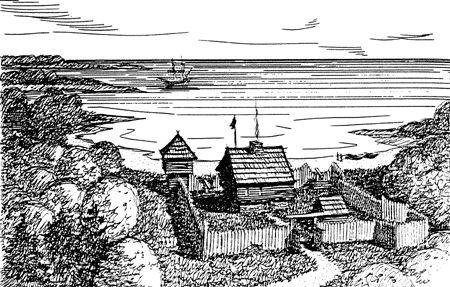
The Hilton Point settlement as it’s commonly been envisioned.

It must have been lonely through much of that first decade. The Hilton-Roberts clan was definitely on the frontier, and ongoing war in Europe cut off much ship traffic.

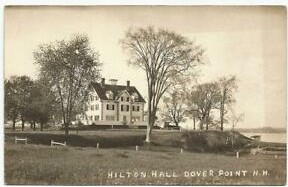
How much, if anything, did Hilton Hall originate in the early settlement at Dover Point? If the house was anywhere near this size, my perspective changes completely.

Edward Hilton is, however, definitively rewarded for his six years of habitation and hard labor by a charter giving him clear control at Dover Point. And they must be prospering, as seen in assessments placed on their province or his brief return to England for the legal document, perhaps a fish delivery, and definitely a marriage.

While Thomas and Rebecca Roberts remain in Dover for the rest of their lives, her brothers eventually move on – Edward to Exeter and William, by degrees along the Maine side of the Piscataqua. All of their lives take colorful turns along the way, which I relate in the book.

Even though Portsmouth baldly claims 1623 as its founding date, it had no European settlement until the Laconia Company chose to set up operations there in 1629 or 1630, calling their site Strawbery Banke. Yes, that was one more convolution of investors.

~*~

AND THAT’S THE BARE-BONES VERSION. There’s plenty in my upcoming book to flesh it out, some of it rather earthy – especially when we get to the contemporaneous and scandalous Merrymount plantation down on Plymouth Bay.

Fact: New Hampshire is the second-oldest state to be settled in New England. Older than Connecticut, Rhode Island, Maine, or Vermont.