Sometimes a Dover connection wasn’t quite what I expected

One of the things about the history of my far end of Maine is seeing how much of it springs from Dover, New Hampshire.

Neighboring Pembroke, for instance, was founded by Hatevil Nutter Leighton, a descendant of both a Dover Quaker family and one of the faith’s fiercest oppressors.

Daniel Hill, the first permanent resident of Calais (1779), came there from Jonesboro, though he had been a pioneer settler of Machias in 1763, along with a J. Hill – his half-brother Japhet.

Knowing that the Hills were a prominent extended family in the Dover Quaker Meeting, I became curious and found confirmation in the fact that Daniel is thought to have been born in Kittery, Maine – on the other side of the Piscataqua River from Dover – around 1734. Close enough. Dover Friends had a neighborhood Meeting on the Eliot/Kittery town line.

But in his case, forget any Quaker influence. That was at least two generations earlier in his line, which did gravitate in and around Dover.

Daniel fought in the French & Indian War and again in the American Revolution. He was rumored to be a skilled Indian fighter. There’s even a controversy over whether he was a Rebel or a Loyalist, considering that he apparently lived for a time on the Canadian side of the border. His father, though, died in Nova Scotia in 1782, befitting a Loyalist position.

Loyalists? You’ll hear more about them later here. Please stay tuned.

Remembering my barn

A barn is a reminder of work once at hand. Some of it is ongoing, while in other instances it was and then put aside, perhaps for another time. Cows – even imaginary – won’t wait long. Everything needs repair or weeding. Feasting is countered by fasting. Again, the season turns. All together.

The barn was my own. A carriage house, actually – in a small city, the oldest settlement in New Hampshire and seventh-oldest in the nation. How I got there is a long story, told in part here at the blog and in part in the novels.

The barn was a central part of my domestic labors, with dreams of a loft studio, once more pressing house repairs were in place. At least its back half was no longer sinking toward collapse on rotted sills. In our possession, the structure did hold a mother-in-law apartment. The remainder provided storage.

A writer collects many materials – fodder for winter. More important, eighteen years after a divorce, I had remarried, this time with children. Once again, I was with gardens and this time, trails of toys, clothing, and chipped dishes. We did have woodstove heat in the kitchen ell.

Not that anyplace with children is truly idyllic. It was always a near-catastrophe, of the best sort.

Acid test poet: Greenleaf Whittier (1807-1892)

Whittier is a poet I’ve come to know largely through Dover, where his maternal grandparents and an uncle and cousins on his father’s side lived. His parents in fact, married in our Quaker meetinghouse.

His poems aren’t about himself but rather a greater faithfulness. While he’s self-effacing, many of his works are deeply felt political and social protests that remain biting and land on-target.

Despite the seeming simplicity of his rhyming form, his lines are sharp. When you read his poems, don’t stop at the end of the line but keep moving onward as a full-sentence thought. There you can breathe. Robert Frost follows in Whittier’s footsteps.

His poem, “How the Women Went from Dover,” commemorates an important event that appears in my Quaking Dover as well.

The old Regulator

Yes, time marches ahead. I can’t count the number of times I rewound and reset this before Quaker worship in Dover each Sunday, or First-Day, in the old parlance. Some Friends said the ticking kept reminding them, “Slow down, slow down.” Others found the sound disturbing.

It’s hard for me to believe my book Quaking Dover has been published more than a year now.


Oh, there could be so much more

If you’ve wondered about the many unanswered questions in my book Quaking Dover, let me say I’m hoping they become a prompt for other history fans to follow up on.

Frankly, if I hadn’t given myself the deadline of Dover’s 400th anniversary, I’d still be in the research stage rather than having a published book in hand.

I would especially be interested in pursuing what happened to Friends who were disowned by Meeting, especially over matters of marriage. How many joined other congregations – and which ones? How many drifted away from religion altogether? How many Quaker values did they continue, as well as which ones did they reject?

There are also the things from our own time that we might answer, if asked, but that will fall through the cracks. Ours are truly fast-moving times, and I’ve often been startled when presenting my own poetry and fiction to find points I have to explain to younger ears in the room. Transistors, the forerunner to computer chips, was a prime example.

So here we are once again, looking ahead and looking back in our own lives.

As for Dover, as the big 400th anniversary wraps up?

Happy New Year, all!

In all of the holiday festivities

In the colonial era, neither the Congregationalists/Puritans at First Parish nor the Quakers/Friends observed Christmas.

So much for singing festive carols or decorating a tree.

The Friends didn’t sing at all, actually, unless it was somehow spontaneous.

At First Parish, meanwhile, a bass viol was introduced in the 1700s to accompany the hymns.

That gave way in 1829 to an organ built by Bostonian William M. Goodrich. In 1878, the instrument was rebuilt and repositioned by Hutchings-Plaisted of Boston, with alterations in subsequent years.

In 1995, a thoroughly revised instrument was unveiled, the work of Biddeford, Maine, Faucher Organ company. A hybrid of the original pipes and of newer electronic and computer elements, it’s a monster machine capable of rattling the house and shaking the bottoms of your feet.

I am glad we simple Quakers don’t have to pay for its routine maintenance, though I am grateful for those who do.

Not bad for holiday festivities, including accompanying a community-wide Messiah sing.

It’s not the only option in town, either. For some, those carols have to wait till the end of Advent, when the Twelve Days begin.

And, for the record, the Greek Orthodox start celebrating Christmas 12 days later.

As for some of Dover’s conventional histories

I’ve previously mentioned newspaper editor George Wadleigh as a fascinating source of Dover historical narrative.

The Rev. Jeremiah Belknap, a renowned historian, proved far less helpful when it came to the Quakers. They seemed largely invisible to him.

I largely ignored the Rev. Alonzo Hall Quint, another Congregational minister, whose historical notes had been read by Wadleigh, probably when they were originally serialized in the Dover Enquirer from 1850 on. One of my reasons was practical: the scanned ebook edition of the book is nearly unreadable. Besides, even in retirement, I have only so much time. One point worthy of revisiting in the original would be the use of “inner light” in 1855 – if accurate, that would be the first reference to the Quaker doctrine anywhere. Previously, it was Inward Light, with a much different focus. I’m assuming this was a “correction” by John Scales in editing the full book edition published in 1900. Scales himself authored an independent colonial history published in 1923.

One source for later research would be the journals of the Rev. Enoch Place, a pioneer of the Free Will Baptist movement. He visited Friends Meetings in his travels from Strafford, which would offer a fresh perspective, as well as presiding at thousands of burials, baptisms, and weddings from 1810 to 1865. His might balance the histories of the period that revolve around Dover’s downtown mills.

For the history student, I see some doctoral dissertation possibilities

There’s so much more I’d like to know about details related to my Quaking Dover story, but I’m not a professional historian.

Some of these could be fodder for a Ph.D. dissertation.

  • An examination of Dover Friends book of minutes dealing with young men who enlisted in the Revolutionary War would be one.
  • Or of where individuals went in their religious affiliations after leaving Friends.
  • Even Richard Waldron’s full biography.
  • A list of the clerks of the Meeting and another of the recorded ministers and elders would be helpful.
  • Or an examination of the actual functioning of the provincial charters, especially the so-called “proprietary colonies.”
  • And, oh yes, a genealogical index of New England Quakers like William Wade Hinshaw’s encyclopedic indexes of New York, Pennsylvania, Virginia, the Carolinas, and Ohio.
  • I would even like to see an understandable examination of English settlement in Maine in its colonial years. Where, for instance, did the settlers go after watching from sea as smoke and flames rose from what had been their homes and villages in a fateful five-week period of 1676, eradicating all English from east of Casco Bay?

Sometimes a little curiosity falls into place

You know, you drive past a thousand times and finally decide to explore a side street.

That’s what happened in Dover when I had a half-hour to spare before my presentation at the public library.

Upper Factory Road off Tollend was the excursion in question, and I was curious to see if I could actually get a glimpse of Kimball Falls in the Cochecho River through somebody’s back yard.

Yeah, suburban-style sprawl.

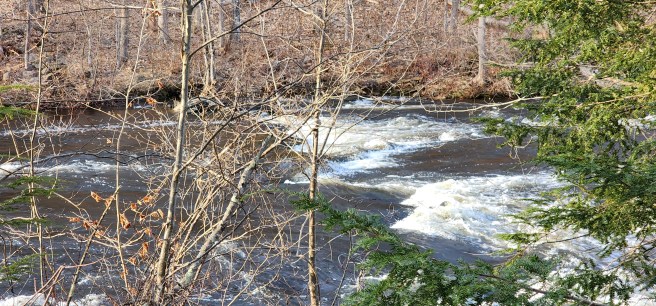
What first appeared was this falls, or rapids, at the foot of the trail. It’s the fourth of six falls as the river runs through Dover, though some of them are more accurately rapids. (I’m guessing there’s a nuance of meaning I hadn’t gotten previously – a waterfall seems to be a more clearly defined kind of “falls,” in contrast to fast-running streams like Jones Falls and Gunpowder Falls in Maryland as well as the Salmon Falls River abutting Dover.)

This one would have been the site of the Dover Cotton Factory, which bought the land before 1820, erected a dam, mills, and housing, and sold it in 1830, when the operation moved downstream to the first falls, now the heart of downtown.

Whittier Falls, which are discussed in my book Quaking Dover, were the second set going upstream.

To my surprise, Upper Factory Road actually leads to a small trail down to the water, along with a twist along the riverbank to a definite waterfall. Alas, that part was too wet to use at the time, but it is on my list for a future trip.

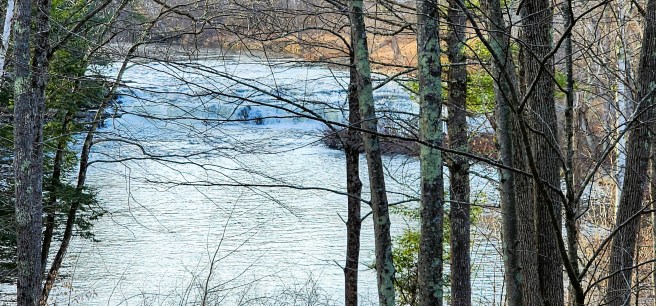
Upstream I could see an actual waterfall, where water pours vertically from a lip into a pool
The water level was up, thanks to recent rain and melting.

Checking the aerial map when I got home, I realized I had frequently passed the falls on the community trail on the other side of the river, but the path had veered too far inland for a direct view. But you can definitely hear them, as I recall.

It’s rather surprising how much you can find in what’s essentially your own back yard when you look. Or, perhaps more accurately, know what you’re looking for. I lived in Dover 21 years and found this 2½ years after I left.

By the way, there’s no Lower Factory Road.

What is it that makes a waterfall so appealing?