THE PERSONAL STAMP

Until landing here, I’d never given much thought to selecting a garden plot. Flat, well-drained sunny soil was a given. Crops could be put out in easily marked rows. The Midwestern loam or Pacific Northwest’s volcanic ash-enriched ground demanded little, other than perhaps a bit of fertilizer boost. What came with our house and its small barn, however, were another matter – one abetted by a decade of deferred maintenance. On the driveway side, hedges had grown to overhang what’s now a kitchen garden and the ground was overrun by invasive ivy. Behind the house, one lilac bush stood nearly three-stories tall. Large limbs rubbed against the barn and blocked the pathway. Three garage-size brush piles soon emerged in the swamp, awaiting a fire department burn permit. It becomes a long history. What I was quickly introduced to is what my wife calls “dead dirt,” almost as hard as asphalt (plucking the stealth maples often required pliers), and then squirrels, especially as they dug up daffodil bulbs they had no intention of eating.

The process of restoring soil is another labor, one that becomes evident years later when the stealth maples slip from the earth, offering no resistance, a result of mulching, pruning, appropriate groundcover taking hold, and composting. In short, the improvement reflects a larger repetition of annual cycles of practice.

Moreover, I’d not appreciated the extent to which actions by earlier residents now shaped what we would build on. For starters, the siting of the house, barn, and driveway likely took advantage of drainage. Later, the construction of a gravel patio in shade on the western side of the barn – screened by a row of lilacs – has become so integral I cannot envision another use for the space, which we call the Smoking Garden, with the panels beside it that we filled with ferns, which have proved more difficult to establish than one might imagine. With two “springs” at the top of the swamp (we argue whether the pipes that feed them come from neighbors’ sump pumps or some other source), the seasonal flow of water becomes even more problematic. Combined with variations in sunlight levels and the soil itself – part of the yard remain quite hard, including asphalt fill – to see what grows well, and where, is eye-opening. For instance, our first season, we planted six pussy willow sprigs. One quickly croaked, followed by another. A third has barely grown over the next decade. Two others have shown moderate growth. The sixth, by the more active “spring,” however, has flourished and been the source of a handful of others planted close by.  The asparagus bed, meanwhile, was built atop an earlier raised bed at the top of the yard. And so on.

What has evolved is something that reflects our own style – more natural than formal, low-maintenance or at least relatively low-cost, and often eclectic. Our little city farm hardly provides enough to sustain us, but it does offer a taste of the changing seasons in all of the amazement that truly fresh produce delivers, as well as celebrating the unfolding of the year itself. This is far from the mossy Zen gardens I thought I would have desired, places I now perceive as expensive to build and maintain, or even from orderly, rectangular beds of rational efficiency. I love sitting beside the berm, in the far corner along the street, sipping coffee or wine – or, especially, in the Smoking Garden as late afternoon slips into night, with our torches blazing and clear lights strung overhead twinkling.

I love, too, gazing at the gardens when they’re buried in three feet of snow, appearing so pure and mysterious. They are both all potential and memory of the previous year – the hummingbirds and finches, butterflies and lady bugs.

WIND BLADE

100_8492

Several months ago, while driving on Interstate 95 to Boston, a remarkable view caught my eye. Headed in the opposite direction was a very long trailer, one at least three times longer than the usual tractor-trailer rigs. A few miles down the road, I glimpsed another. And then a third.

They were blades for wind-powered electrical generators being erected atop several ridges in Maine. Perhaps you’ve read some of the controversies erupting over proposals to build these “wind farms” in suitable locations across the country. But this was the first time I got an inkling to the size of each tower.

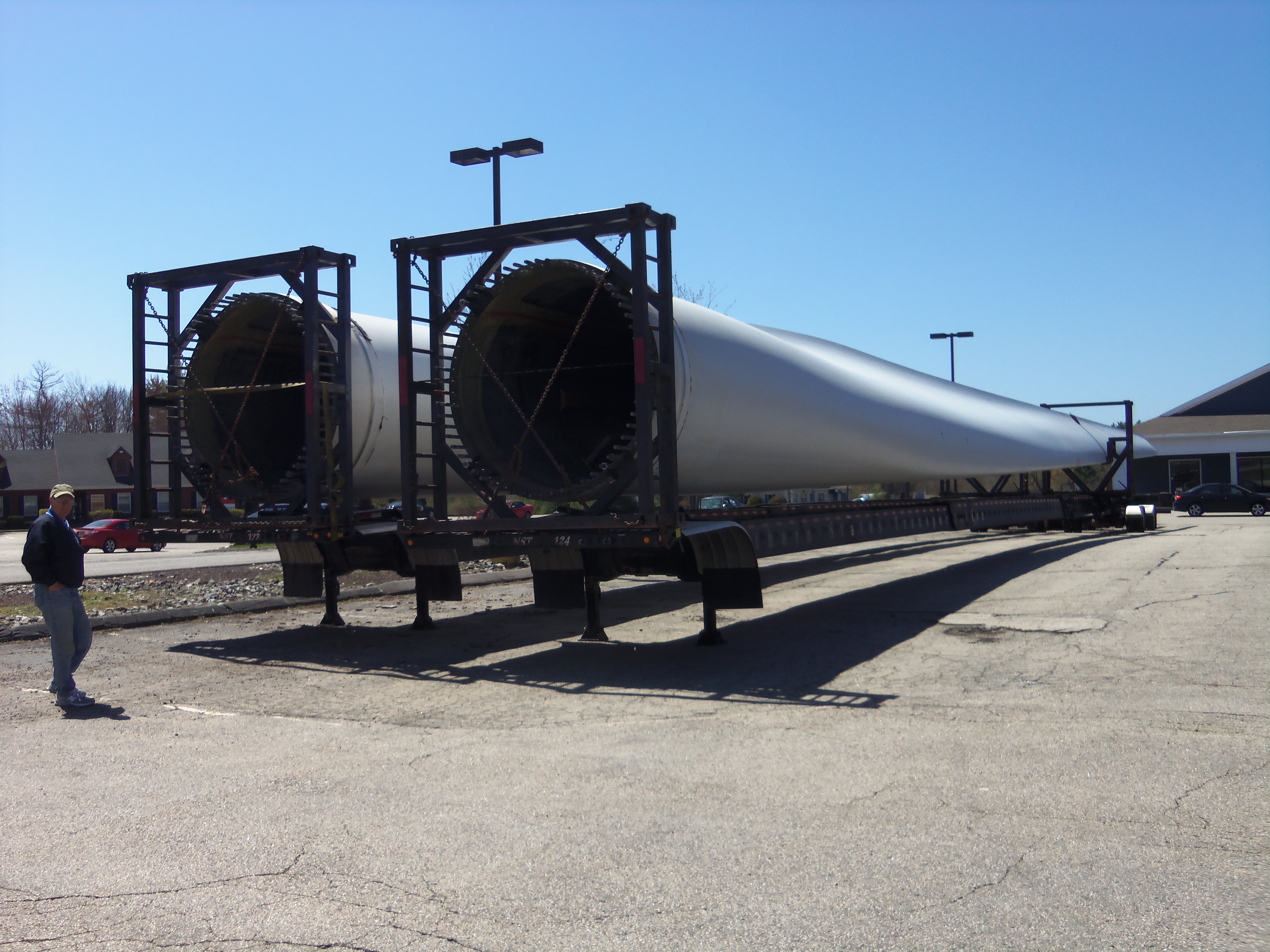
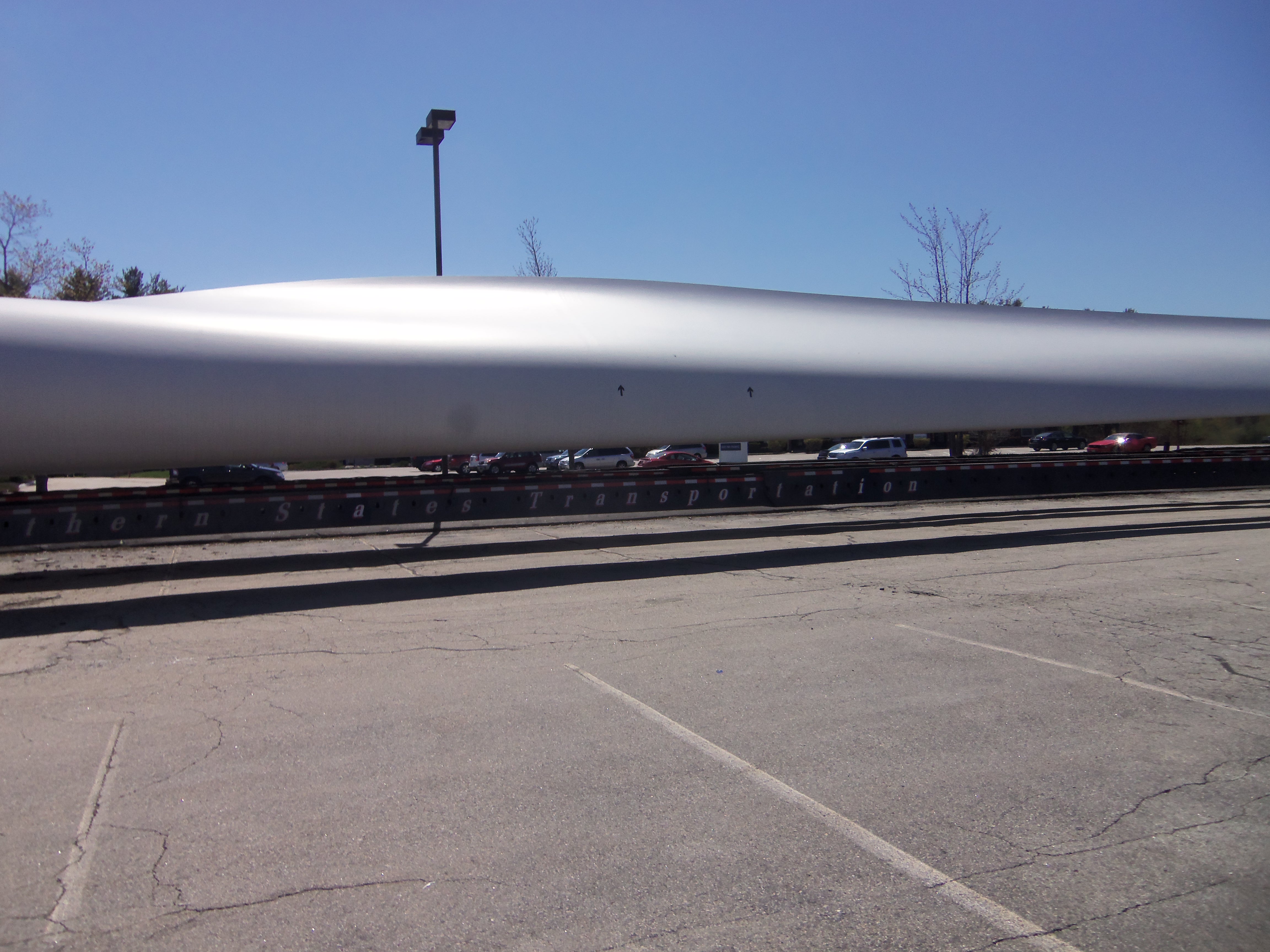
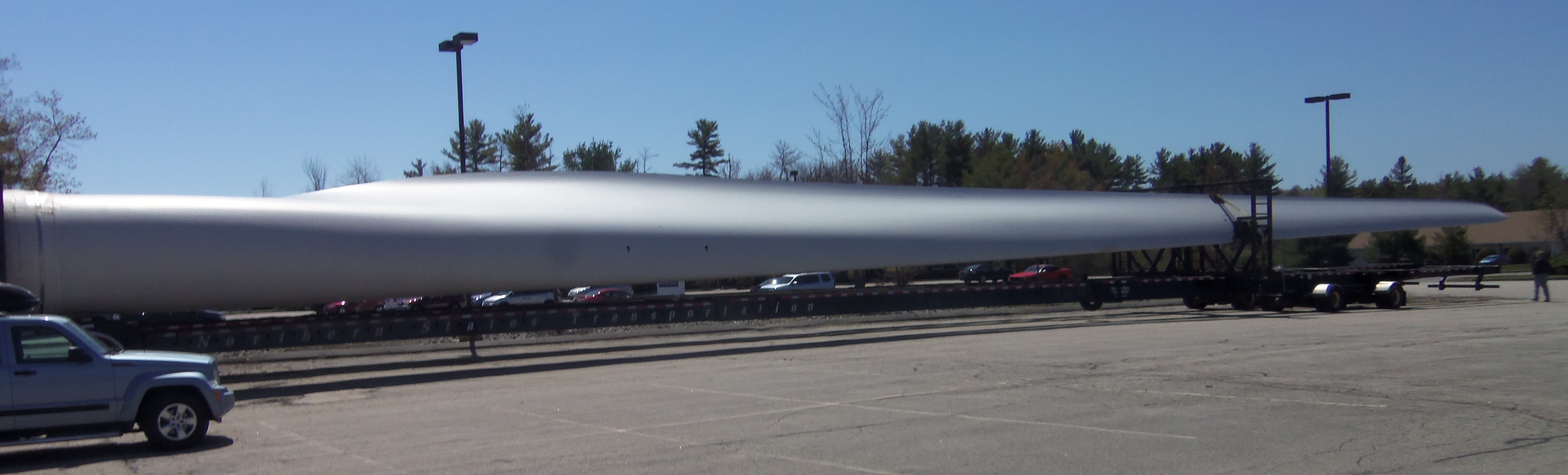
Earlier this month I came across two similar propellers, this time settled in a parking lot, no doubt waiting for a few more to join in a caravan. Even before being erected on a summit, they’re an amazing sight. Somehow, the gleaming sun on the metal reminds me of watching whales lolling in the ocean. Whales, you may recall, were the source of the oil used to illumine many homes in early America. They were another source of energy from New England.

100_8486

100_8490

MYSTERY SOLVED?

While Dover Friends (Quakers) proclaim that we worship in our third meetinghouse, erected in 1768, our history of the previous two structures becomes a bit foggy. Even so, ours is the oldest house of worship in use in the city.

In his authoritative New England Quaker Meetinghouses (Friends United Press, 2001), Silas Weeks mentions that our first house of worship was built about 1680 on Dover Neck, just south of the present St. Thomas Aquinas High School. Correcting an earlier version of the relocation of the structure to Maine, he writes that in 1769 “the 1680 house from Dover Neck was taken apart and re-erected in Eliot at the corner of what are now State and River Roads. There is a bronze plaque marking the site …” (Alas, there goes the tale of its being skidded by oxen across a frozen Piscataqua River. Taken apart and put on a boat now seems more likely.)

Apparently, when our current house was built, we had no need for the smaller structure. I suspect that until our current meetinghouse was available, Dover Friends met for worship in the two smaller structures and gathered together for business sessions.

The disposition of the second house, though, had eluded his investigation. It had stood at what Silas “believed to be the present corner of Locust and Silver Streets,” but there was no indication it had been incorporated in later buildings on the site.

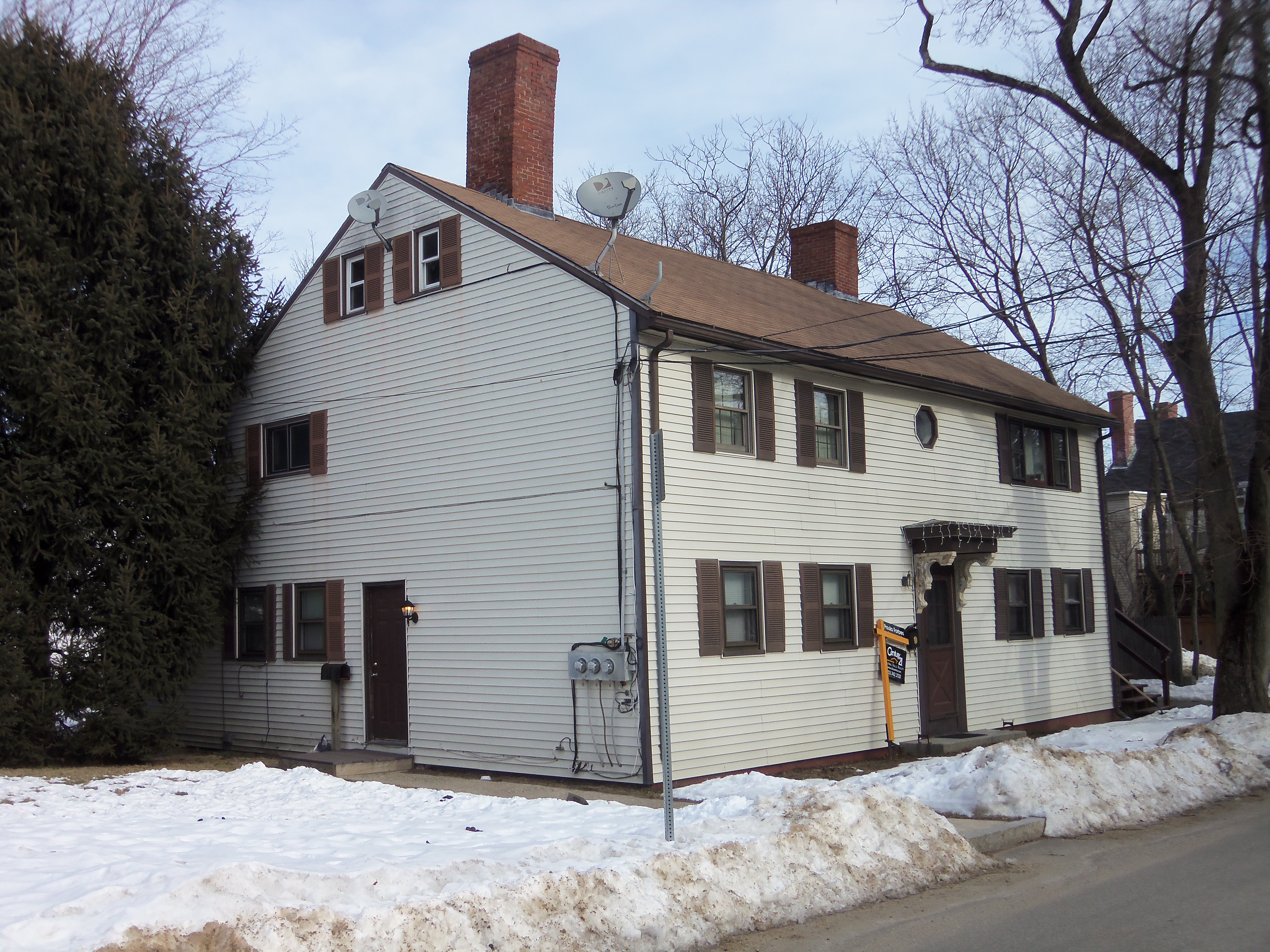
A publication from the Dover Chamber of Commerce, however, may have the answer. Dover’s Heritage Trails, a guide to historic walking tours through the city, notes this at 3-5 Spring Street: “This old dwelling was Dover’s second Quaker Meeting House, built originally at the corner of Silver and Locust Streets and moved to this location in 1728, before Spring Street existed.”

Silas reported “The second was erected in 1712 on land belonging to Ebenezer Varney. The deed, transferred to Friends in 1735, described the site …” in ways that support the Silver and Locust location. My guess is that the structure was moved in 1828, since the Chamber pamphlet mentions that neighboring houses were built in 1810 and 1811.

The building has no doubt changed a lot, inside and out, since it was erected three centuries ago -- including the addition of chimneys. But the shape is right for a Friends meetinghouse.
The building has no doubt changed a lot, inside and out, since it was erected three centuries ago — including the addition of chimneys. But the shape is right for a Friends meetinghouse.

As they say, the plot thickens. And to think, the answer to our search may wind up just a bit more than a block up the street from where we gather.

THE SHRINKING PAGE

l look down on the newspaper page and think how narrow it’s become – about half of the width of the pages I designed at the beginning of my career. The broadsheets of today are about the width of tabloids back when.

It’s all cost-saving measures, of course. Like the shrinking candy bar. Yes, I remember when the joke circulated, “It’s hard to find a nickel candy bar for a quarter these days.” Ditto, for the cola.

So we keep hearing the economists warning about inflation. Not a word, you notice, about the corresponding deflation of the product itself.

WHAT SILENCE? WHERE?

Yes, we’re called a silent meeting. But there’s silence and, well, then there’s silence. As nuns would tell parochial school students at the beginning of chapel, “Quaker meeting has begun, no more talking or chewing gum.” Who knows where that originated, much less why certain people – such as the priest – might be considered exempt. Let me declare, I know of no authentic silence. Nowhere on this planet! (Outer space, maybe? Deafness?) Even when we have no spoken messages arising in our worship, we still have the pulses of breathing, to say nothing of the clock, with its measure annoying some and reassuring others. Waves of restlessness, late arrivals, and traffic and sirens along Central Avenue, too. In summer, birds and crickets. Maybe a bagpiper at the edge of the cemetery. In winter, the furnace kicking on, children murmuring, a cough or sneeze. A coat crackling as it’s taken off or put back on.

There’s even silent noise arising in stray thoughts. Imagined lists of things to do. Recollections of things done in the previous week or decades earlier. News reports echoing through our minds. Sometimes, rain. Or simple wind. Maybe “stilled” is a more accurate description than “silent” or even “unprogrammed.”

Yes, I’ve heard stories of city dwellers who come to the countryside and are soon troubled by its relative quiet. I have to chuckle, realizing how much they miss. I think of a meeting for worship one May morning along Broadway in upper Manhattan, when I heard little else outside the room but birdsong, countered a week later in rural Ohio by loud farm tractors and semi-trailer rigs. Remember, too, a few Mays before that, when the kids came into the meeting room, saying that the boom heard a little earlier was Mount St. Helens exploding. Their classroom faced the west and the volcano eighty miles away, with its inky squall line soon blotting out the noontime sun.

What we have, of course, is a practice of acute listening, capable of detecting far-off explosions as well as the motions of the heart. What we enter is not silence exactly but something I often find more akin to swimming underwater. Something that can be calming, peaceful, refreshing, renewing, good – as in good to eat, too. Filling. “Has thou been fruitful?” as they used to say.

My description of what we have is QUIETIST worship, rather than “silent” or “unprogrammed.” Hushed, still, clearing, typically peaceful, not showy, and unobtrusive being a few of its earmarks. Though this hardly covers the experience, either.

While Quakers traditionally did not hire preachers, they did recognize individuals who had abilities as lay ministers and others with the spiritual gifts of elders (that is, bishops, within the congregation) and still others whose skills might help the members in their everyday struggles. When Meeting gathered for worship, these “weighty Quakes” would sit at the front of the room, in what we know as the “facing benches.” Somehow, their presence still lingers in the room, sweet as it is.

CELLARS VERSUS BASEMENTS AS A DIMENSION OF NEW ENGLAND

Where I grew up, we had basements. They rarely flooded. Some were even finished into spare rooms, with TVs, carpeting, or best of all, a pool table. Here in New England, most of us instead have cellars, where water seeps through the walls after heavy rainfall (some even spurt).

And so, under the house, confusion. Mold. Dampness. Leakage. Not the order of a basement, with dry walls and solid floors, but a cellar. With small garden snakes and a sump pump. Rick, our carpenter, says you find the soul of a house there. Its support. The wiring – we’ve removed many strands of stray threads overhead, each staple a bear of resistance. It wasn’t the same as the secrets we found in the kitchen walls, the 1928 newspapers, during that renovation, but secrets all the same. You sometimes read about bodies being buried in the cellar. Instead, we have trenches along the wall – and maybe some stray tree roots. I need to replace the bottom stair, the one broken from rot. And soon, I would hope, the sump pump itself with something smaller, more powerful, and more reliable.

Yes, an old New England house is always a project. Even one only little more than a century old.

FROZEN FISH

Our antique fish weather vane has long been something of a puzzle. It’s a rather attractive piece of copper, but these things don’t come with instructions, and the parts didn’t quite seem to come together. So it’s sat around in a corner of the barn just waiting for the day it could swim in the air again — or maybe simply on an indoor wall as an ornament. Still, finally getting the roofs over the barn and kitchen re-shingled this fall before the weather turned bad provided a stimulus for action.

The first challenge was trying to figure out how to connect the rod to the roof. As I inquired at one hardware store after another, I kept getting the same response. “I don’t know, it seems like there should be a simple way to do it. But we don’t have anything like that.” A few clerks suggested places that turned out to be dead ends. And as I looked at all the cupolas under many of the vanes around town, I realized that even with a cupola, you’d still have to have some way of attaching the vertical rod.

Finally, after a bit of online surfing, I came across an answer — a store, in fact, we’d passed many times in the coastal town of Wells. Weathervanes of Maine turned out to have a nifty little adjustable roof mount for $30 that fit our needs quite nicely. The store, by the way, has row after row of shiny new weather vanes — roosters, horses, eagles, moose and bear, ships, dragons, pigs (yes, flying pigs), and many more. If you’re ever driving along U.S. 1 there, stop in — it’s quite the destination.

Still, the connection to the fish itself still didn’t seem right. And again, nobody could give me a satisfactory answer. So it was back to Wells, where a fancy soldering job did the trick. Our fish could now face the wind. And, as you can see, more.

Where we live in New England, vanes are useful predictors of weather. While our prevalent wind is from the west, wind from the east or the south comes in over the ocean, where it loads up with moisture we encounter as rain or snow. From the north, of course, means colder than normal — a pleasant touch in summer but a nasty bite this time of year.

I’m quite happy to have the fish provide a modest and useful crowning touch to the barn. Or, as I sometimes announce, “The fish has turned.”