How many types of boats under sail do you recognize?

Living around big waters, as I do now, means hearing a number of new terms to identify boats big and small. When you merely read about them, say in a history book, you can usually skim over the word and move on.

Not so when you’re trying to describe what you just saw.

Today we won’t attempt to get into the array of mostly motorized vessels. Not even a Bayliner versus a Boston Whaler. Naval ships alone would require a long list.

Instead, let’s look at a general overview of boats originally powered by the wind. (Admittedly, today many of them will have an internal engine for additional power.) These can range from small sailboats to majestic tall ships.

  1. Sloop. The most common type of sailing vessel, it has a single mast, usually with one triangular mainsail (in what’s called Bermuda rigging) and, in the front, a triangular headsail, usually a jib. These can range from small, single-person fun boats to larger racing boats manned by trained crews.
  2. Cat. Or catboat. Has a single mast rising from the front of the boat and a large, single sail on a long boom. A second beam of wood, called a gaff, runs along the top of the sail, turning it into a four-sided sheet of hexagonal shape rather than the triangle. They were popular New England workboats around the early 1900s, short (typically ) 20 to 30 feet long and wide, highly stable, and have made a comeback today.
  3. Cutter. A single-masted vessel resembling a sloop, but often having a gaff-rigged mainsail and an extended spar called a long bowsprit extending from the bow, which allows a second headsail (a staysail, or “staysul.”)
  4. Schooner. Two or more masts, with the largest sail (the mainsail) at the aft, plus a foresail (resembling the mainsail) on the mast ahead of it as well as a jib and staysail at the bowsprit. They may also have one or more topsails and a small sail called a mizzen aft of the mainsail. With their complex rigging, they can be fast and undeniably majestic. And, yes, my favorite.
  5. Ketch. Resembles a schooner but has an extra mast behind the mainsail.
  6. Yawl. This term has several different meanings, the first regarding rigs with one or two fully equipped masts plus a mizzen mast aft. It can also refer to a double-ended hull boat that could be worked from the beaches, not that I’m finding any reference to sailing in what would be the equivalent of reverse gear. Some of them, if you’re a bettor, may have been the fastest-sailing open boats ever built. And it even seems to be a kind of dinghy. Just so you get an idea of how loose some of these terms can be.
  7. Brig. This two-masted ship introduces us to square-rigging with sails arrayed on horizontal spars perpendicular to the keel and masts – that is, “squared.” The spars, called yards, present the sails to face the wind from behind. The foremast of a brig is always square-rigged, but some varieties may have a gaff or lateen sail on the mainmast. (Lateen is an ancient arrangement I won’t get into unless you’re going to Egypt.) “Square,” as far as masts go, means more or less perpendicular to the hull, unlike the ones more or less parallel to the hull. Trust me on this.
  8. Barquentine. Its foremast was square-rigged, with gaff-rigged masts behind. But let’s skip ahead.
  9. Barque (or bark). A three- to five-masted square-rigged ship consisting of a foremast, mainmast, and a smaller, often gaff-rigged mizzen mast at the aft for steering stability. Far and away the most numerous of the square-rigged vessels. Enough of the finer points. Let’s turn to the most glorious.
  10. Tall (or full-rigged) ship. Three or more masts, all fully square-rigged, one sail above another, often five or six on a mast, with a hull often much longer than a schooner. The individual sails were smaller than a schooner’s and less likely to rip out in a storm, but the number of them provided more overall sail surface, allowing for maximum speed. The downside was that crews of 30 or more sailors were required for handling those sheets. Still, seeing one of them is exciting. It’s what you really picture first, after all. Now, for all of the subcategories, such as a frigate.
Underfoot counts, too

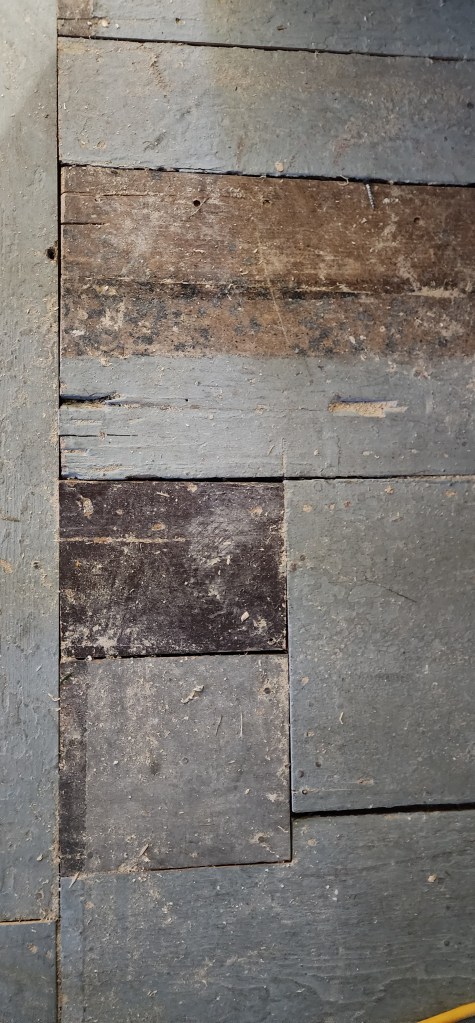
Another consideration I haven’t mentioned was the upstairs flooring.

As much as we would have liked polished hardwood, our budget called for something more affordable.

The existing flooring was more piecemeal, with unevenness and knots. It did speak of the rustic origins of the house and its historic character. Our contractor mentioned some flooring that would match it, and we were onboard. (Sorry for the pun.)

Refinishing those planks might have looked historically charming, though they were never great to begin with. Instead, we salvaged what we could and added fresh to continue.

The next question was how to treat it. Apart from two rooms and a hallway of vinyl flooring downstairs, the existing flooring, upstairs and down, had been painted a light blue that easily flaked. Could it be sanded and refinished in a natural finish? Did we have time to undertake that? Otherwise, what color of paint could we agree on, at least for the bedrooms? The bathroom and laundry room might be a different matter requiring something more waterproof.

I had hoped to decide on a paint color extending across all of the upstairs. Mine was the minority vote.

That left me facing a decision for my room. Please stay tuned.

Surprise at the top of the stairs

People looked skeptical when they heard that we were living in the house during all of the renovation.

It’s not like our budget had enough of an edge for us to lease quarters elsewhere. Were we just more daring or more tolerant than others?

A key to the project turned out to be the translucent plastic “door” created at the top of the stairwell at the beginning of the work, the one with the zipper. It reduced the amount of dust that escaped from the construction and also kept much of our heat down on the first floor.

The sound of that zipper became a fact of life for us. All three zippers we had over the course of the project.

~*~

What awaited us on the other side of that veil went through a progression.

At first it faced a crowded set of shelves set in under the sloping roof, along with sliding doors to two makeshift closets and a narrow hallway running to each side.

After that came the demolition that revealed charred rafters and sheathing.

We briefly had a stretch of open sky followed by the raised roof and then the framing for the bathroom and laundry room.

What caught us by surprise, though, was the blank wall when the sheetrock went up. The stairs didn’t lead straight to another door. What would we put there? A large painting? A bookcase? A settee?

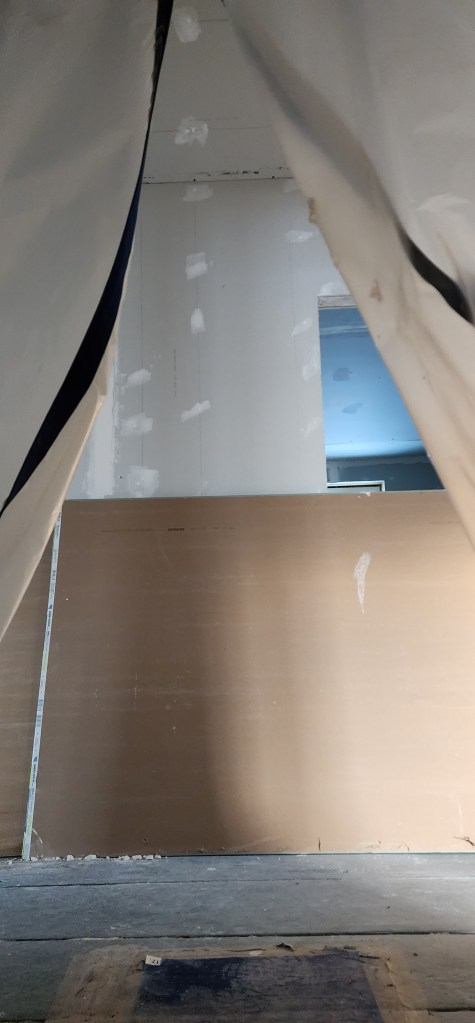
With the zippered curtain pulled back, you can see the wall and a corner of the laundry room door. Drywall panels are stacked upright against them.

One of the coconspirators in our planning insisted on having a wide hallway, or perhaps more accurately, a landing – 6-by-16 feet, it turns out – conjoining the doors for the four bedrooms, the bathroom, and the laundry room. As a practical matter, this would make moving large items much easier, but aesthetically, the space feels wonderful, especially when we decided to keep the ceiling there running all the way to the crown of the house rather than having a low flat one.

No photo would get you a sense of that.

~*~

Somehow, Adam managed to keep the stairwell in place through all of the demolition and rebuilding. It did have that hand-cut oak lathing that predated 1830, for one thing, and the period molding.

For months, it stood like a dark ark at the center of all the action.

Once the new upstairs walls and details were in place, he turned to repairing the stressed stairwell walls and ceiling. One alteration we had envisioned was an interior window for natural light from the bedroom nook. Minor touch, but satisfying. Alas, one that was cut, in part for budget considerations.

We also gained storage space above in a kind of mini-attic accessed from a bedroom. It’s perfect for seasonal decorations that are needed just once a year. Easter, Halloween, Christmas, mostly.

~*~

As I had to confess by this point, the project was much more complicated than I had expected. I could now see why one contractor had just wanted to gut everything from the get-go, while another wanted to rip the top off and replace it with a gambrel roof. But I’m confident neither of those routes would have led to what’s emerged.

I was tempted to call them ‘staterooms’

A full Cape is a classic American design with some good traffic flow downstairs, but it has drawbacks on the second floor, where rooms can feel cramped by low ceilings and be too hot in summer and too cold in winter. Our house was no exception, something we hope we’ve rectified.

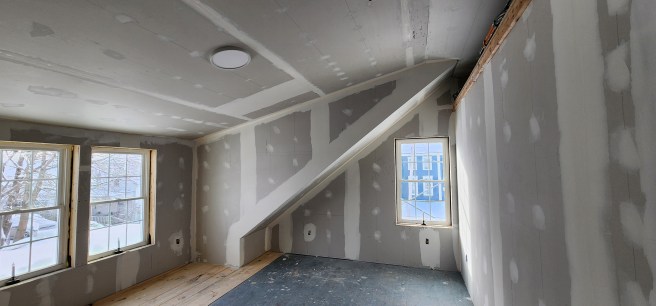
In maxing the ceiling heights by following the new roofline, we gained both headroom and air circulation. That move also adds character to each of the resulting rooms, making them something more than rectangular boxes with holes punched in them for windows and doors. (See the ongoing argument in previous posts.)

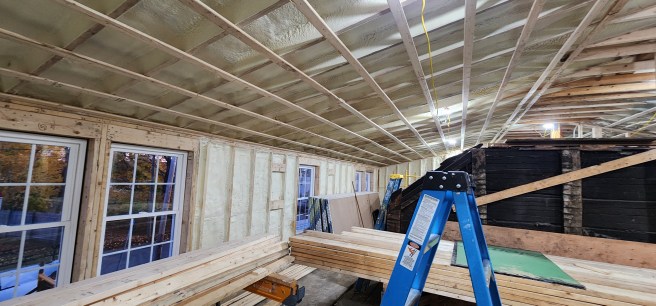
The sprayed insulation also enhances year-‘round comfort by reducing radiant summer sun impact as well as invasive winter cold.

In addition, the setting of the windows in all four bedrooms provides cross-ventilation, as needed, and the casement windows in the two smaller rooms reduces any draft entry. Each bedroom has windows on two walls, not just one.

We’re especially happy with the resulting four bedrooms, what I was tempted to call “staterooms,” as they are on a ship. There, the chambers follow the contours of the hull and deck overhead, and ours do something similar.

The front two also have a commanding view of Friar Roads, the channel between us and Campobello Island, Canada, while another looks out on a street of a distinctly New England fishing village nature. The fourth looks into trees and the village, giving it a sense of being a treehouse. Rather heavenly, as I’m finding.

For now, I’ll turn your attention to the front two, which overlook Eastport’s principal north-south street, not that it has heavy traffic. Remember, our fair city doesn’t even have a stoplight. Not one.

The front two bedrooms have the quirk of a panel that follows the original roofline before the dustpan dormer kicks in. This results in a small cubby space that creates a small storage cabinet in one bedroom but is left free to run to the floor in the second.

The main differences between the two bedrooms springs from working around the existing stairwell. Our historic stairwell, definitely pre-1830, from the hand-cut oak lathing.

If you divide those two rooms apart by drawing a line halfway between the north and south exterior walls, you’d see that the north bedroom would have been smaller than the south room because it had to accommodate the stairwell. What it gained in the renovation, though, was a charming nook between the stairwell and the outside wall. The space between the stairwell and wall had been a mystery, a wasted space where we  thought we might find any buried skeletons in the house. Alas, only dust and spiders.

The nook, as we discovered, had to stretch a bit beyond that halfway line north-south, because the room’s window was centered there (above the front entry door). Our solution was to have that extension be matched by a closet running along the stairwell in the south bedroom.

The nook does make for a nice, slightly secluded study with that stunning view, especially around dawn and sunset.

Let me remind you that all of that distance to the exterior wall was space added during the renovation.

~*~

As we approached the time for priming and painting the upstairs, we had to admit we had more than 3,000 square feet of drywall to cover with primer and paint, even before considering the flooring. More decisions! As well as delays. 

There, I settled on a brilliant white for my walls and ceiling and what Sherwin-Williams called Smoky Blue for the floor.  

~*~

The cathedral ceilings not only enhanced our celebration of the natural light in our house, they also gave us something we didn’t anticipate: loud rain on the now metal roof, something we usually find comforting, so far. Not that everyone would.

But these rooms are also free of any rolling you’d endure on a ship.

Everybody’s mostly happy with the resulting twists. Remember, nothing in life is perfect, no matter how hard we try. 

Back to the press and a personal debt

The first printing press in Britain was established at Westminster in 1476 (during the reign of Edward IV, 1461-1483) by William Caxton. Modern movable type had been invented not that much earlier around 1450 by Johannes Guttenberg.

Caxton is considered a central figure in establishing Chancery English to the standard dialect used throughout England. In his haste to make translations for publication, he imported many French words into English.

Well, England did rule much of France during the century.

As a reader and writer, I’m indebted to both men and a host of those who followed.

Lately, I’ve been returning to the Baskerville typeface, which we used for our high school newspaper, though now its in honor of an earlier resident of our house. The face dates from the 1750s.

One classic I’ve long been fond of is Caslon, from the 1720s, by another English designer. It’s similar to Goudy, a 1915 American design based on historic Italian faces and one I’ve been using on my Thistle Finch publications. It really is elegant.

Sometimes the very appearance of a word in type or a well-designed page will make my heart sing.

Just so you know what happens when ink gets in your blood.

Why you don’t get bids with a binding contract

That’s also a warning if you do find a contractor who will present one on a project like ours.

Experienced tradesmen should know there are too many surprises when you’re dealing with an old house. The only way for them to come out ahead with that factor is by cutting corners or – as often happens – ghosting the client altogether.

Doing the job right, on the other hand, takes the amount of time it demands.

There’s an artistry in working with an existing old house.

~*~

That said, you better be prepared to deal with the expenses that do come up.

On our contractor’s end, when I look at all of the tools and equipment that’s been parked in our house, I’m surprised he’s making any money on this project. Much of his gear is very pricy, and we don’t even see the hidden costs, like insurance.

Dealing a new deck, just for fun

While awaiting the delivery of the windows for the front upstairs – once we had definitely decided on their size and placement – Adam turned to one of our optional side projects, redoing the back deck.

The ramp leading to it was becoming a safety hazard, and the existing deck was tiny and sinking.

The replacement and steps are a huge advance.

The windows arrived, and that put a hold on the bigger plan, for a lower deck on two sides below. It would be one way to keep Eastport’s red ants at bay when we’re dining outdoors, as well as less lawn to mow. Pluses on both counts, right?

Would Adam get back to it before the ground froze? We were facing a time crunch, and the interior was the priority, followed by the cedar shake siding.

~*~

Coincidentally, we found a mason who was able to get to repairing the top of our chimney – it really was in precarious shape – and touching up the exterior of our foundation. We wound up with a layer of supporting cover compound, too.

Our plumber had also installed three outdoor spigots and removed the one we previously had. It was leaking badly anyway and was on the side of the house where it was least useful.

Progress was taking place, just not always of the most noticeable sort.

We did revise the design while underway

Maybe it was a good thing that we didn’t have too much detail in the CAD design we ordered from a local lumberyard. Initially, that was a miscommunication between our contractor and us, plus a looming deadline for a building permit.

The upshot was that as we watched the space open, our vision transformed. We saw new possibilities.

The first big one opted for cathedral ceilings in the four bedrooms. No big problem, said Adam.

Also, we wanted to leave the charred exterior rafters visible in the two back bedrooms. They were evidence of the 1886 downtown fire that started on the waterfront just below our house. They also reflect the original roofline, which we had now raised. And they were dramatic.

Alas, once we realized how labor-intensive (i.e., costly) keeping that touch visible would be, we opted to forgo it.

In another change, the windows in the bathroom and laundry room went from transom-style to narrow vertical.

The ceiling in the upstairs hallway was originally going to be flat, but we liked the feel of having it follow the roofline. Classy.

In the two front bedrooms, the width of the two side roofline panels was halved when we saw how much the original, aligned to the old dormers, really confined the rooms. The purpose of the panels was to keep a sense of the original profile of the house as seen from the street.  What we wound up with does the job.

Note the way the loft over the neighboring closet makes the ceiling look even airier. The slope of the original Cape roof doesn’t run bluntly into that wall.

After that, the windows in the front two bedrooms went from spaced apart to being placed together, centered between the two pairs of windows below.

And there were some big tweaks in closet arrangements between bedrooms. The two smaller bedrooms got larger closets while the two bigger bedrooms got open loft above those.

As I’ve said, none of the bedrooms wound up looking like rectangular boxes with holes for windows punched in.

We did encounter so many unanticipated details. Things like molding, the placement of light switches, even the door latches – you usually open them with your right hand, it turns out. I’d never thought about it. How about you?

~*~

Did we see things an architect wouldn’t? I like to think so.

Watching the rooms take shape was especially exciting

There were moments when we wondered about leaving all of that space open – just one big room. Maybe something like an artsy loft apartment. But then we returned to our projected needs and the plan at hand.

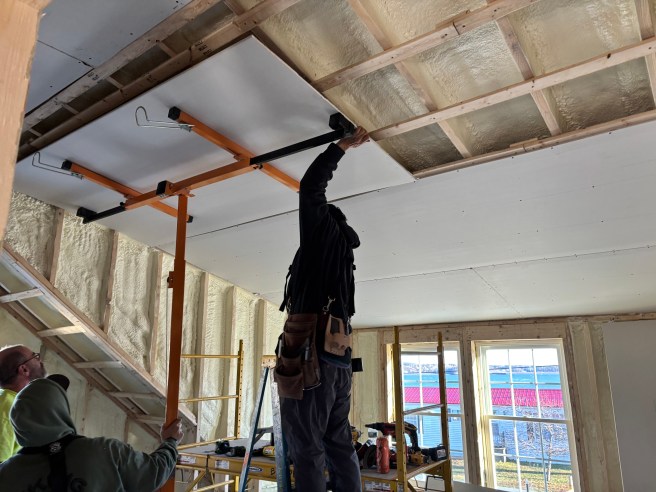
As the framing and wiring and flooring moved along, as well as the drywall itself, our hopes of painting the interior in the weeks between Thanksgiving and Christmas got pushed back till after New Year’s. Still, we were able to sleep some of our visiting family up there in primitive conditions as the drywall taping and mudding dried, thanks to a flurry of action just before Christmas.

The two front bedrooms are nearly twice as large as ones in the back. No surprise there, since the back half also has a small hallway and the bathroom and the laundry room.

Altogether, we have twice as many electrical outlets up there than we do on the first floor. And twice as much natural light.

As for the views? Sometimes breathtaking.

The good news is that the upper level, which prompted all of this work and expense to date, is largely complete.

Yay! Yes, Phase One is in place. The part that demanded we do something, or at least have it done.

~*~

Not surprisingly, this first phase cost about three times what we budgeted and took at least three times as long as we planned. Sadly, it is a rule of thumb in these undertakings. We have arranged refinancing to assure the work will be finished in the months ahead while we have our beloved contractor, rather than trying to reschedule later, but other projects we intended were reconsidered.

Working solo, as many of the carpenters do around here, meant our contractor was moving along at a slower pace. The good news came in the appearance of an enthusiastic apprentice two or three days a week, along with a helper as needed.

Immediately ahead of us was painting the ceiling, walls, and floors and then moving our stuff out of storage and up from downstairs.

In the coming weeks, we’ll be looking at specific areas of the work inside.

At this point, we did take time to review our budget and resources, and consider modifying our direction as needed. Just getting the upstairs under control was a huge relief and accomplishment, one much larger than I had anticipated.

~*~

The most maddening item involved moving the wood-burning stove from one corner of the front parlor (aka living room) to another. It made sense for several reasons, safety for one, but also straightening out the stainless-steel chimney pipe to allow for more room in the kitchen and bedrooms above. Getting a subcontractor back to finish the job was another matter, one not uncommon problem around here, as we’re finding.

That stove is an important factor for us when it comes to the frequent electrical outages in Maine, at least in all but the summer months. And it is a major improvement in heating the house through our cold winters.

Maybe if we had decided on the emergency generator back when?

There are tradeoffs, after all.

As for the placement of electrical light switches or which way the doors opened?

Right-handed or left? Have you ever considered that? You just reach and hope, right?

~*~

We were far from finished, of course. The kitchen remained a priority, along with the adjoining mudroom. And the downstairs windows, with all of their rotting, did need to be replaced. The small downstairs bathroom and tweaks to the other rooms could, if necessary, be put on hold. Not that we’d prefer.

In the bigger picture, we’re hoping the extensive renovation of our old house assures its continuance for another 200 years or more.

A surge of activity after seemingly nothingness

In the renovation, we had periods were seemingly nothing was happening but then, BLAM!, things suddenly moved on all fronts.

This was especially true when we were at the mercy of other tradesmen and their schedules – plumbers, high on the list.

One of those involved the crew that would do the sprayed foam insulation on the front half upstairs. We decided to go with a different company than the one that had done the back, in part because the new one got back to us with a bid promptly, unlike the other. Not only that, they could get to work for us sooner than later.

That did put some pressure on Adam to get the electrical wiring and outlets in the framing before the crew showed up, so it was crunch time there.

But then the electrical panel in the basement blew out.

We were without power going into the weekend. And without heat.

Adam did have an amazing storage battery that we plugged the refrigerator into while he patched the old system.

As he said, the only thing holding the panel together was rust and spider webs.

This came only months after he had rewired the pretty much the whole house, everything but the panel and circuit-breaker box. They were scheduled for later.

And then, the whole town lost power for a few hours, all just before the weekend and the foam-spray guys on Monday.

As a further complication, we had to be out of the house for 24-hours after the foam application. We got a two-night reservation near West Quoddy State Park, in a delightful cabin overlooking Lubec Channel and all the way up to a corner of Eastport. We were so close to home and yet a world away.

The bad news came when we determined the extent of damage done by the power surge. Four of our surge protectors were fried, as was the outlet to our washer (for a while, we thought it was gone), and then a unit in our furnace was also kaput – requiring a night call for service.

It was quite a whirlwind for us.

That sprayed-in foam insulation also covers the wiring. It’s amazing.

We still needed a new electrical panel and, while they were at it, a new circuit-breaker box, too. Adam called in some allies to tackle that, and they got to us quicker than usual. The problem was getting the electric company to come promptly to cut off the power to the house and restore it.

Whew, it did happen, though the utility forgot to include a ladder with the first truck it sent out.

~*~

Perhaps this is the time to explain why we passed on the Generac backup when we moved to town. You might get a charge out of this.

Most of us, at least in the industrialized world, take reliable electrical wiring for granted. An old house, especially if you’re updating it, can remind you otherwise.

I’ve already mentioned the hot topic that Maine is prone to widespread electrical power outages. The state does have some arcane accounting details that likely abate the problem, but I’ll spare you the common rants about our utility companies and their higher-than-average rates.

One upshot is that many houses around here have emergency generators emplaced to kick in at the outbreak of an outage. Sometimes we hear that before we realize our lights and other conveniences are out.

We nearly got one ourselves, despite the high price. The tripping point turned out to be where to put the unit itself, its concrete pad etc., but especially the propane tank – a much bigger one than we thought necessary. The only viable site in our yard was in the heart of our best full sunlight, a spot we deemed more valuable as a future garden bed.

That didn’t rule out a smaller portable Honda generator in the future, though it wouldn’t go into service automatically and requires attention for the duration of an outage.

Better yet, the portable battery Adam lent us looked like the ideal solution for us, especially after we found one on sale.

We’re thinking between that and our wood stove we can ride out the typical outage.

We’ll see.