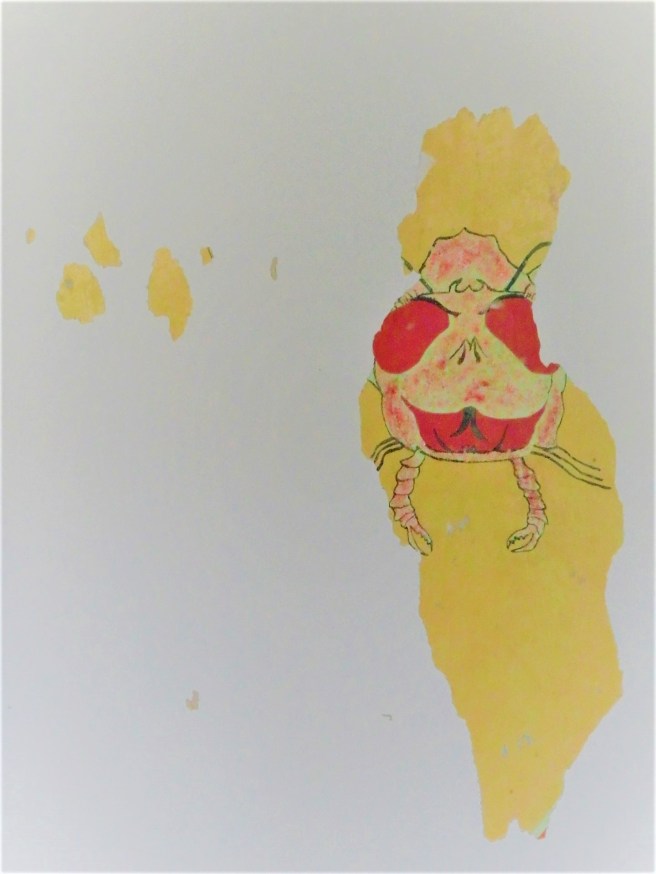
Chief Doe-Wah-Jack’s pride and joy

Comedians Bob and Ray had a regular schtick involving a radio advertisement for Monongahela steel ingots as home décor. You know, “Hey, ladies, are yours getting rusty,” sort of spiel. Usually, it was sitting in the living room.

Having lived in the Rust Belt not far from the Monongahela River, I knew about the massive pig-iron ingots riding flatbed trailers from one part of town to another. Who knows how much they weighed – the trucks carried no more than two at a time – the beasts looked deadly foreboding.

Our equivalent was in the kitchen, though better dressed and somewhat smaller.
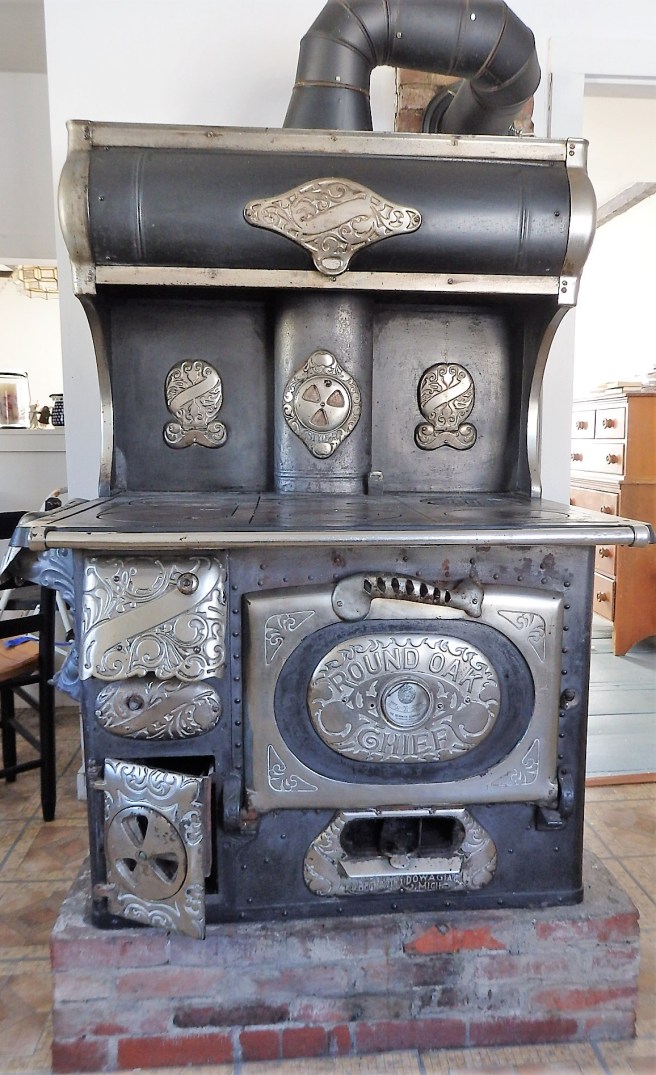
The Classic Round Oak Chief was a top-of-the-line cooking stove that ran on firewood, coal, or kerosene. After 1898, they were manufactured by the “estate of P.D. Beckwith” of Dowagiac, Michigan, and featured a popular mascot, fictional Native American Chief Doe-Wah-Jack – a sly way of teaching the pronunciation of the town. They’re highly collectible in restored condition, but that means getting to a buyer in some other part of the country.

I’ve used wood cooking stoves, back in the ashram, but I wasn’t so sure about this one. I didn’t like the way the stovepipe ran somewhat downhill – smoke rises, after all – or the way it vented into the same chimney the furnace uses, something that’s against building code today.

Besides, the weight of this one was definitely stressing the house structure.

Worse yet, it occupied the center of the small kitchen, and in our life focus, we need more space there – as well as a working oven, year-‘round.

Quite simply, it had to go. And it did.

We’re happy it found a new home – one being built, as it turned out – as well as a crew that knew expertly how to get it apart and out the door.

As for wood heat, which we truly enjoy, we’re planning on a Jotul in the front parlor and a new chimney or pipe to vent it.

Take a sneak peek at my next book’s cover

For several months now, you’ve been getting tastes of my upcoming book, but I have kept much of project under wraps, including the title.

The curtain goes up on that right now.

So roll the drums, please, and take a deep breath of anticipation. Here’s what I’m rolling out:

Do the title and image intrigue you? Pique your curiosity? Hold you for more than a split-second?

As I’ve discussed in previous posts, book covers – and magazines, too – are a specialized design challenge.

The ebook version has to work as a postage stamp, sizewise.

Print editions often get cluttered with pitches of all sorts, just in case one hooks a reader.

An effective title, of course, is a huge consideration, but not the only one.

~*~

Creating a compelling image that matches the content has been especially difficult in this case. The book spans more than 400 years, and I couldn’t find anything that quite reflected the place or its people, now or then, or that extended an appropriate emotional appeal.

A seismograph didn’t do it, though several geometric zig-zag patterns looked cool.

One design that excited me featured a portrait of John Greenleaf Whittier’s mother, but others saw her as forbidding. What I saw calm and collected they viewed as sorrowful and inhibited. Oh, well.

But then, while going through my own photos, I came across a late-autumn photo of the Cochecho River, scene of much of the action. I loved its timeless mystery and beauty and the fact it didn’t look generic to just about anywhere else in the world.

One of my earlier posts pointed out that the cover should promise the reader something rather than mirror the story. It’s a matter of eliciting a gut-level attraction.

Somehow, I hope you feel this cover leads backward into time, with the drama of a storm on the way. Just what is around that bend, anyway?

~*~

Please stay tuned for the release details in the days ahead.

Running on the wind

One sight always catches our breath as we drive Route 9 across what sometimes feels like the fringe of civilization as we’ve known it. And, for the uninitiated, the state highway from Bangor to Calais can become pretty monotonous in its long uninhabited stretches. As they say, make sure you have a full tank of fuel before you tackle it.

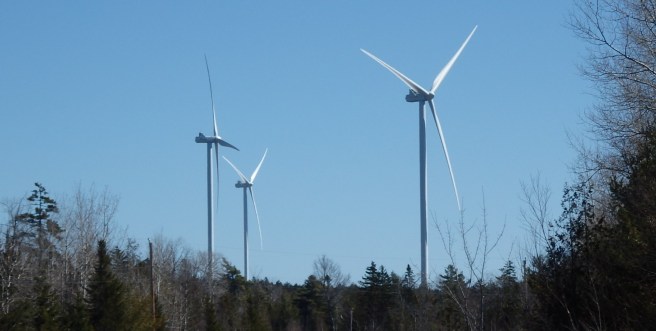
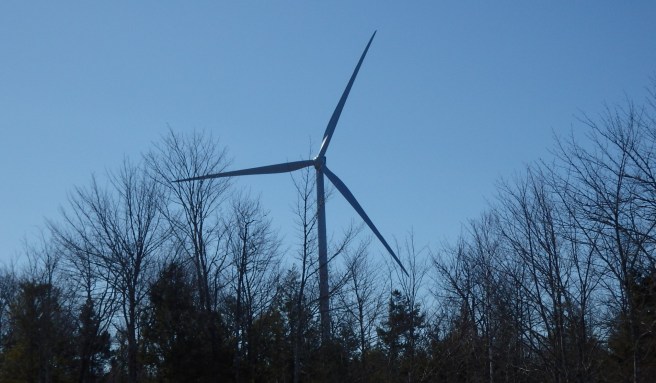
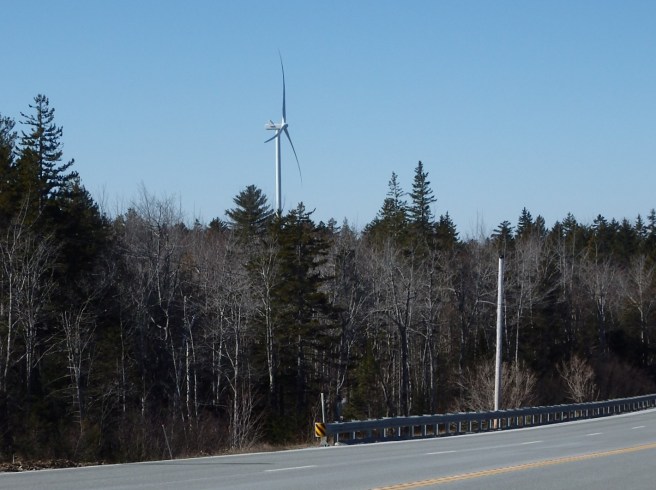
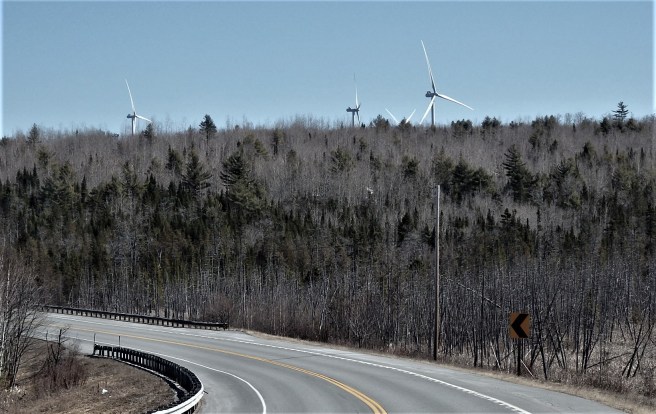
On a clear day, from a dozen miles away you might catch glimpses of a corner of the windfarms on Weaver Ridge and adjoining hills in Hancock County – I’ve counted at least 30 towers before the road dips away – but there are more tucked away in the high terrain. Still, nothing can prepare you for that first flash of the big blades turning gently in the air right in front of your face, or so it seems.

Each blade weighs 1½ tons, even though it appears svelte.

They dance gracefully – sometimes as a solo, then as a pair, or four. You spot them to your left but they suddenly show up on your right – the roadway twists along the slope. As those slip behind you, more giants rise above the hedge of forest. And all too soon, you’ve moved on.

The towers and their blades are bigger than you’d suspect. In fact, at the moment, they’re the tallest wind-powered electrical generators onshore in America, though much larger ones are projected for offshore installation.

The hub stands 382 feet above the ground – that’s more than the length of a football field – and the blade tips reach to 585 feet.

Wind generation accounts for nearly a third of the electrical production in Maine, though the state also imports a fourth of its electricity from Canada, largely Hydro Quebec.

I am baffled by the “not-in-my-backyard” opponents to similar windfarms. They still want energy for their computers and refrigerators and lighting, right?

A tractor-trailer rig could easily be parked in the gearbox or “cabin” attached to the hub.

As if these “spoil the view”? I find them mesmerizing, even enhancing as a kind of sculpture and a reminder of the currents in the air itself. They definitely look better than a toxic oil refinery – and there’s no awful smell. For that matter, they strike me as much more attractive than a television transmitter or cell phone tower as a hilltop crown. And they do remind us of the charming Dutch windmills in a much smaller scale.

The latest installation, 22 Vesta towers and turbines, cost $150 million and went into full operation earlier this year.

Sometimes they seem to play peek-a-boo as you drive.