ABOUT THOSE ROMANTIC MOONLIGHT WALKS ON THE BEACH

If we can believe their proclamations, two things single women in this part of the country typically seek with a partner are romantic candlelight dinners and long strolls on a moonlit beach.

The dinners, we can suppose, are either at elegant restaurants or in his dwelling (where he displays his gourmet cooking skills to her fullest appreciation), either way with suitable wine in sparkling stemware. Let’s just hope he remembers to ask her beforehand if she enjoys his signature dishes. (Mea culpa, on my end.) I don’t think hamburger and fries, by the way, go with her candlelit setting.

From observation, let me add that the restaurants often wind up as intimidating experiences for the would-be couple. When my wife and I go out, we expect to laugh, to banter with the wait staff, to be entertained by the possibilities of food and ambiance. When we were reviewing dining spots, even the disasters turned into fun-filled adventures – OK, if we’d been paying full fare, we would have been justifiably miffed. As columnists, though, we got our revenge.

The nighttime beach, though, is another matter. Having had opportunities to spend time approaching midnight on local beaches, I can tell you few couples are found strolling there, much less romantically. Except for a few nights in prime summer – the days hovering around the century mark, the night’s nippy and windy. The moon, for its part, is in its fullest stages only a few nights each summer, and many of those are cloudy. Without a bright moon, it’s impossibly dark near the water – even spooky, with or without sea fog rolling in.

You can come to love the ocean that way, but it’s a stark environment.

For romance, though, I think you need a driftwood fire. Plus the right wine and a corkscrew.

Wine? It’s the one thing both events seem to have in common.

REVISITING THE PERSONALS

Finding yourself single after the dissolution of a marriage or the death of a spouse is bewildering, at best.

The loneliness and grieving can be nearly unbearable, and emerging from that into some kind of social scene is, well, a lot worse than high school ever was.

Trying to find the right place to meet appropriate potential partners is no less challenging. You hear all kinds of suggestions, from health club to Laundromat, and all of that’s problematic. These days, as a male, I’d look at a yoga studio, just saying …

Another of the complications is the fact – well, it was a quarter-century ago – that the available women were concentrated within the bigger cities, while the corresponding men were an hour or more away, beyond the suburbs.

In the time since then, a number of online dating sites have appeared, and I’ll let others relate their adventures and successes or failures.

But when I was available, the personals ads began to flourish. Out of necessity, I suppose. They even had their own free booklets, like TV listings.

Coincidentally, around the time I remarried, there was a blowup at my newspaper when the publisher went livid over a personals ad where one hopeful had described himself in opposite terms to the usual cliches. (He touted himself as fat, lazy, unemployed, and the like, as I recall.) It was enough to get me and now-elder stepdaughter (and fellow writer) to start reading the Boston Sunday Globe’s more varied ads for insights in the ways people perceived themselves or tried to portray their desires. Usually, they churned out short resumes full of contradictions or things only others could adjudge. “Beautiful” or “handsome” was common, usually preceded by “very,” but that’s something purely for the viewer to decide, thank you.

At any rate, a few entries would stand above the crowd.

One, for instance, described herself as a “Land’s-End kind of gal,” and you really do get a good sense of her in those five words. (We gave her ad a B+ or A-.)

The all-time winner, though, was along these lines: “Happy blue-eyed plumber in search of articulate, well-poised woman to bring (something) into my life. Children a plus.”

He alone could say if he was happy, and “blue-eyed” certainly told the reader about looks. “Plumber,” meanwhile, indicated responsibility and economic status. As for children? Few novelists deliver as much with such economy.

The ad, we noticed, ran just once.


THE UNENDING MYSTERY OF MUTUAL ATTRACTION

To my mind, one of the great questions about the human condition is just why an individual is romantically attracted to one person but not another.

We can start with physical attraction, of course, which opens a whole list of possibilities. Since I’ve always been a heterosexual male, I suppose my checklist would start with blonde, redhead, or brunette, although I must confess that on a few women, bald can be incredibly stunning. By the way, I happen to love long hair, which to my good fortune my wife possesses. We can move on to blue-eyed, true green, hazel, or brown eyes. And that’s even before we get to height or shape or … you get the picture.

Of course, things get really complicated after that. How much do we want the other to share our deepest interests, even to the point of being a mirror image of ourselves, and how much do we want them to differ? Where are the crucial points of commonality and mutual life’s mission – and how much deviation can we accept or allow? And just how do our emotional styles work together … or clash? What about our attitudes toward money, time, wealth, possessions? How much risk can we tolerate? And so on and on.

For me, keen intellect is essential. One who reads widely, at that. And then there is the spiritual side as well as strong ethics.

On top of it all, one of my measures, if pressed, would ask if this is someone I’d like to gaze on over the breakfast table. And, I could ask, is hers a voice I would always enjoy hearing. Would she always have fascinating stories and insights?

No matter how much I once tried to refine the list, though, something was always missing. In all my years between the collapse of my first marriage and the beginning of the one that counts, I came across a few women who were top candidates on paper but, when we were together, nothing clicked. So what was the missing magic? In the end, I still haven’t a clue.

I come back to this question of mutual attraction when I consider the Apostle Paul’s counsel, “Better to marry than to burn” (1 Corinthians 7:9), and ask, “What if heterosexual marriage does not quench the burning?” My examination of Scripture long ago led me to conclude that the ideal of Christian marriage is not so much the bearing of children but rather the “suitable helpmeet” and that, in turn, points toward monogamy and a unique kind of balance I see as more than an equality in the relationship. You can see where I’ve landed on that debate.

Of course, that also spurs another question – one that involves keeping the focus and the flame strong. Anyone have any suggestions there? These are, after all, central enigmas of our human condition.

SO MUCH FOR ROMANCE

A reporter assigned to cover a large singles scene mixer returned to the newsroom with a telling image.

Three women had been remarking about an earnest young man who wore a tag proclaiming himself an “Incurable Romantic.”

As they snickered: “Sounds like a venereal disease.”

~*~

And you wonder what happened to the traditional English love poem? Please think again.

FASTER! FASTER?

I hope nobody’s getting whiplash from the wide variety of my recent Red Barn postings. Much of it I’d scheduled ahead, anticipating the usual rhythm of the seasons. And then the book-length publications jumped in, along with a few other surprises.

As we bounce from one category to another, I’m feeling like somebody’s turned up the speed on a merry-go-round. Way up. As you might sense, life’s been getting chaotic around here. More than usual, that is.

But as I’ve been hearing from others, that’s not unique. Seems May, especially, has everybody on the run while much of the winter cycle wraps up and summer events start to kick in.

And we thought it was a long winter? Maybe (and I hope this isn’t too heretic) it wasn’t long enough?

Oh, and now I’m thinking of all those house painting projects still ahead. The ones I can’t put off any longer.

THE CONUNDRUM OF DATING

With the publication of my latest novel, Promise, I’ve been chancing on a number of blogs addressing the issues of dating and romance, and, to be candid, I feel so blessed to be in the relationship where I am.

From what I’m reading, the first date – usually fraught with terror – is a dinner followed by some kind of anxiety leading to either silence (usually one-sided) or a less-likely follow-up.

From my own distant past, I realize how little some things change, even when they should. There have to be better ways to interacting with potential partners in more natural, less stressful settings. Simply having fun, for starters, rather than having to put everything on the table in something that resembles big-stakes gambling. Well, if you enjoy gambling, maybe that’s fine, but it’s not something I ever would have wanted in a mate.

For contrast, Amish youths have want seems to be a far saner way of finding a suitable companion. From age 16, the kids are active in social groups that include both boys and girls, and out of their playful outings and interaction with other similar groups, they get ample time to evaluate the others before centering on the one. And then it’s pretty much a lifetime agreement.

Similarly, in my novel, Jaya and Erik build the foundation of their relationship before they go out on anything resembling a date.

Anyone else have that experience? Or, for that matter, any suggestions for those looking for ways to meet the right one?

Promise

LEGACY FROM THE ’60S AND ’70S

One of the lingering questions asks, “Just what happened to the hippies in the end? Where did they all go?”

It’s a complex question, of course, which in turn leads to a range of possible answers.

One of them, though, would say that hippies never actually went away, not entirely.

Yes, many donned business suits or the like and were submerged into the broader economy. I’m hoping that as retirement hits, many of them will return to their idealistic and communal roots, especially in the face of the financial realities of living on Social Security, shrinking pensions, and meager investments.

Many others, though, despite their more conventional attire these days, have focused on a particular strand of the hippie legacy.

Among them:

  • Peace and nonviolence witness.
  • Racial and sexual equality.
  • Environmental and “green” concerns.
  • Back-to-the-earth living, including organic farming, natural foods, and vegan.
  • Alternative economics, including sustainability, co-ops, and nonprofits.
  • Music and the arts, often including folk traditions.
  • Healthy exercise, from hiking and camping to bicycling and cross-country skiing to contradancing and yoga.
  • Educational reform, including charter schools and homeschooling.
  • Spirituality, including meditation and chanting or Spirit-infused Christianity.
  • Boho fashion.

You can add to the list. While I touch on many of these as they were unfolding in my Hippie Trails novels, there’s no way I could capture everything, much less discuss the current incarnations.  For example, every time we see a Prius, just think: it’s what the Bug was back then.

I’m curious, though, about which ways you find the hippie experience echoing in your own life. What issues and themes are you continuing? And which ones do you miss? I bet you’re still wearing those blue jeans, too … most likely without the bib.

Me? It starts with being Quaker. And stretches through much of my work as a poet and author. Or even my focus when I was still in the newsroon.

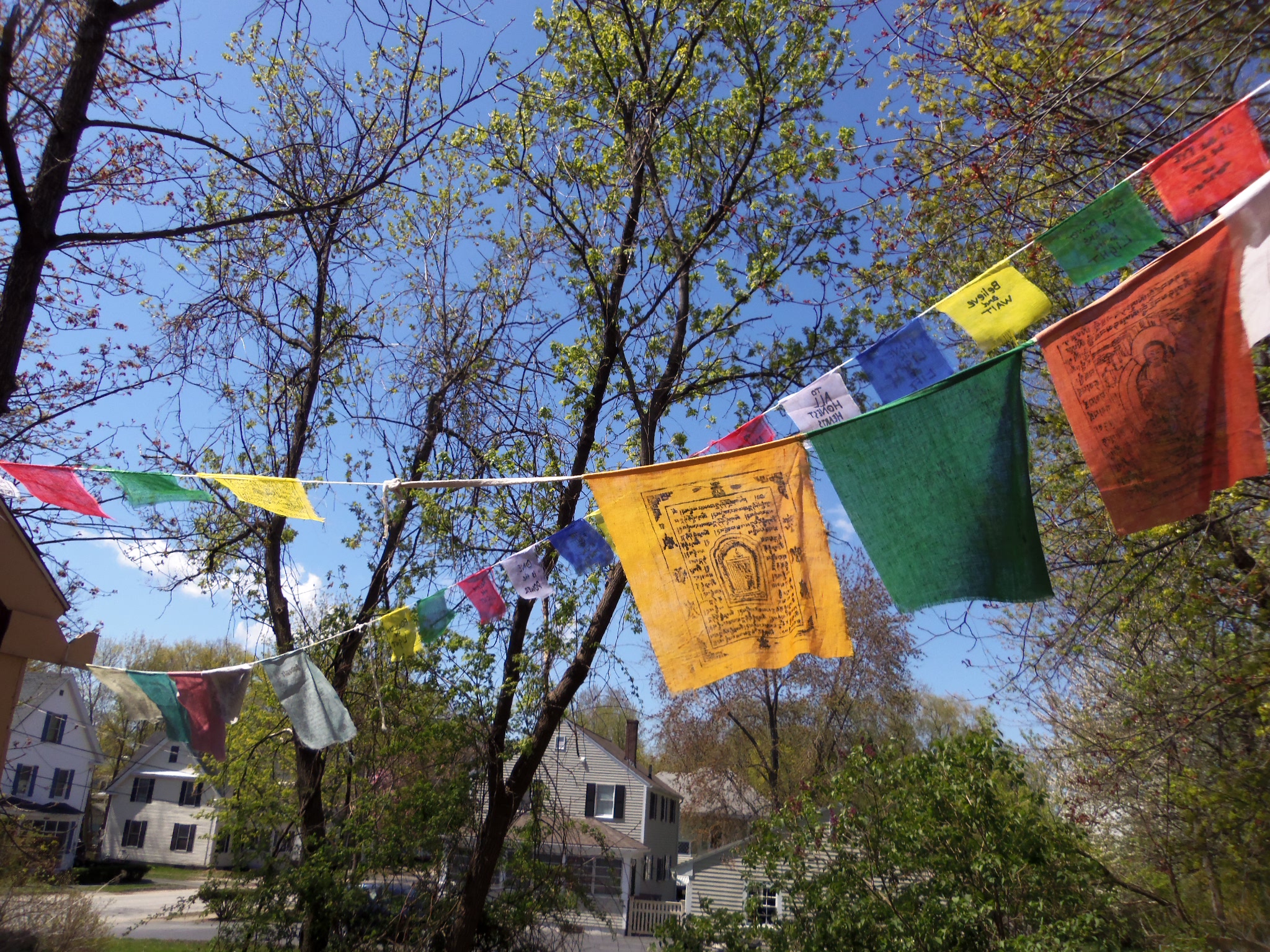
COLORING THE WIND

Each spring, new flags join the line in our yard.
Each spring, new flags join the line in our yard. The second strand, at the rear, has quotations from James Nayler, a powerful minister in the early Quaker movement.

The Apostle Paul has urged Christians to pray without ceasing.

I view Tibetan prayer flags rising in the breeze as joyous reminders my heart can do likewise.

THE SHORT VERSION

Asked for a short theology, I’m likely to reply I’ve come to the conclusion God has a different way for us, individually and as a society, to be living.

It’s the story I see evolving in the Bible, for one thing. And in much of the history since.

It’s not hierarchy-based, for starters, and something quite different from nations, with their armies, as we know them.

We get a hint of it in the suggestion of the Jubilee, the redistribution of wealth every 50 years for the entire populace.

Maybe you’re already sensing I don’t draw a distinction between here and eternity, not the way Augustine did. It’s the “Kingdom Come, on Earth as it is in Heaven,” as Christians pray.

The long version, of course, is where all the details come into play.