We’ve already looked at music and literature from the hippie era, but now I’m wondering about movies. Yes, there were some that played straight into the stereotypes. Peter Sellars’ The Guru would head my list there.
But there were also others that took the issues and era seriously, even when they were comedies. Not all of them, I should emphasize, come from the ’60s or ’70s.
For a starter Top Ten list, let me propose:
Alice’s Restaurant
Putney Swope
I Love You, Alice B. Toklas
Yellow Submarine
Brother Sun, Sister Moon
Godspell
Hair
Jesus Christ Superstar
Love Story
Zabriske Point
Maybe The Graduate, Swept Away, 10, or Hippie Masala belong on the list. But it’s your turn to weigh in, savvy viewers that you are. What other nominees do you propose?
So what have our children learned, as far as religion goes? What seeds have we planted? Actually, I’m thinking of this not so much as a curriculum matter for the Religious Education committee or as a reflection for parents but rather as a consideration of what’s happened in American society in general – the kind of place where soccer practice is now seen as more valuable (“value enabling”) than Sunday School. Or where a child may develop an aversion to being viewed, in any way, as a “Miss Goody Two-Shoes.”
My thoughts leap ahead to the tension many of us feel in the workplace. As Michael Lerner writes in The Left Hand of God, it’s the conflict of values between our dog-eat-dog competitive economy and those we hold dear and sacred. Fundamentalists, at least, attempt to resolve it by separating the two worlds, but at what cost? Children, of course, pick up on this, tuning out what they see as useless to their survival. And that includes what they observe at home. (Should we note the popularity of so-called “reality TV” – as manifested in The Survivor?) The Amish and other old orders attempt to hold the values of workplace, home, and faith in one sphere, but we can easily imagine the difficulty that, too, presents.
Obviously, I’m not going to resolve any of this in the next few sentences. Without the music of hymns and praise songs, the pageantry of robes, processions, lighting of altar candles, and communion, or the attentive consideration to set prayers and sermons, what do we give our children to cling to? (In the old days, did the plain clothing and “thee/thou” speech offer some refuge or rooting?) Or what invitation do we extend to those “voted off the island”? What I am going to suggest is that the answer is not found so much in any catechism or ceremony as in the way we treat our smallest members, our moments of laboring together, and, yes, the repeated ritual of a certain casserole on youth retreats and its reception.
I’ve never really liked the “baby boomer” description. Besides, I think there’s a major barrier between the early experiences of those born before ’47 or ’48, and those after. Around ’48, my wave, was when TV sets were present from the very beginning of our exposure to the world. We can’t remember ever not having one at least somewhere in the neighborhood. (Suddenly, I remember being three or four and having the Sullivan brothers show up to watch “Howdy Doody” with me. They didn’t yet have a tube of their own.)
Every year as our class advanced, our new round of teachers was baffled. All they knew was we were “different” from the previous ones. So to some extent, the TV influence feeds into the hippie outbreak. We were, in effect, wired differently from our seniors. Still are, for that matter.
But the other big shortcoming in the boomer classification is the way it ignores the huge fissure within our generation between those who supported the Vietnam Conflict and those of us who opposed it. That’s something that’s never fully healed, and it’s certainly crippled our ability to come together to advance the ideals some of us, at least, so passionately embraced. I suspect there are many politicians and corporate executives – the dreaded Establishment, that is – who actively worked to keep the wound festering.
So here I am, calling for a renewed vision of our legacy. That’s been one of the promptings of the novels in my series Hippie Trails. You’re welcome to come along on the trip.
Sometimes as I listen during an open mic, especially (and oh how I hate that spelling!), I find myself focusing on a particular reader’s moralizing and editorializing or cliche or heavy reliance on simile rather than metaphor, and that soon sends me into a disturbing zone.
What happens is that I begin editing heavily with an imaginary thick black marker, striking through all of the offending words and phrases, and pretty soon I’m tuning into only to the blackened blocks in the air and tuning out everything else.
Admittedly, I edit myself heavily, and this is a central step in the creation of many of my own works. Admittedly, too, I’m projecting myself onto the poor writer onstage. Admittedly, in particular, I’m forgetting to be humble and open here, star that I might imagine myself to be.
On my Monday free of the office, I drove up the palisades to nose around a picturesque river city in dull, mid-October weather. Looked at the signs. City Fish Market – Fresh or Smoked, down along the water. “Bill’s,” one door said; the other was “Private.” Down the main street from Doug’s Steak House, which was supposed to be THE place for Mississippi catfish, the town school stood in front of Lock and Dam No. 10.
I pulled into the Corps of Engineers parking lot as the Jack Wofford pushed its barges into the lock, noticed an observation tower, and climbed up to a deck occupied by mostly married retirees. But in the corner, more my age, was a woman in a London Fog trench coat and big boots, her long, black hair blowing in the cold wind. For a while I wondered if she was part of the pairs and quartets of older folks with their cameras who had come to view the autumn foliage and poke around the gift shops and galleries. She turned her head, noticed me briefly, turned back several times. Between twenty-five and thirty-two, I guessed. Proper makeup, classy.
Then, on the riverboat, a cook appeared at a door and fired back with his camera. She laughed.
Once the retirees beside her left, I asked her how the crews got their three lengths of barges – 3×3, for nine in all – out of the locks. “I don’t know,” almost a question. “I’ve never been here before.”
This time I noticed her crooked teeth. Began to wonder about games.
The cook emerged again, this time from the pilot house, and threw something, calculating for the wind. The object curved sharply at the last moment, into her fine catch. She unwrapped it a bit, saw it was a brownie with a phone number and address inside. She giggled to another old couple: “I think he’s had a lot of experience.”
Once the riverboat churned out of the lock, she descended to a powder blue Ford Torino, donned kid gloves with little holes for driving, and drove off.
The wrapper around her plates left me wondering if she was from the Henry County in Iowa or the one up in Minnesota.
I was left wondering, of course. Why so dressed up? And free on a Monday? That wasn’t a typical single person’s car. A professional, between stops? An art major, who gave it up for money? A government worker, with Columbus Day free? Off to a sweet rendezvous? Delightful divorced? Bored, with kids?
Me, at the time, with my own wife a thousand miles to the west, presumably finishing college.
A central problem for newspapers in the past half century is that they became increasingly homogenized and thus lost their distinctive, individual identities. Admittedly, that was always a problem when people saw it as “the paper” rather than the Times or Post or Chronicle or Herald and so on. But in the days when a city would have two or more daily newspapers, each one needed to have some unique identity to set it apart in the marketplace. Sometimes it was along party lines – Republican or Democrat – or social identities, such as blue-collar or proper society, but often it also meant the kind of news that was emphasized: national and international, for instance, versus local. And hometown columnists were always a voice that readers could count on. Think Herb Caen in San Francisco, Mike Royko in Chicago, or Jimmy Breslin in New York – or any of the great sportswriters.
In those days, newspapers were thinner than they became in the last decades of the 20th century – often just two sections – rather than the four to eight that followed in the great mergers and closures that led most cities to have only one daily journal. Much of that problem, we should note, could be blamed on the “unduplicated readership” that ad-space buyers relied on in allocating their budgets. No matter how marvelous the Washington Star was in its final days, or the suburban Journal papers were in the counties around the city, they couldn’t overcome that hurdle – when it came to outright readership, the Washington Post had the monopoly. Since everybody had to read it, there was no point in advertising elsewhere.
With few exceptions – New York, Boston, Chicago, Philadelphia – we’re left with single-paper markets where the product looks and reads like those everywhere else, except that the stories take place there than elsewhere.
As the local newspaper more and more became a one-size-fits-all model, what I no longer heard was the feeling that it “speaks for me” or my section of the wider community. And now, even those special voices within its pages are no longer there – one by one, the columnists were never replaced.
The newspaper I longed to create had little resemblance to that bland crime-and-crashes emphasis that too often prevails these days, in place of more difficult and costly investigative reporting or a bigger view that critically examines education, the fine arts, social justice, the environment, and so on.
It’s hard to get excited by what’s there. And we wonder why circulation kept declining even before the Internet?
This is, I should note, a contrarian viewpoint, since the publishers kept proclaiming the “improved service” each time they merged two papers into one. So here we are, online and blogging.
~*~
Hometown News
To find out more about Hometown News or to obtain your own copy, go to my page at Smashwords.com.
It’s tune in, turn on, and take action in this tale of campus intrigue. Little does a small band in a remote college town realize its opposition to small-ante bureaucracy goes straight to the state capital. And then Washington and the Mekong Delta are another matter as the hippie movement hits tranquil Daffodil. Nothing will remain quite the same.
As the headline said:
BOTCHED DRUG BUST BACKFIRES.
When narcotics agents made an early morning knock-down-the-doors raid on the twelfth-floor of one of the high-rise dormitory towers, they turned up nothing – and were surrounded by irate residents before they could frame anyone, either.
“If you think the slaying of innocent students at Jackson State University was merely a racial atrocity,” Lakasha proclaimed, “you’re not seeing the big picture. It’s about an attack on civil rights – freedoms that belong to all of us. You don’t have to live in a big city to live in ghetto housing. Every student in Daffodil lives in a ghetto. Where I come from, we have a word for high-rise housing like these big dorms – the Projects. And the pigs who come charging into the Projects act just like those who busted in on the twelfth floor the other night. Never mind whether they find anything or not. Look, the university’s demanding that the students pay for the busted doors and busted furniture and busted walls. That’s why they call it a bust in the first place. Wake up, America! Demand the names of the ‘unnamed informants,’ the ones who were so wrong about the presence of illicit substances in those rooms. Wake up, I say! Mississippi’s closer to Daffodil than you think!”
~*~
To learn more about my novel, go to my page at Smashwords.com.
Rockport, Massachusetts, sits at the end of Cape Ann.
Mention “the Cape” anywhere in New England and people assume you’re talking about Cape Cod, that marvelous arm extending from southeastern Massachusetts. (Well, it does have its own dictionary entry.)
Mention “the Other Cape,” and a few knowing heads will nod or smile in recognition of Cape Ann, jutting from Boston’s North Shore.
It’s not that those are New England’s only two points of land extending into the ocean – the definition of a cape. For perspective, two of Maine’s most photographed lighthouses are on Cape Elizabeth and, close to us, Cape Neddick.
What Cape Ann and Cape Cod share is a certain ambience, a feeling that – well, you’re in a unique place and not just anywhere in New England.
If you’re not familiar with Cape Cod, let me say there are many fine guidebooks that describe the experience. Today’s gallivant, though, takes us ever so briefly to Cape Ann, which by its most generous definitions (probably mine) can be no more than a third the length of its famed rival. While Cape Cod is neatly demarked by the Bourne and Sagamore bridges, Cape Ann is a bit more diffusive. Since we come down from the north, we find that “Cape” familiarity in the air as we come into Ipswich, which claims more “first period houses” (1625 to 1725) than anywhere else in America – 58 in all. It’s a charming community and, like most of Cape Ann itself, has a more varied mix of social classes than you typically find on the bigger peninsula.
My introduction to the town came last fall when K. Peddlar Bridges invited me down to do a poetry reading on his Roadpoet cable-access television show – and we had a blast. Before the taping, I went for a walk through some lovely year-round neighborhoods that could stand as textbook tours of American architectural styles. I crossed a stone arched bridge as geese took V-formation and honked low above me. Turns out the 1764 Choate Bridge is the oldest double stone arch bridge in continuous use in the country. (I don’t make this up, nor do I challenge the accuracy of the claims.) Leading to an impressive Colonial-era garrison house, the span connects to Turkey Shore and Labor in Vain roads. You get the picture. And, yes, you don’t get a better sense of that Puritan outlook than “Labor in Vain,” do you?
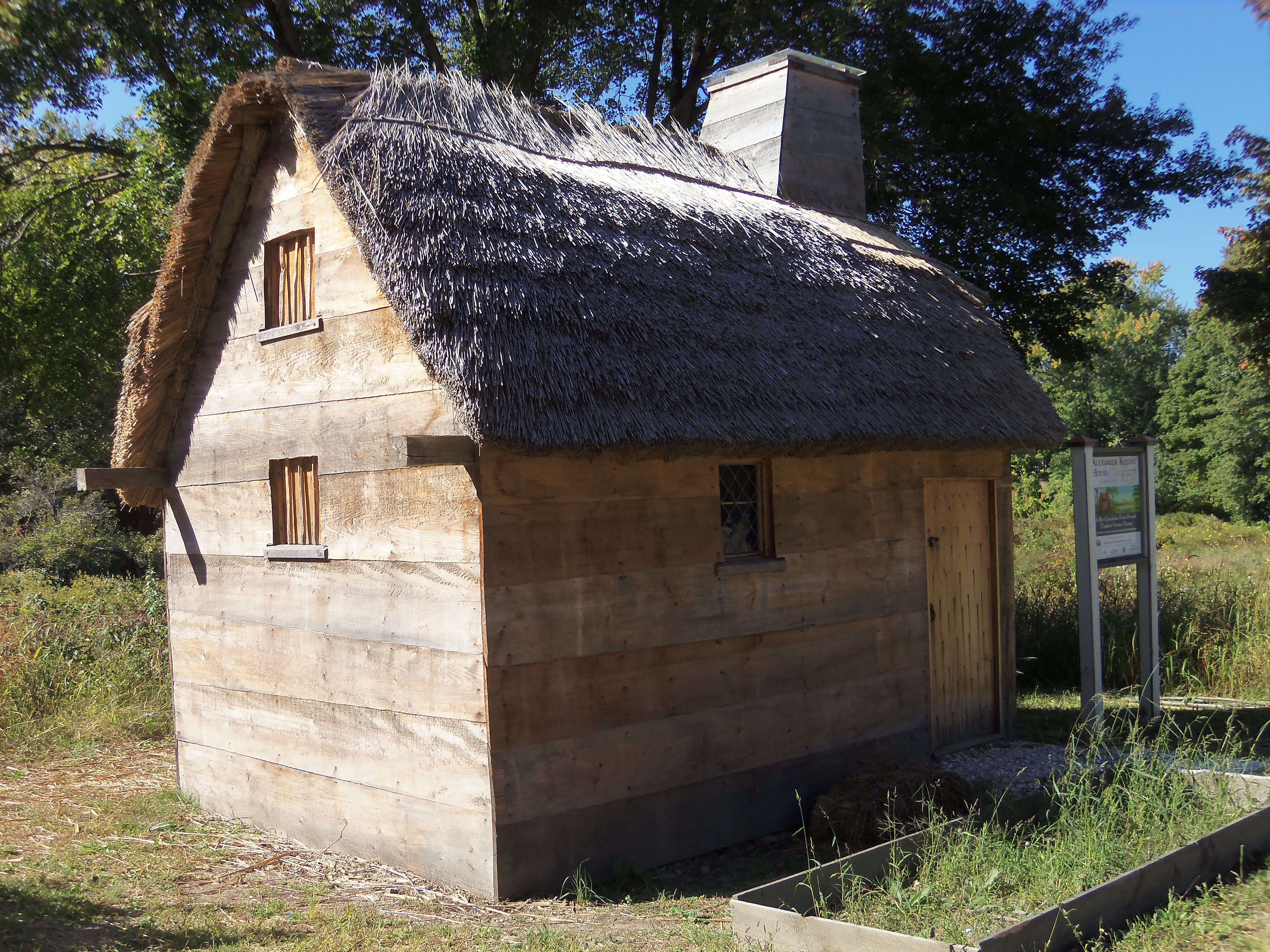
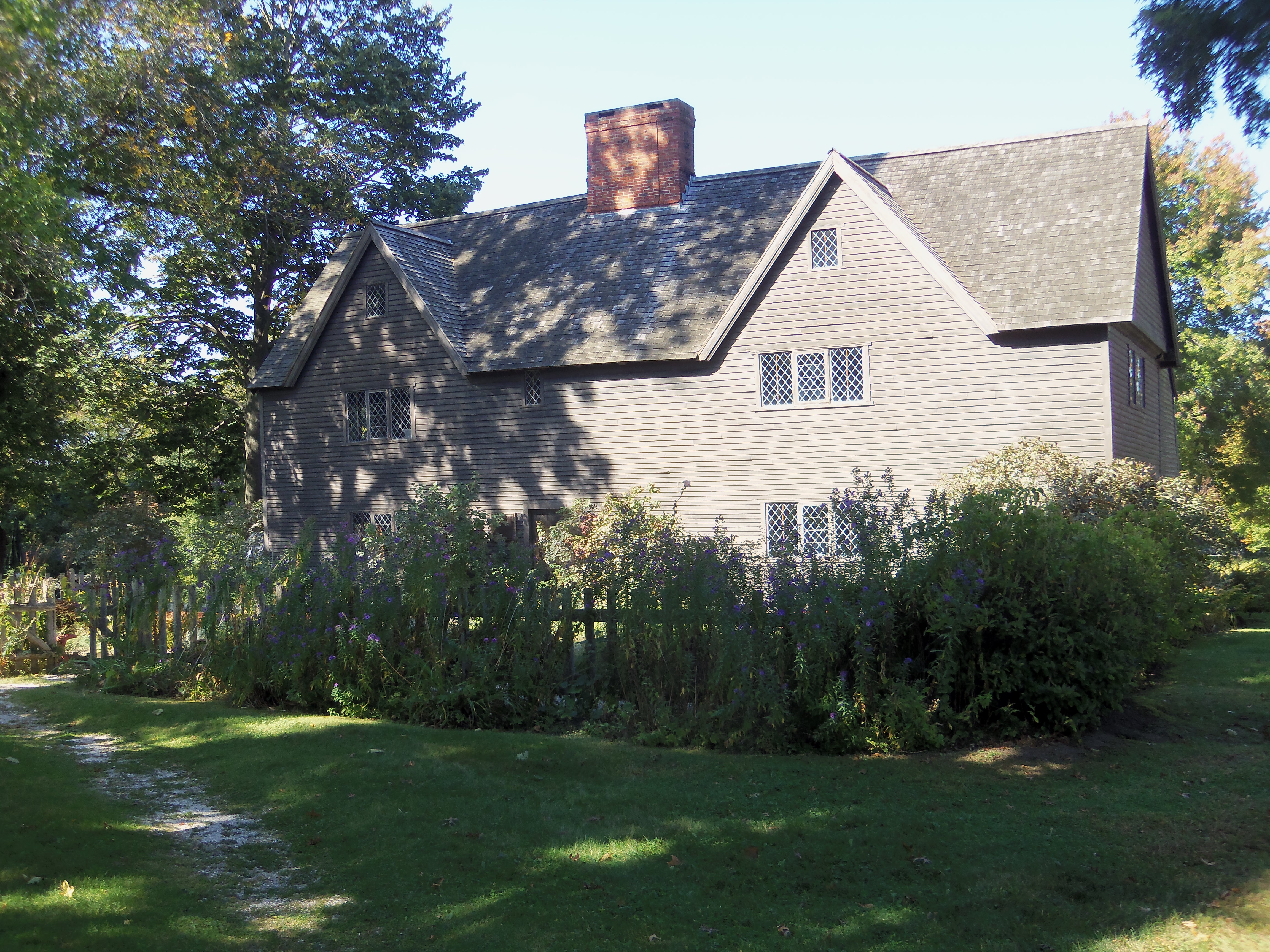
The reproduction 1657 Alexander Knight house in Ipswich, Massachusetts, suggests the difficult life facing the early settlers, especially through a New England winter.The elegant 1677 Whipple House in Ipswich is considerably smaller than the House of the Seven Gables in Salem but similar in style.
So the next week, my wife and I took off for a fuller exploration. We headed on down the road through gentleman farms and veered off for Crane Beach, passing long vistas of salt marshes where prized hay was once harvested. (It was high in mineral nutrition but gave the milk a salty taste, according to the tales.)
The beach itself was once part of the Crane family’s Castle Hill summer estate, which is another destination. The estate, the 1,234-acre Castle Neck dunes and beach, and adjacent 700-acre wildlife preserve are part of the Trustees of Reservations holdings. (Be advised, there’s an admission fee to the park – $8 a car when we went; up to $25 a car on summer weekends.)
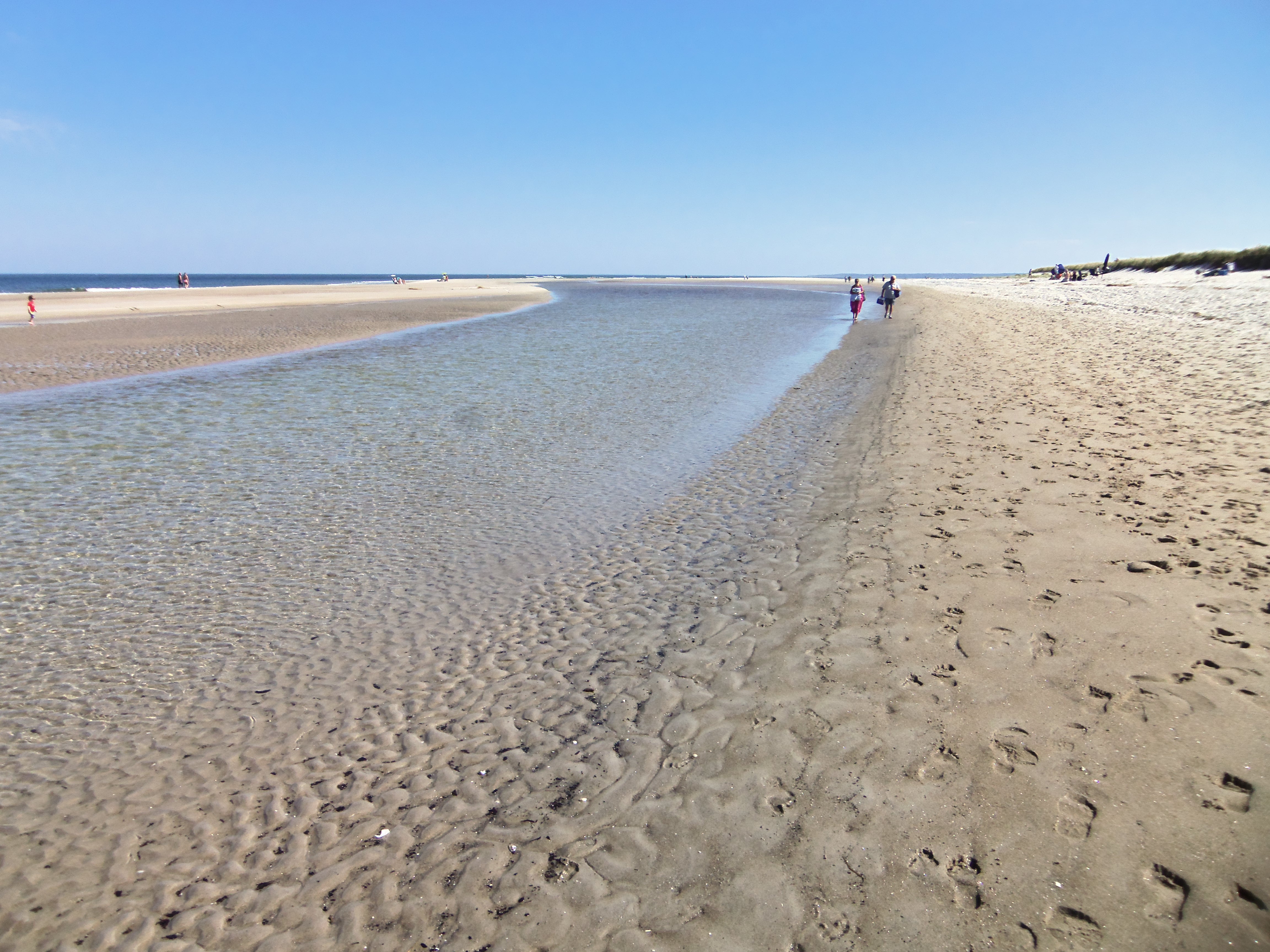
But what a beach! My wife was overjoyed to see white sand, like those of her native North Carolina, rather than the usual gray or brown of New England. And that sand seems to run on forever, with fascinating patches of rippled washboard, tufts of sea oats, and an array of shells we don’t find in our usual rounds of the coast. It may have been October, but our nostrils were greeted with that distinctive Coppertone aroma, and our eyes viewed an array of sun worshippers extending their tans as well as a few daring souls in the water. We walked and walked and, well, might still be walking if we hadn’t felt hunger kick in.
We’ll be back.
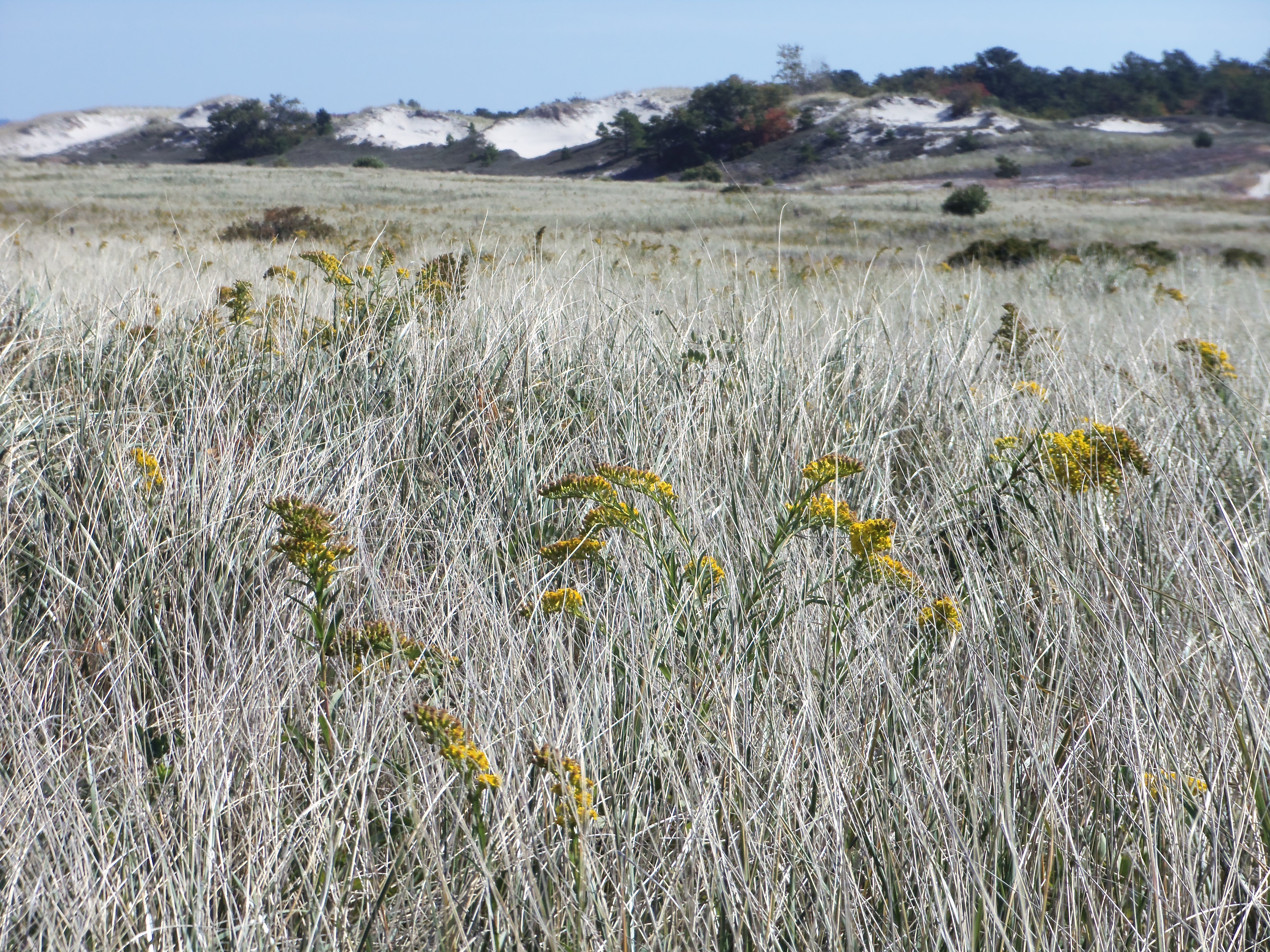
Washboarding and footprints decorate the sand at Crane Beach.Here’s a view looking into a dune behind the beach.
Venturing on, we came into the small waterside village of Essex, where we poked into Woodman’s “in the rough” for a seafood lunch. “Rough,” which is also in the name of an outdoor haunt we love in York, Maine, seems to indicate ordering and picking up from a counter rather than wait staff service, as well as a picnic-flavor rustic decor. As we looked at the blackboard and its prices, we nearly left for cheaper fare, but Rachel caught a posted review by food gurus Michael and Jane Stern – and I knew we weren’t leaving. I’m glad we stayed.
It was fun and filling – they don’t skimp on their portions. We can see why it’s a classic destination for the traditional regional seafood, especially of the “messy” sort. And, as she said, they “know how to do batter.” That’s a high compliment on her part. (Onion rings, anyone?)
The heart of Cape Ann is the city of Gloucester and its varied neighborhoods around the waters. It claims to be from the same year as Dover, although unlike my city, it was abandoned for a period, and is about the same size, roughly 29,000 residents. It lays claim to being America’s oldest seaport and has always been a busy, often brutish, fishing harbor. Gorton’s Seafood uses the city’s sea captain sculpture as its emblem. The Perfect Storm movie captures some of this legacy. These days it’s also the home to a number of whale-watch operations, due to its proximity to the famed Stellwagen Bank fishing grounds. In the 1950s and ’60s poet Charles Olson sought to capture the local spirit in his Maximus series, drawing on Ezra Pound’s literary foundation.
For us, though, the glory of the place is its three large wind-generator turbines rotating gracefully from the highest points along Route 128. They are immense works of art, comforting, landmarks. How anyone can oppose their construction baffles us. And, yes, they do sing … softly.
The trees might give you an idea of the scale and majesty of these Cape Ann landmarks.
Cape Ann culminates in the town of Rockport, which has long attracted summer artists to its shores. More recently, the three-decade old Rockport chamber music summer festival has developed a loyal following, which led to the 2010 opening of the 330-seat Shalin Liu Performance Center and its year-round offerings that include classical, folk, blues, and jazz. When they say “intimate,” it’s true. What makes this hall truly amazing is that the back of the stage has wooden panels, for acoustical purposes, that roll away to reveal a panorama of the harbor. Maybe the Santa Fe Opera surpasses the view, but I bet you can find folks who can quibble.
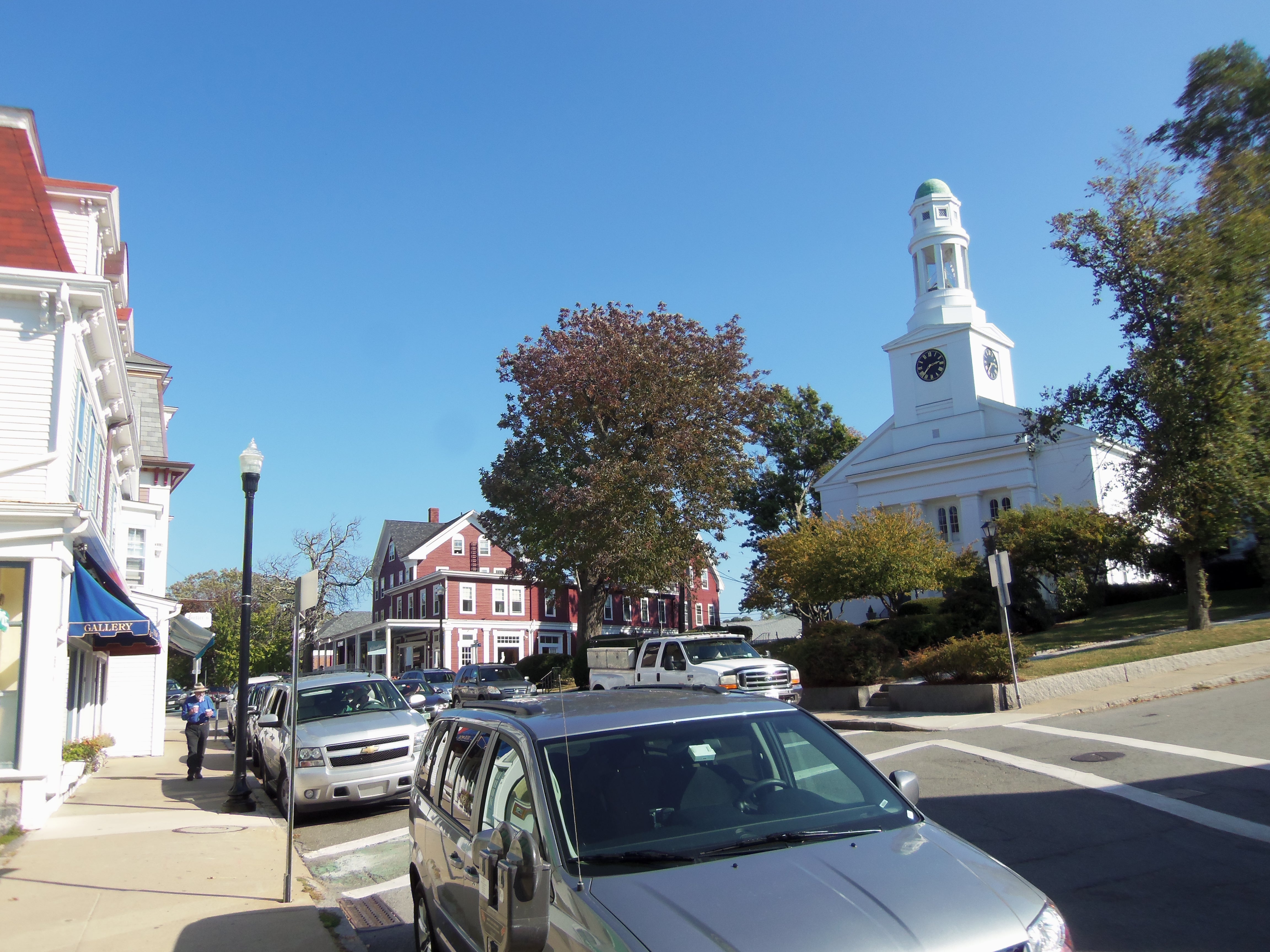
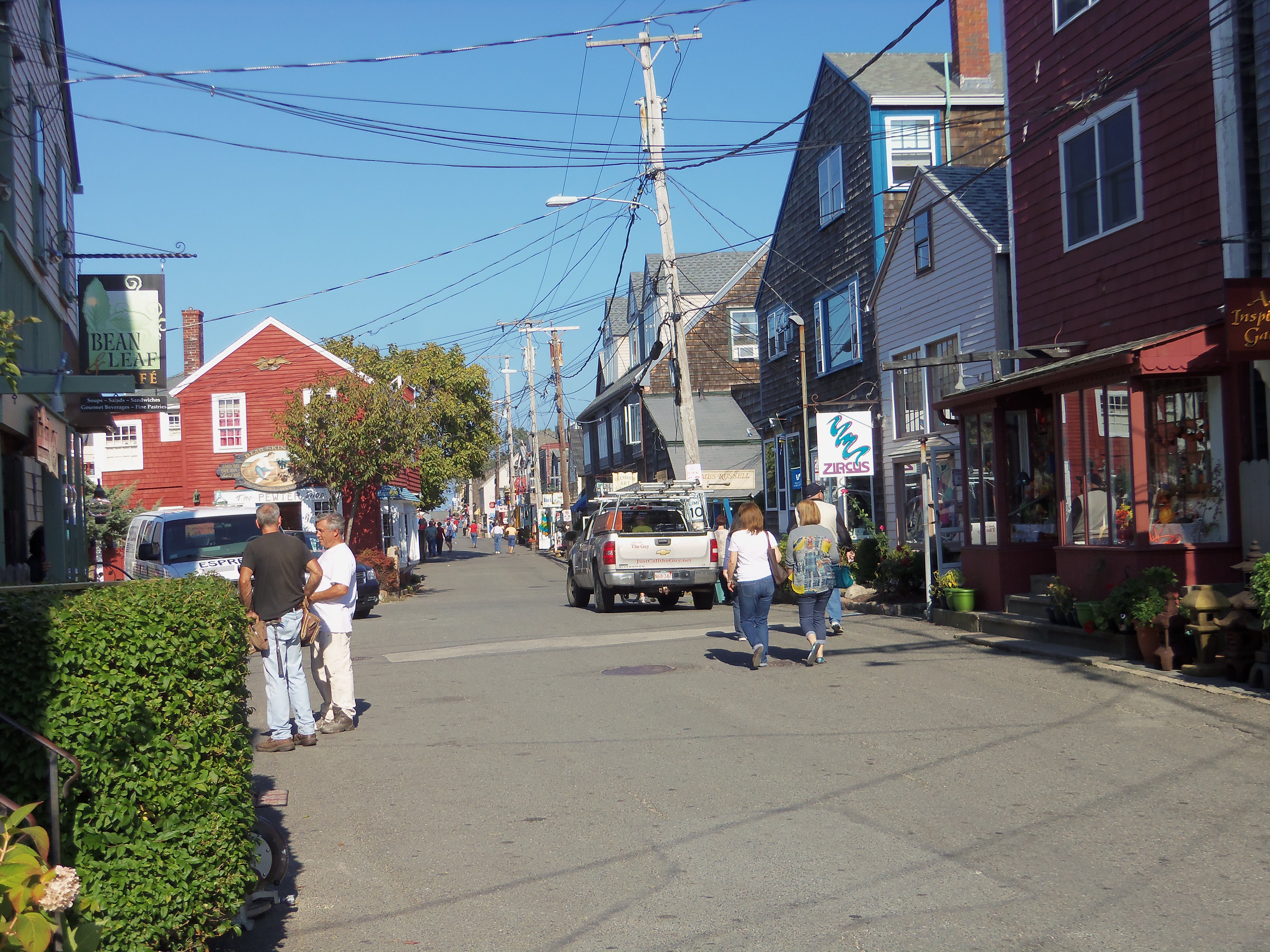
The village itself has much of the Cape Cod shopping flavor of boutiques, restaurants, artist galleries, jewelers, and so on – especially in its Bearskin Neck district.
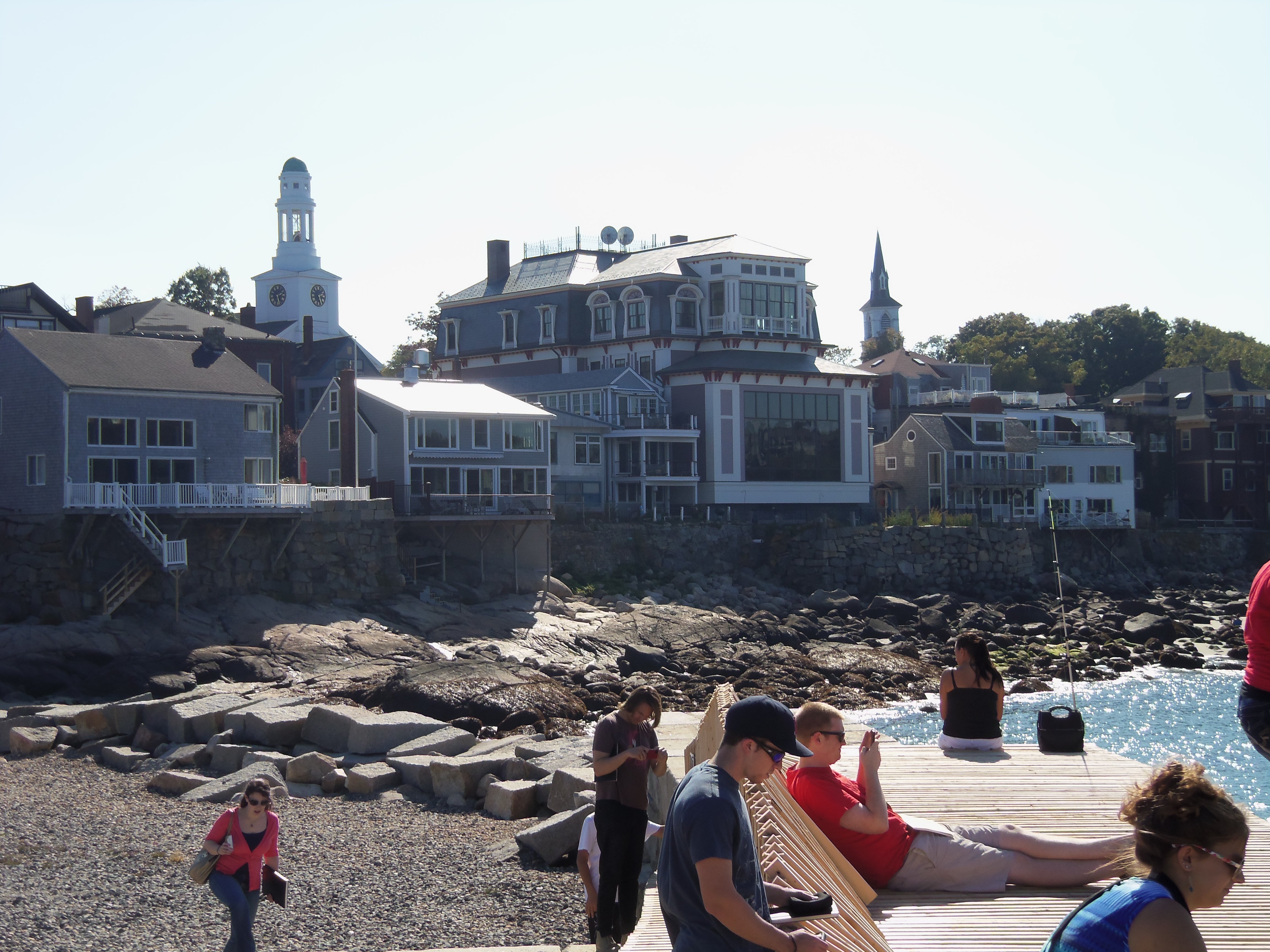
The big window in the largest building overlooking Rockport Harbor is the back of the stage at the Shalin Liu Performance Center. By the way, the tide’s out. We were among a crowd enjoying an art installation that doubled as sunny seating on one of the stone wharves.Downtown Rockport has a traditional blend of resort retailers … and shoppers to match.
By the way, Massachusetts Bay Transit trains run from Boston’s North Station to Rockport, with Cape Ann stops along the way.
While I mentioned whale watches, I should note we prefer to venture out from Newburyport to the north, in part because the vessel there has the option of heading to either Stellwagen Bank in Massachusetts Bay or Jeffrey’s Ledge in the Gulf of Maine. When it goes to Stellwagen, though, it cruises around Cape Ann and offers fine views of the Straightsmouth Island and Thacher Island twin lighthouses – the 1861 replacements for the 1771 originals – closer to Gloucester Harbor.
Shifting to the world of epublishing has stimulated a gentle learning curve for me. Maybe because my to-do list has always been much longer than I can manage or maybe because I felt I already had too much detailed work at hand, I’ve tried to avoid becoming a computer geek who spends all his time in the technical minutia. Actually, it’s the same way with my cars – I don’t want to spend my mornings, afternoons, or weekends under the hood or on my back under the chassis; I just want to get in and drive. As for high tech, I’ll wait for all the bugs to get worked out before I buy the updated version, thank you, especially since I’ve always been on a very limited budget. And for the record, I hate Windows 8, which is always interrupting my work by blowing its apps in my face or requiring me to log on again throughout the day.
On the other hand, keyboarding on a computer has been a vast improvement over a typewriter, at least for klutzes like me, and the ability to correct and revise as I go or rewrite and edit later is, well, divine. Sometimes progress really is progress.
And sometimes it isn’t, as we seemed to discover at the office each time we moved on to a new system whether we wanted to or were instead forced to when our current equipment was declared obsolete. (I’ll let others relate those nights of terror when they pulled the plug on what was finally working as promised.)
Participating in the small-press literary scene has been another matter. When I first ventured into email, thanks largely to my now-wife, well, let’s say broadband’s been a huge improvement over those telephone connections and leave it at that. Still, cutting and pasting poems into the email and having them accepted within hours rather than be rejected months later was quite an eye-opener. These days, with most of the liveliest literary action happening in online journals, the process has taken leaps forward; typically, you use a submissions program, upload your file, insert your cover letter, and follow the pieces through the editorial process, if you wish. For a long time, I tried to maintain two sets of files – one for journals that still used, or even required, submissions via the Postal Service, and those that took them online. This year, finding that too complicated, I decided to drop the postal-only journals altogether. (That move, let me add, was hastened by problems with our computer printer as much as the much higher rejection rate on the envelope entries.)
The 2005 publication of my second novel, Ashram, as an ebook was another eye-opener. I was surprised by how easy its preparation was, how quickly it went from acceptance to general availability, and how pleasurable reading a long work on my computer screen could be (even if the work was issued only in PDF format). Unfortunately, we were also a bit ahead of the ebook reading trend and many would-be readers told me of their difficulties in downloading the volume. The other snag was getting the work reviewed at all – even online critics stuck solely to paper editions.
Blogging has revolutionized much of this world, probably more than we realize. For me, avowed neo-Luddite that I am, WordPress has been heavenly. It’s allowed me to take a model “out of the box” and run with it without modification, even if I do admire the customized tweaks many of the rest of you add apparently without hassle. The Blogs That I Follow, searching by topical tags, and Freshly Pressed streams have introduced me to many wonderful voices around the globe for my daily perusal. In fact, I’m still struck that in its first year, the Red Barn had readers in 72 countries. Amazing.
These days I’m learning again. The opportunity to publish my novels to be distributed across a variety of platforms (as they say) has meant following a new set of directions to strip out all the hidden codes (we hope; some of mine go back to the first versions on WordPerfect4.0) and set up the work to flow smoothly in a reading device. (I started to say “reader,” but for me, that will always be a person, not a machine.) I’ll admit that adjusting to the concept of considering a long work as a continuous text, rather than pages, has been major, as has the matter of inserting hyperlinks. Remember, I’m someone who loves the art of printing from its very origins. (How many Gutenberg Bibles have you seen?)
Even so, I’m excited by the new opportunities and the new visual dimensions.
Even as a cub reporter, I loved writing long pieces. It’s what I prefer to read, really read, when I have time. By long, I don’t mean pointless minutia or the trivia of, say, a public hearing, but rather the probing look at how and why a thing has happened and maybe even what to expect as a consequence. Add to that the human dimension, especially from the point of view of those most impacted by the action rather than those at the top of the pyramid.
One model of this style of news writing came in the three stories on the front page of the Wall Street Journal each day – what they called their “leaders,” back in the era before Murdoch. If you looked closely, you’d see how each one was composed of several smaller stories, each one telescoping into the next. The reporters could joke that their work was so heavily edited they no longer recognized the finished version, but for those of us reading, the result was rewarding, the way a good meal is.
As a journalist, the irony has been that I spent much of my career crafting headlines and photo captions … short, short, short … and that was even before I relied more and more on news briefing columns to get the day’s world and nation reports into the paper at all.
Not that I lost my love of long writing. My “shelf” of ebook novels is proof of that, including my most recent, which delves into the news business itself.
As a blogger, though, I’m also admitting pleasure in composing shorter postings like the ones that appear here at Jnana’s Red Barn. Apparently, from the stats, they must be connecting.
My other four blogs provide venues for the longer writing, and the results to date are mixed.
To my surprise, my genealogy blog, The Orphan George Chronicles, has drawn far more hits than I’d anticipated. I figured its appeal would be to a few dozen fellow researchers, and having the results online would be much easier to find than if the files were archived in a few libraries somewhere. As for publishing them in paper editions, the likely audience would never cover the expenses.
My Quaker blog, As Light Is Sown, has shifted from the two book-length presentations that appear as the initial postings to a year-long Daybook of short postings, so I must admit that trying to analyze the results there can be inconclusive.
Thistle/Flinch exists to present book-length PDF editions of poetry and fiction, so I guess you can say that’s writing long.
And the remaining blog, Chicken Farmer I Still Love You, is still taking shape, as the numbers show. The first part, Talking Money, presents essential material for addressing the material sides of life … income, spending, wealth, possessions, labor, time, goals, and the like … followed by a close look at New England’s famed foliage. These days, it’s taken on a new focus in reconsidering the hippie outbreak and its renewal. Again, many of its postings are chapters for book-length presentation.
What I am finding in general is that even without the demands of daily employment, time is still the most precious commodity in my life. There just ain’t enough of it for what I hope to accomplish these days – including reading or writing, much less in any length.
So I guess that’s the short of it, for now.
~*~
Hometown News
To find out more about Hometown News or to obtain your own copy, go to my page at Smashwords.com.




 Jnana's Red Barn