TIFFANY?

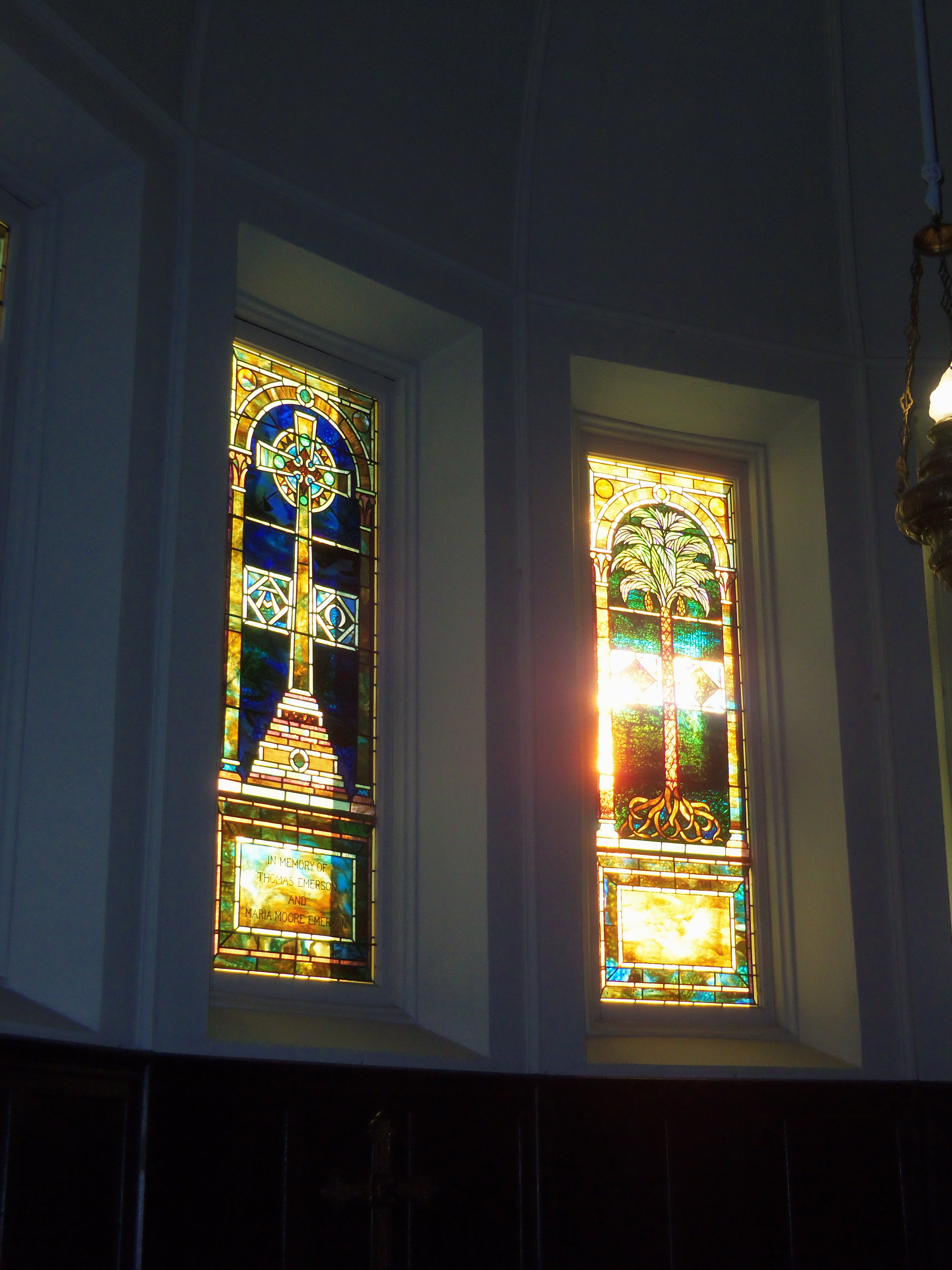
From the pews in the sanctuary, the five stained-glass windows over the altar appear curiously bland in contrast to the two vast arrays to the left or the rear. Only if you cross into the chancel and catch a glint of sunlight might you sense something quite different is at hand before you.

That’s how I first noticed that unlike traditional stained glass, none of this set had been enhanced by paint. All of the color was in the glass itself, yet there were no muddy patches where colors overlapped, as might be expected while mixing pigments. Some of these resembled Impressionist painting or bookmaker marbling. Moreover, when direct sunlight hit some of the pieces, the color blazed with gold or copper or fine jewels.
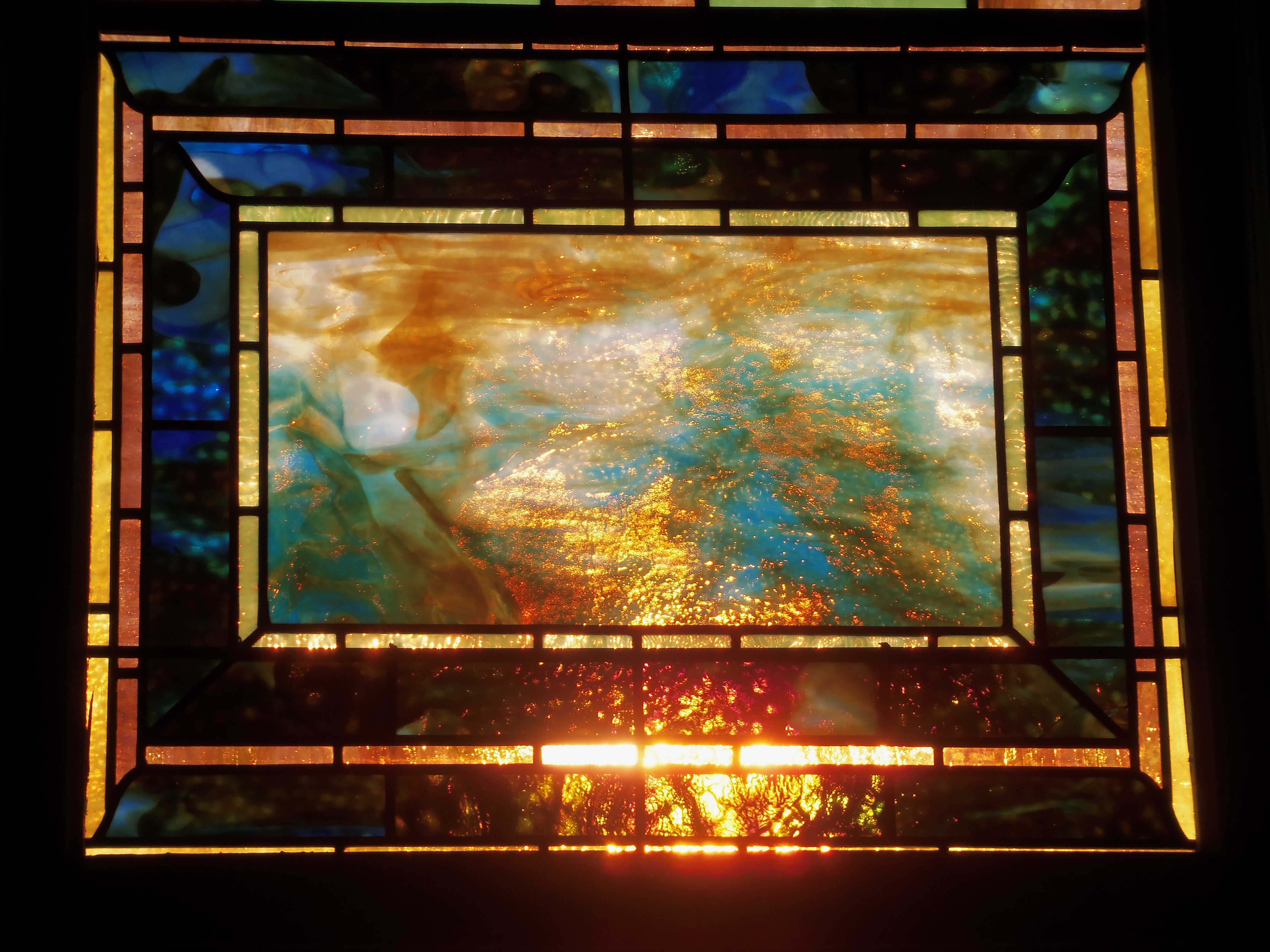
Look at that gold blazing.


A little context.
A little context.

Could it be? I’d heard that one reason Louis Comfort Tiffany obtained such incredible effects in his work was that he used such materials in his glass. For starters, the only way to get a gold color is to use gold.

As I started to seek documentation, some fascinating connections appear.

As it turns out, the Tiffany Glass Company and its successor, Tiffany Glass and Decorating Company, created thousands of ecclesiastical church windows. Many of these were designed and executed by his studio, rather than Tiffany himself, but they would nonetheless bear his stamp and influence.

Tiffany’s 1890 Hay Memorial at Emmanuel Episcopal in Pittsburgh presents some striking similarity to the set at the 1895 St. John’s Methodist in Watertown, Massachusetts.

A simple design.
A simple design.
Such a range of colors, shifting with the light.

Both are narrow arched windows with greenish bottom panels ringed in copper tones. The central cross resembles the crosses at Watertown. And the mention of Tiffany’s love of exotic Oriental painting and his travels in northern Africa might explain the two Watertown windows dominated by palm trees.

The Watertown congregation originated in 1836 in the Whitney family home, and they remained active supporters at the time the 1895 stone building was erected. Their David Whitney Jr. relocated to Detroit as a young man, quickly became that city’s wealthiest resident, and built an 1894 mansion that still features its elaborate Tiffany windows.

Finally, I run into the pastor as he’s leaving his office. I pose the question, “Tiffany?”

“Technically, no.”

“His studio, then?”

“Yes.”

Regardless of the creator’s name, these five windows are marvelous, especially when struck by sunlight. Unfortunately, their placement on the west side of the building means the Sunday morning worshipers would not get to view them at their best.

Vespers, anyone?

Three of the five windows around the chancel in late-afternoon sunlight.

CHURCH WINDOWS

I’ve long joked that our Quaker meetinghouse has the prettiest stained-glass windows in town. That’s because they’re clear, looking out to the hardwood trees surrounding the grounds and all of the seasonal changes. The colors are those of snow and ice, spring greening, fog, mist, rainfall, autumn foliage. Admittedly, the new synagogue, with its view over a hillside to forest beyond, and the Methodists, at the edge of a millpond, can make rival cases. I’ll plead to being partial.

Crucially, though, transparent windows remind us of the world beyond the house where we sit in worship, a reflection of our awareness that our faith is a constant part of our various daily life activities. They remind us as well of the powerful rhythms of nature and God’s creation.

On the other hand, most congregations – including the Evangelical United Brethren of my childhood – gather within rooms of filtered light cast by stained-glass designs. I was puzzled by it then, and remain so today. Yes, I know the colored windows of the great medieval cathedrals were illustrated storybooks for the illiterate populace, but what I encountered always felt second-rate and often mildewed. Few individuals, I suspect, could say much of anything about the event being depicted or express any understanding of the decorative filling. Pointedly, the translucent windows cut off any view beyond the room. Perhaps the intention is to create a holy space – one set apart from normal life; perhaps, too, this hints at eternity as a departure from the landscape we know. But a shady or even creepy quality always seemed to lurk in the shadows. This is, I will note, quite different from the icon-based frescoes of Eastern Orthodox custom.

Apart from a few December afternoons at the National Cathedral in Washington, when I finally experienced the dazzling sunlight through the windows and recognized how Rose windows earned their esteem, my encounters with stained glass were few and fleeting. That is, until late one afternoon last year when I arrived early for our weekly chorus session and stepped from the room where we rehearse, crossing into the sanctuary on the other side of the sliding shutters. The square vaulted room is dominated by two imposing displays in traditional style – painting, essentially on pieces of colored glass that are then leaded together. Something about these, though, suggests quality sustained by wealthy donors. The impressive room has demanded closer investigation.

If the late 19th century brought about a flowering of stained glass in America, it was also a time before the spread of public art museums. Windows like these, then, would have been art made available to all for their wonderment.

The south wall of the sanctuary is dominated by this traditional design, which includes a row of named angels along the bottom.
A detail of one of the angels.
A detail of one of the south windows.
Traditional stained-glass style using cut pieces painted with enamel.
A decorative window in a social hall where our chorus rehearses.

ART GLASS PIECES

When it comes to art museums, I head straight for the paintings. The other displays, including art glass, come later.

Actually, glassworks as art rather than craft came to my attention largely through the glass-blowing compatriots of my now ex-wife (we’d save clear bottles for her circle to melt down and reform as fine-art creations) and her grandmother, a knowledgeable antiques dealer who specialized in glass collecting, which was quite appropriate considering our location in a former glassmaking mecca that included Toledo, Tiffin, and Fostoria, Ohio. (At the end of the 19th century, an oil boom meant plenty of cheap natural gas, allowing affordable conversion of sand into glass.)

These days the Henry Melville Fuller Paperweight Collection at the Currier Art Museum in Manchester has expanding my regard for glass artifacts, even if I do head first to the paintings.

My favorite paperweight has a cobalt-colored core enveloped by clear glass. How they ever produced the swirls of bubbles remains mystifying.
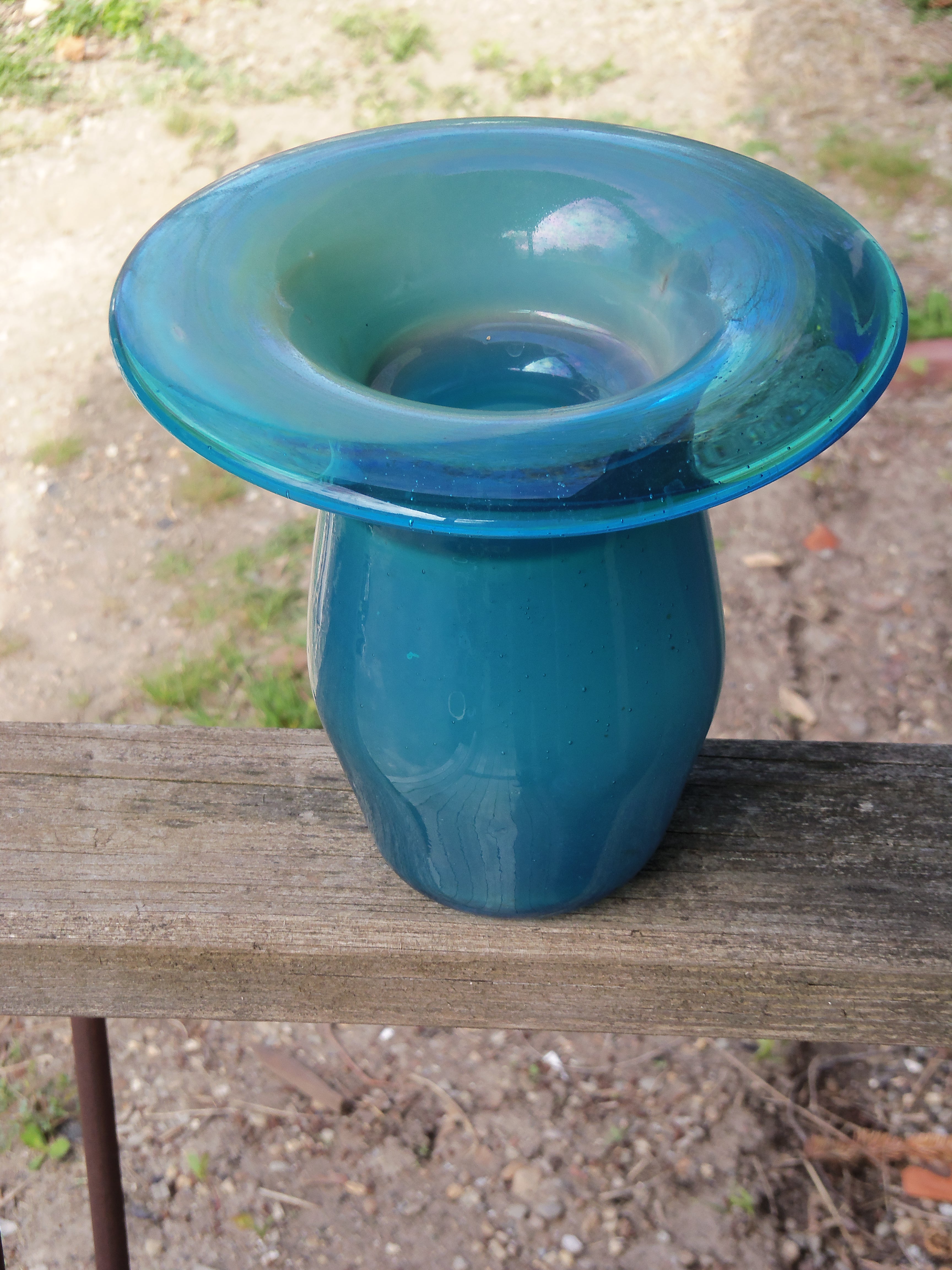
A blown-glass vase created by an art student. We saved clear beer bottles for the cause.


PIPE ORGANS

Waiting in silence.
Waiting in silence.

For a classical music enthusiast like me, one of the great things about living in New England is the plethora of fine pipe organs. They’re found not just in many of the historic steeplehouses, but also in places like the city hall in Portland, Maine, or the music hall in Methuen, Massachusetts, built especially for the massive Wurlitzer, and, of course, Symphony Hall in Boston.

(They’re not, however, found in our Quaker meetinghouses, except for the occasional harmonium or a modest electronic organ in a corner. I could even point to my quibbles about the expense of building and maintaining great instruments in a house of worship, but let me add how much I appreciate listening when they’re played in good hands.)

Their very variety can be remarkable. Locally, we have an 1876 Hutchings instrument that two Eagle Scouts rescued in unplayable condition from the old Methodist chapel, carefully dismantling, numbering and cataloguing the pipes, storing them in a barn, and eventually seeing their restoration in the congregation’s new building. (Hutchings, by the way, created the original part of the organ at Boston’s Symphony Hall in 1900.) Hook and Hastings, meanwhile, is credited with an 1850 one-manual instrument at First Baptist, a 1908 two-manual at St. Charles Roman Catholic, and a 1911 two-manual at St. Thomas Episcopal. First Parish (U.C.C.) has an impressive 1995 Faucher hybrid that incorporates the building’s earlier Goodrich and Hutchings instruments. Expanding the circle a bit adds a wonderful 1975 two-manual baroque-style instrument at Durham Community Church and the oldest playable organ in America, the circa 1665 Brattle, now at St. John Episcopal in Portsmouth. (Manuals, for the uninitiated, are the number of keyboards, one atop another. And don’t overlook the incredible bass notes played by the pedals under the feet!)

Maybe I shouldn’t have been surprised, then, when I stumbled upon a four-manual keyboard in Watertown, Massachusetts. “Is it still playable,” I asked. “Oh, yes. I sit down to it from time to time,” I was told. “It has a lovely, soft sound. It was built by Aeolian-Skinner but never made leaner,” meaning the E. Power Biggs’ influence in the ‘60s, especially through his performances and recordings on the Flentrop organ at Harvard’s Busch-Reisenger Museum and his advice – or misguided advice, depending – to organ owners in that era.

I love the soft, late afternoon light in the chancel.


A NOTE ON PATRON SAINTS

My girlfriend in college dreamed of creating a private language all our own. In those days, I thought creativity came down like lightning bolts with something absolutely original.

What I’ve come to see instead is the fact that true creativity happens at the frontier of what’s come before. It builds within and upon a tradition and a culture. For that matter, I’ve recognized how difficult dealing with our own marvelous language can be – and how vast its resources.

The practice also reminds me how easy it is to go slack. When I’m working, I like to keep the work of another at hand, as a sharpening stone. Sometimes it’s another poet, sometimes a painter or photographer. As guiding lights. As reminders. Companions on the trail.

Of course, it’s fair to ask. Where do you turn for inspiration and models? Any places or names in particular? How do we keep going deeper or higher, or keep our instruments sharp and shiny?

THE NOVELIST STRIKES ANOTHER POSE

100_9850Dear Reader:  Are you aware that this is a social protest novel? Have you delineated the symbolism running through construction? Can you guess the antecedent novels that most influenced the Author in his quest of the Muse? What form will his next opus assume? Will he learn from his mistakes? Does he even perceive them? Will he renounce writing? Who will turn this into his next movie? What music will be selected to amplify it?

Please clip and mail to the Author. Your comments are always appreciated.

Thank you.

The Author.

~*~

To learn more about my novels, go to my page at Smashwords.com.

MOSTLY FROM A LAST TRIP TO ENFIELD, MAINE

I was on my way to  the Metzlers’ farewell reception in the Grange hall as they wrapped up 19 years’ service in a rural community. As I often do driving solo, I slipped into a meditation and jotted down random thoughts and observations on the five-hour drive. Here they are.

31 May 2009, unexpectedly staying over and returning Monday, before an evening shift at the office:

Wells, Maine, en route – so long since I’ve gotten AWAY! (Excepting Ohio.) The commute … toll … York … driving a lot, same old loops for starters. And then beyond the usual fringe.

A pilgrimage. Saturday night major revisions to “On the Broad Penobscot,” which I would read at the reception – and see at that time it’s as much about marriage as kayaking.

Summer in New England:
When the air temperature
finally reads higher
than the open-roadway
speedometer.

 Driving the Maine Tpk. same time as Meeting for Worship: a driving meditation.

Tide way out, Fore River and Casco Bay – mud flats.

Seems so natural now.

No CHECK ENGINE light on for the past month or two, and then, sometime around Brunswick, on a tank of Mobil rather than Irving, on it comes again – and stays on.

Losing another Friend: Heather Moir. (Morning e-mail.)

Just before Bangor: What the hell am I doing? This long, gust-torn drive? So many emotions and memories stirred up! So I’ve been here almost 22 years now – NH from Balto – and they’ve been part of it most of that time. The one lover’s wounds still fresh and intense, then another.

Their efforts to establish a medical practice and to be ordained. The kids. So much time, so many lost years! The barn they took down, the crowded kitchen, the introduction to homebrewing, the treehouse. The trip taking Megan to China Lake and then R and I continuing to an overnight in Orono – and Carolyn’s “She’s a keeper.” (Our canoeing across the lake and, on our drive home, the long loop up through Rangely and down through Berlin.) Much sadness here, this transition.

I find myself running way ahead of schedule. Stop at the Weathervane in Waterville, and find the contrast between their fish and chips and those at the Shanty in Dover a revelation; the later doing everything right, the former cutting every corner. At the next rest area, I phone R and tell her she’s spoiled my appreciation of food – it’s like discovering great champagne, I tell her.

I skirt a serious thunderstorm, get only sprinkles, and then it’s sunny again.

Stop at Borders in Bangor, find a collection of Andre Dubus stories and Henry Miller’s Tropic of Cancer, as well as a Keith Jarrett trio CD.

In Enfield, I kill time along the Penobscot, where the sky has turned gray and the wind is kicking up whitecaps.

Clouds reflecting
in the pollen-covered
Penobscot current

(the river a mile wide in places?)

Passadumkeag
water striders
and sedge (reeds)

 – the public access landing

 river mussels

(A few days earlier, Sherry told of attending Andre Dubus’ funeral: he had insisted on being buried in the backyard, which created a controversy in the town. The coffin had a copper plate on top, which all of those present at the graveside service were to sign before the burial. It was all quite strange, she said, but there was lots of food.)

In the Grange hall, their motto: Unity in essentials, liberty in non-essentials, charity in all things – the Pilgram Marpeck!

In one conversation, a man was telling about his three-year-old grandnephew’s first reaction to the paper mill in Lincoln: Who farted! (How accurate! Who am I to complain, writer – user of paper?)

Only a portion of paper mill production is newsprint, office paper, or book/magazine stock. So much cardboard, tissue, etc. instead. Just for perspective.

Before entering the Grange hall, I drove down to Cold Spring Pond, looked across. R and I canoed that far? Amazing. With all of its clarity that day and the big boulders 20 feet down.

Their Jesse was in Budapest, but Margaret was quite present. As were Bill and Barbara – both after all these years. Other than that, I knew no one.

Was surprised D wasn’t present. Didn’t get a chance to inquire, either.

Good thing I went. Sense of closure. The poem went quite well.

Carolyn’s sister, Marsha: “You’re a deep thinker.” She should see what happens with Carolyn.

Raining during the gathering and through the night.

But next morning clear and bright.

A perfect day for driving – after the rain.

How dramatically the drive changes from Portland south – no more of the same rural quality.

~*~

How vivid all this, these years later! And how precious the friendships and memories!

GOING WITH THE GRAIN

Just days before, I'd heard an excited account of a gathering of a dozen and a half "woodies" in southern Maine. A good number of the surviving wooden station wagons, as I was told emphatically. So there I was, tooling along Storrow Drive in Boston, when I came upon this Plymouth. Had to get proof, didn't I? Even though I was driving ...
Just days before, I’d heard an excited account of a gathering of a dozen and a half “woodies” in southern Maine. A good number of the surviving wooden station wagons, as I was told emphatically. So there I was, tooling along a misty Storrow Drive in Boston, when I came upon this Plymouth. Had to get proof, didn’t I? Even though I was driving in the rain …

BEYOND DRESSING FOR SUCCESS

Waiting in an airport lounge for their flight to arrive and begin boarding, a wife was describing to her husband the computer she had ordered (not just any computer, mind you) and then detailing the renovations required for the room they were upgrading, or perhaps it was a wing they were adding. He nodded in thoughtful agreement throughout. They appeared to be comfortably retired, and she was resolved that this was what she needed to sit down and begin writing her first novel.

Somehow, it all felt wrong.

Not the writing, but the matter of appearances, as though one begins the volume by posing for the back cover color photograph – tweed for the men, a tasteful blazer for the women. As though writing depends on the workspace itself. As though you just plump down in a picture-perfect setting and turn out a critically acclaimed bestseller. Or at least a hefty advance. It is echoed in the group photographs of famous authors one comes across in Vanity Fair, the half-dozen or more serious novelists arrayed in a two-story private library or a publisher’s corner suite overlooking Manhattan, the happily ever after with afternoon cocktails. Leather and brass.

I’ve long pondered the airport scene, attempting to nail down what has struck such a loud discordant note. Listen to published authors discuss their workspace and you often hear it comes down to a concrete block cell or a corner of an attic or even, thanks to laptops and wi-fi, a booth at McDonald’s – not an interior designer’s photo spread. We write wherever we can – sometimes, as I prefer, in solitude, or other times, as daily papers’ newsrooms, in a large office crowded with shared computers and telephones augmented by TV screens and police radio scanners. They write, I would hope, out of some urgency – some sense each one has something unique to explore and present to the world. It’s what Bukowksi called his daily “butt time.” It’s what you put in to be a writer, the dues you pay, the actual effort rather than any posturing.

This is not a matter of comfort. The best writing, I will argue, comes with discomfort. It’s hard, after all, doing good work. Finishing the first draft is just the beginning, leading into multiple revisions and a pile of correspondence (much of it unanswered, even when the obligatory SASEs are included) attempting to connect with an agent and publisher before embarking on the marketing of the finished work – one of the five hundred or so novels published that week.

Did the retired beginner actually complete a first draft? Or did she find excuses along the way? Did her health hold up? (Writing demands more physical strength than one imagines – especially in maintaining the mental concentration of developing the characters and plot turns.) Did she have a storehouse of memories and exotic experiences to draw upon or a long gestated outline to quickly fill in? Had she done her homework in devising a story fitting a tightly defined marketing niche – one that would easily sell? Had she filled suitcases with letters, notes, and snapshots to prompt specific details or sketched in a lifetime of personal journals? Did she possess crucial contacts who would come to bear on publication?

There’s more to writing than looking like an Author – whatever that is. Maybe in the ensuing years she succeeded. But at the airport gateway, she gave no awareness of the actual struggle ahead. I, for one, cannot wait for the perfect space to appear. Rather, I’ve settled in to work where I could and then plugged away, between sleeping and the commute to my paying job.

CANDY COLLECTORS

Getting ready for the trick-or-treaters tonight means bringing the box of decorations down from the loft of the barn, perhaps carving a jack o’ lantern or two, putting up some spooky lights, and making sure we have bags of candy ready for the kids who come knocking on our door between 5 and 8 p.m. (Dover’s officially sanctioned window).

For readers in other countries, I should perhaps explain America’s Halloween tradition of allowing children to go door to door, knocking or ringing the doorbell, and then calling out “trick or treat” and receiving a sweet morsel in return. In the old days, there was the veiled threat, “or else,” which often led to a prank like having your windows soaped – or worse. These days, it’s often a matter of having any pumpkins left out being smashed in the middle of the night, regardless of your good acts.

Over the years, though, the event’s lost a lot of its edge.

For one thing, as a result of tales about razorblades being found in apples and other urban myths, only commercially prepared and sealed products are acceptable as handouts – no more apples, little bags of homemade caramelized popcorn or cookies, or (my favorite) Rice Crispies squares. It’s almost universally little candy bars, door after door. Gone’s the wide variety you’d compare at the end of the evening. Of course, most kids get candy throughout the year, so it’s no longer the Other Christmas when it came to rare sweets.

For another, concerns about safety mean it’s rarer to allow children to roam on their own. In our neighborhood, at least, almost everyone’s accompanied by a parent – and many of them have better costumes than the kids. For that matter, they often seem to be enjoying it more, too.

The safety issue has led to some weird twists of its own. Manchester, for instance, moved the event to Sunday afternoon – broad daylight. As one neighbor kid at the time observed, how lame! There’s nothing spooky in that! And then there’s the going store to store in the malls. Even lamer.

The one vexing situation is the car that cruises slowly while their children go door to door. Get out and walk, please! You’re being asocial. Usually, these are people who don’t even live in the neighborhood but have chosen to live out in the country, “away from neighbors.” And now they want what they don’t offer in return.

I remember, especially, living in a neighborhood of modest townhouse rentals and seeing the BMWs and Mercedes cruising through. Nobody in the neighborhood could afford vehicles like those, and now we were expected to give their kids little gifts?

I had the urge for a little tricking on my own in return. If I only had a plan …