TOMBSTONE: THE PREMISE

One late October afternoon, after most of the foliage had fallen, Randy Kezar and I simultaneously looked up from our pathway and beheld a large red maple fully aflame in sunlight as we strolled through the burial ground behind our Quaker meetinghouse. It was the embodiment of the single detail that says everything, the flash of perfection; this individual tree expressed the season as much as all of the previous color change and shifting light we had savored in the previous weeks. “I suppose if we were Japanese, we’d sit down and write a haiku on the spot, in celebration,” he said. Later, I took up the challenge and came up with a few lines I hope come close:

Somehow each New England autumn
comes down to boughs in a graveyard

– a common of stone and bone –

But my provocation and observations kept ranging wider, invoking a calendar not just of the place across  a year but also the epochs that fill what went from a boneyard and burial ground to a Victorian cemetery to the present, as well.
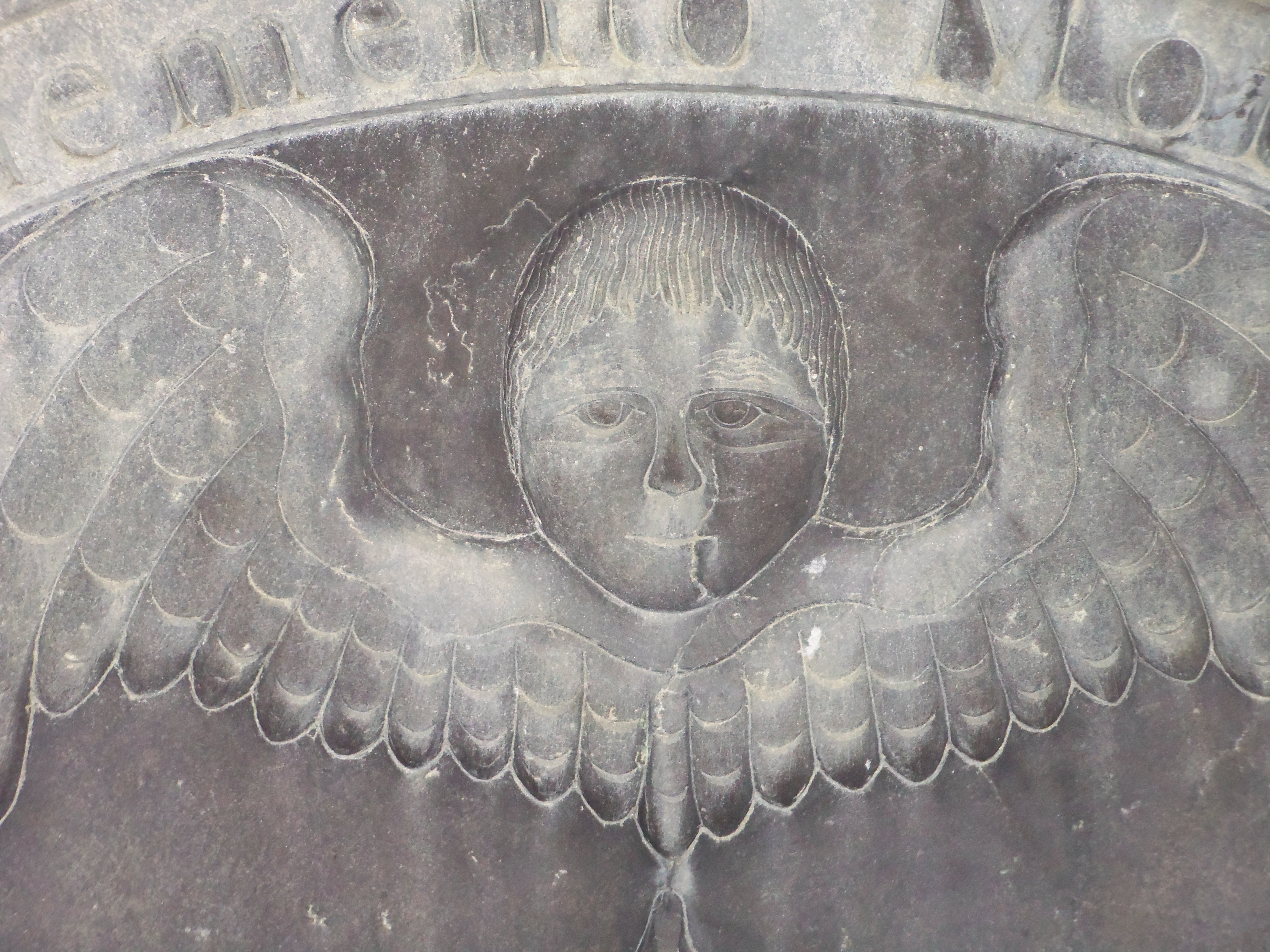
The winged death's head is a common gravestone motif in New England. This example is in Watertown, Massachusetts.
The winged death’s head is a common gravestone motif in New England. This example is in Watertown, Massachusetts.

The poems that resulted have one foot in Portsmouth and Dover, New Hampshire, and another in Portsmouth and Newport, Rhode Island, where I quote from the 1664 will of Alice Shotten Cowland and some of the activities of her son-in-law, Robert Hodgson – sometimes spelled Hodson, as well as Hutchin. (I detail what is known of their lives in my genealogy blog, The Orphan George Chronicles.) She was part of the early dissent against Puritan authority, first with Samuel Gorton and then as one of the first Quakers in the New World. I love Robert’s memorial minute, which calls him “an ancient traveler in the Truth.” He arrived in America on the historic voyage of  the tiny Woodhouse, causing turmoil in Manhattan and Long Island before heading on to Boston. As far as I can determine, he was no relation to my line, no matter how much many have tried to find the link.

~*~

Winged Death 1To see more, click here.

IN THIS JOURNEY TOGETHER

I’m always startled to hear people say they can pursue spirituality without any teacher or community. Nothing in my experience, as a yogi or a Christian, supports that. If you point to George Fox’s time of sitting “in hollow trees and lonesome places,” and his recognition that among the priests (and preachers) he consulted, “there was none among them that could speak to my condition,” and his eventual proclamation of discovering “the pure knowledge of God and of Christ alone, without the help of any man, book, or writing,” the fact remains that he was stimulated by that early dialogue and, once he’d experienced Divine Revelation, did not keep it to himself but was instead drawn out to others who were having similar transformations.

I would point, too, to the spiritual support he received initially from Elizabeth Hooten – whom I consider the first Quaker and who, incidentally, came across the Atlantic in her advanced age to Dover to minister among Friends here — and later from Margaret Fell.

One reason we need community to accompany our spiritual deepening and expansion comes in the ways it can counter tendencies toward self-deception, human weakness, laziness, or distraction. In the practice of our faith, we instruct, encourage, acknowledge, embrace, correct, inspire, comfort, guide – even rebuke – one another. These are matters the New Testament calls discipleship.

Lloyd Lee Wilson has reminded us there are no Quakers apart from the meeting, which is another way of saying each Friend needs to be part of this interactive dynamic. I remember my shock in picking up a book on leaders of the Confederacy and finding three Quakers indexed; “Impossible,” I muttered, until seeing in the text that all three had been raised in Quaker households but resided far from any meeting – and its corrective discipline – when the war erupted.

Try dressing Plain and adhering to Plain speech without a circle of Plain Friends at hand, and you’ll discover just how hard it is to continue even an outward practice. Maintaining a witness is no less difficult. Moreover, I find it’s hard to keep from being overwhelmed by the negative influences around us. Maybe part of the restorative answer is right in front of us all along – Society of Friends, plural.

Or in some other, similar circle.

TALK ABOUT HARSH CRITICS

Perhaps nothing separates us from earlier generations of Quakers more than our love of arts and entertainment. It’s not just that our frequent references to music, fictional stories, and visual arts would have perplexed or even annoyed them. Especially as part of our vocal ministry during worship.

Rather, these were simply forbidden as vain or even useless. The focus was on piety and humble service.

Pleasure for its own sake? We wouldn’t have been members back then, period.

~*~

And now I find myself envisioning some of Peter Milton’s wonderful lithographs in which earlier generations of artists watch from the balconies or wings of the scene unfolding. I often have that sense of the past watching us — and that includes in our Quaker circles.

REGARDING THE DLQ

Jaya, in Promise, isn’t the only character in my fiction to address a concept I’ve dubbed the DLQ, or Dedicated Laborious Quest. But she does, I’ll argue, come closest to aspiring to an artistic expression for its encounters.

The DLQ, as I envision it, is the long-range discipline of spiritual pursuit, one that can be found in any number of variations in any number of religious, artistic, social activist, or even athletic lines of action. It’s a blending of heart and head, body and soul, awareness and discovery – the poet Gary Snyder refers to something similar as the Real Work, for instance, or maybe simply “daily practice” will touch on it as well.

One of Jaya’s concerns is a search for a fitting vehicle to embody the experience. Essays are too prosaic. Poetry? Sometimes. Drawings or paintings? To a degree. Maps of a kind? Getting closer, I’d hope.

Even so, I’ve wanted to leave the ultimate form she uses open to the imagination.

And then, more recently, I came across something that comes closest. An exhibition of Shaker art and artifacts at the Farnsworth Museum in Rockport, Maine, introduced me to what are called Gift Songs or Gift Drawings or Gift Paintings, which take their name from the faithful artist’s position as a medium receiving the song or design from a deceased member of the sect (that is, given) to be conveyed to another, living member of the sect (also, as given). To be appreciated, these must be seen in the original, full size, since much of the detail gets lost in reproduction. Sometimes the words are in a secret, private language and alphabet. Sometimes they blend. The lines flow, turn upside down, sideways. The works are sprinkled with artwork as well as words. Are they magical? Or simply mysterious?

Whichever, they spring from a tradition and discipline and practice to utter something deep in the heavenly desire and earthly community of a particular recipient.

I can tell you Jaya would have been most impressed. Definitely.

Promise~*~

To turn to my novel, click here.


YOU’RE ALLOWED TO MISS A SELF-IMPOSED DEADLINE

It’s mildly amusing to see how many of my fellow bloggers apologize when they haven’t posted anything for several days. Or weeks. Or months.

I want to cry out to them, “Don’t worry!” And then, “No need to apologize!” After all, there’s no shortage of material on the Web or even here in our WordPress networks. Nobody’s paying you to write, there are no hard deadlines you’re required to meet, you’re not being graded. The whole point is to have fun and then, if time allows, share your experiences and insights. In reality, few of us are keeping track of who’s posting daily … we just enjoy reading good stuff when it’s there, especially when it’s coming from a circle whose company we enjoy.

That, I should emphasize, is the crucial detail: post when you have something to say, not just to fill space.

Unlike many of you, I have a whole lifetime of writing to fall back on, but as you already know, the Red Barn is a different kind of blog, one with its own mission. And accept my thanks for stopping by when you visit. Especially those of you who leave comments, where I never know what to expect.

Now, what’s on the menu for tomorrow? We’ll see. Maybe I need to step out and check the garden.


QUERIES IN THE SOCIAL HOUR

Some of the most profound and lasting messages I’ve received among Friends have come outside of the Meeting for Worship – and often as questions. It may surprise many of you to learn that in my first years with Quakers, I was generally pretty hostile to anything smacking of Christianity. And yet seeds were planted. I recall, for instance, Norris Wentworth’s observation while giving me a lift in his car – something to the effect that because America has an underlying Christian mindset, Eastern religions would have trouble taking root here.

Or “What do you think of Jesus?” during my clearness session for membership in what turns out to be one of the most universalist meetings in America. (Our preparative meeting was about 150 miles away in the desert of Washington state.) Followed by a remark to me, “I fear that we’re losing our Christian connection.”

A few years later: “What do you think of the Bible?” as an elderly Wilburite Friend in Whittier, Iowa, drilled her eyes in my direction. I doubt my analogy of a sharpening-stone wheel satisfied her.

Or, a year or two later: “And just what spirit was thee speaking of?” Mary Hawkins, an elder at Middleton Meeting in Ohio, before adding. “there are many spirits – anger, envy …” Since then, I have since been careful to say, Holy Spirit or Spirit of Christ.

The most influential Friend, though, was Myrtle Bailey, a recorded minister at Winona, Ohio. I’ve been thinking a lot lately about her asking me what I considered the perfect meeting, and my response, which seemed to surprise both of us. Rather than looking at meeting as the experience of worship, I looked at it as a community – a woodpile, in fact. We need good pieces of seasoned wood, as well as kindling; but also green wood, to begin seasoning. Here at Dover, we seem to be falling behind on the green wood supply. Which leads us to the next question.

ALONG WITH THOSE ARTISTS WE KNOW

As I said at the time …

For too long, there’s been a huge gap between the blockbuster superstars and the rest of the practitioners, many of them far more innovative or penetrating.

Paris for American ex-pat writers? Again, I smile. By the time you and I came along, the destination was Seattle or San Francisco or Greenwich Village. Or some mountainous terrain, for those of us who couldn’t afford anything better. (Or thought so.) And then Minneapolis and, of all places, San Antonio. As it turns out, New Hampshire has far more than its share of authors, probably because of its proximity to both Manhattan and Boston, in addition to its tax structure – so again, I’m in a decent spot.

Especially compared to many of the others.

STEP BY STEP WELCOME

These days, the Greek Orthodox community has much more substance – and influence – in Dover than do the Friends, even though Quakers once formed a third of the population.

Our plumber, our wine retailer, our favorite meat store, the downtown seafood restaurant … the list goes on. Add a daughter’s boyfriend, one-half of his genetic pool. The local congregation’s participation in the ecumenical Thanksgiving service. Or its annual Labor Day weekend festival and traditional food and dancing.

Even so, it’s a largely invisible presence … and quite a legacy, as I’ve been discovering, step by step. Let me add, a very tolerant circle, too, as they’ve welcomed me to the line in dancing. Oh, my, have they!

POINT OF TRANSCENDENCE

Curiously, growing up in Ohio, I was nonetheless somehow fascinated by mountains. They arose in my early drawings. On family trips, it didn’t take much for a wooded hill to become a mountain in my mind. An astrologer might argue it has something to do with all the air signs in my chart. Whatever the reasons, a ridge line or summit calls to me.

There were a few tantalizing early encounters in childhood trips to the Great Smokies and eastern Kentucky. My true initiation, however, came at age eleven with a week of backpacking on the Appalachian Trail in Tennessee and North Carolina. It was miserable and magical, and left lessons for a lifetime.

Still, it wasn’t until after my college graduation that I came to fully appreciate mountains – living, by turns, in the Southern Tier of Upstate New York, the Poconos of Pennsylvania, the Cascades and Olympics of the Pacific Northwest, as well as Maryland (with its Catoctins and access to the Shenandoah Valley) and finally New Hampshire.

Many of my poems arise in some of those experiences over the years.

We could collect them as “By Gully,” playing off Louis Ulrich’s vow to climb Ulrich Couloir to the summit of Mount Stuart (9,415-foot elevation) one final time – “my gully,” as he referred to the trajectory more than four decades after he and two partners established the now basic mountaineering route in July 1933. A climber explores a slope, recognizes the avalanche chutes along the higher crests, approaches summits themselves via passes, gaps, or notches, usually following a streambed. The connection of gullies and mountains is established. By Gully.

Yet that is only half of the equation. Mysticism, as I’ve known it, keeps a foot to the ground, and often a hand or the butt, too. The spiritual journey leads to the mountaintop and back – if you don’t run ahead of your Guide.

~*~

It’s the background for some of my novels and poetry now appearing at Thistle/Flinch editions. To read more, click here.

Back Pack 1