TRIANGLE

the pack, as in cards or dogs
or the one after

Enigma Variations but it’s snowing
and there are no birds

finally, a female
cardinal

teapot and cup
beside a four-poster bed
with the long shadows of sunrise
on a plank floor

I love you truly madly deeply

mountain laurel and a Cigar Store Indian
unpainted carved wood

this relationship has changed

four State Supreme Court Justices, their backs together

a Portuguese woman
walking the beach with a TV set balanced atop her head
as the husband waves

leathery kelp as “cloven tongues”

the orderly farm in the Shenandoah overshadowed by two tall silos

nine pitchforks hanging in three rows in a shed
with two gasoline cans and four spades
on tool pegs

a map of Sturbridge Village

a pack of poets or painters or ex-lovers or actors or dancers
could be a loaded deck, all right, shuffled together
4-EVA

at the Hague, then Edinburgh
in the burning letters, her third line
how flat, stretched out under the sun

“Your crimsoning lips”

Poem copyright 2016 by Jnana Hodson
To see the full set of
Partitas, click here.

MORE THAN A QUESTION OF IDENTITY

What would you be if you weren’t Quaker?

I usually pose it in terms of religious affiliation, skirting the bigger issue of what we’d be without that particular spiritual discipline and nurture.

The question often illuminates an individual’s leanings within the Society of Friends, and it’s one that can be telling in many other denominations as well.

Many of us come to where we are from other religious traditions, and even among Christians the variations can be vast. And then there are yogis of all stripes, Buddhists, Native practices, arcane and pagan seekers, non-theists, agnostics, and much more. Neo-Muggletonians, anyone?

Some Quakers are very drawn to the social activist side of our community; others, the meditative worship. Some are quite Biblical; others, anything but. (Shall we mention the Gospel of NPR?) And that’s before we get to the full spectrum of today’s Friends, from ultra-univeralist to evangelical to alternative Christian to, well, we’re all over the map. And yes, many of us do miss music in our worship.

Continue reading “MORE THAN A QUESTION OF IDENTITY”

RECOVERING WHAT HAD BEEN LEFT UNSAID

Decades ago, faced with a question of just what Friends believe, I embarked on an exploration that might provide a more inclusive answer than “Some believe this …” or “Most do that …”

To the surprise of many, the Religious Society of Friends does have a rich underlying theology, one so radical our First Publishers of Truth (one of the original names for the Quaker movement) couldn’t voice it in its fullness in the earliest years before settling into a system of practice rather than fully pursuing its intellectual implications.

Call it an alternative Christianity if you will, but even Friends need to understand its dimensions.

~*~

For more, check out my essays, Religion Turned Upside Down.

DIMENSIONS OF ARTISTRY

The space of art also works in other dimensions. The artists themselves are rarely of the same social class as their benefactors or audience. We repeat the cliché of starving artist, even when some become comfortably wealthy and dwell in chic locales. Still, they’re employed in ethereal fields — actors, musicians, painters, the stagehands and gallery owners, box office managers, and a host of others. They work different schedules from the general populace. Many sleep late or stay up through the night.

There are even the spaces as a work moves away from its creator into other locations. A painting, for example, appears one way in the studio, another way on one’s walls, and still another way in a gallery — none of them resembling what happens when the same piece is hung in a major museum. Musicians and actors know the difference between the intensity and argument of rehearsal and the propriety of performance itself. An author can observe how different a piece appears in manuscript, in galley-proof, in a magazine or literary review, or in a bound book. A poet or a poetry supporter becomes aware of the differences between viewing a piece on the page, voicing it on the lips (either in a public occasion or for one’s own private pleasure), or performing it in a formal reading.

We can move outward, of course. Into ballparks or arenas. The loud crowds. But those are other spaces, in some ways overlapping fine arts and religion.

We might consider as well the ways the fine arts have been acceptable as civic religion. An Oscar or a Grammy is more valued than a Crucifix in our society. A comedian is a better master of ceremonies than a preacher or priest. We’re nervous about civic events held in houses of worship. A wedding or funeral, perhaps, though it carries a sense of crossing into something private.

On the other hand, as religion has retreated largely from public awareness, or perhaps simply to the suburbs and better parking, it has abandoned earlier houses of worship, especially those downtown or in the inner city. Some have been converted to arts spaces — galleries, concert halls, night clubs, theaters, restaurants. I regard these as being somehow different from structures designed and built for arts uses. It’s more than recycling, I’d say.

For more insights from the American Far West and Kokopelli, click here.

PRELUDE & FUGUE 35/

red maple on gray rock against
vertical tan stripes
the pooling and hill

*   *   *

blue-eyed moth on yellow chopstick folder
star lilies against horizontal green striation
Chinese river scene, the coin inscribed
from a tickle-free zone of “Dried Dark Plums”

red maple on gray rock against vertical tan stripes
pooling under a blue-eyed hill of moths
over another yellow river, the Chinese “Dried Dark Plums”
held aloft on scenic chopsticks or inscribed coins

as folded red maple on gray rock against vertical tan
line up between the pooling and hill of star lilies
as horizontal green striation from a tickle-free zone
the blue-eyed river inscribed with yellow moths

as “Dried Dark Plums” are maple red on gray rock
against vertical tan striped pooling water buffalo work
in a wet field of chopsticks between star lilies open
against the blue-eyed horizon with its variations

as coins and moths inscribed in yellow Chinese
calligraphy, the tickle-free zones become a river scene
for a “Dried Dark Plums” holder of chopsticks
made from red maple in their tan stripes

as the gray rock against vertical pooling
toward the hill of star lilies and their horizontal
green striation from a tickle-free zone
water buffalo patiently work a field

~*~

Poem copyright 2016 by Jnana Hodson
To see all 50 Preludes & Fugues, click here.

THE SPACE OF ART

This time, flipping through a glossy magazine, I confess to myself a sensation I’ve often experienced in the realm of the fine arts. It’s a consciousness I first associated with the hush of large museums, a rarified atmosphere that could well be pressurized. There’s a degree of trespass, moving from the everyday world into this temple, and an expectation of awe.

The museum itself could be dedicated to history or natural science or even military technology. We speak softly, walk slowly, reflect and absorb impressions.

There would appear to be similarities to religion in the expectation of awe or the ephemeral. These are holy places, consecrated and set apart. They are cathedrals built to preserve sacred relics — not just any bones or works, then, but all those who have advanced the cause. There are rituals, as well, in the progression through exhibit spaces or the celebratory openings. There’s also a sense of the departed, as though wandering through a cemetery; here the memorial names are included as donors of objects, rooms and wings, or endowments, in addition to the artists or high priests themselves. But there are differences, as well: where religion has at its core what is eternal, timeless, and righteous in the eyes of God, art often strives for a sense of progression, which fosters curiosity, novelty, play, even a touch of shock or scandal. Where religion imposes ethical behavior, art frequently excuses or even encourages the practitioner in indiscretions. In both, though, there’s an expansion of one’s field of awareness, however brief, and a moment of personal renewal and refreshment before resuming one’s usual activities.

These spaces are not just those for visual reflection. A concert hall, playhouse, or theater has similar dimensions. We settle in, become quiet, and the house lights go down as the stage lights brighten. We show reverence and appreciation by applauding at appropriate moments. Newcomers are initiated in the customs.

Layers of wealth and breeding also appear. The institutions typically originate in noblesse oblige. The patrons reserve box seating or receive invitations to openings, private showings, or galas. Members and subscribers enjoy their own privileges. Smaller spaces, such as art galleries, chamber music settings, or poetry readings extend the experience. Libraries, as well, can be seen in this light. The sensation often recurs when I’m handling a thick, refined, costly literary quarterly — one printed on carefully selected paper and published with an eye for expert, balanced typography. (Sometimes the work presented becomes secondary to the presentation.)

We might speak of the thoughts and emotions that arise in these encounters. The space of art can be acknowledged in one’s own life, then. We observe, but don’t touch. We listen, but don’t speak. We’re voyeurs who do not taste what’s on a plate before us. Here, in public places, we visit our own private musings. There is an outward uselessness in it, ultimately. Time in these spaces does not add to our wealth, our table, or the usefulness of our apparel. It does not transport us physically from one place to another, although it may do that in our imaginations. What does happen is our moving from our animal roots into uniquely human possibilities.

For more insights from the American Far West and Kokopelli, click here.
COURANT

with closed eyes, a bare-shouldered
young Victorian woman
and black gloves
holds the exploding champagne bottle
upside down

the next leg of your journey has been canceled

smells the foaming

am I waking?

I keep forgetting where I’ve been
(where I put this or that)

who said what
even me

on the horn: “the One who shall not be named”

keep trying to admit
where I am

the raised garden beds as love letters

how others perceive that negative side, especially,
certainly, toward me,

an ambulance with its lights flashing
at an intersection beside the Laundromat
is forced by congested traffic
to wait for the light to change

it’s Friday and I’m running late

Poem copyright 2016 by Jnana Hodson
To see the full set of
Partitas, click here.

HARVARD’S GREAT THEATER

The aspirations are obvious.


Instead of gargoyles, just look ...
Instead of gargoyles, just look …


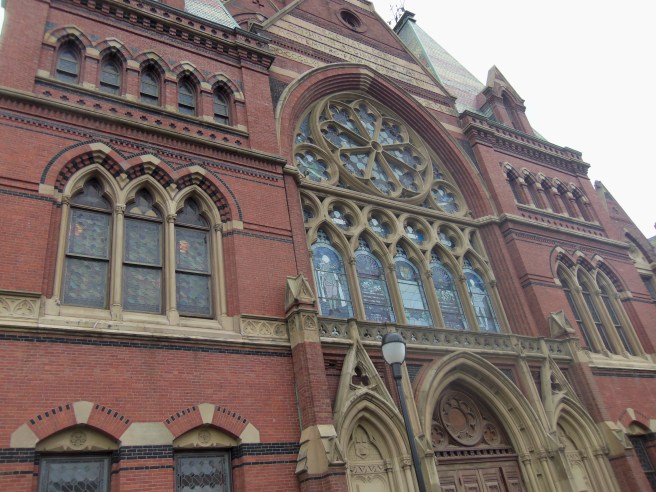
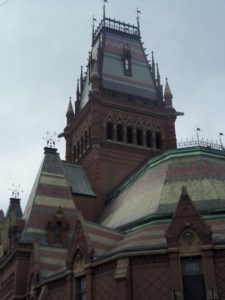
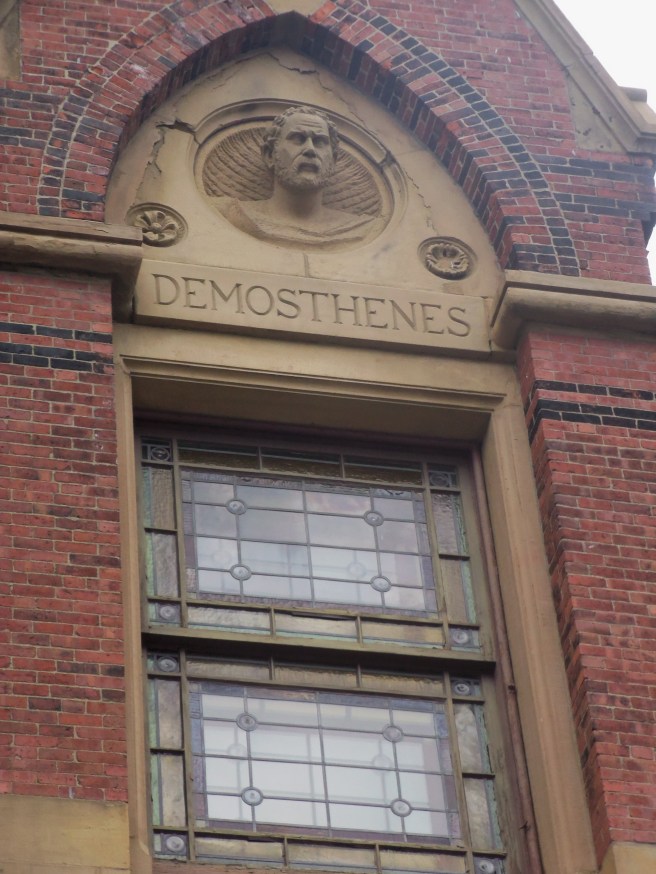
Memorial Hall in Cambridge is a high Victorian Gothic building erected in honor to the Harvard University men who died defending the Union in the American Civil War. One end of the structure holds Sanders Theatre, an intimate, wood-toned Globe-style auditorium – one we treasure for its Christmas Revels productions each year. The other half of the building embraces the Harry Potter-like Annenberg dining hall. The two parts connect at a marble-lined hallway engraved with the names of the fallen Harvard students.


Even on a cold, blustery day, it's hard not to be impressed when approaching its entrance.
Even on a cold, blustery day, it’s hard not to be impressed when approaching its entrance.


Imagine trumpets from every portal. Not that the Revels do it ... yet.
Imagine trumpets from every portal. Not that the Revels do it … yet.


Greater Boston is a rich and varied destination – the Hub of New England, or the Universe, as they used to say. Living a little more than an hour to the north, we’re well within its orb.

JUST WHAT, THEN?

In town, the side of one building has a ghostly paint on black brick. With difficulty I decipher

COMMERCIAL SALOON
T. MALLET PROP.
CIGARS NOW 5 c

across from the train depot and next to the OPERA HOUSE. Railroads, cigars, saloon, and opera all fit together in a remarkable calculation. Just where were women, besides up on stage?

What, precisely, mad the Far West so different? No family roots? It was all male: cowboys, loggers, miners, fishermen, soldiers, trappers. Even an orchard’s considered a ranch. You need only a few acres, Buckaroo. Where is my wife at this moment? Like Maya of Sanskrit lore, she’s a weaver. Like Maya, she had spun a web of entrapment. Maybe these open spaces aren’t really so open.

For more insights from the American Far West and Kokopelli, click here.
PRELUDE & FUGUE 34/

the angel Aquarius, with a bare foot pointed to the stars
reclines on a stone bench
in front of a domed courthouse

*   *   *

Vermont green in decline where money
was once transformed into Corinthian columns
and porticos overlooking lawns high over reflected
water as much as the Grand Hotel first-floor porch
the length of a building that would blast your yuppie façade

hidden opposite a kitchen under an atrium lined
with classical Greek busts inscribing some tryst
in Greek drama nightlife countered by the classical proportions
of a domed courthouse goddess in laurel and a red gown
far from the masted ships in a storm, her arms bared

her bare feet Vermont green, reclining where
once money was made carving Corinthian columns
uphold a portico on a Grand Hotel high over the water
with a first-floor porch the length of the lawn and
your blasted yuppie façade hides a kitchen under an atrium

its shelf of classical Greek busts inscribed with dramatic
trysts countered by classically proportioned nightlife
behind a domed courthouse goddess in lilac and laurel
and a red gown mast stripped in a storm of Vermont green
to such bare arms, bare feet now in decline

there was once money to be made behind Corinthian column
porticos on lawns high over the waters of the Grand Hotel
porch the length of your yuppie façade kitchen
atrium with classical busts and dramatic trysts
countered by dome nightlife courting a Greek goddess

in laurel and red gown stained glass, a Greek revival mansion
with four pillars and broken colonnade dividing a green lawn
from a tall hedge statuary in a gray-headed cemetery
the angel Aquarius, with a bare foot pointed to the stars
now intertwined with tree
(Ursula, Arctos of bear legs and bear paws)

reclines on a stone bench in stained glass statuary
in a gray-headed cemetery (Ursula, Arctos of bear legs
and bear paws) revives four pillars as the angel
Aquarius, with a bare foot pointed to the stars reclines
on stone bench broken colonnade dividing a green lawn

from a tall hedge now intertwined with trees
in stained glass statuary in a gray-headed cemetery
(Ursula, Arctos of bear legs and bear paws)
reclines on a stone bench with no uprising of life within it
this Greek revival mansion with four pillars
broken colonnade dividing a green lawn from a tall hedge

in stained glass the angel Aquarius, with a bare foot
pointed to stars now intertwined with trees
statuary in a gray-headed Greek revival mansion
with four pillars, the angel Aquarius now intertwined
with no uprising of life within it dividing a green lawn

~*~

Poem copyright 2016 by Jnana Hodson
To see all 50 Preludes & Fugues, click here.