Ten popular Hindu deities

Nobody knows how many gods and goddesses there are in Hinduism. Some say more than 100,000. They’re likely to pop up in places like the ashram in my novel Yoga Bootcamp.

Here are ten of the most popular.

  1. Shiva. The destroyer, especially of evil.
  2. Parvati. His wife. Goddess of fertility, love, and devotion. Also known as Uma.
  3. Vishnu. The preserver or protector.
  4. Lakshmi. His consort and shakti (source of energy). Goddess of wealth, fortune, and prosperity.
  5. Brahma. The creator or self-born.
  6. Saraswati. His consort. Goddess of knowledge, art, music, learning, and wisdom.
  7. Ram or Rama. The seventh avatar (incarnation) of Vishnu.
  8. Krishna. The eighth avatar (incarnation) of Vishnu.
  9. Ganesh or Ganesha. A popular, comical son of Shiva who gained his elephant head as the result of one of his father’s wild rampages with a sword. A kid can’t go headless, can he? Let’s see what we can find as a substitute.
  10. Hanuman. He’s monkey-faced and an ardent devotee of Lord Rama. Some versions have him as a son of Shiva. He’s popular for all kinds of reasons.

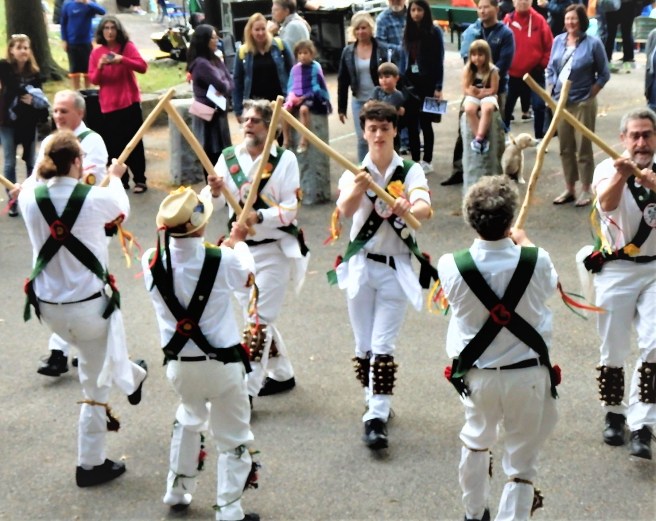
Morris men in a ring at the autumn equinox

The Pinewood Morris Men continue a festive dance style from the late middle ages in rural England. The performers wear costumes specific to their troupe, including bells, and often wield sticks or handkerchiefs in their routines. This group frequently appears in Boston Revels’ events throughout the year. Here they are greeting concertgoers to last fall’s equinox RiverSing in the Herter Park amphitheater along the Charles River in Allston.

Ten facts about the Romani

The more she learns about her great-grandmother in my novel What’s Left, the more reason Cassia has to be curious about her roots.

  1. Romani or Roma: The preferred terms for “Gypsies.” They are ethnically and genealogically different from other Europeans. They originated in northern India and migrated about 1,500 years ago as a group.
  2. Roma subgroups differ in language and variations of customs: These hold social distance from each other.
  3. They are a dispersed population: They have significant concentrations in Egypt, Turkey, Romania, southern France, Spain, and Hungary.
  4. Population in U.S.: Estimated at one million. Largely centered in southern California, the Pacific Northwest, Texas, and the Northeast./
  5. Population in Greece: Between 200,000 and 300,000.
  6. Population in Brazil: 800,000.
  7. Roma slaves: They were shipped with Columbus in 1492. Spain sent Romani slaves to Louisiana, 1762-1800.
  8. Romania: Abolished Roma slavery in 1864.
  9. Marriage: Couples generally wed within their tribe. The parents of the boy customarily select his bride, and a bride price would be paid to compensate her father for his loss.
  10. Community: When a Roma male marries a non-Roma, she may in time be accepted by the community, if she accepts their way of life. For a Roma female to marry a gaje, however, is a serious violation of marime or marimhe code originating in Hindu purity laws.

They sound like happy fireworks

The street drum band aNova Brazil joined us last fall to help celebrate the cleanup of the Charles River two decades earlier. Here they are warming up for the Boston Revels’ equinox RiverSing last fall at the Herter Park amphitheater along the Charles River in Allston. They later fired up the procession down to the stage and performed several unbelievably complex and infectious numbers. They’re a hard act to follow, but we did it. Boston Revels hosts events throughout the year to enhance community through folk traditions.

One on each hand

Wendell Berry’s two Muses (Standing by Words – highly recommended – page 204): “There are, it seems, two Muses: the Muse of Inspiration, who gives us inarticulate visions and desires, and the Muse of Realization, who returns again and again to say, ‘It is yet more difficult than you thought.’ This is the muse of form.

“The first muse is the one mainly listened to in a cheap-energy civilization, in which ‘economic health’ depends on the assumption that everything desirable lies within easy reach of anyone. It is the willingness to hear the second muse that keeps us cheerful in our work. To hear only the first is to live in the bitterness of disappointment.”

Here, a different slant on work from an unabashedly Christian poet and essayist. (North Point Press, San Francisco, 1983.)