Witchcraft in New England before the Salem hysteria

Something I pretty much skip over in my history of Dover is the Puritan authorities’ close examination of the bodies of the early Quaker women missionaries for any signs revealing them to be witches, from 1656 on.

That was down in Boston, for one thing, and I’ve seen no indication of similar actions along the Piscataqua watershed in New Hampshire and Maine, the center of my new book.

But it has come back to haunt me.

Much of my argument regarding the readiness for a significant portion of the Dover population’s joining Quakers has to do with the ways they differed culturally from the Puritan majority in the Massachusetts Bay colony and Connecticut. What David Hackett Fischer terms “folkways.”

For example, in all of their fearful piety, what made the Puritans so morbidly curious about the naked female flesh, anyway? And just what, exactly, were they looking for? This gets weird, doesn’t it? I’m not sure I want specifics, as in details, much less in those parading through Salem, Massachusetts, these days in preparation for Halloween. I’ll have to admit that part leaves me feeling queasy.
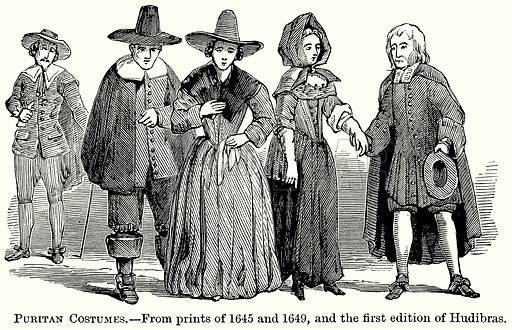
Puritan Costumes. Illustration from The Comprehensive History of England (Gresham Publishing, 1902).

Just consider the stereotypical presentation of witches in pointed hats and black capes and then recognize how much that resembles the dress of Puritan women in New England at the time. As for flying on brooms? How strange! Just how did that conflation happen, anyway? Put another way, witches didn’t dress differently than anyone else. As for the brooms? Every housewife had one.

Well, maybe that points to the male authority role in all of this, something I’m perceiving as a gender power play.

Back to the Quakers. As historian Arthur J. Worrall explains, “Two groups of Quakers arrived in 1656. The first, led by Anne Austin and Mary Fisher, came to Boston in July. The Massachusetts government promptly imprisoned them for five weeks; after checking them for signs of witchcraft, they expelled them in August. A second group of eight Quaker missionaries came to Boston two days after their expulsion,” aboard the Speedwell.

“Massachusetts imprisoned this group for eleven weeks and expelled them also, after the clergy had examined and debated with them.”

For perspective, Fischer notes that from 1647 to 1692, the Puritan colonies accounted for ninety percent of the accusations and eighty-five percent of the executions for witchcraft in English-speaking America. That is, almost ALL of them.

Moreover, “In England, every quantitative study has found that the recorded cases of witchcraft were most frequent in the eastern counties from which New England was settled.” Specifically, the Puritan heartland, in the motherland and then in the New World.

“Even white magic was regarded as a form of blasphemy. In 1637, for example, Jane Hawkins was punished for selling oil of mandrakes in Boston. Many other magicians and sorcerers were treated in the same manner.”

So just what defined a “witch,” anyway? Anyone who drew on folk remedies? Or even a midwife who knew more than she was supposed to?

Fischer goes into ways the Puritans’ Calvinist teaching and likely their earlier folkways combined to make them especially fearful.

As I observe, Salem itself was a cauldron of controversy from early on and a place where the Puritan invasion clashed with the existing population. Like Dover, the Puritans were latecomers there.

I’m still curious about the zealot ferocity of the Puritan outburst at the time of the infamous mistrials in Salem, 1692, in a perfect storm that may have fused an outbreak of hallucinogenic ergot in rye, a clash between traditional ways of examination versus newer ones, a gap in the governorship and jurisprudence, and a drive to curb the influence of the now well in place Friends by attacking their servants instead. Many, many other factors, perhaps even the weather, likely also come into play. All of the other angles I’ve heard point in the same direction.

One of the overlooked aspects in all the controversy is how the witch persecutions in Salem solidified the collapse of the rigid Puritan reign in New England. In a way, the old guard overplayed its hand and had to bear the consequences. With widespread revulsion at the executions and their abuse of the court system, a new strand of teaching and emphasis emerged in the Congregational churches. In another century-and-a-quarter, many of them would even become Unitarian, a far cry from the Puritan orthodoxy.

What makes witches so romantic for so many today?

Did the accused “witches” have their revenge in the end?

Our newspaper is the Quoddy Tides – not Times

One of the factors in our decision to relocate to Eastport was the quality of the local newspaper, which appears every second and fourth Friday of the month.

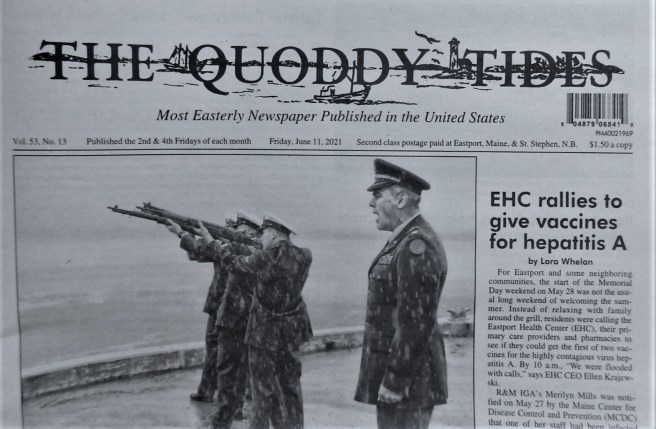
Typical front pages.

There’s nothing flashy about its tabloid-format editions, but everything I see strikes me as solid, even compelling, community journalism.

The quirky – and unique – use of Tides rather than Times in its name is not just humorous but altogether appropriate. The paper reports on all of the communities the tides touch on in Washington County, Maine, as well as many in neighboring Charlotte County, New Brunswick.

One of my ongoing criticisms of American newspapers over the past half-century is that very few of them give you a feel for the place they serve. Ownership by out-of-state corporations is only part of the problem. Continuing cutbacks in coverage is another. (I play with those and other factors in my novel Hometown News.)

For most dailies and weeklies, there’s a generic look and taste in the stories. Everybody has city-council and school-board meetings, for heaven’s sake, and most car crashes are just as boring.

Somehow, though, that’s not the case with the Quoddy Tides.

Consider the lead on a report of the start of the important commercial scallop harvest, a story that was presented on Page 2 but teased from the front page by a dramatic black-and-white photo of a fishing boat plowing through rough seas:

“Winds gusting over 50 knots did not deter many Cobscook Bay area scallop fishermen from going out on the first day of the season on December 1. About three-quarters of the fleet of over 20 draggers based in Eastport and about 10 boats from Lubec headed out that day.”

Remember, it’s not just windy with choppy surf. This is December, blowing icy water. As for a feel of the place, just listen to the quotes in the next sentence:

“Lubec fisherman Milton Chute observes, ‘The tops were blowing off the water like it was pouring,’ and Earl Small of Eastport says that while it was ‘sloppy steaming back and forth,’ once the boats were on the lee shore either off Lubec or down in South Bay, it wasn’t bad towing out of the wind. ‘It’s not as dangerous as people think,’ says another Eastport fisherman, Butch Harris, noting that two or three boats will fish together in case anyone gets in trouble. ‘It was a rough ride out, but once you’re there fishing it’s not that bad.’ Harris points out that scallop fishermen have only so many days that they’re allowed to fish. ‘If you don’t go, you lose it,’ he notes.”

Much of their quotes, I’ll venture, is pure poetry. And off the cuff, at that.

The rest of the story fills out the page, detail after detail. I bet you’ll think of some of this dedicated labor, too, next time you eat seafood.

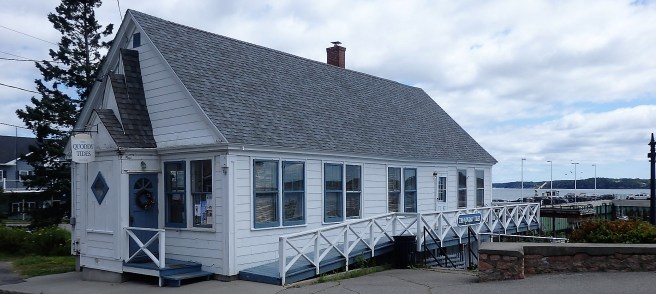
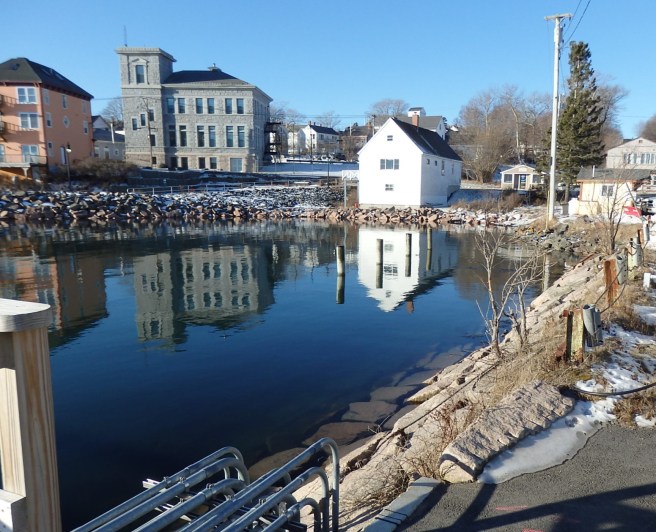
The newspaper offices occupy the 1917 Booth Fisheries headquarters downtown, once part of a sardine cannery.
The building sits right on the harbor. The post office and former customs office stands to the left.

The Tides was founded in 1968 by Winifred B. French, the wife of Dr. Rowland Barnes French, M.D., and mother of five. They moved to Maine from Arizona in 1953 so he could help found the Eastport Health Center, itself a remarkable story in community medicine.

Winifred had no background in journalism, but she saw a need, studied hard, and ventured forth in launching and editing a small-town paper with a regional outlook. In 1979, for good reason, she was named Maine Journalist of the Year. Remember, the Tides isn’t a daily or even weekly newspaper, it’s every two or sometimes three weeks.

Reporters attend public meetings rather than chasing afterward by phone, correspondents provide meat-and-potatoes servings of neighborhood interest, Don Dunbar contributes top-drawer photography, and local columnists all weigh in for what becomes must-read pages throughout the area. The mix skirts the glib boosterism and doom-and-gloom morbidity too prevalent elsewhere.

Winifred died in 1995, but son Edward French and his wife, Lora Whelan, continue on her model. (Another son, Hugh, heads the Tides Institute and Museum – note that Winifred’s sense of “tides” continues there, too.)

I like the fact that the stories don’t carry datelines. Nope, the reader doesn’t get a chance to turn off on the basis of a single word. The region is closely interlinked by people living in one place and working in another or having family elsewhere, so it’s all of interest or should be – both sides of the U.S.-Canadian border.

I also like the fact that headlines come in just two sizes, with a serif face used for a touch of variety. There’s no need to scream to draw attention. Instead, we get an orderly and fair-minded sensibility.

So that’s an introduction. I could go on and on.

In some ways, it reminds me of Annie Proulx’ novel The Shipping News, without the dreariness and grimness.

Nothing flashy or sensationalized. Fits the character of the place. 

One thing I would tweak is the nameplate, which goes back to the first edition. That shoreline still seems to strike out the paper’s name.

Still, it’s a joy to be retired and not have to be in the midst of producing all this. These days I do delight in being able to sit back and simply enjoy what I’m reading – even if I do on occasion feel an urge to “fix” something on the page.

What – or whom – do you look forward to reading the most? On a regular basis. (Apart from this humble scribe.)

How can anyone ever read all of what’s pouring in?

There’s just so much out there, in print and especially online, and it keeps proliferating daily, even hourly, and I don’t know about you, but I’m in the camp that finds it truly overwhelming.

Everywhere, each minute, make that second, we’re expanding outward, away, from any notion of a renaissance man, and woman, who could possibly be well informed on every facet of a civilized society.

Even in science – or maybe, especially in science – it’s become impossible to keep abreast of the flood.

Interdisciplinary collaboration has become more essential than ever, but also more elusive.

Is this leading toward disintegration?

Is this, in fact, the root of the reactionary backlash around the globe, not just the Trumpian cultists?

Yeah, the folks who rely on Fox TV biased “news” in the USA.

I look at the crises facing our children and grandchildren, and these are critical, but there are so many it’s mindboggling trying to decide where to pitch in taking a stand. Climate change, population explosion, racism, corrupt politics, the one percent and injustice, environmental protection, medical systems, education … Hey, I’m back to hippie era causes on steroids.

How are we supposed to preserve our sanity and still press toward a better future?

We still have to be informed, right? And thinking clearly?

About the Wabanaki

In writing my history of Dover, I had to face up to the problems of the word “Indian,” which can refer to someone from the Asian subcontinent as much as it does to an Indigenous person of North America. In the end I decided to avoid it altogether unless it was part of a direct quotation or traditional title.

The fact is, the Native tribes themselves can differ widely in their language, customs, and culture, so a generalized label can be downright misleading. And in a particular place, the same people may have been referred to by different labels, depending. You know, the way a Daytonian was also an Ohioan, Midwesterner, or even Buckeye, though not necessarily an Ohio State football fan.

In addition, the tribes themselves may have been much more fluid in their associations than the English and American authorities could comprehend, insisting instead on a more rigid classification.

That was the case with the Passamaquoddy and Penobscots in Maine.

In the Dover history, I ran up against that when some sources called the local Natives Abenaki, while others called them Cochecho or Penacook or something else.

As the Wabanaki Confederacy explains, though, all Abanaki are Wabanaki, but not all Wabanaki are Abanaki.

That said, let’s take a quick look at the Wabanaki.

  1. It’s not a tribe. Rather, the confederacy today is an official alliance of four East Algonquian nations remaining in Maine – Mi’kmaq, Maliseet, Penobscot, and Passamaquoddy.
  2. Historically, it was a looser alliance of tribes stretching from Newfoundland and Prince Edward across Nova Scotia, Cape Breton Island, New Brunswick, and part of Quebec in Canada on to the Western Wabanaki in the Merrimack Valley of New Hampshire and Massachusetts and perhaps beyond into Vermont.
  3. Native names for the affiliation included “convention council” or “orator council,” “be related to one another,” “those united into one,” and “completely united.”
  4. The tribes formed their council after a rise in raids by their ancient enemy the Iroquois League, especially the Mohawks.
  5. In the colonial era, many members aligned with the French, who called the region of Maine the Wabanaki inhabited “Acadia.” Many of the Natives converted to Roman Catholic faith. The defeat of the French in 1763 proved costly for the tribes.
  6. For thousands of years, Mount Desert Island – in today’s Acadia National Park – was a summer gathering place, where they arrived by seaworthy birchbark canoes.
  7. They didn’t live in tepees. They lived in small round bark-covered buildings called wigwams.
  8. Most of them grew squash, beans, and corn, and also harvested berries and other wild fruit.
  9. They didn’t dress like the High Plains Natives out west. They had their own distinctive style.
  10. They loved storytelling and legends. Mount Katahdin, for instance, was inhabited by a half-human, half-bird winged spirit called Pamola who could make the night wind blow or generate snowstorms. And the Maliseet had tales about the little people, who were like brownies or leprechauns.

About the Passamaquoddy

Getting to or from Eastport means driving through the Passamaquoddy’s Pleasant Point Reservation. And yes, I dutifully observe the 35 mile an hour speed limit. I also gladly pay the voluntary “toll” that helps fund the fireworks for the tribe’s annual festival. Besides, it’s a better bargain than a movie and, anyway, we’re all invited.

Having lived previously at the edge of the Yakama reservation in Washington state, I appreciate having an Indigenous population so close at hand.

Here are some things I’ve learned.

  1. The first time I heard of the tribe was through a traditional healer and his apprentice who were our house guests maybe a dozen years ago back in Dover. And ever since, thanks to his warning, I never disrespect a mockingbird. Could that be why I’m still here?
  2. The tribe generally proclaims itself as “people of the dawn” or even “keepers of the dawn.” I’ve already posted that the dawns around here – the first light in the USA – are unique and full of wonder. But the tribal name’s root reflects the importance of fishing in their culture – “pollock-spearer” or “those of the place where pollock are plentiful.”
  3. Traditionally, for most of their 10,000 or more years, they summered in settled villages around the coasts and tributaries on both sides of the St. Croix River, where they harvested shellfish and worked the deep waters. In winter they dispersed inland, where they hunted large game.
  4. Today their centers are Sipayak (the Pleasant Point Reservation adjoining Eastport), where 2,005 members are enrolled; Motahkomikuk (Indian Township an hour to the north), 1,364 members; and Qonasqamkuk in New Brunswick, 206. There are also uninhabited tribal tracts inland.
  5. Economically, on-reservation families have a much higher poverty-income rate compared to Maine overall. The tribe is making efforts to improve income. A blueberry enterprise, a maple-syrup operation, and vacation sites are among its new directions.
  6. About 500 people speak its Algonquian dialect. After a steep decline in numbers over recent decades, efforts to preserve and reclaim its use are under way. It is being taught in the elementary schools.
  7. They’ve long been considered first-class loggers and woodworkers, as well as excellent basketry artists.
  8. In 1993 the state banned the use of the word “Passamaquoddy” by businesses, products, and activities without the written authorization of the tribe. Those using it before that date, however, were exempted.
  9. The tribe is one of four comprising the Wabanaki Confederacy today.
  10. Joe Clabby’s two excellent histories about Eastport and the Passamaquoddy vicinity delineate seemingly endless governmental mismanagement, mistreatment, and betrayal of the tribe and others in Maine and the nation – even when its members have served with honor in the world wars. One entry, relatively minor in comparison, hits home for me. In 1950, longtime “Indian agent … Hiram Hall allowed the state to charge the Passamaquoddy Fund $8,000 per home for home construction (the homes are worth only $2,500.)” Not that it ended his career.

Giving the devil his due

In researching a project of any scope, you can’t ever read everything touching on the subject, and sometimes that can be a blessing in disguise.

For one thing, it may mean you have to examine points afresh and unguided rather than relying on another’s assumptions or conclusions.

And, for another, you may find reassurance or in seeing how another researcher has come to the same results you have independently or, in another vein, you may strengthen your disagreement.

That’s where I find myself on The Devil of Great Island: Witchcraft and Conflict in Early New England, Emerson W. Baker’s 2007 examination of a paranormal outbreak of flying rocks in an inn on an island in Portsmouth, New Hampshire, ten years before the infamous Salem witch trials just to the south. Now that I’ve finally read it, I can say he’s cleared up some questions I had on events upstream and provided backup for some of my deductions.

My new book, Quaking Dover, takes place one colonial town upriver from Great Island, today’s New Castle, and shares some of the same cultural and historic influences. While I examine a sharp divide in Dover between its English settlers from Devonshire and the Puritans from East Anglia, Baker identifies this in Portsmouth and much of the rest of New England as the Old Planters, of Anglican faith, being pushed aside by the newer Puritans, and their rigid Calvinism. Quite simply, the tensions were more prevalent and widespread than I’d assumed.

The target of the airborne mineral projectiles was innkeeper George Walton, along with his family and guests, evening after evening through an entire summer.

Baker labels Walton repeatedly as a Quaker, as he also does for the identity for Nicholas Shapleigh, continuing a widespread misconception. The prominent Shapleigh proved a valuable ally but, as his descendants point out, he was never a member of the Society of Friends (Quakers). While Major Shapleigh suffers persecution for maintaining some of the Friends positions, nothing in Walton’s life or character suggests he did so. Quite the contrary, there were many reasons he would have been disciplined and disowned, if he had been part of a Quaker Meeting, the closest one being at Hampton.

As Baker, a Salem State University history professor, lays out Walton’s family and neighbors, what becomes clear that just about everyone had good reason to target the contentious innkeeper. As for a devil on Great Island, I’d have to say it was Walton himself.

Baker sees the New Castle incident as a precursor to similar events that culminate in Salem, and he traces individuals who would have been familiar with the Walton stoning incidents to the outbreaks elsewhere. He further finds common elements that include contested land claims and political upheaval, which far outweigh theological issues.

Baker has since written much more about witchcraft, befitting his locale. The Devil of Great Island is a fun and fast read and a fine introduction to a definitive moment in the American experience.

As I’m arguing, there’s much more in New England’s past than you were ever taught. Or maybe even suspected.


There’s more to history than the usual names-and-dates scenario

As I’ve admitted, many of the historical persons in my new book, Quaking Dover, really deserve full-length biographical treatment or maybe individual operas or Hollywood blockbuster movies, if only we had time to linger. Four hundred years requires a lot of compression and that meant keep moving ahead. Anyone looking for a writing prompt can dig in with a host of possibilities on the list.

Retired librarian Olga R. Morrill, bless her, rises to the challenge with her historical fiction, Vagabond Quakers: Northern Colonies, published in 2017, focusing on the three women missionaries who came to Dover in 1662 and were whipped out of town in what was essentially a death sentence.

In doing so, she also portrays Richard Waldron and Nicholas Shapleigh as fully fleshed characters, even though they both have much more ahead in their lives after the three troublesome Quakers venture off-stage, the part she follows as the women venture south. (Yes, we need a full bio for each of the guys, please.)

As fiction, Vagabond Quakers resorts to some creative history and plausibility to fill in huge gaps. I see this in Waldron’s chronology, especially – with details where my findings and her tale conflict – but she does induce a compelling drama even in the minor players. She weaves fact and fiction seamlessly and manages a credible dialogue. (What they actually said would sound unintelligible gibberish to our ears.) If only I were sure which parts arise in her invention and which parts rest on solid evidence.

I’m happy to see that she examines Waldron’s life as a major figure in Boston, not just his existence as the most powerful man in New Hampshire, where he’s usually confined in the telling. Dover may have been his private fiefdom, out on the fringe of New England, but he wasn’t exactly provincial. She even manages to stir some sympathy for the man I dub the perfect villain.

She also gives full due to the deep conflicts in the town church before the Quakers arrive. Those are something I’ve long suspected contributed to the willingness of so many residents to join Friends early on. My one quibble is that I think Elder Starbuck would have been in the other party than the one where she places him.

For me, Morrill’s biggest contributions come in her envisioning the proceedings from the women’s perspective – not just the Quakers, but even those in the Waldron household. In the actual dates-and-names history, they’re mostly invisible. Many of Dover’s earliest wives remain ciphers, and even too many of their first and maiden names are missing. As for their language, demeanor, and dress? Morrill has me willingly suspending disbelief in her storytelling. Was one of the Quakers of short stature? Not that I’ve found anywhere. As for singing? Unlikely, but the quirk does pop the individual into three dimensions.

The events she describes in what would seem an out-of-the-way frontier settlement remain an important breakthrough in establishing religious freedom, anywhere.

Morrill and I both find these events to be endlessly fascinating, and hope you will, too.

Let me know of examples of courage you find that match the Quaker women’s.