Many of the presentations at the annual Common Ground Fair in Unity, Maine, focus on healthy garden and kitchen practices.
Today’s workshops and discussions include seed saving for the home gardener, my love affair with garlic, stories of climbing fruit trees, weird and whacky wire weeders you can make, beekeeping, honey harvesting and winter preparation, cider apple tasting, growing curcubits, unusual edible plants in the landscape, three-season gardening, year-round vegetable production, building and maintaining healthy soil, green manures, heritage tomatoes, and running a “from scratch” kitchen. There’s also canning, cooking your way to health with mushrooms, health and healing with products from the hive, medicinal uses of tannins, a panel answering your questions about herbs, a solar cooking demonstration, a children’s apple pie contest, and judging of baked goods and dairy and cheese entries. Remember, that’s just one day out of the three and there are plenty of other things happening at the same time.
Among the specialties being offered by the 43 food vendors you’ll find maple fried dough, Zylabi fried dough, sausage and chicken gumbo, jambalaya, red beans and rice, chai tea, traditional empanadas, Maine fish tacos, hummus and falafel pita sandwiches, spiced beef and lamb bowls, bialys, sourdough bruschetta, tofu fries, seaweed salad, sambusas, oysters on the half shell, eggplant and hummus sandwiches, pad Thai, Asian rice bowls, festival sweet dumplings, lamb shawarma, elote (street corn), switchel, fried shitake mushrooms, chicken tikka, aloo palak, chicken and lamb flatbreads, vegan egg rolls, and wild blueberry crisp. Maybe there’s only one way to find out what some of those are.
The lamb and oysters definitely have my attention.
For more conventional tastes, there are Italian sausages, burgers, smoothies, French fries, lemonade, cheesecake, thin crust pizza, soft pretzels, Belgian waffles, popsicles, and coffee and tea.
If that’s not enough, tomorrow includes growing rice in Maine(!) and yesterday had a future of psilocybin in Maine (21+ must have ID).
I think it’s a good example of ways America’s cuisine has expanded in the past 50 years. Back in my youth, mushrooms were an exotic item that came out of cans.
There’s no Ferris wheel, no cotton candy, no neon lighting, no celebrity performers – for years there wasn’t even coffee, until fair-trade organic became an option – but the three-day event still draws roughly 60,000 folks to a two-lane road toward its grounds in the rolling farmland of central Maine.
For the first dozen years I lived in New Hampshire, I heard about the most recent gathering and spotted its current T-shirts at contradances and farm markets afterward, but my work schedule didn’t fit attending.
And then, newly remarried, I took some precious vacation time that gave me a first-hand experience – including the now legendary traffic jam that rivaled any big city. Once there, we encountered a number of people we already knew, even though we lived three hours away.
Another dozen years passed before we returned, from the other direction, and this year’s an encore.
It’s the Common Ground Fair, a three-day weekend affair held a few weeks after Labor Day – more or less an equinox celebration held by the Maine Organic Farmers and Gardeners Association, or MOFGA, the nation’s oldest and largest statewide organic organization in America.
It’s like a Whole Earth Catalog come to life. Of, if you’ve ever wondered where the hippies went, a good place to see places the movement has evolved and continues in practical ways.
Not all of it’s back-to-the-earth, either. Sustainable living, local economies, and spirituality augment the emphasis on organic agriculture and food use. There’s even a workshop on organizing a labor union.
As Dover First Parish pastor David Slater wrote in 1983: “Christianity is becoming more and more counter-cultural. In the 1950s public values were largely Christian values (even Protestant Christian values). Today we are more religiously pluralistic, but even more importantly, more secular. We can no longer assume that the values of the church will be shared by the larger society.”
How prophetic, considering where American society is today.
And how ironic, considering that his congregation embodied the common culture the Quakers in my book were countering.
The ruling Puritans in New England had reasons for opposing the Quakers, something I need to remember in the midst of my Quaking Dover arguments, They don’t get much sympathy in their objections, at least from my audiences.
As Dover First Parish historian Donald R. Bryant put it, “The Quakers did not conform with the orderly practices of the Puritan churches. They would not join in fellowship, and met among themselves, propagating their own beliefs. Many of them did not do this quietly, but in a manner that was disturbing to regular church members. They were apt to interrupt a meeting or a preacher, or to even interfere with the proceedings of a court. They insulted church order and disturbed the peace. Their conduct was described as ‘indecent and provoking.’”
Some of these points still sting as I look at today’s political and social polarization.
The ’60s and early ’70s unleashed a revolution, one I tend to see from the progressive side of the experience.
But after writing about it in many of my novels, I’m having to acknowledge a dark underbelly.
There was a strand of ghouls who opposed any kind of common action, including politics. They were deeply angry but wanted to hide in a hole rather than celebrate oneness with each other and the greater universe and then work to advance that awareness.
That points, unfortunately, to the Trumpist ultra-right wing or Libertarians with no broader community sense other than what they can get out of it directly – or otherwise get out of supporting, period.
What I’m having to see as anarchy.
Yup, I’ve overlooked those who just wanted to escape any, well, Peace & Love revolution outside of their own turtle shell.
Maybe that’s the side the younger generations have perceived all too clearly in their negative view of hippie, despite the many other aspects they openly pursue.
A comment from a professional historian after one of my Quaking Dover presentations has me realizing how much more needs to be seen in fresh light.
New England history, he said, is told through Harvard. And then, to smaller degrees, Yale and Williams College. A more accurate verb might be “filtered” or “focused,” but the implication was clear. The tale is party-line. Even Greater Boston-based.
When I delved into the roots of tiny Dover to the north, from the perspective of its Quaker Meeting, I had no idea how unconventional my stance would be.
The traditional history, I will argue, is Puritan-based and largely pushes aside the earlier settlers and the cultural differences or influence they had.
The well-organized Puritan invasion began full-force in 1630 with Massachusetts Bay and then the Connecticut colonies. Their utopian vision was far more fragile in practice than we’re led to believe. In that first decade, Roger Williams, Ann Hutchinson, and Samuel Gorton were banished, leading to the establishment of Rhode Island and quickly afterward, in reaction, Harvard College. Their own charter was under threat of revocation from the king, and they placed cannon on Boston Harbor to fire on Royal Navy ships, if needed. Think about that. And its Pequot War enslaved Natives who were exchanged for Africans, spurring the lucrative slave-trade.
That’s a lot in a small space in a short time.
Settlement to the north was not immune.
In New Hampshire, two of the four colonial towns were established by religious dissidents fleeing Massachusetts. Dover’s Edward Hilton conveyed his charter (exactly how or for how much remains unclear) to the Lords Saye and Brook for their own management … or mismanagement. As my book details, the New Hampshire province and neighboring Maine quickly became a hotbed of dissidents and misfits – a story that is largely overlooked in the traditional accounts. Let me just say it was a ripe time.
What I’ve also been seeing is that the story of dissent has focused on Rhode Island and largely ignored the north, including Salem, Massachusetts.
Should one of my upcoming presentations redress that?
A classy magazine published 11 times a year in Philadelphia and having a readership in all 50 states and 43 foreign countries has reviewed my book Quaking Dover. Yay!
As Friends Journal critic Marty Grundy asks, “What was it about Dover, N.H., on the Piscataqua River separating it from Maine, that enabled early Friends ministers to establish first a toehold and then to gather a third of the populace into the meeting, in spite of New England’s violent opposition to Quakers?”
Dover, I might venture, is way off the radar of the usual Quaker heritage addicts.
For answers, she notes, “This book offers an alternative history to the usual Puritan-centric stories,” a volume where “history is not just the result of the larger, impersonal scope of folkways, economic and political forces, or social class. It is lived by individuals who are part of families, individuals who make personal choices and influence those with whom they live. So Hodson also traces family connections showing that both a bold embrace of Quakerism and bitter persecution of the disturbers of the status quo tended to run in families.”
Yes, it is about people.
As Grundy also observes, “The book is an artifact of COVID in that it was created using what is available on the web, including secondary sources, much older published accounts, and summaries of meeting minutes … As anyone knows who has tried to do historical research recently, there is a gratifyingly wide variety of materials available electronically. Hodson has done a good job of mining; juxtaposing; and, as he says, ‘connecting the dots’ to produce a somewhat speculative but eminently well-argued and documented account,” one “also filled with verbal asides as the author comments on what he is discovering and sharing with the reader. He offers various versions of events and cheerfully acknowledges when he can’t find facts to fill in gaps.”
For the full review, see the magazine’s March issue.
My, and this was in a periodical going back only to 1827.
All of them regard waltzing, rather than the facing lines that give New England contradances their name.
I should mention that there’s something special about waltzes, which usually come just before the break after the first hour or so and definitely at the conclusion of the evening. In fact, one girlfriend would always grill me about my waltz partners on those nights she decided instead to stay home.
The first memory here involves a dance at the town hall in Bowdoinham, Maine, always special in my experience, especially those when the band centered on three families of musicians.
At the break, as I was conversing with a lovely potential dance partner, I noticed that a young fiddler, maybe six years old, was still on stage and teaching an even younger fiddler some music. It was enough for me to say, “Hey, it’s a waltz, let’s dance,” and we did, soon joined by others. I looked up and saw the amazement in her eyes. You know – If we play, they will dance – as an epiphany.
~*~
Years later, elsewhere, I was telling that story to a fantastic young dancer as we waltzed.
Her eyes lit up.
“So you’re the one!”
~*~
And then, at a Bob McQuillan retrospective honoring the rerelease on CD of an earlier LP, the partner I had for the waltz was named Amelia.
Coincidentally, the same as my step-grandmother, fondly recalled.
And the waltz was titled “Amelia’s Waltz,” composed by Bob for the daughter of a beloved band member.
The same one, it turned out, circling with me and ever so light on her feet.
~*~
I’m getting teary as I relate all this, but there you have it.
Something I pretty much skip over in my history of Dover is the Puritan authorities’ close examination of the bodies of the early Quaker women missionaries for any signs revealing them to be witches, from 1656 on.
That was down in Boston, for one thing, and I’ve seen no indication of similar actions along the Piscataqua watershed in New Hampshire and Maine, the center of my new book.
But it has come back to haunt me.
Much of my argument regarding the readiness for a significant portion of the Dover population’s joining Quakers has to do with the ways they differed culturally from the Puritan majority in the Massachusetts Bay colony and Connecticut. What David Hackett Fischer terms “folkways.”
For example, in all of their fearful piety, what made the Puritans so morbidly curious about the naked female flesh, anyway? And just what, exactly, were they looking for? This gets weird, doesn’t it? I’m not sure I want specifics, as in details, much less in those parading through Salem, Massachusetts, these days in preparation for Halloween. I’ll have to admit that part leaves me feeling queasy.
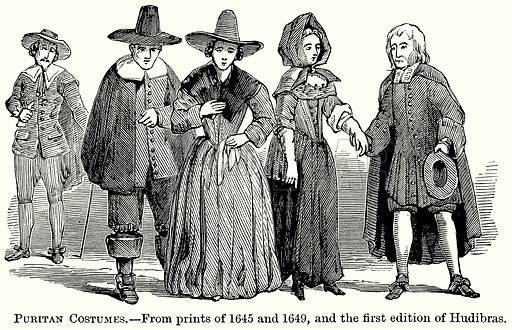
Puritan Costumes. Illustration from The Comprehensive History of England (Gresham Publishing, 1902).
Just consider the stereotypical presentation of witches in pointed hats and black capes and then recognize how much that resembles the dress of Puritan women in New England at the time. As for flying on brooms? How strange! Just how did that conflation happen, anyway? Put another way, witches didn’t dress differently than anyone else. As for the brooms? Every housewife had one.
Well, maybe that points to the male authority role in all of this, something I’m perceiving as a gender power play.
Back to the Quakers. As historian Arthur J. Worrall explains, “Two groups of Quakers arrived in 1656. The first, led by Anne Austin and Mary Fisher, came to Boston in July. The Massachusetts government promptly imprisoned them for five weeks; after checking them for signs of witchcraft, they expelled them in August. A second group of eight Quaker missionaries came to Boston two days after their expulsion,” aboard the Speedwell.
“Massachusetts imprisoned this group for eleven weeks and expelled them also, after the clergy had examined and debated with them.”
For perspective, Fischer notes that from 1647 to 1692, the Puritan colonies accounted for ninety percent of the accusations and eighty-five percent of the executions for witchcraft in English-speaking America. That is, almost ALL of them.
Moreover, “In England, every quantitative study has found that the recorded cases of witchcraft were most frequent in the eastern counties from which New England was settled.” Specifically, the Puritan heartland, in the motherland and then in the New World.
“Even white magic was regarded as a form of blasphemy. In 1637, for example, Jane Hawkins was punished for selling oil of mandrakes in Boston. Many other magicians and sorcerers were treated in the same manner.”
So just what defined a “witch,” anyway? Anyone who drew on folk remedies? Or even a midwife who knew more than she was supposed to?
Fischer goes into ways the Puritans’ Calvinist teaching and likely their earlier folkways combined to make them especially fearful.
As I observe, Salem itself was a cauldron of controversy from early on and a place where the Puritan invasion clashed with the existing population. Like Dover, the Puritans were latecomers there.
I’m still curious about the zealot ferocity of the Puritan outburst at the time of the infamous mistrials in Salem, 1692, in a perfect storm that may have fused an outbreak of hallucinogenic ergot in rye, a clash between traditional ways of examination versus newer ones, a gap in the governorship and jurisprudence, and a drive to curb the influence of the now well in place Friends by attacking their servants instead. Many, many other factors, perhaps even the weather, likely also come into play. All of the other angles I’ve heard point in the same direction.
One of the overlooked aspects in all the controversy is how the witch persecutions in Salem solidified the collapse of the rigid Puritan reign in New England. In a way, the old guard overplayed its hand and had to bear the consequences. With widespread revulsion at the executions and their abuse of the court system, a new strand of teaching and emphasis emerged in the Congregational churches. In another century-and-a-quarter, many of them would even become Unitarian, a far cry from the Puritan orthodoxy.
What makes witches so romantic for so many today?
Did the accused “witches” have their revenge in the end?
It’s like a state fair in the hippie, organic, granola-mind reality. There’s no midway with carnival rides, for sure, but for truly inquiring-minds folk, it’s an autumn equinox slash harvest-time celebration.
Yes, let’s declare a true Thanksgiving, minus turkeys.
Shortened in its post-Covid resurrection, this year’s gathering in Unity, Maine, is the premiere event of the Maine Organic Farmers and Gardeners Association (MOFGA), and runs Sept. 23 through 25.
Now that we’re living in Maine, we can identify as members and look forward to attending, even though in New Hampshire we were surrounded by devotees. Yes, it’s that boffo.
As an aside, I can attest to enjoying my best-ever souvlaki ever, from a wood stove, no less, at an earlier fair. Gee, and I hate standing in line. It was worth it.
This is definitely a hippie-vision positive manifestation of the radical mindset of nirvana. And there’s no honky-tonk.
This year’s poster will no doubt be displayed on a wall of our new abode.
 Jnana's Red Barn