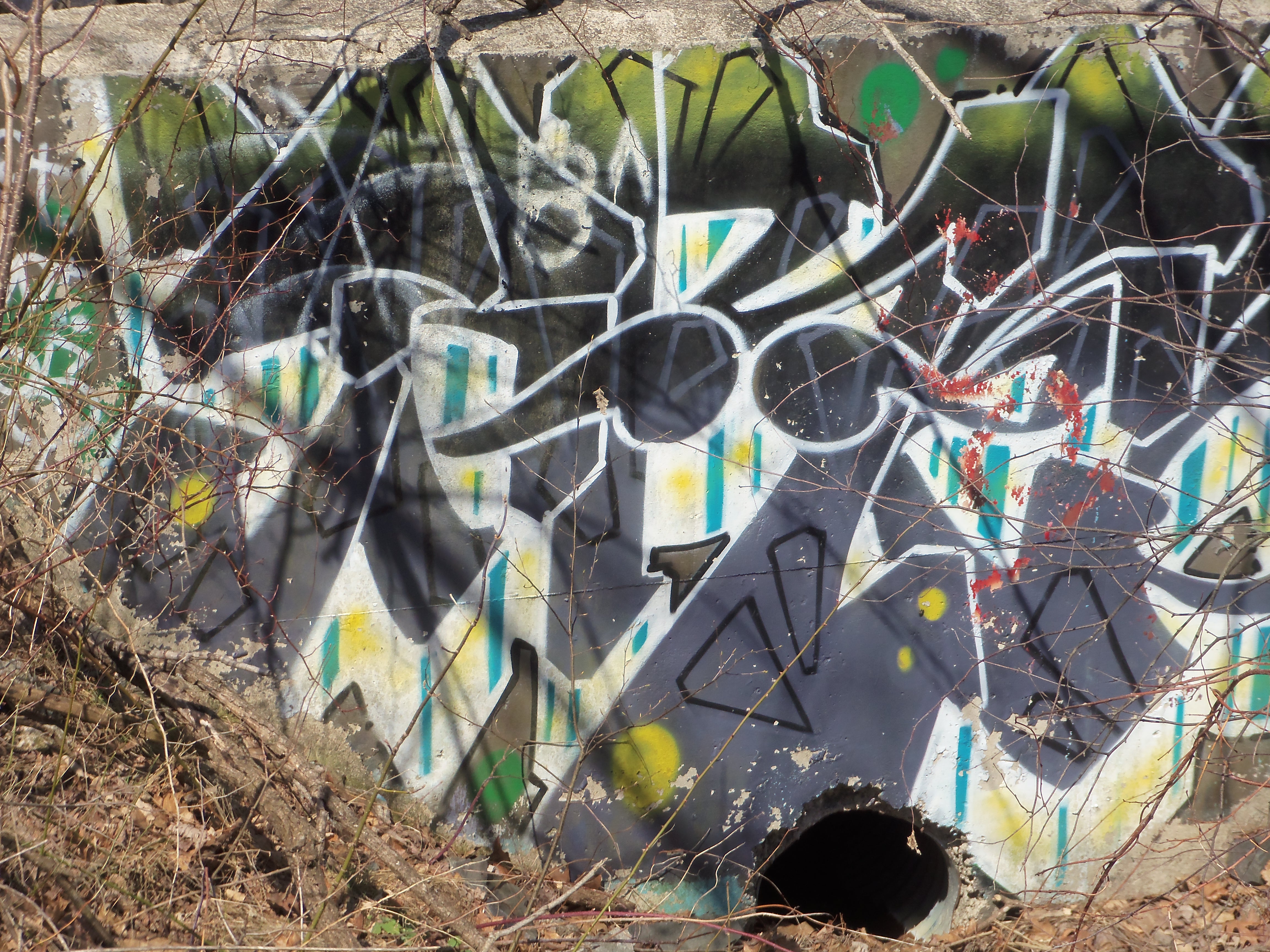
WILD CULVERT
You never know what we'll churn up in cleaning a stall
As I noted at the time …
It remains work, except for that sense, in the practice of the art, of being alive. Aware. Totally there, at times. A balance, between inspiration breath within and exhalation the atmosphere without.
Yes, it would be wonderful if we were all so spiritually deep that pure worship and our daily work of gardening and cutting firewood would be sufficient. But from experience, we can see that too often what resulted from enforced exclusion of color and imagination from our lives leads, over time, to extinguishing personality our gifts, as a group, are diminished and rather than loving delight, a bitter boredom sets in bringing with it, the backbiting profits of Satan. Which brings us full circle!
I believe we are expected to bring something back to the world from our solitude. Expected to be visionaries and priests. But not, as some would claim, shaman not unless we want to stake our life on the healing power of the individual work. Perhaps, as was recognized in Zen some time ago, when we start writing and singing and painting from this experience, the spiritual movement is already past its zenith. Nonetheless we also know the power of the Zen-suffused works of painting, poetry, pottery, architecture, tea ceremony, various martial arts.
Tantra: as means of going deeper. Concentration. Vibrations. Here the importance of the work of art is not the surface itself but what it triggers within the psyche of the viewer. That is, the canvas we Westerners revere is not so important mere surface of paint. The reverberation within the viewer is, ultimately, the point of value. (All that the viewer brings to the work, or the use of religious icons in the Eastern Orthodox traditions.)
Art as discipline. Self-discipline. Form. Submission/obedience. Never ending practice.
Stravinsky’s “limitations make art.” Heifitz’s love of movies yet no time to attend.
Solitude. Prophecy. Communion. Community. Vision. Hard labor.
Magnetic center point of growth.
Simplicity/direction versus art/artifice.
A separate life, our art? Or integrated?
Having something to say to express. Versus blue smoke and mirrors. Spiritual man has no need to be clever. Distrust of tricks. (Difference between craftsmanship and trickster?) Rather, to stand naked. Irony? Sarcasm? Or loving concern for the good of all? Celebration! Creation/creating. Versus discovery. Contrived versus organic. Maybe everything is different when played on a blue guitar. Not at all!
Exploring the Mystery. Connections. Links.
Here I am, writing (a) fiction about (b) sex and drugs and other aspects of searching. Also, (c) poetry from my pre-Christian experience. Some of my fellowship would argue that’s not where I should be. Some have been praying for me through this period. The kind of work that could get me read out of Meeting. Is this acceptable activity for a free Gospel minister? All I can do is explore the Truth as it’s been given to me.
How, then, turning outward into community or the world? To be candid, including the desire to get laid, the poet’s quest, the troubadour. Yet most of us, as “artists,” are out of touch with our communities. This is a manifold argument, too complex and heated to explore here, except to say.
Perhaps we really do need to be actively intertwined with our community to write well. Not necessarily a community of fellow artists, either. Rather, an intimate fellowship. Speak honestly, critically. Now look at the faces on the magazine covers or workshop brochures. How few look like people you’d like to meet! How much anger, hatred, envy, darkness brooding comes through. How little serenity, how little joy. (Would I want any of them for neighbors? Even the ones whose work I admire?)
Yet through the act of writing, I’m also more aware of qualities in other workers. Interesting. One measure of admiration is seeing something in someone’s work and recognizing a quality I wish I had but know I don’t. So I read that with gratitude and admiration rather than jealousy. Fellow workers in the fields.
Think of the spontaneous and to our “trained” ears, trite verse composed and uttered at Ohio Yearly Meeting, that when shared received an immediate reaction: “I would like to see that included in the published Minutes” and it was, because it expressed a communal feeling.
In the ancient Shah’s court, the poet stood at one end, and the jester, at the other. When one moved, performed, the other remained absolutely motionless: the unspoken balance.
Maybe it was one of those equations on the blackboard in an episode of Big Bang Theory, but suddenly I perceived that grammar could be tackled as mathematical equations.
What finally hooked me on grammar – and the art of writing – was a very patient and very demanding English teacher my sophomore year of high school. We spent far more time than we were officially allotted mastering the rules of grammar, and looking back, I see a close similarity to what we were also doing in geometry.
The turning point came in our diagramming of some very long sentences – 250 to 300 words or so – and then realizing the lines and forking could be arranged in various manners, depending on our application of the rules.
Put another way, those lines on the blackboard were also equations that might also reveal errors in thought and observation or even allow new ways of balancing what was at hand.
A few years ago, though, when my elder one delved deeply into sentence diagramming as part of her linguistics training, I hoped we’d soon be swapping insights. Didn’t happen. Didn’t work, either. The newer approaches she was being taught – and a completely different terminology – were so far from the classic approach in my discipline that we simply had no common ground.
Anyone active in the math and sciences world have similar experiences?
Few Friends in unprogrammed (or “silent”) Meetings of our size would admit that we need a pastor. Not for a sermon or vocal prayers, mind you, but simply to provide all the behind-the-scenes counseling and comfort, as well as some administrative oversight. But it’s true.
The job of clerk as envisioned is one of a chairman/moderator. As it turns out is something altogether different. We have no chief administrative executive, and that creates a vacuum, especially if Friends in the meeting fail to step up to do their share of community service.
As one former pastor from another denomination quipped, watching our clerk be besieged by questions in the few minutes before we settled in for worship, “You need an office manager.”
Point noted. That would be a step in a useful direction.
If you want a clue to a person’s educational achievements, don’t ask about degrees or where they went to college. Rather, ask, “What are you reading now?”
The answer will tell you whether the individual has curiosity and intellectual growth, and where those are occurring. Having no books on the list, for me, would be reason for concern. Where are their horizons and challenges? Or even their guilty pleasures?
I’ve met too many people having a slew of degrees who are still unimaginative hacks, whatever their field. And I’ve met people having nothing more than an elementary school education who are well read and have minds to match.
Reading, I’ll insist, is a discipline that needs to be engaged if one is to have credibility as a thinker. Any idiot can have opinions, but a reasoned analysis, well, that’s a much different matter.
By the way, just what are you reading these days?
I married into it, the homeschooling. Expected the kids would be hunkered down at their own desks a certain number of hours each day, the clock running. But that’s not how it was. No, the version (and there are many, I’ve learned, spanning the range from strict fundamentalists to loose unschoolers) I married into had piles of books and academic exercises and online resources and, well, I was surprised by the end of my first year to find out how much of what we’d told the local school superintendent we’d cover, we actually had – just not on the schedule we’d intended. Sometimes it came about as an impromptu trip to a museum – an outing in Boston, for instance.
I was also surprised how many group classes homeschoolers actually take. The taekwondo, for one, or the weekly White Pine outdoors lore, for another. Music lessons, anyone, or soccer?
Another component came on Thursdays, when the Dover Homeschooling Resource Center convened in the Quaker meetinghouse – about 100 parents and children – for a range of activities my wife dubbed “lunch-hour” or “recess for the homeschoolers.” It wasn’t all fun and games, either, despite some intense chess matches. Some of the older kids formed a science fiction group that read, wrote, and discussed the field.
My kids have some fond memories of their experiences across a number of activities.
Much better memories, in fact, than I carry from my public school days.
Poking around in the barn, as it were (actually, it was several folders in my computer, if you insist on being accurate), I wound up reopening collections of my poetry – and to say I’m astonished by their range, variety, and depth is not a matter of boasting. You’ve already sampled some of that here in my postings, not all of it “finished” work, either.
At the same time, as I survey the literary scene today and its opportunities, I’ve decided to issue as much of it as I can now (while I’m still ticking) rather than continue to seek piecemeal publication.
The upshot has been the resurrection of Thistle/Flinch editions, my personal imprint, as a free bookstore venture here on WordPress. Each month, it’s offering a new work as a PDF file to read on your computer or print out to paper.
In some ways, it’s like tucking a print shop into a corner of the barn. I rather like that image.
As an introduction, may I suggest:
 Or the rocky shores of my latest:

Hope you enjoy what you find there. And as always, here’s to happy reading.
One of my favorite passages in all of poetry comes from Howard McCord’s “Longjaunes His Periplus”:
A chest of maps
is a greater legacy
than a case of whisky.
Followed by:
My father left me both.
Like my younger one, I’ve always been fond of maps. My bedroom wall was lined with tacked-up National Geographic charts, which tended to sag in our humid summers.
I was reminded of this the other morning when I was looking for a Boston street map, just in case I lost my bearings. Yes, I could have gone to the maps at Yahoo or Google. Even looked for the satellite views and all of the scary ability to snoop that goes with it. I couldn’t, though, use a GPS, neo-Luddite that I partly remain.
So I opened the drawer and here’s what I found (I won’t give you the years, though many are from the early ’80s):

And that’s before we get to the drawer of topographical maps, especially those from my Cascades years. Or the books and atlases. Or the genealogical maps, Guilford County, especially in those files.
Oh, the memories! And you want to tell me they’re obsolete? Fat chance!
No other time of the year opposes our testament of simplicity as much as the Holiday Season. Here widespread expectations of generosity and excess counter our Quaker discipline of frugality and moderation. The situation becomes especially complicated for individuals like me who find themselves lacking in gift-giving savvy.
Even when Friends formed a sizeable community, they found standing apart from the surrounding society on these activities became impossible over time. Quakers eventually yielded to giving the children an orange or two the day after “the day the world calls Christmas.” We can see similar struggles among Jews regarding Chanukah, where its essential message from 1st and 2nd Maccabbees – to withstand pagan demands, no matter the cost – instead begins to mirror the activities of the general populace. Add to it our mixed families, coming from many different traditions, and any distinctive witness falls by the wayside. In my case, having a wife with a German mother, I’ve learned just how much compromise is required in these decisions.
Actually, she’s taught me a lot about ways to wage a Guerrilla Christmas. Yes, there’s the battle with consumerism, but most of us – and most of the people we know – don’t need more “things.” We have enough clutter already, thank you. So preference is given to gifts that can be used up – food or tickets to an upcoming cultural event or a promised action on behalf of the recipient. Whenever possible, small local enterprises are favored over “big box” retailers. Some of you know about our family tradition of making gingerbread houses, a bit of silliness that accompanies our observation of Advent. As for Advent itself, when you remember that the Twelve Days of Christmas begin the day the advertising ends, you’re liberated to enjoy a less frenetic round of being with those you love.
It’s not what earlier Quakers would have expected from us, but it’s still a witness. Maybe it’s also a way for us to expand our understanding of simplicity and joyfulness, too.
So here’s to the First Day of Christmas. Remember, the season runs all the way to January 6, so enjoy.
 Jnana's Red Barn