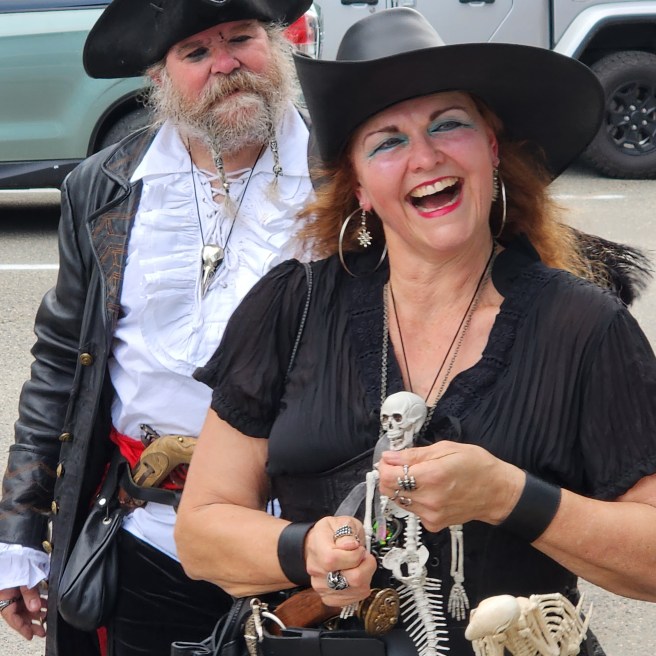
The weekend after Labor Day is observed around here as the Pirate Festival. It’s even a prelude to Halloween.
You never know what we'll churn up in cleaning a stall
The weekend after Labor Day is observed around here as the Pirate Festival. It’s even a prelude to Halloween.
Its origin, I’ve heard, arose in the Quaker peace testimony of 1662, with its refusal to swear oaths. Before that, political factions were supported by their own armies. The Quakers, or Society of Friends, promised to hold firm to their beliefs and yet not coerce others to their stand. Persuasion was another matter altogether. And William Penn, in the colony of Pennsylvania in the years we knew it as the Holy Experiment, insisted on having at least two candidates for every public office.
The Quakers not only refused to bear arms but also conducted their faith community business by consensus, without ever taking a vote. Minority opinions were respected, often leading to a third solution superior to the original options. This was not, do note, a compromise, seen as the lower common denominator, but rather something superior.
Theologically speaking, we sensed that Christ had a better answer for us, if we would only listen. “Mind the Light,” as we said.
Flash ahead to today’s death grip in the United States, where one party has steadfastly stood to obstruct anything proposed by an administration other than theirs. President Obama learned the hard way that they wouldn’t participate in crafting a third way. And he faced their open disrespect, which continued during President Biden’s term. Just look at the F— Biden flags for confirmation. Or their chants of “Lock her up,” regarding T-guy’s first opponent. Not that they would acknowledge the same for their guy, for far better documented reasons.
The Don Old, as we’ve seen, has significantly worsened the conflict and is threatening to imprison those who don’t agree with him.
The conundrum with a democracy could rapidly pivot on what to do with a disloyal opposition.
This could get very ugly, indeed. Before and after the national election.
Eastport is preparing to welcome eight cruise ships for visits after Labor Day. That’s about half as many as last year’s record but could top it in the number of passengers. Four others were slated to visit but had to change plans when Customs could not provide agents to clear passengers and crews into the United States.
So far, I’ve found seven of the expected ships.
The visits have boosted the local retail season for many merchants, especially after the Summer People have retreated to their usual haunts.
It was one of those stretches where nothing seemed to be happening. For me, that translates into stuck, or more accurately, an emotional funk.
And then, in a single day, the dumpster arrived, opening way for the big front of the upstairs demo to begin.
The plumber showed up, after a few months on a big project in the Midwest. He made necessary moves preparing the upstairs bathroom and laundry room for walling, lighting, and flooring to be finished before the toilet, bathtub, shower, sinks, and washer and dryer go in.
He also removed our one outdoor faucet, with its leaking pipe in the wall and no indoor shutoff valve, with three new spigots and lines, all of them closer to our gardens. This was a huge quality of life improvement we do enjoy right now.
Three cords of firewood were delivered, about a month after being ordered. It was our first time dealing with them, and while I wasn’t worried that they wouldn’t show up before the first snow fell, this was reassuring and I’m satisfied with the quality of their product. Now I’m spending an hour or so most days stacking it. (Let’s not overdo it, not at my age.)
We heard from the mason, who was slotting us in with other projects around town. He and a helper were on the scene a few days later to repair the top of the chimney. Added to his work were repairs to the facing on the foundation – something noted in the building inspection when we bid on the property – and several future tasks, including moving the wood stove and metal chimney to another part of the front parlor. This was our first time dealing with him, and I can say he takes pride in good work.
Our contractor installed the flooring on the deck, restoring use of the back door to us. The railing is next.
Each of these lifted another obstacle from the horizon. Each one felt quite invigorating. The deck even has us in amazement.
Discounted “sale” prices would be used to move a backlog of volumes, either at the bookstore itself or at the publisher’s warehouse. It was rarely a good sign.
With ebooks, there are no stacks of boxes or precious book-shelving problems.
Maybe you remember the “remaindered bin” with its cheapo prices. What you likely don’t remember was that authors didn’t get paid royalties on those.
Still, they got books moving into readers’ hands.
Events like Smashwords’ big July-long ebook sale exist to stir things up a bit.
Check out my four selected entries at my Jnana Hodson author page at Smashwords.com to pick up some real deals.
Many of the books in my personal library arrived in the newsroom as advance reading copies, intended for reviews or perhaps mention in a column, except that we rarely printed one of those. Instead, the freebies went out on a shelf for first-come to be first-served.
For the book publishers and authors, it was a huge waste of money.
In addition to the two books I’m offering for free at Smashword’s big July-long sale, you can pick up a copy of my new Hamlet: A Village of Gargoyles poetry collection at just half-price.

It really is worth a visit.
Hometown News is the one novel Cassia from What’s Left didn’t press me to revise, but it got the treatment anyway. At least the title stayed the same, though the subtitle “Reports from Trump country” was added.
Political novels rarely work, so I’ve heard. And I didn’t pitch this was as dystopia, though casting the book more along those lines might have been more successful.
The book still stands apart from my others.
In the time since its first draft and my big round of deep revision, much that I had investigated only worsened. The once powerful newspaper industry was a ghost of itself, and many of the once legendary nameplates were owned by hedge funds whose owners or managers were among the world’s top billionaires. The Rust Belt communities like Rehoboth still hadn’t rebounded – their lucrative unionized manufacturing jobs were never coming back, either.
~*~
Unlike my previous newspapers, the final one I served had job security and decent wages, thanks to our Newspaper Guild representation. I finally made it to median income, even.
Socially, its newsroom broke down into three distinct circles with little overlap. There was the daytime staff, an echo from the days when we still had an afternoon edition; it was the crew that did the features and opinion pages. The nightside staff produced the next day’s daily editions right up to 1 a.m. And the Sunday News staff worked a four-day week culminating in a double shift on Saturday. We got to know each other the most through union meetings revolving around contract time.
At my first paper, where we worked into the night, the staff usually gathered at the bar next door after their shifts and stayed till closing time.
At another, where we were mostly young and without kids, it was on Friday afternoon – the POETS society, as our divorced city editor dubbed it: Piss On Everything, Tomorrow’s Saturday.
Usually, everybody lived at a distance from the newspaper plant. Few could afford the rents or mortgages in the city of publication.
I can’t speak for other office situations or professions, but I did find that close friendships were rare. You knew your coworkers more by a phrase or two they repeated or a favored style of clothing they wore or, as some of the guys seemed to do, by the kind of car they owned.
Still, things came up at parties. Consider the quip from one generally naïve woman regarding the allegator-skin cowboy boots one of the sportswriters once appeared in: “Hey, you look like a pimp. What’s up?” And then the shock we felt a month or two later when he was arrested, having procured women and motel rooms for men in the car racing circles he covered.
At these gatherings we usually huddled around the share our war stories and talk what one spouse dubbed “Bodoni-Bodoni,” after a widely used headline typeface.
Most of the papers I worked at were the smaller operation in a broader market. And I usually was part of a news team with a competitive, aggressive mindset. That part was exciting.
In the revisions, I did have a new paper to draw on, not that it was of the progressive mold I was pursing in the book. The daily interactions, though, could be just as rich.
~*~
From what I’ve seen, the situation of low-level, “shirt-sleeves” managers has only worsened across the board. Perhaps the Covid pandemic work-from-home option has eased the pressures on white-collar jobs, but that happened after my final revision.
There was little job security in working for mass-media companies. When I was with the features syndicate, I’d spend a year nurturing a relationship with the top editor, who promised to buy a certain comic strip or opinion-page columnist or weekly business report from me when the next annual budget was approved – only he was gone by then. Turnover was high, often blamed on “bad numbers” like shrinking circulation or advertising revenue. Or, in one case, because the company headquarters decided to buy a radio and TV broadcast chain.
I do wonder what happened to several of the family-owned papers I called on. They’re top editors didn’t feel a need to attend the usual annual conventions where networking occurred.
I should also mention that several of the papers I worked for did bring in management consultants, giving rise to the team in my novel. Give credit to the one that threw up its hands halfway into the projected year of monthly meetings, declaring that the news business just didn’t fit any of their models.
The Dilbert comic strip touched on many of the office realities, but at a superficial level.
Best-selling management books – Tom Peters’ In Search of Excellence, for example – were exciting but didn’t reflect the everyday realities we faced meeting hourly deadlines leading up to the big, final deadlines. The ones you didn’t dare miss by more than a few minutes.
~*~
So I made tweaks to strengthen the focus on central characters and acknowledge the big hit from the Internet.
~*~
I should say something about public misconceptions of journalists and their papers.
One colleague, who lived a block from me in the town I call Rehoboth, told of a neighbor who complained to him every time the met around the driveway. There was always something wrong with something we’d done. Finally, my buddy fired back. “What do you think the reporter of that story is paid?” The man, a steelworker, fired off a figure. “Less than half of that,” my buddy said, “and she has a Master’s degree.” The man was shocked. After that, he always had something good to say.
As for the right-wing perception of liberal bias, the reality was that many of the biggest papers were unabashedly conservative: Chicago Tribune, Los Angeles Times, Phoenix Republic, Boston Herald, Cincinnati Enquirer, Columbus Dispatch, Indianapolis Star, and probably the majority in the smaller markets. And that was before Fox.
If there’s a bias, it’s for facts rather than presumptions. The Louisville Courier Journal’s Pat Siddons, who covered Bloomington, once said. “I know I have a controversial issue right when I get complaints from both sides of a story I’m covering.”
The fact that journalists are largely low-paid, working nights, weekends, and holidays, did nothing to incline them toward big business, though. One thing we hated was injustice. Another was the lies that accompany it.
~*~
Trying to locate Rehoboth?
It was a composite, drawn mostly from the Rust Belt that extended from Philadelphia and Baltimore west to the Mississippi or so. While my book describes the steel mill that dominated the town, similar communities may have had auto assembly plants, appliance manufacturers, parts makers – the list would be long, like the empty factories they left behind. I observed large swaths of devastated industrial zones in Youngstown, around Pittsburgh and greater Philadelphia or upstate New York or Detroit – places that resembled arial bombing scenes from World War II Germany and Japan. Similar scenes existed along the Lake Michigan shoreline of Indiana, and across Wisconsin and Michigan.
I could now add to that the former papermill towns of Maine.
The fact that there’s personal breakdown as well, as I present in the story, is more than symbolic.
~*~
As for authors and books percolating through me during the final revision and later, the culture J.D. Vance describes in Hillbilly Elegy is one I knew well. Our high school basketball team played his, for one thing, and I had toured its steel mill twice as a Boy Scout. His Middletown could be one more nominee for my Rehoboth.
Add to that Ben Hamper’s Rivethead: Tales from the assembly line, David Foster Wallace’s The Broom of the System, Charles Bukowski’s fiction, a shelf of business case-studies, Kenneth Patchen’s poetry, E.F. Schumacher’s Small Is Beautiful. And Brian Alexander’s Glass House: the 1% economy and the shattering of the all-American town is high on my TBR pile.
~*~
Seeing the loss of status and influence of an independent press has been personally painful, as has the breakdown of communities despite the opportunities of small is beautiful, especially in the Midwest.
Since the final revision, one of the figures in my book, the major scumbag, really, died in a horrific late-night car crash. And pneumonia took out Major Bohroh a little over a year ago.
If I were to tweak Hometown News yet one more time, I’d intensify their evil nature.
That’s the vein the poems in Hamlet: A Village of Gargoyles explores, carving them into dramatic stone, as it were.
The experience may even lead you to revise how you define yourself.
And this month only, it’s available at half-price. What a deal!
Check the ebook out at my author page at Smashwords.com.
Eastport’s big homecoming week and Fourth of July celebrations are just ahead. We face a long list of events.

The annual all-ages cod relay race, using salmon, is zany fun.

And people turn out for parades.

We don’t know if it really is the world’s largest or even legal, it’s still a good gag.

As well as a few surprises.
I rather backed into this project, beginning with the elusive question, “What do Quakers believe?”
It led me to something much bigger, ranging beyond the Society of Friends, but springing from the seemingly quaint language of its earliest voices in mid-1600s Britain. There are good reasons the time and place are referred to as the world turned upside down.
Centering their experiences in three interlocking metaphors – Light, Seed, and Truth – they created what’s been called an alternative Christianity, and though their thinking and process have been diluted over the centuries since, their foundation remains revolutionary, startling, and challenging. I’ll argue that it’s cutting-edge contemporary, as well, in a time of disbelief and skepticism.

For one thing, how do you see “truth” as a verb? It becomes something quite different from carved marble or courtroom proceedings.
While some of the chapters originally appeared as chapbooks at Thistle Finch editions, this newly enlarged volume of essays is now available on your choice of ebook platforms at Smashwords.com and its affiliated digital retailers. Those outlets include the Apple Store, Barnes & Noble’s Nook, Scribd, and Sony’s Kobo. You may also request the ebook from your local public library.
The book now ranges far beyond religion and spirituality, by the way. Even atheists have their beliefs. Change the perspective, as I think I do, and you can find the exchange of first-hand experiences refreshing. How else can we talk about the deepest issues in life?
The move unites the essays in a single volume, rather than a series of four smaller chapbooks, and makes them available to a wider range of readers worldwide.
Do take a look.
 Jnana's Red Barn