Worshiping together, too

The Shackfords and Olmsteads had more in common than their livelihoods on and around the sea.

The oldest church in Eastport, founded in either 1798 or 1802, was the Calvinist Baptists, as some in town knew them, or more accurately, Particular Baptists, largely in line with the majority of Baptists today. That group moved into its Washington Street house of worship in 1837. (Today, it’s the Eastport Arts Center.)

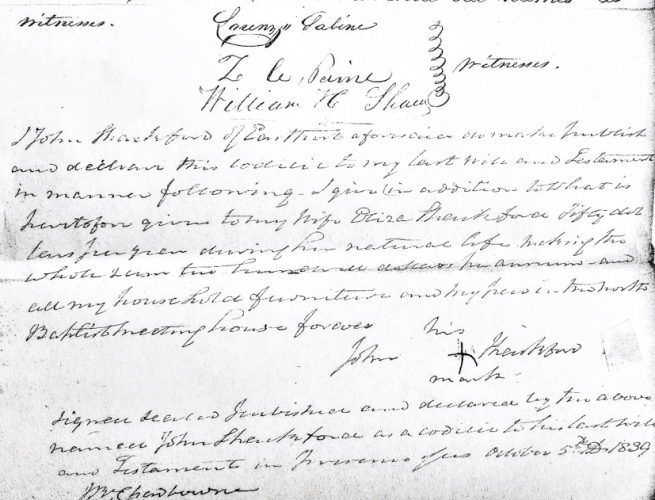
The second congregation in town was the Free Will Baptists, organized in 1816 and incorporating with the state in 1820. Darius and Ethel Olmstead along with John and William Shackford and their brothers-in-law John Hinkley and John C. Lincoln were named in the incorporation papers.

Among other things, Free Will Baptists avoided alcohol consumption and, in its Northern stream, opposed slavery. As a rite, it practiced foot-washing. The denomination stemmed from the Dutch Mennoninte-influenced General Baptists in England, unlike the Baptists just down the hill. I am curious to learn how much our Shackfords and Olmsteads hewed to the denomination’s values. The General Baptists, I should point out, were earlier a strong influence on the emerging Quaker movement in Britain. My Quaking Dover book details more.

The Free Will Baptists dedicated their first meetinghouse in town in 1819, a year before the other Baptists had theirs. They were later known as North Christian Church, with the building at Washington and High streets.

Next to organize in town were the Congregationalists, 1819, and Unitarians, 1821. Roman Catholics had a chapel in 1828, early for New England.

The 1820 Census for Eastport has the brothers Darius, Ethell, and Jesse Olmstead as heads of household.

Two years later, Mrs. Darius Olmstead (Elsie Haddon) and Mrs. Ethel Olmstead (Nancy Ann Haddon) were among the charter members of the Eastport Benevolent Female Society, as were Mrs. William Shackford, Mrs. Jacob Shackford, and Mrs. John Shackford.

The Olmsteads and Shackfords obviously shared in an emerging social structure, having arrived in the Passamaquoddy region at the same time.

All of it, of course, has relevance on the house we bought.

A surprise dimension opened

Courthouse records go only so far in piecing together a story like this. But the names I had found did give me enough to start turning to online genealogies, Find-a-Grave posts, and related histories to augment the investigation, often including the exasperating process of eliminating possibilities before chancing upon nuggets.

A conventional telling I found repeated contained this: “Captain John Shackford died at his home in Eastport, Maine, on Christmas day, 1840, having attained the eighty-seventh year of his age, and his widow obtained a pension from the U.S. government by reason of his service in the American revolution.”

Christmas, by the way, was not observed in Massachusetts, and likely not Maine at the time, even now that it was an independent state. As many journals of the time noted, “It was an ordinary day.”

The quick mention of his widow slid by almost unnoticed. It seemed to be an error, no, considering that Esther had died a decade earlier?

My big “ah-hah!” moment came in coming across a free ebook copy of the 1888 Eastport and Passamaquoddy, a Compilation of Historical and Biographical Sketches compiled by William Henry Kilby. Of special interest was in the 506-page book was a chapter, “Captain John Shackford and His Family,” by his grandson Samuel Shackford, living in Chicago. I’ve already referred to it, but the most crucial part for me was this: “After his decease, his second wife, who was widow Elise Olmstead, obtained a pension from the United States government for his services in the Revolution.” The crucial points were that Captain John had married a second time, something not obvious elsewhere, and even better, I now had a name to focus on.

As I soon found, her name was Elsie, though it also appears as Elise, Elsa, and Eliza. She was the widow of Darius Olmstead.

~*~

The September 27, 1831, Eastport Sentinel reported the marriage of Elsie and John Shackford senior, with the Reverend Bonds officiating. In the Sentinel, her name was Mrs. Elsa, widow of the late Darius Olmstead.

Captain John would have been 77 or 78. Elsie, around 52.

She was born around 1779 in Chatham, England, to James Haddon and a presently unknown wife. He then then brought the family to Saint John, New Brunswick.

Elsie’s first husband, Darius Olmstead, was a merchant, “copartners in trade under the firm D&E Olmstead, with his brother Ethel. Between 1822 and 1825 they purchased sections of Central Wharf in Eastport from James Olmstead.

Darius died July 13, 1825, age 48.

He descended from a well-known and prolific colonial family in Connecticut., one that becomes difficult to follow in its many repetitions of Darius and Ethel across generations and geography.

In the instance at hand, Darius was born in 1776 to Aaron and Hannah Peat Olmstead.

His brother Ethel married Nancy Ann Haddon, presumably Elsie’s sister.

While Olmsteads appeared in historic roles during the American Revolution, Aaron was of the Loyalist faction and relocated to Saint John, New Brunswick, at the end of that war.

Partisan alliances aside, the border between the United States and Canada was loosely enforced. In 1798, Aaron drowned in the harbor at Eastport.

Among the children born to Darius and Elsie Haddon Olmstead was son Ethel (a name also spelled Ethal and Ethell in the records). He was born in 1814 in Eastport. Another son was named Darius.

In 1826, Eliza Olmstead, widow, and Ann Olmstead, wife of Ethel, sold a property on Key Street that Darius had purchased from John Shackford in 1810.

With the widow’s remarriage, her son Ethel, around age 16, would have become Captain John Shackford senior’s stepson.

I have nothing more on his brother.

All of it, of course, has relevance on the house we bought.

Theirs was a booming and closely knit family

Captain John and Esther’s adult children eventually built their own homes more or less within a half-moon crescent about a block away in each direction around our house.

John Shackford junior built on the southeast corner of what’s now Water and Middle streets. He married Elizabeth Batson (1790-1830), and probably remarried another Elizabeth afterward.

William built at the southwest corner of Shackford and Middle streets — just beyond the diagonal edge of our block. He married his sister-in-law, Sarah Ann Batson (1788-1837) in 1807, and then Mary Cutter Lincoln, who survived him. She was the daughter of Captain Jacob Lincoln, whose 1790 farm is now the Rossport by the Sea resort in Eastport’s Quoddy Village neighborhood.

Jacob Shackford, meanwhile, built at the southwest corner of Water and Key streets. He married Eliza D. Pearce/Pierce (1794-1869). She was the sister of Darius, husband of Jacob’s sister Hannah. Eliza was born in Rhode Island, like her brother, and died barely a month after her husband’s passing.

Samuel, probably the first male child born in Eastport, died in 1820 of yellow fever at Demerare, South America. He had married Elizabeth, daughter of Otis and Elizabeth Lincoln of Perry, before the Shackford siblings divided the holdings. His son Samuel received a half-share in Captain John’s will.  More on him later. Elizabeth, meanwhile, is the Mrs. Eliza Shackford who married Captain Silvanus Appleby on October 16, 1825, officiated by Charles Morgridge.

The repeated surnames among the spouses continues over the next generation or two. Finding siblings in one family marrying another set of siblings is not uncommon in the period.

Darius Hannah and her husband, Captain Darius Pearce/Pierce, built at 9 Shackford Street, a block northeast of our house. Born in Rhode Island to a prominent family, he came to Eastport and, after marrying, was a surveyor by 1833, the customs inspector in Eastport by 1841, and a merchant.

Daughter Esther and her husband, Joshua Hinckley, lived on Key Street, just to the west of Jacob. She died, 1880, in Dennysville. Joshua’s father, Matthew, had died at sea in 1809 near Sulawesi Tengah, Indonesia; he was born in 1752 in Georgetown, Maine. (Also born in Georgetown and living in Eastport was John Hinkley (1764-after 1850), son of John Hinkley. Cousins?) The Hinkleys, we should note, were among the early returnees to Maine amid the devastating travails of the French and Indian wars. Joshua and his wife, Esther, were living in Portland in 1823 and relocated to Eastport shortly afterward.

Sarah M. “Sally” and her husband, Captain John Lincoln, remain largely nebulous. I had even wondered if they died at sea. Many captains’ wives accompanied their husbands on long voyages, typically serving as navigators as their children grew up aboard ships. What I did eventually find was a real estate transfer dated October 15, 1832, where “Sarah Lincoln, widow of John Lincoln, shipmaster” sold her one-sixth share in the 1826 land purchase to her brothers William and Jacob and brother-in-law Darius Pearce/Pierce for $150. She was born in 1795 and died in 1846.

The Lincolns, who originate in Hingham, Massachusetts, include a branch that came north after Benjamin Lincoln, a celebrated Revolutionary War General, and two others purchased 10,000 acres in to Washington County. His son Theodore arrived to oversee those holdings and, in establishing a related timber industry, was an original settler of Dennysville. Other portions of the tract extended into what would become the towns of Pembroke and Perry. His brother Jacob, came to Moose Island, as noted. And their cousin Otis was an early settler of Perry. They’re the source where the Shackford marriages fit in. Another branch led from Hingham to the 16th president of the United States, should you be asking.

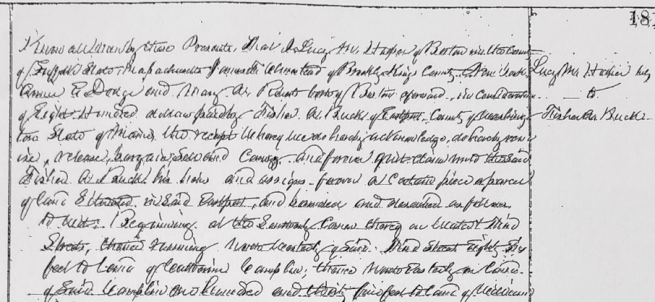
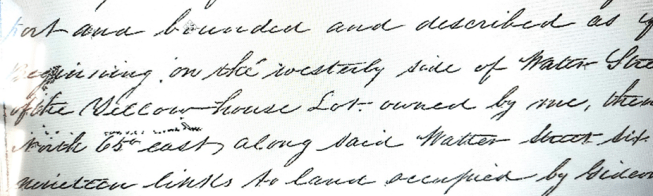
Even before getting to John and Esther’s grandchildren and beyond, I had many loose ends of potential owners of our house who may have led to Lucy M. Hooper of Boston and Brooklyn, New York, and also Anne Dodge and Mary Roberts, both of Boston, the ones who sold the house in July 1875. Trying to run the deeds from them and down to the Shackfords had me stonewalled.

Who were they and how did they come into its ownership?

All of it, of course, has relevance on the house we bought.

Turning to real estate

As the growing village took shape, John senior had his tract surveyed by Benjamin R. Jones, resulting in Shackford’s Plan of lots. A copy of that would help make sense of the wheeling and dealing that followed. Many of the purchasers were by John’s own children, individually or in combinations of partnership often formalizing land they had already “improved” and buildings they had constructed or sites where they would. Others went to Eastport’s new merchants and tradesmen. In all, I find 73 transactions, most of them as a grantor, or seller, recorded at the Washington County courthouse in Machias. I’ve probably missed a few, so take that as a rough figure.

It wasn’t just housing lots, either. Captain John’s waterfront properties were valuable sites for wharves, docks, and storehouses. He was even selling sites between the high and low tide lines. I’ll spare you the tensions between low tide mark claims today.

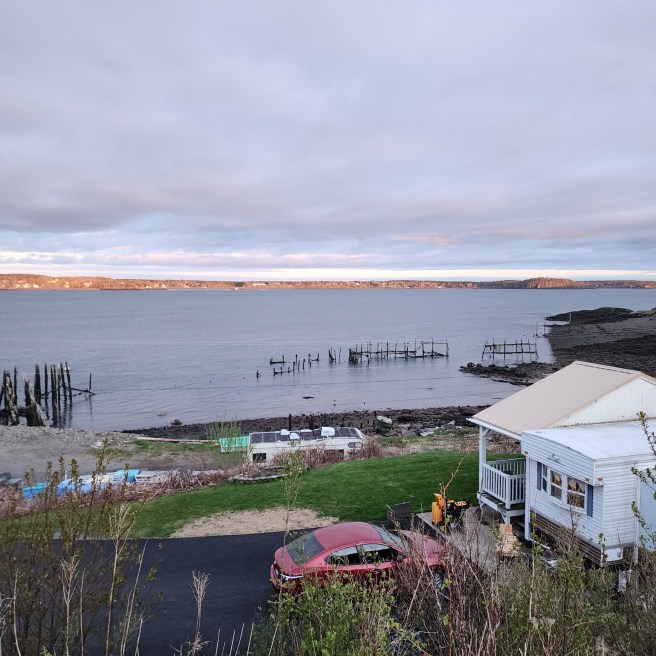
This is how some of the shoreline below our house looks today.

The one transaction I haven’t been able to track down is his title to Shackford Head. Was it simply overlooked by the indexers?

A significant deal took place on April 14, 1826, when his surviving offspring, all in adulthood, paid him $3,000 for the land between High (also known as Back) Street and County Road. And here I thought he had given it to them. Where did I get that idea? That was a huge figure for the time, by the way.

Was he a Scrooge with his offspring? Or merely cunning?

He still had plenty of lots left to sell.

Esther died on June 21, 1830, age 76.

All of it, of course, has relevance on the house we bought.


Another taste of the shipmaster role

Among the many vessels in Eastport by the 1820s, according to historian Jonathan D. Weston, John Shackford senior was one of possibly two residents owning ships of “suitable size and equipment to perform voyages at a distance.”

Captain John’s schooner was the Delesdernier, named after an Eastport family owning the tract just south of his own.

Lewis Frederick Delesdernier was the town’s first customs officer, in fact, and Weston’s grandfather. Note the “D” for the middle name.

Was the naming of the ship an inside joke? I’ll take it that way. He may have also been an investor in shares, another common practice.

The remaining ships of note in Eastport, incidentally, were “owned by inhabitants of other parts of the country.”

All of it, of course, has relevance on the house we bought.

Our house as an early landmark

While Eastport had a twisting trail into the village, the first real road was Water Street, laid out in October 1803, “from Mr. Todd’s house to Mr. Shackford’s.”

The Todd house, most recently known as a bed and breakfast inn, is believed to be the oldest surviving dwelling in Eastport. It was built around 1781 — some say as early as 1775 as a cabin – by John C. Todd and has early additions. Unlike ours, it had a large central chimney with multiple fireplaces, a colonial New England architectural signature. Ours had two smaller chimneys, including a precariously collapsing brick arch in the cellar when we bid on the place. That had to go before the rest of the bricks caved in.

When I began this investigation, I didn’t feel our house goes back quite that far, though I’m now convinced that Captain John had some residence on our lot by the time Water Street came along. For now, let me simply say the plot has thickened. No pun intended.

As historian Jonathan D. Weston describes,

“Water Street was laid out, 24 feet wide, after opposition by those who contended that 18 feet was ample width as it would allow two wheel-barrows to get by each other with room to spare, and, at the suggestion that it would be too narrow for horses and carriages to pass, scouted the idea that the idea that strange curiosities would ever be seen on Moose Island.”

That does explain the traffic congestion downtown today, long after horses and carriages yielded to automobiles and delivery trucks.

Key Street, bordering Shackford’s northern property line, came along in 1805, and then Shackford Street. Third, meanwhile, appears to the third east-west street in the Shackford tract. It is the only numeral street in the city.

Do note that Water Street was interrupted by gates and bars until 1808, when the town ordered their removal.

Up to 1820, as Weston observed, the town had only four public ways and no suitable places of worship. The annual town meeting was conducted in a small meetinghouse on today’s Clark Street..

The 1855 and 1879 Eastport maps show the main section of the house situated as ours is on this property. In the 1855 map, above, there were two ells but only one, larger than the current mudroom, in the 1879 map. Thus, for a time, a small courtyard existed, a common feature of the period. We have no way of knowing their use, for now. Sheds for horses or firewood are possibilities, as are a kitchen and common room.

The cellar, though, has thick stone walls, a serious undertaking.

As our renovations work has confirmed, the house is timber framed — what you may think of as post and beam, except that pegs were used rather than metal brackets and bolts. The nails, by the way, were hand cut.

That rules out Weston’s mention of the second framed house in town being built shortly after 1812 by John Shackford but removed shortly before 1888, perhaps the one John junior had a block further south on Water Street. (It may have been moved across the street sometime after 1835, if we go by the maps.)

Other evidence of an early origin of the house are the hand-split oak lathing, found in the ceiling. and the hand-cut nails. Those lathes disappeared from common usage by 1830, or so we were told.

All of it, of course, has relevance on the house we bought.

As for the windmill?

Once the war was over and Eastport returned to the United States in 1818, the Shackford family thrived anew.

The heart of his activity seems to have been an old log store built at what would become Steamboat Wharf. Described as being at the foot of Shackford Street, it would more accurately be placed right below our house. When the store was constructed, the Customs Office was south of Shackford Cove, rather than to the north of the eventual downtown and its docks. That first store was standing as late as 1840 but being used as a stable.

Its replacement, the so-called Red Store, was removed from the waterfront around 1833 by John Shackford junior and still exists within the main part of the residence at the south-west corner of Third and Middle streets, an elaborate mansard house best known as master shipbuilder Caleb S. Huston’s residence.

Another portion of the old building went into a small, two-story frame house, “situated on the windmill lot” on Water Street, at the foot of Third Street — diagonally across the corner intersection from us. I’m told that the windmill foundation sits in the cellar of that house.

Windmill, you ask?

Windmill painting by Mrs. Bradish. Our Cape is at the upper left, though the artist omitted two windows on the front.  Note that there are no dormers.

Captain John junior is also credited with building a windmill upon the bluff at the entrance of Shackford’s Cove, one that “proved faulty in construction and was of no practical value, but remained standing on the bluff for many years as a conspicuous landmark.”

The small Cape at the left in the painting would be our house.

In the Kilby history, Samuel Shackford recalled, “The windmill which stood upon the bluff at the entrance of Shackford’s Cove for a generation or more was built for him,” John Shackford junior, “but, on account of location or fault of construction, proved a failure. In a moderate breeze, like a balky horse, it would not go, and in a gale of wind nothing could stop it until the wind abated. The old mill, after it had become dilapidated by wind and weather, was a picturesque object in approaching the town from the sea. It was taken down by its owner about forty years ago, much to the regret of the public.”

That is, dismantled around 1848.

~*~

But that leaps ahead.

All of it, of course, has relevance on the house we bought.

The War of 1812 impacted the Shackfords personally

Eastport fell under British control in 1814 and was then attached to Canada for four years. Not that it went quite that easily.

As the conventional story proclaims, Captain John “commanded the first militia company organized in Eastport, his uniform consisting of an old Continental three-cornered hat, and he wore an old sword. His company was made up largely of veteran soldiers of the revolution, a wild set of fellows whom their captain found it difficult to control.”

More descriptively, in William Henry Kilby’s history volume, as Shackford’s grandson Samuel contended, “His men were of a sturdy, wild set of fellows, who appeared to think that the first duty of a soldier on training days was to drink toddy; and their captain had a hard enough time to control them. Many of them, having served half-clothed and half-fed in the Continental Army, doubtless felt that they had earned the right to an occasional frolic.”

I won’t question his sources, but he neglects to mention that Fort Sullivan and its commanding officer surrendered without firing a shot, as did Castine, Machias, and a fourth Downeast town. Still, continuing the Shackford account,

“When the British fleet captured the island and the commodore came on shore to take possession of the island, Captain Shackford met him at the shore, carrying a goad stick in his hand,” not the old sword, mind you, “and addressed him thus: ‘Well, sir! What brought you here? I am King of this island, and these are my subjects. If you behave yourself, you can come on shore. If not, you had better be gone.’ The commodore politely assured him that he had called on business, and trusted that he should conduct himself in a manner becoming a gentleman and to the satisfaction of his Majesty.”

Goad stick? Like for cattle? Captain John apparently had a flair for drama, as the next incident illustrates.

“After the English had taken possession of the town, all of the inhabitants were ordered to swear fidelity to the King, or leave the town and have their property confiscated. But the old soldier, when summoned to appear and take the oath, replied to the officer that he had fought under General Washington; that he might take four horses and draw him in quarters, but never would he swear allegiance to the King of England. It was probably on account of his eccentricity and boldness that the old gentleman was excused from taking the oath and allowed to retain his property.”

Follow that? Who would you nominate to portray Captain John in the movie? And, for that matter, the Brit? It’s still a great scene.

Beyond that, Lorenzo Sabine, editor of the Eastport Sentinel, later contended, “No privateer was owned here,” though Eastport was subject to heavy privateering (state-sanctioned piracy) during the War of 1812. The British cruiser Breame took prize of the Delesdernier with master John Shackford junior and Samuel Wheeler, an owner on board as a passenger. They paid ransom for their property and were released.

Another ship, commanded by Captain John’s son William and sailing from Eastport in early 1812 with a cargo of rice and flour, was captured 25 miles from the port of Cadiz, Spain, by three French privateers. He and his mate and cook were left destitute.

Another prize was a chebacco boat with Captain John’s sons Samuel and Jacob Shackford, who paid a stipulated sum and were given up. The chebacco design, by the way, was a little two-masted boat, popular among New England’s inshore fishery, originating during the Revolutionary War. They were built by the hundreds and averaged from 24 to 48 feet in length, had two masts and no bowsprit. They were usually a flush-deck vessel with several cockpits, or “standing rooms” in which the fishermen stood to fish. A middle hatch gave access to the fish hold. They were also almost always built near the dwelling of the builder and sometimes no more than a few yards from the front door. Shackford Cove, then?

The third time John junior was taken prisoner was when the Delesdernier was captured off Cape Ann, Massachusetts. He and companion brother Samuel were taken to Halifax, Nova Scotia, where he was left without a hat and, one dollar excepted, entirely destitute in the streets.

Captain John’s son-in-law Darius Pearce/Pierce, in command of the schooner Sally, better known as Old Sal, was taken by the frigate Spartan and taken to St. John, New Brunswick.

Quite simply, the War of 1812 hit the Shackford family heavily. At one time, John and Samuel Shackford and Darius Pierce were all held captive by Lieutenant Blythe, who then released them.

All of it, of course, has relevance on the house we bought, as you’ll see.

Back to Benedict Arnold

After the close of the Revolutionary War, and by then disgraced as a traitor, Benedict Arnold took refuge among the Loyalists in neighboring St. John, New Brunswick, where he emerged as a merchant and shipowner. Once, he personally directed the work as Captain John Shackford and presumably a crew loaded a vessel at Campobello Island.

Shackford later recalled,

“I did not make myself known to him, but frequently, as I sat on the ship’s deck, watched the movements of my old commander, who had carried us through everything, and for whose skill and courage I retained my former admiration, despite his treason. But, when I thought of what he had been, and the despised man he then was, tears would come and I could not help it.”

The Loyalist impact on Eastport, as I’m seeing in this project, was immense. Neighboring St. Andrews, New Brunswick, and St. John further up the coast were both founded in 1784 by Loyalist families exiled after the American Revolution. Many of them later filtered back into Eastport, including some lines that owned our house.

All of it, of course, has relevance on the house we bought.

Last chance!

If one of your New Year’s resolutions is to get back in shape – or even simply to get more physically fit, period – the characters in my novel Yoga Bootcamp will stand by you as inspiration. Or, as I’ve been confessing of late, as a reminder of what 50 years of neglect can do to you. (Some of the easiest hatha yoga moves are beyond my ability these days, and that’s before getting to my sense of balance. I don’t think I’ll get around to writing that story, though.)

Yoga Bootcamp tells of a back-to-the-earth funky farm not far from the Big Apple and covers a day in the life of its founder and followers as they seek to ride a natural high without tripping over themselves. As they discover, yoga is about much more than just standing on your head.

The humorous and insightful ebook is one of five I’m offering to you FREE as part of Smashword’s annual end-of-the-year sale, which ends tomorrow.

As they say, Act soon!

Get your copy now, in the platform of your choice, and then celebrate.

For details, go to the book at Smashwords.com.

Come on in to Big Pumpkin’s ashram