We’re sold on our neighborhood deli

You know the adage in real estate that location is everything, and you’ve no doubt seen spots where one failed restaurant is followed by the opening of another which also fails and then another. It might be a different kind of retailer but a similar pattern. Wrong location is the usual explanation, followed by the question of why anyone is foolish enough to repeat the disaster. Lightning may not strike the same place twice (though certain prominent heights would seem an obvious exception), but business traffic follows a different set of rules. Even one side of a busy thoroughfare might flourish while the same offering on the opposite side withers.

Now for the operation in practice.

A side street near us in our end of town has a charming carpenter-gothic style store we’ve watched undergo a similar sequence.

This unassuming delis sits on Ham Street (I’m not making that up) … two blocks from New York Street, at that. Well, there’s already a Katz’s New York Deli in Manhattan, and it’s famous. The refurbished Woodbury Mill rises behind the parking lot.


Back in the day before big supermarkets took over, such mom-and-pop groceries could do a lively small-scale business for a neighborhood trade. Send the kids off to pick up some milk, eggs, and maybe a head of cabbage or bag of flour. By the time we came along, this site was either struggling or posting a For Sale Or Lease sign, one owner after another. Just having bread, beer, and candy plus lottery tickets hardly made for a going enterprise, no matter how charming the setting. We wished them well, all the same, and actually lamented a bit when they went under. Something was obviously missing in the business mix.

And then, maybe five years ago, a new owner took over. We admired his low-cost, aggressive hustle – things like parking a pickup on a busy Central Avenue two blocks away and putting a big sign in its bed to alert passing traffic to his deli if they made a quick turn. It got our attention but not our business, we just weren’t ordering much food out and when we did, it was usually from a great Thai restaurant three more blocks away, a Lebanese takeout next to it, or a nearby pizza house. As for the milk-bread-beer-lottery tix, a chain convenience store sat next to the Dunkin’ Donuts on the big artery, though it too kept changing hands to a 7-Eleven at the moment.

Fast forward, it’s a Saturday afternoon my wife and I are both feeling too whatever to cook, we don’t want to spend much – and pizza is getting pricey – she suggests subs, I say fine but want something more satisfying than Subway.

That’s when she suggests Katz’s, where she had popped in a week earlier to grab a six-pack and was amazed by how great the place smelled. Good sign, trusting your nose. So we look up the menu online, see lots of tempting choices, and phone in an order. I trot off all of three blocks and am nibbling on amazing fries even before I get home. In short, we’re sold.

We can see why the place has taken hold and developed a loyal following. Sometimes we’re slow, OK?

It’s not a franchise chain, definite plus. The food is tasty, very, another plus. Some of the menu pays tribute to earlier occupants of the store, once the Busy Hill Market, local awareness. Breakfast is available all day, smart option, especially considering a lot of college students live in the neighborhood – well, they also likely go for the aforesaid beer cave. The prices are also affordable and the portions, generous.

Two sub orders later, we go for the pizza, and it more than lives up to our expectations. So we now have a new go-to pizza joint, unless we really want to splurge and go for Festa, another story.

Turns out the owner’s from Jersey, so he brings some deli savvy, and he has a great manager from all I see, and a skilled crew. None of these guarantee beating the odds, but we are impressed and definitely like the way it’s changed the neighborhood.

Continue reading “We’re sold on our neighborhood deli” →

Let’s not kid ourselves, it’s popularity, not excellence

We wanted to give a local business a boost, so we went online to cast a vote in “Seacoast’s Best” polling. You’ve no doubt seen other places touting some similar honor.

We very quickly realized that for many of the designations, we had little or no awareness of most of the nominees. Like we knew the six women running for the region’s Best Nurse? Or we’d eaten at all six parlors in line for the Best Pizza? No, a vote went to the one you might already know, if you didn’t skip over it altogether.

Such results are bound to be quite different from those based on a few knowledgeable critics who evaluate on quality criteria and point us in unexpected directions.

Now that’s a Best I’d respect.

Ten ways faith communities are being hit hard

The Covid-19 shutdowns are reminding many of us how much of religious practice involves community interaction.

Yes, personal practice is also essential – we could easily build a list of ten examples – but it blossoms and bears fruit in our interactions.

Here are ten ways those are being impacted by coronavirus.

  1. Communal worship. It’s a coming together in celebrating and compassion. For now, we’re coping with a substitute, one without the touches of shaking hands, hugging, or kissing. We’re not even in the same room.
  2. Streaming our services. Across congregations, we’re finding this to be a mixed bag. It’s definitely not the same as being together in person, but members who live at a distance or recovering from illness or suffering chronic debilitating conditions are welcoming the opportunity to be better connected again. Attendance for morning vespers or the like is also up.
  3. Pastoral visits. Hospitals, especially. Pastors, priests, ministers, rabbis, and other leaders deeply miss being able to comfort those in pain or be with those who are dying, especially.
  4. Funerals and memorial services. On hold, when family and friends could feel the support the most.
  5. Weddings. Baptisms, too?
  6. Choirs. It’s more than just making harmony together, though you do come to feel a special kinship with your fellow singers.
  7. Committees. OK, we are continuing via Zoom, maybe more than ever. But it’s more awkward, and I miss sharing the snacks.
  8. Study groups. This can be done online, but it’s less personally revealing and interactive.
  9. Church suppers and soup kitchens. There’s a reason that Jesus and the disciples are always eating in the New Testament. As one rabbi I know explains, it’s because they were Jewish. Let’s honor our connections through food, when we can.
  10. Festivals and other fundraisers. These require advance planning and working together. Again, food’s often involved and sometimes ethnic identities, too. My favorite ones feature dancing, and that leads to joining hands.

I do want to mention a renewed appreciation for the medieval tradition of anchorites, women who lived in isolation in the church tower itself and prayed unceasingly for the members’ well-being. These days, their writings seem especially meaningful.

OK, there’s no bingo on my list. What else am I missing?

Do we really mean the same thing?

I’ve had to learn the hard way that a word can mean something quite dissimilar for two people. Sometimes it’s based on assumptions or misunderstandings. Sometimes, on deliberate deception.

Either way, one person can be deeply injured by the outcome.

Take “I love you” as an example.

A used car is in “perfect condition.”

“I’ll be right there.”

In the hippie era, we had a raft of phrases that glossed over differences – “Hey, I’m cool with that,” “Don’t hassle me,” “I dig,” “Chill out.” Meaning?

It comes up especially with “God” or even “peace.”

There are plenty of other examples, some of them keeping lawyers in business.

What’s one from your own experience?


A generic side to Dover’s downtown transformation

As I’ve looked with delight at the renaissance of my small city’s downtown, one modeled in part on Jane Jacobs’ then revolutionary attack on urban renewal back in the ’50s, I am a bit bothered by how much of it is now based on a commercial cookie-cutter concept known as mid-rises – five-story stick-frame construction above a steel-frame pedestal that’s then given a brick or similar exterior facing.

It’s happening all over the country, actually, and not just in the heart of a city, either. Even here in Dover, we’re seeing something similar happening about a mile south of downtown as an over 50s-something neighborhood called Pointe Place with rents that astound me. Who can afford it? Some retirees, apparently. It’s a downtown within a doughnut, in effect. You can’t really walk there from anywhere else.

Of course, the Covid-19 pall casts a big shadow over these developments, but some observers say it might encourage more people to move from big cities to smaller communities like ours. We’ll have to be patient and see what actually unfolds.

As I’ve argued here in various forms, I’d rather have a real city center abutting organic neighborhoods, one with a funky fringe of mixed-use buildings, unlike apartment complexes surrounded by parking lots along the major highways or shopping strips.

What we definitely have here in Dover is the attraction of a river that rises and falls with the tide, as well as the historic mills once renowned for their calico and now serving as entrepreneurial incubators and housing.

Call it atmosphere and scale.

~*~

As Dover’s emerged as New Hampshire’s fastest growing city, the bulk of the new downtown residents are presumably singles and child-free couples, either young professionals or older folks who want the amenities of living close to restaurants, parks, and public events.

The retail and professional rentals are a larger concern, though, especially as many small merchants find themselves at a disadvantage against Amazon. Take the local hobby shop as an example. And that’s even before the bigger threat of coronavirus hit the entire economy.

Even so, these projects haven’t been on hold.

OLYMPUS DIGITAL CAMERA
The new Orpheum takes shape downtown, matching the height of the old Masonic building to its east and the old Strafford Bank across from that. The spire at top left is city hall, a block away from the back of the new building in what was previously a parking lot.
The Robbins Block storefronts are now gone and a five-story Orpheum is rising in their place. The hardware store, lower right, is still there. From the top left are the library, community center, and district court.

The old block may look charming in the photo, but the buildings were rundown and unwelcoming to pedestrians, as was the sprawling parking lot behind them. There was also a traffic bottleneck that’s being eliminated.

An aside on poetry readings

Catching up on my stack of Harper’s magazine, I came across a remembrance of the poet Etheridge Knight, and it stirred a long buried memory.

Etheridge? I paused, before remembering he was a black inmate of the Indiana State Penientiary when he began writing seriously. Damn good stuff, as I discovered.

My introduction came in the mid ’70s when Roger Pfiingston asked if I wanted to go with him up to Indianapolis, aka Naptown, to a reading and open mic. I was free that night. The trip from Bloomington was a little over an hour, and he was driving.

The event was at a bar in the inner city, not a familiar terrain, and Etheridge was hosting. I should go back to my journals for details, but I recall it as a warm and comforting evening. I think Jared Carter was the featured reader. Another damned good Indiana poet.

I was a bit nervous about one of the pieces I’d brought with me, one that quoted a friend’s father about a lover in the ’30s, but I read it anyway.

The line in question triggered delighted, loud laughter from Etheridge, especially. I was sooooh relieved!

Looking back, I see it as one more confirmation – and welcome – as my identity as a poet.

What a wonderful community!

Zoom? Ten takes on group meetings online

By now, you’ve probably had your fill of Zoom or GoToMeeting or Skype. (Any others I haven’t heard of?) They’ve become inescapable, it seems, and essential.

Here are ten takes from my end.

  1. We don’t look good, folks. Everybody looks older. More wrinkled. Distorted, too. (There are reasons actors use so much makeup!)
  2. We spend too much time on trying to figure out what we’re doing. It’s not just the agenda, but mostly about getting settled, figuring out who’s “here,” and tweaking our settings. It’s a real problem when we have only 40 minutes total.
  3. Tech confusion. Are you muted or not, why isn’t this or that working, that sort of thing.
  4. Remembering to cover or uncover the camera
  5. We sound wobbly. That, and all the awkward pauses and unintentional interruptions. Oh, yes, and all the ambient noise if a group is mostly unmuted.
  6. The moderator is very important. Though trying to chair a meeting and simultaneously man the controls is a bit much. We really need a “producer” for that.
  7. Selecting who’s to speak next. Do we raise a hand to the camera or press the little hand button instead? How about the Chat function? Are we unmuted? This gets difficult once the group gets bigger than a handful and the moderator has to keep scanning the panels that were offscreen.
  8. We get to “visit” in others’ homes. Often, the scene is an individual’s dining area or study, but we’ve also been outdoors on a porch and down in the cellar (which looked and sounded more like an Apollo space mission). It’s been fun seeing other sides of our friends this way, though often the lighting’s not so hot. (See Point 1.)
  9. Remembering to “attend.” Or to send the invitation out to all in time. Somehow, we’re losing track of time, even the day of the week, in this self-isolation.
  10. Doesn’t work as well on smart phones or tablets. No, you really do need a laptop, PC, or large screen for optimal control.

What stands out from your encounters?

Greetings from the bunker

Unlike many journalists, who lust after the scoop – to be hailed as the first to the punch in revealing the newest surprise in a hot ongoing drama, especially – I preferred to wait for the dust to settle a bit so we could discern the bigger picture. Yes, I was still competitive, but too often all the latest clamor struck me as confusion. What’s REALLY going on here, rather than who’s speaking the loudest or all that, is what I wanted to hear.

(Actually, with the presence of ’round-the-clock cable news and Internet connections, it’s gotten much worse. Just look at how the current resident of the White House stirs up something fresh before the outrage of his last errant lunacy can even sink in.)

The Covid-19 situation is turning into something similar. Who can keep up with the story? There are so many elements, not just the latest numbers or locations.

We’re definitely facing some ominous long-term impacts here, and we’re not getting much clarity yet.

A big exception has been voices like the Atlantic, as well as the New York Times and Washington Post.

~*~

For me, many of the biggest issues emerge around the question:

Who’s going to pay for this?

Wall Street still hasn’t factored in the debt load, unless maybe as inflation. Make that HUGE debt load and HUGE inflation, unless the wealthiest five percent of the population come to the rescue, whether they want to or not. We can look at their gains via tax cuts as longterm loans to be repaid royally now.

As a few of the clairvoyants have noted, many of the problems now emerging have been long simmering and coronavirus is merely bringing them to the fore.

Student debt loan would be one, especially if bankruptcies become widespread.

The future of retailing would be another. And the entire medical system.

The lack of antitrust action in the face of cable operators, Amazon, Walmart, and the like would be yet another.

We get glimmers here and there, but little in the way of big pictures, which are ominous.

As one voice emphasized, we do have socialization in America, but not for the people. We’ve privatized profits while socializing risks for big corporations. That’s not real capitalism. Just watch as they line up for a bailout at the public trough. Keep an eye especially on the ones laying off people and closing plants while taking the aid for themselves and their overpaid top executives. How about tying any aid to an exchange of stock placed in public trust funds, for starters?

By the way, is anyone else aghast at the Donald’s insistence on putting his signature on those relief checks, as if he’s paying out of his own pocket? Such bombast!

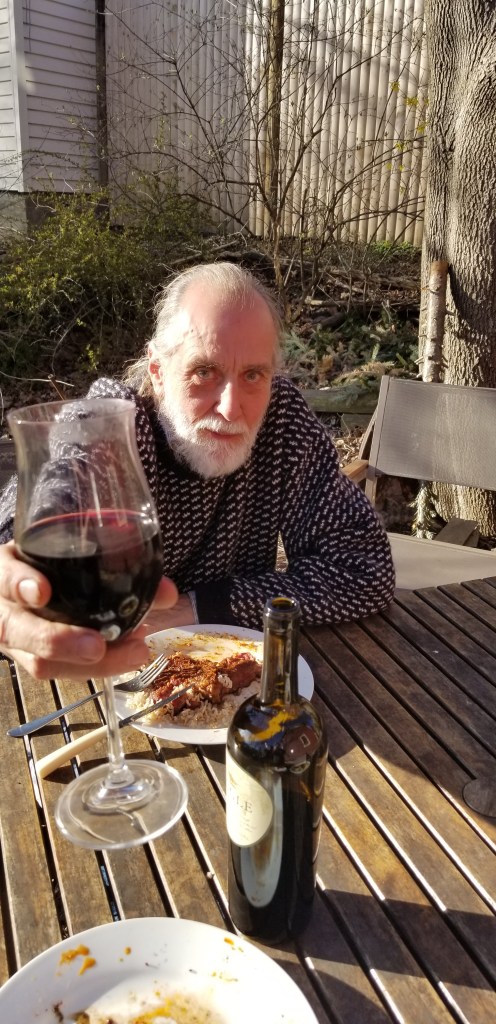
Well, we can’t go out to dine, but we can get an early start on grilling in the Smoking Garden beside the barn. Cheers!

~*~

One canary-in-the-mine-shaft question of mine asks:

How will performing arts organizations survive this shutdown?

For me, they’re essential components to society. The artists have trained all their lives for what are often marginal wages, and the supportive structures are not easily created. Rebuilding audiences will not be easy, especially in the face of damaged incomes in general. Yet they’re crucial to the fabric of civilized community.

Unlike sports, the arts don’t have huge advertising revenues. They reflect a number of similar services that make our communities better places to live, no matter how modest their seeming place in the overall scene. We need to make note of them, too, and redress the suffering.

~*~

Is anyone else watching the impact as Covid-19 spreads from the big cities into the suburbs and rural areas – that is, from urban (which also translates as black and immigrant and blue) into red-district Trump country? The virus is no longer a safe distance from “them,” or what was originally dismissed as a liberal hoax to tarnish their cult leader, and instead clearly appearing as a cruel reality. We’re back to the already fragile state of health care in rural America, for starters.

~*~

The fact is, at the rate Covid-19 cases were initially multiplying, we could have had 40 million infected people by Easter, had we not gone into quarantine. As I almost quipped back then:

How would the nation’s funeral industry cope with an extra 450,000 corpses?

As one friend said

It’s like we’re living with no destination. We can go out for a walk but can’t stop casually at the store or the library or café. Maybe wave to neighbors through a window.

To call what we’re doing “monastic” misses the mark. After all, monks live in communities, working and praying together. And being single, as he is, still doesn’t mean monkish.

We can’t hug or even touch anybody outside of our household, not if we’re maintaining quarantine.

Humans are social animals, after all.

At the moment, the one thing that makes sense doing is prayer.