Here’s how the organizers of tomorrow night’s program are touting the event:

I’m so psyched!
You never know what we'll churn up in cleaning a stall
Here’s how the organizers of tomorrow night’s program are touting the event:
I’m so psyched!
A program Thursday night at the Dover Public Library promises to be lively fun.
Hosted by Dover 400, the folks behind the year-long celebration of the town’s settlement 400 years ago, I’ll be one of three authors of new books about the community’s past. Each of us brings something different to the table, and I’m really looking forward to meeting the others, as well as an audience full of additional insights and angles.
The program will allow each of us to address some prepared questions and briefly discuss our book before turning into wider discussion and an audience Q-and-A.
Retired librarian Cathy Beaudoin, the unofficial (and unrivaled) Dover historian, will be moderating. As an aside, I do wish she’d write the big volume about the city’s textile mills and the ways they transformed the community. She’s already curated a comprehensive lode of entries you’ll find on the public library’s website.
As a handy book you can follow around town, J. Andy Galt contributes an updated set of neighborhood walks that were originally conducted by the Dover Heritage Group. As I’ve previously posted, the city is pedestrian-friendly and has quite a range of architectural styles. In many neighborhoods, every house you pass seems to possess a history, if you stop, look, and have a few tidbits of info in hand. From the directions to one of those walks, Dover Friends Meeting finally learned where our second meetinghouse, from 1720, had been moved and now sits as a private residence.
Former Woodman Institute trustee Tony McManus brings a newly published, wide-ranging collection of newspaper columns he’s written on local history, especially the people involved.
And I’ll be there looking at the early developments from the perspective of the Quakers, for decades the town’s biggest minority.
As a grand finale, there will be an opportunity to sign books we’ll have for sale and meet one-on-one with readers. I couldn’t do that with ebooks.
(The snow date is March 9.)
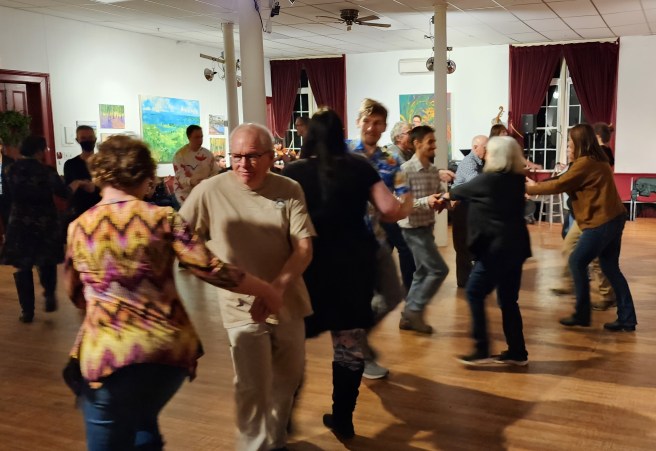
Last month we had our first indoor contradance this far east in Maine since the outbreak of Covid, and it was a blast.
I’ve posted before about the New England tradition from colonial times, which hippies then spread around the globe. Not that you have to identify as one to attend. Let’s just say free spirited?
A typical contradance is something for all ages and abilities, singles and couples alike – you do mix during the evening – and the live music is reason enough to come out for a substance-free environment. As we say, if you can walk, you can dance. Besides, a caller has us practice the figures, as they’re termed, before the music begins. It’s a great community-builder, for sure. A great way to meet neighbors of all kinds, or even a potential mate, if you’re unattached. It’s low-pressure, OK?
The whole point is to have fun, mistakes included. Just keep smiling. As I tell the newbies, we experienced dancers make just as many mistakes, mostly because we’re too busy talking.
Our dance last month had mostly beginner dancers, and they were delightful. I’m hoping and expecting to see them back Saturday night at the Eastport Arts Center, bringing a few friends in tow. Frankly, that’s how we all got addicted to this activity, word of mouth with an invite, or even being dragged, as I was, to show up.
Not that you need that much to enter the door.
Remember, just keep smiling.
EARLIER RED BARN POSTS have touted of Revels as a unique Boston-based arts institution that presents joyous performances blending story, theater, music, dance, literature, history, and much else from many varied world peoples into a magical collective experience. Sound amazing? It’s been. Everyone in our family has delighted in these offerings, no matter how eclectic the theme. As the motto proclaims, “Revels creates musical and theatrical events and educational programs that celebrate cultural and seasonal traditions from around the world, for and with the communities we serve.” It’s even spawned similar groups across the country, as I learned while living in Baltimore and had friends active in the neighboring Washington productions.
While many Revels programs are centered on solstices and equinoxes, the most popular one, far and away, leaves most of the public knowing our organization only as the “Boston Christmas Revels” and then being surprised to hear that Revels Inc. also offers workshops, concerts, pub sings, children’s courses, and a harbor cruise or two throughout the year. I know I’m forgetting some others. That successful “Christmas” identity, for what it’s worth, created a branding problem that’s finally being rectified, in part by rebadging the holiday extravaganza as Midwinter Revels. In addition, let me point out that the flagship attraction has always included many decidedly non-Christian and secular elements, as well as some familiar carols sung by the entire audience. Quite simply, these shows are not about baby Jesus front and center.
My family’s treks from New Hampshire to those Yule pageants in Harvard’s Christopher Wren-inspired Sanders Theatre (which seems to come straight out of Shakespeare or Harry Potter) quickly became a highlight of our year. It meant a day exploring the big city itself as well as across the Charles in cosmopolitan Cambridge, where you could find yourself in amazement at the many languages heard along its sidewalks. We’d always stop at the Harvard Coop for new calendars if nothing else. On those outings the family was introduced to subway rides, bowls of Vietnamese Pho in Chinatown, even the coffee and wine isles of Trader Joe’s back before there was one close to home. How could I forget watching our seven-year-old be absolutely enthralled by a Leonardo da Vinci theme full of Renaissance music in Italian and Latin and featuring Revels legendary founder John Langstaff in what turned out to be his final appearances, not that I could have dragged the kid to a concert of the same program. She was hooked.
Once I retired from the newsroom, I became a charter member of the Revels Singers, a marvelous, non-auditioned community chorus, which then gave me something of an insider’s view of the organization itself, as well as of a broader Harvard University outlook, not that everyone in the ensemble had Yard credentials. It was more of what we might call atmosphere, breathe it in. Believe me, I never imagined being able to sing at such a glorious level. The rehearsals were well worth a two-hour commute down and another two hours home each week.
Just seeing others go through the agony of auditioning for the next Yule show and feeling crushed at being rejected or knowing the sacrifices ahead if they were selected was edifying. So this is what Broadway actors go through? At least they get paid.
But then we faced our move much further to the northeast, plus the Covid outbreak.
LIKE OTHER PERFORMING ARTS arts organizations, the company took hard financial hits from Covid. The highly anticipated 50th anniversary show was scrapped, replaced with a shortened virtual retrospective. That had to hurt, financially and creatively. A renewed outbreak of the vicious virus forced the last half of the next year’s run to be cancelled on short notice. Gone was half of the ticket revenue and related sales of CD albums and related goods in the monumental lobby. In addition, seating for that and the most recent run was reduced due to Covid precautions – down from the 1,000 max that the fabulously intimate auditorium normally packs in. Pre-Covid, sold-out dates were the norm.
On the positive side, Revels began offering online video streaming after the live run, something that allowed us to keep up with the latest manifestations from 353 miles away.
From our perspective, though, what’s resulted is two duds. They just didn’t hold our interest, no matter the quality of the video production.
What worries us is the pandering nature of seeking a more diversified or at least younger audience, even as I applaud shifting from “Christmas” to “Midwinter” in labeling the event. It’s like Netflix or Disney took over.
The first theme in response was set in a decrepit London pub that had just been sold to a naïve American couple. I’m still disturbed by the idea of placing a family-friendly show in a bar, OK? Like “Cheers” from the other side of the Big Pond? Besides, there was none of the mystery and majesty that frame the Revels experience. Quite simply, it felt cheap. The musical line introduced commercial pop tunes known to almost everyone, even me, a far cry from Revels’ usual exotic folk and classical foundation that would take us places we’d never previously imagined. Those tunes were merely predictable, cliché, far from Revels’ usual intrepid discoveries or original compositions. There are many other places ticket buyers can go for a secular Christmas experience, high among them the Boston Pops. So far, at least, Revels has avoided anything Santa. Thankfully. Ho-ho-ho.
The latest entry, set in drab Ellis Island a hundred years back, is even more troubling. The storyline tried to mix Irish Catholics and Czech Jews along with Mexicans already in the USA. It felt forced, artificial, ultimately superficial. Actress Carolyn Saxton was squandered in a preachy, stocky, unessential Spirit of Place role. Hers wasn’t the only polemic that told rather than showed. A “Christmas in the Trenches” sequence was a further reach, even with the German carols, which at least were more seasonal than the Irish “Long Way from Tipperary” and “Wild Rover.” The storyline definitely veered away from any Czech winter opportunities.
The show finally burst free of its wooden action after intermission with some hot Mexican dancing and singing, especially Ricardo Holguin’s flying tenor and fluid movement. If anyone should be in line for David Coffin’s jack-of-all-trades MC replacement (should that ever come), Ricky could be the one. But I am left having no idea what those South of the Border flares had to do with Midwinter.
More troubling was the way that so much we anticipate each year is being reduced in size and impact. The words to “Lord of the Dance” were recast to eliminate the Lord Shiva comparison to Jesus, which has always troubled me, yet in universalizing the thought, it wound up greatly diluting the original. The powerful concluding “Sussex Mummers Carol” was reworded and shortened, and the abbreviated mummers’ play unintentionally announced that winter was already over. So why are we here? I didn’t even see any of the traditional morris dancers, unless they were carrying stag horns. The sword dancers, I’m told, are their own discipline. Praise be, even if for most of their scene, they were five rather than the usual six I remember!
Overall, quite simply, where had the enchantment gone?
I believe that points to a bigger problem for Revels and other arts realms today. Let’s call it the tension between artistic expression versus marketing.
AS BACKGROUND, in Revels’ evolution each year’s holiday show went from a British-centered Christmas party to a celebration with a storyline probing selected national, regional, and cultural themes. Acadian/Cajun was a recent one, with Renaissance Venice for another as well as a northwest Spanish hike on the holy pilgrims’ Way, in addition to Scandinavian countries and then American roots. I think back, too, on an engaging Armenian-Georgia Republic production and another from woolly Russia. Ireland, Wales, Scotland, parts of England, and especially Victorian London also delivered profound entertainments.
At its core, though, are what should be some trademarked, let’s call them sacred, scenes – Sidney Carter’s “Lord of the Dance” that leads the audience out into the Civil War memorial lobby in a serpentine line dance at the intermission, as well as the eerie Abbots Bromley horn dance of stag deer in moonlight once we return to our seats. Add to that the seemingly improvised mummers’ play, a showstopping sword dance, Susan Cooper’s dark-night poem “The Shortest Day” that concludes with “Welcome, Yule!” shouted by the entire audience as they burst into the “Sussex Mummers Carol” blessing that also raises tears and goosebumps with its soaring soprano descant and artificial snowflakes falling from above. In that concluding flash, no choir in Greater Boston is more heavenly, not even the Tanglewood Festival’s with the symphony.
Quite simply, we are disturbed by the tinkering we’re seeing in these essentials. Yes, the Revels are ultimately Anglophile, even Elizabethan or Edwardian, saturated in brocaded deep reds and golds, no matter where the storyline ventures. Don’t deny what’s in Revels’ bones and blood. And don’t ever count me as an Anglophile, no matter how much I’m venting in its defense. Remember, when in Rome …
COMPARED TO OTHER Boston-based arts enterprises, Revels has lacked deep-pockets, despite the sumptuousness of its holiday productions. Its passionate core staff is surrounded by many dedicated volunteers, but aging does mean a change at the helm is in the works, especially with the upcoming retirement of its artistic director a year hence. Something similar has already been transitioning with its music director, the other top creative position, though I’m not convinced it’s securely in place.
In the performing arts, after all, not all of the drama transpires on stage. Revels is no doubt already in the early stages of planning next year’s Midwinter plot and accompanying score.
I would hate to think, as the Bard said, “Our revels now are ended.”
My first-ever Zoom presentation is now available for streaming, thanks to the Whittier Birthplace Museum. The presentation on January 26, “Starting with a marriage certificate: Why Whittier was no stranger to Dover,” focused on the famed poet and abolitionist’s many connections to, well, my new book Quaking Dover.
For the full YouTube event, do take a look here.
John Greenleaf Whittier is hardly the central theme in the book, but for me, developing the topic for this show, along with the accompanying PowerPoint slideshow, another personal first, was fun.

If you’re a regular here at the Barn, you know I do lag behind on the tech front. One step at a time, right?
I didn’t expect an unusually itchy nose and scratchy throat resulting from our dry indoor air. So much for my up-in-the-corner-of-the-screen stage presence.
On top of that, with the PowerPoint up in front in me, I couldn’t see who was attending. Oh, well, I had my hands full anyway.
Earlier, behind the scenes, there was concern about a possible power outage on my end as unusually warm temperatures dropped below freezing amid heavy rain. We did have a contingency plan, just in case.
I’m so glad we didn’t need it.
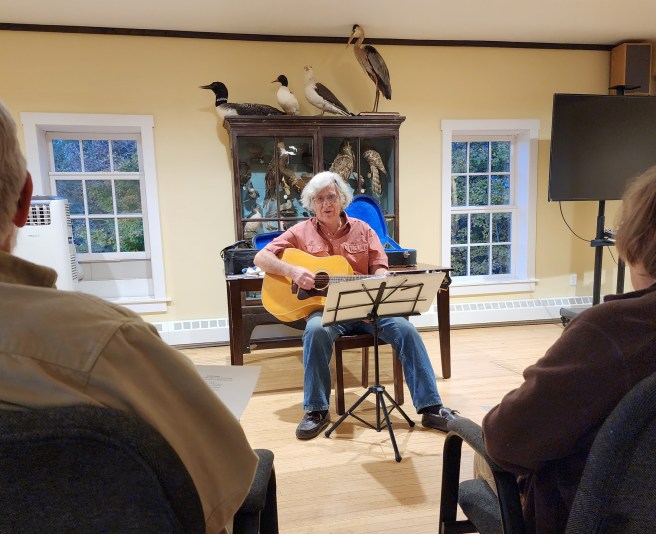
Stephen Sanfilippo is both a wonderful folk musician and a professional historian, two strands that weave together delightfully in his performances and recordings of maritime songs.
He’s a master of the sea chantey repertoire as well as many other seafaring tunes and lyrics – many of which, as he’ll explain, traveled far and wide into the American hinterlands but not back. He does prefer the spelling “chantey” and “chantey man,” for reasons I’ll leave to him to explain. And there are plenty of opportunities to sing along.
Here’s an invitation to his free appearance on Wednesday, January 25, at 6 pm at the Pembroke, Maine, public library, itself an appropriate venue. (I do love the stuffed birds displayed behind him.) The event will be followed by a series of more monthly concerts. Yay!
From his previous appearances here, I can acclaim this is one more facet of what makes living Way Downeast Maine so special to me.
My first New Year’s Eve in Dover was filled with wonder when all of the church bells burst out ringing. The next year, however, they were silent.
The occasion, I learned later, was the new millennium, even if technically 2000 was the last year of the old millennium while the actual arrival went unnoticed as such.
This year, Dover’s churches have been asked to ring their bells at 9 pm as a prelude to a fireworks presentation to welcome in the city’s 400th anniversary year observations.
Here’s hoping the weather obliges.
From many miles away, we’ll be thinking of folks there and hoping for a most exciting new yar.
Streaming? Radio is what I do in the car, while driving.
As for podcasts?
Now they’re pretty routine.
Any idea why?

 Jnana's Red Barn