The two small cities that emerged on the New Hampshire side of the Piscataqua River ultimately found themselves rivals.
While Dover, hidden upstream, developed earlier and had much of early Maine on its side, Portsmouth took on its own character.
Portsmouth had a harbor, for one thing, and as waters upstream became polluted with sawdust from the mills, along with the clearing of forests miles inland from the banks, Dover’s wharves and landings faded in importance. Its goods were relegated to small local vessels called gundalows, which could maneuver the shallow waters, and then repacked into larger ocean-going vessels rather than continuing directly.
All of that then had Portsmouth emerging as the focus for trade, connecting it to towns up and down the Eastern Seaboard and beyond rather than anything much inland.
The center of Dover, meanwhile, kept creeping upstream from its waterfront origins at Hilton Point. Its outlook turned increasingly up-country, powered by the waterfalls along the Cochecho River and the mills, along with farming and timbering.
It was a common pattern in New England, so I’m told. The merchant class of the harbor settlements kept informed on activities along the coastline and destinations overseas but knew little to nothing of what was happening just five miles inland. The inland points, for their part, had little interest in distant locales.
By the time of the American Revolution, Portsmouth boasted of some impressive Georgian houses owned by wealthy seagoing merchants, some of them signers of the Declaration of Independence. (The squalid, roughnecked, red-light neighborhoods that went with all that seagoing were left more unspoken.) Dover was far more modest, about 50 years away from emerging as a major textile manufacturing center, with the red-brick mills.
George Washington visited Portsmouth but not Dover. You get the picture.
The character of the two communities continued to diverge after that, and they still do. Today, Portsmouth is driven in large part by tourism, both as a destination and as a stopping off point for almost all of the motor traffic in and out of Maine. In contrast, Dover sits quietly to the north, though the new bridge at Dover Point makes the place more accessible.
~*~
The other two towns of New Hampshire’s first century also had different personalities.
While Hampton sat on the Atlantic coastline, it lacked a harbor. Nor was it inland enough to have the waterfalls to power manufacturing. Its base remained agriculture.
Exeter, further inland, did have the falls but somehow also took on a more cultured tone. It’s a story I anticipate hearing of more.
~*~
I was often puzzled that so few folks in Portsmouth knew anything about Dover, just a dozen or so miles away. Not so for Dover residents when it came to Portsmouth, the smaller of the two.
That just may be changing, however, with the downtown renaissance in Dover and the increasing commercialization and crowding of Portsmouth from the funky, artsy edge we so enjoyed just 30 years ago.
The one thing that hasn’t changed from the late-Colonial era is that Portsmouth remains more monied. Some of that, at last, just may be migrating northward, toward family-friendly Dover.
Heaven forbid I give anyone a false impression of the place I’m now residing. With all of its isolation from much of the rest of the nation, Eastport can be way too small for many people, though for a few others that adds to the appeal, even in the depths of a very long winter, which for some of us has a charm all its own.
For a sense of our life, find and then stream the Northern Exposure television series, and throw in a demographic that skewers heavily toward retirees and too many summer people, many of whom we’d love to have year-round. We’re not even as faraway as Cicely’s Alaska, either.
One of the unanticipated dramas is at the local government level. While Eastport is organized as a city, our ruling council has had more than its share of friction going, well, far back, as reflected in the ongoing turnover of our city managers and police chiefs. Last I heard, the assessor/building code inspector was also open.
Pay scale is only part of the problem.
Council meetings are often reported, in print and by word of mouth, as contentious, so much so that one member was forced off the council altogether after obscenity-laced outbursts, another fine councilor resigned in utter exhaustion, and one resident once again started recall petitions after being cut off in public discussion.
There are good reasons a popular bumper sticker does say “Don’t New York My Eastport.” However you want to interpret it. I hope it doesn’t include poetry in our monthly open mic sessions.
Not only is there a tension between the born-and-raised here locals and those of us who are from away (PFAs), or those who pinch pennies and those who see investing in the future, the tension can be seen between paying the bills now versus long-term vision.
~*~
One bit of contention that came up since my moving here has been the painting of a downtown crosswalk by a volunteer group. Their color scheme was a rainbow, emblematic of their identity. I thought it was great, in part because drivers wouldn’t be able to overlook it. Safety first, right?
But then the blowback came, and the council backtracked.
I can understand the opposition, which saw the colors as a partisan statement, something I would resent if someone were in turn to paint a crosswalk in some kind of Trump support. Perhaps, more neutrally, a sexual abstinence outside of marriage stance? These were, in other words, gut-level issues that led to a slippery slope or the proverbial can of worms.
Not that there are easy solutions.
~*~
I’m not about to run for city council or the school board – we need younger blood than I’d offer, and someone more focused on detail than I’d muster these days.
But I’ll certainly back others who are willing to embrace the challenges openly.
It’s a big deal, I’m told, and will bring a flock of bigwigs to our tiny but fair city. We got a taste of U.S. Navy presence over July 4th, but this is more uppity.
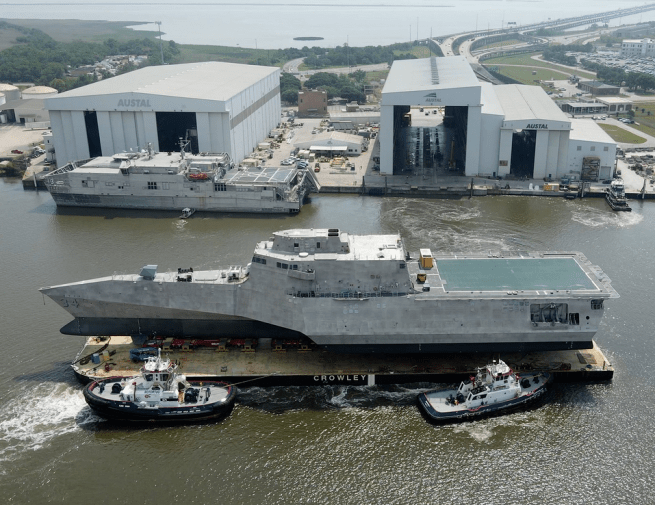
A state-of-the-art trimaran hulled stealth vessel of war, the USS Augusta (LCS-34), will ceremonially go into service. I guess it’s like a grand opening celebration.
Since the independence-class littoral combat ship is named for the city in Maine, the second vessel to carry that distinction, the Navy wanted to uphold a tradition of performing the ritual within the state being honored.
The event’s not to be confused with the christening, which happened with a shattering champagne bottle across the bow or some equivalent in December last year in Mobile, Alabama. Nor is it to be confused with the launching, May 23 last year.
So instead of witnessing the infusion of three thousand guests to Eastport for the day, I’ll be out on the waters of Penobscot Bay, two-plus hours to our west, sailing and sleeping in the oldest active two-masted schooner. Definitely more my speed.
Given the two first-time experiences before me, I think I’ve made the right choice, not that the other was an option at the time I made my reservation.
Living in the path of a hurricane, even as far north as the Maine coast, made for some tense past few days.
From midweek on, we watched with mounting dread as the weather forecasts showed Hurricane Lee’s projected pathway congealing in a route that would bring the eye of the storm directly over Eastport rather than curving away from landfall. Expected sustained wind levels rose from 25 to 35 miles an hour, which litter the town with roof shingles in a typical nor’easter, to a stressful 50 and then, ugh, 70 with gusts even higher.
A day of 70 likely would have ripped much of our roofing away – we’re actually moving ahead with replacing that in a remodeling in a few weeks, now that we have a contractor lined up.
Projected rainfall also kept rising, from the 4½ inches with the slower winds.
The other concern was a power outage, a common problem here. The question was how long. Would everything in the freezer be lost? My wife even planned for three days of cold meals. Smart woman.
Friday was gorgeous, without an inkling of what was ahead. We had a flurry of securing anything outside that might take flight in the wind, including the charcoal grill and the outdoor chairs. Removed the plastic covering over the woodpile. Wrapped the mattresses, books, and fabrics upstairs in black plastic, should the roof start leaking. We were especially worried about a patch over a former chimney that was removed when we bought this place three years.
Then we gleaned all the nearly ripe tomatoes, peppers, and cucumbers from the garden, assuming that high winds would break the vines. A tall tree on one neighbor’s side of the property line has been a worry – the top is quite exposed and includes a widow-maker branch that’s been dangling ominously the entire time we’ve been here, despite other large branches that have come down.
We parked our cars along the street rather than closer, just in case.
An additional concern was the possibility of ocean surge at high tide, flooding the causeway that’s our only route on or off the island.
Yes, as our acting city manager reminded the world, Eastport’s an island city in the bay.
We did think of earlier times when these things struck without warning, sometimes wiping out entire fishing fleets and their crews, and leaving villages of widows and orphans in their wake.
Quite simply, we remembered to be grateful the kind of forecasting we too easily take for granted.
At this point in the cycle, though, there wasn’t much more we could really do. Even fleeing would be difficult. So we’d hunker down and hope for the best.
~*~
Friday afternoon’s newest forecasts did hold a hint of relief. After drastically rising in the previous 24 hours, in what should have been growing accuracy, the winds and rains were actually being scaled back, though not universally, as the projected path was revised further east. Still, we were warned that this was a very broad storm – the size of Montana, as we heard.
~*~
The air had clouded by late afternoon, and, as I washed dishes, I saw a police car parked in the driveway of an elderly, reclusive, and very hard-of-hearing woman on that side of our house. We assumed it was a welfare check, she rarely answered the door, and the young officer was obviously very perplexed – and determined – in conducting his mission. He tried all the doors, returned to the car to make calls, and then tried the doors and peering through windows again.
I went about some other tasks before returning to the window to see the police car still there and then, through the apple trees, a hand in blue latex that connected to another man, or at least a black suit. Then I saw a second black suit guiding the rolling table and wrapped bundle toward the back of their black SUV.
This wasn’t entirely unexpected, but the timing on the verge of the storm remains uncanny.
~*~
Saturday dawned with heavy rains and winds, but still manageable. We had our early steaming coffee, checked the forecast and saw that Lee was now expected to land over neighboring Nova Scotia rather than our end of Maine and then travel up the far coast of Fundy Bay rather than our side. But as I was about to pull two slices of bread into the toaster, the kitchen power kicked out. We assumed it was the toaster overloading the circuit again but then heard the growling chorus of generators around the neighborhood kick in.
No, the power was out, much earlier than we expected. It was only 7:15 and we were far from the worst conditions ahead.
The ground was saturated, meaning trees were more likely to be uprooted, but this was still unnerving. The longer hours without a working sump pump or the freezer functioning were the prime concerns.
We did get a cell phone text saying that the winds and rain were keeping the utility crews from using their bucket trucks. Oh, joy. That on top of an earlier one saying they didn’t expect power to be restored until Tuesday. We hoped they’d do better, since the entire city was down.
We hunkered down into Plan B, which included a lot of reading, even a little journaling on my part. If I really got bored, I could start packing for my travel the next weekend. My wife was probably relieved there wouldn’t be the usual Saturday afternoon opera broadcast. We would live.
But it was a very dark, gloomy, day.
The inability to be online or use our laptops left us squirrelly. I wasn’t surprised. But without power, our desktop weather screen was blank, leaving us ignorant of the latest wind or rain levels on our deck.
Fortunately, the temperature was still in the low 60s, so we weren’t freezing. Still, it would have been nice to have that woodburning stove we’ve finally ordered, along with the new insulated metal chimney to be installed in a few weeks. Here, we thought we were making progress. And I do find watching the flames mesmerizing.
If it were only the Internet being out, we might still watch a DVD together, but scratch that.
At least we enjoyed cold but braised pork chops and cold mashed potatoes for an early dinner.
Outside, the driving rain outside flew horizontally, and from the upstairs windows I viewed the channel between us and Campobello Island was whitecaps racing southward. The island really does shelter us from the heavy surf elsewhere. One gull that foolishly rose up to fly was sent spinning sideways.
Periodically, the rain or perhaps fog obliterated any sight of the Canadian island or the channel itself, a situation that continued through much of the day.
The stop sign on our street corner was fluttering wildly, as it’s prone to do in heavy wind. The big tree was bending heavily, but in that neighbor’s direction.
By midafternoon, when I was dreading the worst, however, things let up. There were actually a few people walking along the street, something that would have been impossible in the heavier winds. A few cars passed, too, though the question of where they were headed remained a mystery.
Was this the calm eye of the storm? A false lull? Even more surprising, we got a postal delivery, earlier than usual, at that, and the rain let up entirely, at least briefly.
Around dusk, the light in our HP printer flickered on, a harbinger of power restoration, even before the other lights came on. Could it be? Only 6:15?
Nothing in the freezer had thawed. We had four to six inches of water in the cellar, but that would be going down rather than rising, as long as the power held. I stepped outside and saw that the roofing, including the patch, had held. The top of the tree was still in place, though there were some big limbs in the said neighbor’s yard.
We were back to a mostly normal Saturday night at home.
~*~
Sunday arrived as sunny, cloudless blue, perfectly comfortable.
The ground was littered in fallen apples, wet leaves, and twigs everywhere. The apples, I’m told, will soon ferment, scenting the air and luring deer and birds that, no kidding, delight in being intoxicated. We’ll see.
We did learn that what had hit us was a post-tropical cyclone, now that Lee had been downgraded. A gust of 83 mph was recorded at a weather station just six miles from us. That blast had come unimpeded straight down Passamaquoddy Bay.
The eye of the storm had passed 50 miles to our east, making a huge difference in the impact, even though we were still in the thick of the action.
We did realize the listing of the peak number of customers without power was misleading. They should be called “accounts,” as in households and businesses, rather than customers. Think of three people or more in a median household. In sprawling Washington, population 30,000 or so, for one utility to say that 10,000 customers were affected really means that the entire area, about the size of Rhode Island and Delaware combined, was cut off. The county’s biggest city and some towns to the north were also out but part of an electric coop reporting separately.
We do sympathize with our neighbors in Nova Scotia to our east. We’re separated by Fundy Bay, about 80 miles wide here, but share a kinship. The province has been heavily hit by drought and forest fires this year, as well as last year’s Hurricane Fiona.
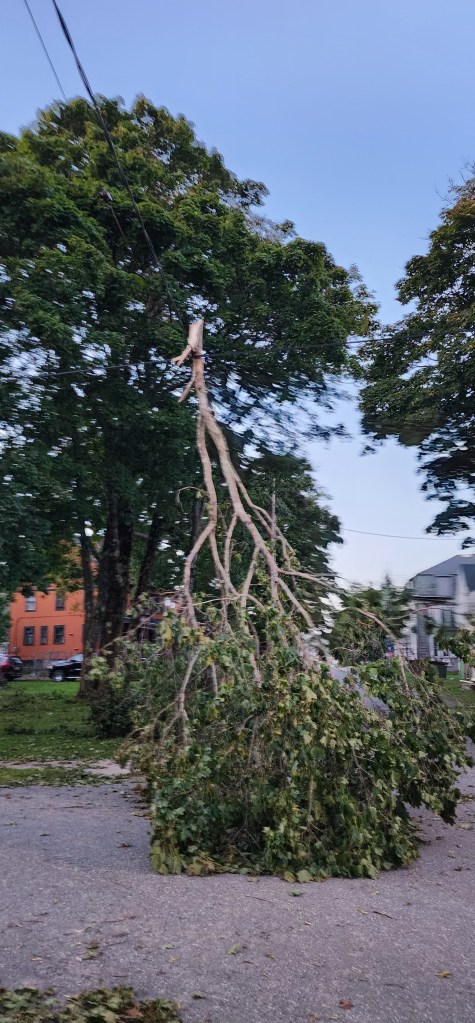
The intersection at the other side of our block is obstructed by this fallen branch.This view gives you a sense of how precarious it hangs from utility lines running along both streets.
Through much of my career, I never quite appreciated the sports staff. The sports desk was over there in its own corner or maybe even a separate room or suite. Unlike the cops beat or business or education or even the courts coverage that filled the “real” news.
But it did produce some of the best political writers and editors in the business.
Their perspective, facing two teams, essentially – especially baseball, with its daily games in season, and delivering on tight deadlines – provided a character-based focus in contrast to those of us who were more policy driven.
Its baseball angle for some fine writers first came to my attention in John Updike’s prose and later David Halberstam, though they didn’t have newspaper experience.
The drama of contests, strategies, determination, hard work, fairness, and a vision is central in their work, along with the reality that so much of the field is about losers who persist and sometimes come out on top or have lasting influence, especially within the realm of a hometown team. Not a bad paradigm.
These former sportswriters and editors were around me throughout my career, though I never kept a list and now wish I had. On the national scene in my time, though, I can point to Charles P. Pierce, Mike Lupica, Ward Just, and Mike McAlery as prime examples of those who broadened their game.
Curiously, I haven’t seen that crossover occurring much from a football foundation. Perhaps that game’s more like a weekly television series or shouting match than the realities of a daily grind.
I’ll let up for now before I’m playing out of my league. But I do want to hear more from others – players and fans alike.
One of the more baffling things I’m finding in living here is the reluctance of folks in one town to participate in something in a neighboring town, as if they were worlds away.
It’s not just a matter of coming in to the Eastport Arts Center, either, or watching a movie in a little theater in Calais.
Pembroke’s renovated library has been hosting a series of free chantey sings by maritime historian Stephen Sanfilippo, and those would welcome (and do deserve) more participants. His well-researched programs usually include much than work songs, despite the title. A recent one that dug into clams and oysters would be a fine eye-opening example.
The most recent event included an illustrated talk by Susan Sanfilippo, drawing on the town’s historical society’s archives. She discussed ships built along the local tidal banks and then showed images of the resulting vessels as they sat in faraway places like Cuba, China, San Francisco, or Hawaii.
Stephen then used the varied destinations of the Pembroke ships as the basis for songs we all joined in singing later, often including nonsense verses while we looked at slides of the vessels. A calypso, anyone?
I should say it was all delightful and enlightening.
Besides, it was a sampling of what happened all along our Quoddy coast. I could image launchings from Shackford Cove in Eastport that then made similar extraordinary voyages.
Who says there’s nothing to do around here? Please look again and expand your horizon.
As we came together in a shared physical space after Covid, we continued to wear masks as a safeguard against resurgences of the virus. Choirs were, after all, a major source of contamination.
We even gave several concerts donned in special masks that gave us extra breathing room. But they did muffle our sound and diction while also fogging our glasses.
What a relief, then, when our director agreed about a month before our last set of concerts that we could go without the masks, if we individually desired.
What a difference it made! We were clearer in tone and lyrics, and our sound projected better. Our ability to hear each other also improved. It was like being unshackled.
It was like declaring the pandemic over, though we knew the virus was lingering.
What single move gave you that ah-hah! Breakthrough as we came out of the Covid onslaught?
The ruling Puritans in New England had reasons for opposing the Quakers, something I need to remember in the midst of my Quaking Dover arguments, They don’t get much sympathy in their objections, at least from my audiences.
As Dover First Parish historian Donald R. Bryant put it, “The Quakers did not conform with the orderly practices of the Puritan churches. They would not join in fellowship, and met among themselves, propagating their own beliefs. Many of them did not do this quietly, but in a manner that was disturbing to regular church members. They were apt to interrupt a meeting or a preacher, or to even interfere with the proceedings of a court. They insulted church order and disturbed the peace. Their conduct was described as ‘indecent and provoking.’”
Some of these points still sting as I look at today’s political and social polarization.

 Jnana's Red Barn