I’m looking for a new motto

I really didn’t use this online, but it did give me a focus:

blogging about Dover

and the world beyond

But now I’ve packed up and relocated. The way this Red Barn blog functions, though, Dover will continue to be a big part of the lineup. It’s a happenin’ place, for one thing, and my next book is a unique history aimed at the community’s 400th anniversary, which takes place in 2023.

As I refocus, I’m open to suggestions. Officially, the heading’s subtitle used to proclaim “a space for work and reflection.” Somewhere along the line, it became “come view the world from my loft,” but now even that is, no pun intended, up in the air.

This blend of here and there has me thinking of dreams, which have one foot in the present and one in the past, or so I’ve heard. From previous moves, I know that my previous home will be part of my awareness for a long time ahead.

Thanks for the memories. And for the new adventures.

Now, though, how should I define my new reality?

Ten dream moves in our new project

As the inspector said, the house has good bones. And as others have confirmed, the place feels good.

If I were living here solo, it would be too big for my needs. The second-floor could be reserved essentially for guests in season.

For two of us, both working from home, that second-floor would definitely come into play, and adding a daughter and son-in-law to the mix, even as frequent visitors, makes for yet one more set of calculations.

So here’s what we’re looking at on the horizon:

  1. Raise the roof into extended dormers across the second floor, plus an addition over the mudroom.
  2. Get heat for the second floor.
  3. Grade and better define the parking area.
  4. Install a wood stove or fireplace in the main parlor.
  5. Redo the old bathroom, moving doorway to the hallway rather than the dining room.
  6. Add an upstairs bathroom.
  7. Add small butler pantry between kitchen and dining room and move washer-dryer to second floor.
  8. Remove the ramp to the back door and move back entrance in the mudroom.
  9. Add a deck – we do miss the Smoking Garden – and implement a garden design – one that’s smaller but deer-proof.
  10. Enlarge the front porch.

It sounds like a lot, but we’re finding it exciting. We did just as much in Dover, only piecemeal.

In sharp contrast

I recall two poet-friends:

One a public high school teacher, quite prolific as both excellent poet and gallery-exhibited photographer, did most of his work during the busy school year rather than the summer; he could never quite figure out why the pattern was exactly opposite of what people would expect.

The other, having all the time in the world to write, could produce only disconnected flashes – nothing sustained or full but wild all the same.

They were buddies.

Some house maintenance that remains to be done

Good luck to the new owners. They’ll have their plate full. As I’ve said, we bought the place as a fixer-upper, and two decades later, after a lot of big work, it’s still a fixer-upper.

  1. The roof, again. If they’re really ambitious, they’ll go for standing seam rather than asphalt shingles.
  2. Replace the upstairs windows. Winter gets cold.
  3. Paint the exterior. We had a tradesman lined up, but he backed out after his wife died.
  4. Scrape and paint the hallway. Caulk the floor, too.
  5. Repaint the floors. The interior rooms could also use refreshing.
  6. Retackle the mother-in-law apartment. When we added it when we first moved in, it was the nicest room we had. But a two-pack-a-day habit took a toll.
  7. Downstairs toilet. Minor, but annoying.
  8. Regrade and repave the driveway.
  9. Minor landscaping issues, but they add up. I’d start by felling the trees next to the house.
  10. Improve the insulation. Seriously.

According to some owners, a boat is a hole in the water where you pour endless amounts of money.

In the same vein, an old house is a hole in the ground where you pour endless amounts of money.


Ten big things to tackle right away in our new project

The Cape we bought was listed as circa 1865, but from some of the detailing, we’re guessing it was more likely around 1835. A bird’s-eye view map from the 1835 shows a house on this site, though maybe not this one.

Many potential buyers passed on the place, for whatever reasons. It is definitely a fixer-upper, but it feels good, and we like its in-town, close-to-the-ocean location.

One chimney was in peril of collapse, and it’s already been removed. The fuel-oil tank had to be replaced. Also done.

We’re looking at the work ahead in two stages.

The first, of course, is more essential. The second, renovating the place more for our dreams.

Not that I especially wanted another This Old House kind of series, but this time we think we can tackle the project more comprehensively, rather than piecemeal.

Here’s what’s on our plate as soon as possible:

  1. Insulate exterior walls.
  2. Repair foundation and cellar. Work from the bottom up.
  3. Level the flooring.
  4. Rewire, to accommodate more electronics and appliances, especially, and add grounded outlets.
  5. Replace windows.
  6. Straighten and fix gutters.
  7. Touch up and repaint exterior trim.
  8. Add a garden shed. We really miss our barn and need more storage space.
  9. Remove the old fireplace iron insert (now sitting in the middle of a room) and the big wood cookstove.
  10. Remodel and update kitchen.


Moving past Covid

Yes, we were Zooming, as our monthly gathering of religious leaders in town has been doing for the past year, but the suggestion did come as a jolt.

For decades now, the largely informal group has been a way of supporting each other, clergy and laity, as friends and neighbors, and out of that has grown joint activity, such as our community-wide Thanksgiving, Blue Christmas, and Martin Luther King services or overnight shelter for the homeless in the depth of winter or recognition of challenges we face as congregations. It’s one of the things I will especially miss in moving from Dover.

“We need to think carefully about how we come out of Covid,” the Congregational pastor mused. “We need to give it the same attention we did going into the restrictions.”

We still haven’t had the conversation. Maybe we will on our next agenda. But she’s right. Our new normal won’t be the same as the old.

I’ve been hoping that when the restrictions are lifted and we’re all immunized, we’ll be hungry to be back in public get-togethers more than ever, including worship. But there’s also the reality that we’ve fallen out of social habits and may cling to our newer stay-at-home routines. There’s a recognition that for some, continuing the online connections may be beneficial – for invalids or people living at a distance, especially. In addition, a Zoom session can be more convenient than driving hours to a committee meeting, as we’re finding, though it also has drawbacks.

As organizations, we appear to have kept a loyal core but also seen, I sense, newer participants drift away. Can we find ways to lure them back or attract others once we’re “open again”?

~*~

You’ve probably already seen the report that for the first time since the figures were kept, church, synagogue, and similar membership in the U.S. has fallen below 50 percent. Some of the reaction has noted a difference between joining in a congregation in contrast to unaffiliated “spiritual” identity. Some other commentators have derided religion altogether, but we should also be aware of declining membership in various associations across the board. One of the things that struck Alexis de Tocqueville about American society in his travels in 1831-1832 was the degree to which we were joiners. Not just in churches but also trade and economic associations, fraternal societies, political parties, lodges and clubs, sports teams, choruses, bands, and theatrical groups, and more.

While I don’t consider myself to be especially “social,” I’m still a member of a half-dozen groups, and I’m not counting those that are essentially an annual donation and a membership card or magazine in return.

Not so for the younger generation. One daughter does belong to the county beekeepers’ group, but that’s it.

As others have noted, that’s not a good sign for building democracy or community.

~*~

But folks are understandably restless. Already, everyplace seems to be booked up for vacation travel. (Glad we have a place that’s suddenly “in.”)

That transition from lockdown to normal now promises to transpire over the summer, giving organizations a chance to anticipate the changes and readjust more slowly. There’s so much we don’t know, after all.

And we haven’t even touched on the future of retailing and other local business.

What are you looking forward to post-Covid? And when?

Think you’ll miss Zoom?


Ten big renovation and maintenance projects we did

In absolute numbers, I suppose you could say we lived in the place for free, once you compare what we paid for the place and added as renovations against the selling price two decades later, but I’m not sure that would hold up if we factored in inflation or what we might have earned if we’d placed much of that money in the stock market.

Even so, here’s some of what we had done:

  1. Reshingled the roof.
  2. Lined the chimney. And then the other.
  3. Replaced the cracked boiler.
  4. Saved the barn from collapse, created a mother-in-law apartment, later removed the second-floor deck from the house to the loft, and wired the loft.
  5. Replaced the downstairs windows.
  6. Remodeled the kitchen.
  7. Remodeled the upstairs bathroom.
  8. Restored the downstairs bathroom as more of a utility room and added a kitchen pantry.
  9. Replaced the sump pump, this time sunken into the floor.
  10. Replaced the rotten bulkhead with steel.

And that’s not counting all the garden beds and plantings or tree work.

From a Jungian interpretation of the Holy Grail myth

So I lost the source, this still applies: “One of the first characteristics of a mood [the author distinguishes feeling, emotions, and moods] is that it robs us of all sense of meaning. Relatedness is necessary if we are to have a sense of meaning or fulfillment. If something is wrong with one’s ability to relate, the meaning in life is gone. So depression is another term for mood. … So a mood is a little madness, a slight psychosis that overtakes one.”

Also: “A woman is much more in control of her moods. She can use them. She tries them on and sees which one she is going to wear. A man doesn’t have as much control over his moods; in fact, he has almost no control. Many women are masters of the whole feeling department as few men ever are. Much difficulty arises because a woman presumes that a man has the same kind of control over his mood that she has over hers, but he doesn’t. She must understand and give him time, or help him a little bit. …

“There is a fine but important difference between mood and enthusiasm. The word enthusiasm is a beautiful word. In Greek it means ‘to be filled with God.’ . . . If one is filled with God, a great creativity will flow, and there will be a stability about it. If one is filled with the anima [a man’s shadow side, his feminine aspects; in a woman, it’s the animus, her male qualities] one may also feel creativity, but it will probably be gone before nightfall. One must be wise enough to know the difference between God and the anima; most men aren’t. … Laughter is positive and creative, unless it comes from a mood.”

Among the points the writer in question raises in that section is one noting the danger of a feminist stance pushing women into their animus side, which gives men no refuge. “In some respects this is necessary, but in some other respects it could be nearly fatal. Each [man and woman] should serve the other. This is the ideal. We can’t do without it. One cannot live without the service, without the love, without the nurturing and service of the other. Parsifal understands this …”

No wonder I’ve been going out of my gourd!

Farewell, Dover … in a way

It’s not like I won’t be back. My next book is a unique history of the town’s Quakers, for one thing, and I’ll be promoting it. And I’ll still be connecting with Dover Friends, especially through New England Yearly Meeting. Yes, Downeast Maine is still part of New England, thank God.

Will I miss people? Definitely. Some great neighbors, the Greek Orthodox circle, the lifeguards and fellow swimmers at the city’s indoor pool would be high on that list. My fellow musicians, on the other hand, were down in Boston, and I haven’t seen them since before Covid. Our beloved conductor even stepped down in the face of its digital demands. The local writing circle, meanwhile, adds some valued faces to the list, though I can’t say we were close or even much on the same page. But that’s where I did learn about Smashwords, where all my novels quickly appeared.

Which brings up another point. This new move would be much harder if we were leaving extended family behind or, more crucially, that rare friend who connects intimately on a range of shared interests – those things that fit one’s life mission or identity. For me, that would be a nexus of Quaker spirituality, off-beat literature, classical music, natural wonder and wilderness, back-to-the-earth awareness, even folk dancing. Things like gardening and foody smarts would be more on my wife’s side of the equation.

What, you think there are tons of people who match my varied interests? Surely, you jest.

Death has already taken a toll there, as has spiraling illness, their moving away to a distance, or even insurmountable conflict. But in my new setting, I am meeting some fascinating eccentrics. More later, I’m sure.

I do wish we had more words to describe friendships, though I’m afraid any subtlety would quickly be eroded. The fact is there are few of those soul-mate connections, especially among males of our civilized species. Women seem to be naturally inclined toward that one-special-friend connection, the kind of person you have to phone (or text) every day. Or every-other hour. Not so guys, to our own detriment. Mea culpa.

Let’s also note that Covid precautions have also already detached us. We’re rarely in physical contact, no matter how much Zoom and other platforms allow me to catch up with buddies even when I’m way up Downeast Maine. And, from everything I’m seeing, that’s likely to continue into the foreseeable future.

~*~

My wife and I have both been surprised how quickly I’ve switched into my new center. Once my workstation and files were set up in our new address, that’s where my heart was. Dover is undergoing what I expect to be an amazing rebirth, but I won’t be part of it, and I’m aware of that.

Quite simply, it’s become a great place for me to visit, but no longer home. All of my goods have ether been moved to the new address or are in the storage unit we’ve rented.

In other words, the dream has stepped on.

~*~

As I look back on my years in Dover, I realize I see I hadn’t spent as much time in neighboring Portsmouth as I’d expected or at the University of New Hampshire just a town away. Even once I’d retired from the newsroom, I was largely hunkered down in writing, revising, and publishing. So much for the writer’s life!

I can say I feel comfortable in leaving Friends Meeting in good hands and wish the best for the new owners of our old house, barn, and precious gardens.

I can say Dover’s been the best years of my life. So far. You will be seeing more from that through the coming year, here at the barn.

What would you miss most if you uprooted?
 

Leaving the barn behind … but not entirely

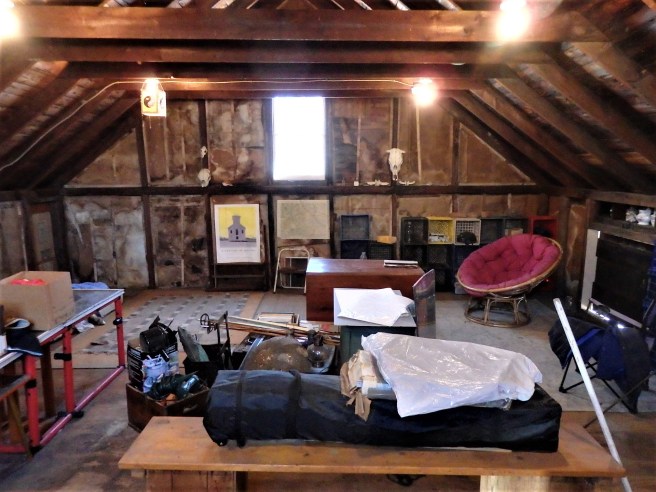
I had sweet dreams of remodeling the loft of the barn into a year-’round studio. Something like critic/professor Jack Barnes’ cozy literary digs on his farm in Hiram, Maine. Alas, it never quite happened.

Family life pushed us in other directions, and then the publishing scene also changed. I didn’t need quite so much room to spread papers or stack submissions, for one thing. More and more was on the computer, and in time, I no longer needed computer discs for storage. Remember them?

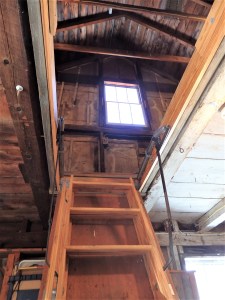
Climbing to the loft was kind of like going up into a treehouse.

When we redid the loft, it was more as a three-season space, a retreat, and it did give me the room to spread poems about when I considered the sequence for one of my chapbooks. It also allowed us to decompress a lot of the stuff we’d packed into the house. But it was, as you’ve seen, pretty funky – not the polished compartment I once desired.

At least I painted the exterior traditional New England barn red and not that loud crimson used elsewhere. Not that I could tackle that project again. I’m not sure I could even manage the ladders these days, and I definitely wouldn’t be up on the roof repairing the weather vane.

What the barn did give us was space, even though much of that soon became crowded. Garden tools and pots, shelves of canning jars, chairs that just might be re-caned or repainted, bins of Halloween, Christmas, or Easter decorations. Carpentry tools, an array of wood, and painting supplies. Picnic coolers and charcoal. Two big freezers, well stuffed, at one point, on the ground floor.

The barn did become an emblem for me, as a repository for many souvenirs from my zig-zag journey out from Ohio, and maybe even for us as “city farmers.”

And now I’m waving farewell to all that as I head off on new adventures.

So here goes. Just be warned you’ll still be reading about it and its surroundings in upcoming posts. The Red Barn is definitely continuing.

We had already moved out a lot of stuff, and the loft still looked like this.