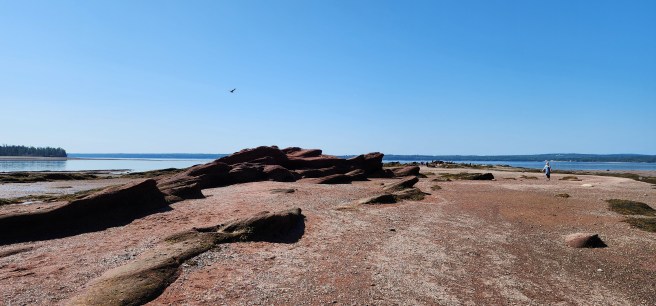
Historic St. Croix Island viewed from the north

The first French attempt to colonize North America took place in 1604 on this island in the St. Croix River but ended disastrously. The historic site is now an international park between Maine, USA, and New Brunswick, Canada.

Access to the island itself appears to be problematic.

Here it is seen from Ganong Nature Park (east of St. Stephen, New Brunswick) at the confluence of Pagans Cove, Oak Bay, and the Waweig River while the St Croix River veers off to the west and quickly narrows before continuing the international border.

Lorenzo Sabine was a Yankee, all the same

After running across his name repeatedly while researching the history of our old house, I decided to look him up. Lorenzo Sabine turns out to have been a remarkable character. Best known today for his two-volume, provocative 1864 book Loyalists of the American Revolution, his adulthood included an influential span in Eastport.

Here are some highlights.


  1. He was born in 1803 in what’s now Lisbon in the White Mountains of New Hampshire, with a Methodist minister for a father and roots going back to French Huguenots who arrived in Rehoboth, Massachusetts from Wales in 1643. Lorenzo moved with his parents to Boston in 1811, and then to Hampden, Maine, in 1814, where he completed his preparatory studies. His father had been taken prisoner by the British in the War of 1812 while working in a military hospital.
  2. At age 18, following his father’s death and his mother’s remarriage, he came to Eastport not long after Maine gained statehood from being a district of Massachusetts. At first, he was employed as a clerk, then tried his hand at his own business but went bankrupt, followed by working as bookkeeper of Passamaquoddy Bank and then engaging in a series of enterprises, including stints as a mercantile partner with William and Jacob Shackford, sons of the Revolutionary War veteran who built our house and much more. He shows up as a witness on many property deeds and other court records.
  3. He was editor of the weekly Eastport Sentinel newspaper to 1834, during Benjamin Folsom’s time as publisher. He was also founder of the Eastport Lyceum, and incorporator of the Eastport Academy and Eastport Atheneum.
  4. He served as a member of the Maine House of Representatives, 1832-33, and was deputy collector of customs at Eastport, 1841-43.
  5. From early childhood, he was what he called “revolution-mad,” something that grew in other directions after his move to Eastport, abutting Canada and having many residents descending from Loyalist lines. This led to his insight that “there was more than one side to the Revolution.” Prior to this “every ‘Tory” was as bad as bad could be, every “son of Liberty” as good as possible.” During the 1840s, the results of his research appeared in the North American Review, America’s first literary magazine.
  6. Quite simply, his work was not favorably received by “patriotic” Americans though it did receive support from several important historians. Lorenzo then revised and expanded his material into an 1847 book The American Loyalists, or Biographical Sketches of Adherents to the British Crown in The War of the Revolution; Alphabetically Arranged; with a Preliminary Historical Essay, erupting a firestorm of controversy. The work received a more thorough two-volume edition for its republication in 1864. You can read it online to see why it challenged many of the conventional treatments of the Revolutionary War and the tensions leading to the War of 1812 from the British side. He did, do note, receive honorary degrees from Bowdoin College and from Harvard.
  7. He moved to Framingham, Massachusetts, in 1848 as a trial judge and was elected to Congress in 1852 to fill a seat vacated by death but did not run for reelection.
  8. Appointed secretary of the Boston Board of Trade, he relocated to Roxbury and also served as a confidential agent of the U.S. Treasury Department.
  9. He was married three times, to Matilda F. Green in 1825, Abby R.D. Deering in 1829, and 1837 to Elizabeth M. Deering, who survived him. Only one of his five children survived him.
  10. He died in Roxbury in 1877 but is buried in Eastport’s Hillside Cemetery.

How French-speaking Canadiens provoked the American Revolution

In my research for the book that became Quaking Dover, I became much more aware of the ongoing tensions in New England with the French to the north.

I thought that ended with the Treaty of Paris in 1763, but I was wrong.

The British tried to assimilate the Canadiens into the wider society but by 1774 realized the futility of the effort.

To alleviate the situation, Parliament passed the Quebec Act, covering the former New France. The measure permitted the continuation of the French language, legal system, and Roman Catholic religion in what was now enlarged and renamed Quebec. Crucially, reference to the Protestant faith was removed from the oath of allegiance required for holding public office, and the Catholic church could again impose tithes.

Many of the English in the New World were outraged, seeing this as a granting freedoms and lands to their former enemy and including the possibility of stripping them of their self-elected assemblies and voiding their claims to land in the Ohio Country, granted by royal charter to New York, Pennsylvania, and Virginia but now unilaterally ceded to Quebec.

The act had been passed in the same session of Parliament that imposed punishments on the Boston Tea Party, among other affronts the Patriots derided as the Intolerable Acts.

Patriots also saw the measure as establishing Roman Catholicism in the 13 colonies and promoting the growth of “Papism.” in general.

I was unaware of its inflammatory influence as a direct cause of the American Revolution until I heard of the measure as an aside on a CBC Radio commentary.

Just nine months after the act’s enactment came Paul Revere’s midnight ride and the “shot heard ‘round the world” in the rebellion at Boston.

Barely two years after its passage, the Declaration of Independence was proclaimed in Philadelphia.

C’est vrai.

Happy Canada Day – and a nod to the Loyalists who fled from the American Revolution  

When I was growing up, we occasionally heard that not everyone in the American colonies supported the Revolutionary War, but we never, ever, got a clue of how many opponents there were or how strongly they resisted. Sometimes it went past as “a third.”

Living where I do, facing the border of New Brunswick, Canada, has been an eye-opening experience on that front.

In fact, a premiere historian of their support of the Crown was Lorenzo Sabine, a prominent figure in early Eastport and a business partner, briefly, of two of the sons of the man who first presided in our house. We’ll look at him in a Tendrils next week.

Today, in observation of Canada Day, we’ll focus on the United Empire Loyalists who were expelled from the new United States to the south. Or, where I live, it’s also east.

  1. An estimated 42,000 white settlers plus 3,500 free blacks and 2,000 enslaved blacks migrated to the remaining British North America holdings during and especially at the close of the Revolutionary War. They came from all 13 rebelling colonies, but principally from New York and New England. Many other expelled monarchists relocated to Florida, Britain, and the Caribbean.
  2. They came from every social class but often after enduring the confiscation of their property and wealth. Some did manage to dismantle their houses and erect them anew in Canada, as I learned in a neighborhood of Castine, Maine.
  3. Sir Guy Carleton – the 1st Lord Dorchester and governor of Quebec and governor general of the Canadas – created the identifying label to distinguish the English-speaking settlers from the descendants of New France inhabitants of the Province of Quebec, otherwise known as Canadians or Canadiens, possibly akin to Acadia.
  4. Growth resulting from the arrival led to the creation of new colonies. In 1784, New Brunswick was partitioned from Nova Scotia to reflect significant new settlement around the Bay of Fundy. In 1791, the Province of Quebec divided into Lower Canada (present-day Quebec), and Upper Canada (present-day Ontario).
  5. To encourage Loyalist resettlement, especially along the frontier of Upper Canada, the Crown awarded the new arrivals land grants of 200 acres a person. This added English speakers to the population and was followed by additional waves of immigration that established a predominantly Anglo-Canadian culture both west and east of the modern Quebec border.
  6. Loyalists in Upper Canada petitioned the government to be allowed to use the British legal system, which they were accustomed to in the American colonies, rather than the French system. Great Britain had maintained the French legal system and allowed freedom of religion after taking over the former French colony with the defeat of France in what we call the French and Indian War but is more widely known as the Seven Years’ War. Thus, most Loyalists in the west could live under British laws and institutions while the predominantly ethnic French population of Lower Canada, who were still French-speaking, could maintain their familiar French civil law and Roman Catholic religion. (I’m assuming that the residents of Nova Scotia and New Brunswick already functioned under the British system.)
  7. Thousands of Iroquois and other pro-British Indigenous peoples, expelled from New York and other states, resettled in Canada. One group established the Six Nations of the Grand River, the largest First Nations reserve in Canada.
  8. In laying out St. Andrews, eight miles from my home in Maine, Loyalists named the north-south streets after the 13 children of King George III. The major east-west streets include one named for Queen Charlotte and another as the Prince of Wales. The county is also named for Her Highness.
  9. Largely influenced by its Loyalist presence, Canada resisted U.S. overtures during the War of 1812 and successfully repulsed American invasion. From the Loyalist perspective, the War of 1812. Other parties viewed it as a mixed bag.
  10. Many Canadians take pride in their Loyalist ancestry. As In 1898, Henry Coyne wrote in 1898, “The Loyalists, to a considerable extent, were the very cream of the population of the Thirteen Colonies. They represented in very large measure the learning, the piety, the gentle birth, the wealth and good citizenship of the British race in America, as well its devotion to law and order, British institutions, and the unity of the Empire. This was the leaven they brought to Canada, which has leavened the entire Dominion of this day.”

George Washington, we may note, did not view them so favorably. As he remarked in a 1776 letter, “One or two have done what a great number ought to have done long ago, committed suicide. By all accounts, there never existed a more miserable set of beings than these wretched creatures now are. Taught to believe that the power of Great Britain was superior to all opposition, and, if not, that foreign aid was at hand, they were even higher and more insulting in their opposition than the regulars.”

Now, for tonight’s fireworks from an island on the other side of the international border.

A French priest had a different perspective on early Maine

In my research for the book that became Quaking Dover, I became more knowledgeable about what emerged as northern New England.

There was the attempted English settlement, Popham, at the mouth of the Kennebec River in 1607-1608, of course, which had a direct line to the project that settled Dover in 1623.

But the French also had their own perspectives and influences on the region, as is seen in the English raids on the village of Norridgewock upstream. Because the Jesuit missionary Sebastian Rale had established a Roman Catholic church, the French considered the settlement a French village on par with places like Castine, even though apart from Rale, the inhabitants were Abenaki.

That settlement was destroyed in 1705 by 275 New England militiamen headed by New Hampshire’s Winthrop Hilton, the second son of Dover founder Edward Hilton. This was during what the English called Queen Anne’s War, which the French termed the Second Intercolonial War.

It was attacked and destroyed again in 1724, leaving Rale among the slain, as part of Dummer’s or Father Rale’s War, as the English called it. From the French point of view, he was a martyr. The English colonists saw him as a villain who had led deadly raids further to the south.

Both events happened during what we are more likely to know as the French and Indian wars, not that the French or the Natives used that label.

~*~

More recently I came across a long letter from the French Jesuit Pierre Biard in Port Royal in today’s Nova Scotia to his superior in Paris in 1612.

Here are some highlights related to what would emerge as Maine.

~*~

And in truth it would be much better if we were more earnest workers here for Our Lord, since sailors, who form the greater part of our parishioners are ordinarily quite deficient in any spiritual feeling, having no sign of religion except in their oaths and blasphemies, nor any knowledge of God beyond the simplest conceptions which they bring with them from France, clouded with licentiousness and the cavilings and revilings of heretics. Hence it can be seen what hope there is of establishing a flourishing Christian church by such evangelists. The first things the poor Savages learn are oaths and vile and insulting words; and you will often hear the women Savages (who otherwise are very timid and modest), hurl vulgar, vile, and shameless epithets at our people, in the French language; not that they know the meaning of them, but only because they see that when such words are used there is generally a great deal of laughter and amusement. And what remedy can there be for this evil in men whose abandonment to evil-speaking (or cursing) is as great as or greater than their insolence in showing their contempt?

~*~

At these Christian services which we conduct here at the settlement, the savages are occasionally present, when some of them happen to be at the port. I say, occasionally, inasmuch as they are but little trained in the principles of the faith — those who have been baptized, no more than the heathen; the former, from lack of instruction, knowing but little more than the latter. This was why we resolved, at the time of our arrival, not to baptize any adults unless they were previously well catechized. Now in order to catechize we must first know the language [Algonquin]. …

Rude and untutored as they are, all their conceptions are limited to sensible and material things; there is nothing abstract, internal, spiritual, or distinct. … And as to all the virtues you may enumerate to them, wisdom, fidelity, justice, mercy, gratitude, piety, and others, these are not found among them at all except as expressed in the words happy, tender love, good heart. Likewise, they will name to you a wolf, a fox, a squirrel, a moose, and so on to every kind of animal they have, all of which are wild, except the dog; but as to words expressing universal and generic ideas, such as beast, animal, body, substance, and the like, these are altogether too learned for them.

~*~

[Regarding one convert:] Even before his conversion he never cared to have more than one living wife, which is wonderful, as the great sagamores of this country maintain a numerous seraglio, no more through licentiousness than through ambition, glory and necessity; for ambition, to the end that they may have many children, wherein lies their power; for fame and necessity, since they have no other artisans, agents, servants, purveyors or slaves than the women; they bear all the burdens and toil of life.

~*~

All night there was continual haranguing, singing and dancing, for such is the kind of life all these people lead when they are together. Now as we supposed that probably their songs and dances were invocations to the devil, to oppose the power of this cursed tyrant, I had our people sing some sacred hymns, as the Salve, the Ave Maris Stella, and others. But when they once got into the way of singing, the spiritual songs being exhausted, they took up others with which they were familiar.

~*~

Then our people were sure they were captured, and there was nothing but cries and confusion. Monsieur de Biancourt has often said and said again, that several times he had raised his arm and opened his mouth to strike the first blow and to cry out, “Kill, kill,” but that somehow the one consideration that restrained him was that I was outside, and if they came to blows, I was lost. God rewarded him for his good-will by saving not only me but also the whole crew. For, as all readily acknowledge at this hour, if any foolish act had been committed, none of them would ever have escaped, and the French would have been condemned forever all along the coast.

~*~

At the confluence of these two rivers [today’s Castine], there was the finest assemblage of savages that I have yet seen. There were 80 canoes and a boat, 18 wigwams, and about 300 people.

~*~

Do note that in most accounts I’ve encountered, the French are seen as far more sympathetic to the Indigenous peoples than were the English.

My favorite radio program at the moment

It’s called “My Music,” a Saturday morning staple on the CBC Music FM radio network.

For two hours each week, a notable Canadian classical musician is invited to share his or her favorite music. Not all of it’s classical, either. Sometimes it’s a pianist or a violinist or even a conductor or composer. Some are quite famous in musical circles, while others are fairly obscure. Organ, clarinet, harp, percussion, and varied ethnic instrumentalists have hosted as well. And there are some amazing singers, not all of them opera.

Sometimes they stick to their particular niche, but I especially enjoy the ones who venture far beyond that.

It’s quite touching when they honor their parents, siblings, teachers, and friends with their selections, and quite enlightening why they explain what makes someone they admire stand out. As I said, it’s not always classical. Canadian jazz pianist Oscar Peterson turns out to be a huge influence.

I do wish classical stations in the U.S. had a similar program. To attempt this on a national level would be too overwhelming. Part of its joy is a small-town feel. Basing one in Boston or Los Angeles or Chicago might even be too big.

Bloomington, Indiana, would be a natural, or San Francisco, or even a whole state like Minnesota.

Whaddya think?

Meet patriot Lewis Frederick Delesdernier

In researching the history of our house, I learned about many of its earlier neighbors as well. Of note to the south was one with a rather exotic surname. Turns out he was a rather influential figure in the establishment of Eastport.

Here are a few points about him.

  1. He was born as Louis Frederic DeLesdernier in Halifax, Nova Scotia, in 1752 to Gideon de les Dernier and Judith Marie Madelon Martine. As for that French surname? The precise location at that time could have been under either French or English rule – the conflicts are quite tangled. He was, however, a generation removed from Geneva, Switzerland, by then. French-speaking, all the same, however anyone wound up spelling it.
  2. His uncle Moses was the first Protestant to farm among the French Acadians.
  3. When the American Revolution broke out, Lewis enlisted in an effort to bring the American Revolution to Canada. The attack on British Fort Cumberland in Nova Scotia was defeated and then, in retreat, Lewis ultimately wound up in Machias, Maine, where he was charged with maintaining good relations with the local Passamaquoddy to assure that they didn’t defect to the British. During this time, in 1779 he married Sarah Brown, the daughter of a fellow garrison member. For a Frenchman, attacking the English makes sense.
  4. After the war, he resettled on an island in the waters either in today’s Lubec or Eastport, Maine, one called variously Fredrichs or De Les Dernier island. There he was appointed as the first customs collector for the district, possibly encompassing both today’s Lubec and Eastport, and, in 1789, when the first post office was established, was named postmaster. Could that island have been what emerged as Moose Island, today’s Eastport?
  5. In Eastport, he was not only the first postmaster but also the first collector of customs. Case closed?
  6. The first owner of our house did have a ship named after him. In those days, naming a ship after someone often obligated them to buy a share in it. Did this present a conflict of interest for the custom’s collector?
  7. After Delesdernier’s first wife’s death in 1814, he married the widow Sophia Fellows Clark in 1817. Trying to determine the number of children remains elusive, but I’m finding no descendants in the region today.
  8. When he died in December 1838 at his son’s home in today’s Baileyville, Maine, a warm friend, Alfred A. Gallatin, the fourth U.S. Secretary of the Treasury (1801-1814) under President Thomas Madison, said, “He is to me of all Americans I have seen, the most zealous and full of enthusiasm for the Liberty of his country.”
  9. An 1803 arrival in Eastport of Harvard graduate Jonathan D. (the initial for you can guess what) Weston was auspicious. Shortly before his death, provided details on much of the early settlement of Eastport in a history published in 1834 and later woven into William Henry Kilby’s 1888 volume. He also hosted famed ornithological artist John J. Audubon at his 1810 home at the corner of Boyden and Middle streets. I’m not finding any direct relationship, but will venture that the middle name was in honor of Lewis, perhaps even hinting at the reason for Jonathan’s moving to Eastport.
  10. Lewis’ circa 1807 house was eventually moved from down on the water to higher ground. The only remaining evidence of its original location is in the naming of Customs Street, far from the later custom’s offices. Today, the Delesdernier home on the south end of the island is proudly owned by symphony conductor and cellist Dan Alcott, who anticipates moving into it year-round. We can’t wait!

To add the word ‘island’ to Grand Manan would be redundant

Despite our many trips to Cape Cod back when I lived not that far away in New Hampshire, I never got around to visiting tony and history-laden Martha’s Vineyard or neighboring Nantucket. It’s an oversight I don’t want to repeat when it comes to Grand Manan, an impressive Canadian island we can see from some points here in Eastport, Maine.

I am hoping to get there this year. Even if I don’t, here are some high points:

  1. Its closest point on the mainland is the town of Lubec Maine, nine miles across the Grand Manan Channel. For mainland New Brunswick, it’s Blacks Harbor, 20 miles over the Bay of Fundy. Yet if you look at most maps of Maine, it doesn’t show up at all, despite its proximity. That part
  2. As the largest of the 25-plus Fundy Islands, Grand Manan is 21 miles long and has a maximum width of 11 miles, covering 53 square miles in all. (Campobello and Deer Island, which border Eastport, are the second and third largest, respectfully.) It’s home to 2,595 year-round residents.
  3. The principal way of getting there is by a 90-minute ferry ride from Blacks Harbour. Reservations are recommended, both ways.
  4. For comparison, Martha’s Vineyard is 20.5 miles long, covers 96 square miles, takes a 45-minute ferry jaunt, and has 20,530 full-timers; Nantucket covers 45 square miles, is a 2¼-hour commute by traditional ferry, and has 14,444 residents. Both of the Massachusetts towns are much wealthier than Grand Manon, where most folks eke out their living “on the water.”
  5. The economy is based primarily upon commercial fishing – lobster, herring, scallops, and crab – plus ocean salmon farms and clam digging.
  6. For the traveler, the island is largely a step back in time, with a single highway along the eastern half, where most of the modest residents live. That leads to the rest of the Grand Manan archipelago of nearby smaller islands such as popular White Head (reachable by a second ferry ride), Ross Cheney, and the Wood islands, plus countless surrounding shoaling rocks. Meanwhile, the rugged and forested western side, with 300-foot-high cliffs, high winds, numerous passages, coves, and rocky reefs, incorporates wildlife-rich preserves.
  7. Tourism, the second source of income, provides unspoiled ocean views, whale-watch cruises – rare right whale breeding grounds adjoin its waters – as well as kayaking, hiking, camping, photography, painting, and bird-watching with more than 240 species, including nesting puffins in season.
  8. Among the lighthouses to check out are Gannet Rock, Swallowtail, Southwest Head, Long Eddy Point, Long Point, and Great Duck Island. Not all of them are what you would call picturesque or prime condition. Not to slight them.
  9. Linguistically, “Manan” is a corruption of mun-an-ook or man-an-ook, meaning “island place” or “the island” in the local First Nations’ language. The suffix ook, meanwhile, means “people of.” French explorer Samuel de Champlain recorded the place as Manthane on a 1606 map and later changed it to Menane or Menasne – close enough in sound. So if Manan already means “island,” why be redundant? You don’t need to add “island” to the Vineyard or Nantucket, either – everybody knows what you mean without it.
  10. Grand Manan’s not for everyone. As one review said, “A long way to travel for nothing. Nice rocks but you can see those in Maine. Sea glass was hard to find and sparse. Very poor, depressed area. Lighthouses are ugly and there is nothing to really do other than hiking, which you can also do in Maine. Ferry stunk and was disgusting. Never saw any whales or seals. Nothing on the island except rundown shacks. All the online promotions are just hype. Waste of a day. … Go to Campobello island, it’s 100% better.” In short, sounds right up my alley for adventure.

The first permanent settlement, by the way, was in 1784 by Loyalists fleeing the U.S. at the close of the American Revolutionary War, a common occurrence across New Brunswick.