A huge challenge to family-owned businesses arises in the passing of one generation to another. The unanticipated death of the patriarch or matriarch in his or her prime can wreak havoc on the company, even if inheritance tax liabilities aren’t overwhelming. Sometimes the heir apparent isn’t the best option, not all of the heirs want to be part of the operation, or bitter rivalries emerge. Getting through the fourth generation, with a spreading number of family members and interests, can determine the fate of the enterprise. As I saw in the newspaper industry, most nameplates sold out to media chains at this point, losing much of their underlying local connection in the process.
Do you know of any businesses that fit this description?
When a family-owned business has two siblings at the helm, how effectively they resolve conflicts – or ignore them – is crucial. As one well-known New England brother has said, he learned that family was more important than always being right. In their case, it worked. They even became TV stars in their ads. I suppose there were other corrective mechanisms behind the scenes or ones that would kick in later. We’ll see the biz school case study in time, no doubt. On the other hand, differences can also lead to lawsuits, the breakup of the company, even its sale to rivals, perhaps followed by a longstanding refusal to speak to each other. We’ve also seen those headlines.
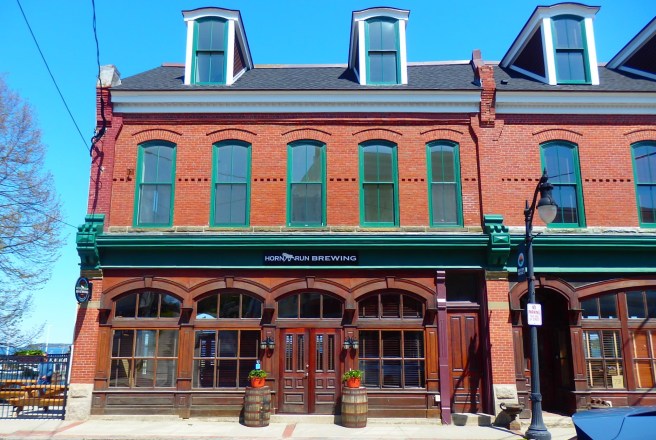
We’ve been watching the renovation of a former bakery downtown, including the clues it was going to be a brewpub. Everyplace seems to have one, except Eastport, until now.
Only a month ago.
The work felt like it was taking forever, but then, to our surprise, the one storefront had some “soft openings,” 2 to 7 or so over the past couple of weeks, ironing any kinks out. It was announced only by a small chalkboard on the sidewalk. I’ll just say they’ve been lovely, low-key, and fun. The Horn Run’s brew’s excellent, too. From all signs, Lisa and Jeff know what they’re doing. They already have a loyal following.
The interior is cozy with an English pub feel, with a view that would be hard to beat. It’s become a place where it’s easy to make introductions.
The choice for the official opening matched many of the downtown stores and galleries, which already planned to reopen for the season today. We’ve definitely felt something building in the air.
But look now. And, yes, there’s an outdoor deck to our left.
Horn Run? Well, for baseball fans, it’s a kind of pun, with a moose as the runner. But it’s also an inside joke, based on the nearby Moosehorn National Wildlife Refuge. Seems that when the pub’s owners were younger and wanted to go for a drive, they’d say, “Let’s take a run around the ‘Horn.” Which then introduces a second inside joke. Moose don’t have horns – they have antlers.
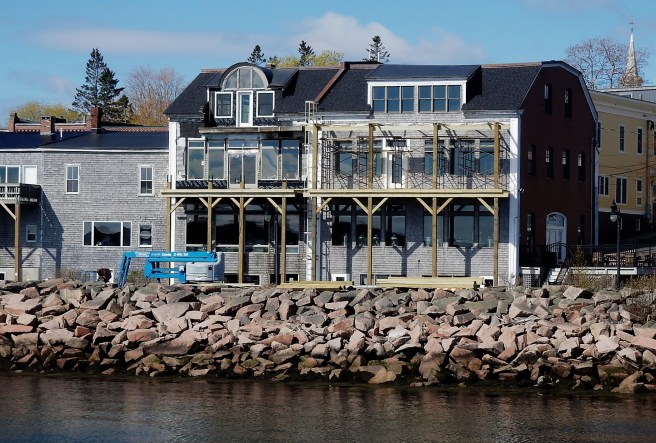
Overlooking the harbor, once the porches are finished.
Work on the apartment porches overlooking the harbor continues. I have seen some of the daring residents already having their morning coffee on the deck, enjoying the ocean air and the view.
The hope is that Horn Run will spark renewed vitality downtown as we come out of Covid. It definitely has appeal for summer visitors as well as younger residents looking for a suitable social center.
In my novel What’s Left, her generation of the family will face some crucial decisions that resemble those their parents were charting when her father-to-be showed up in the household.
In a passage I cut from an earlier draft, she wonders:
What would you do?
While Dimitri and Barney have niches in the business, Nita has her chosen career. Tito, meanwhile, will likely have his hands in both the Zap enterprises and an independent law firm.
That leaves Manoula, who hopes to head off in a literary direction, not necessarily as a writer.
~*~
As I’m revisiting this, I’m getting a bit steamed. I realize how little guidance I had regarding my future. We didn’t talk much about it at home, and even college was somehow mostly off the table. The so-called guidance counselor at my large high school was mostly a disciplinary officer and military-draft registrar. College? No help from him!
I got more from the editor of the first newspaper that hired me as an intern. He had a knack for nurturing talent. I just wish he hadn’t retired when he did.
Dimitri seems to possess much of that skill, perhaps even more than Nita. They’d likely ask:
What would you really like to be doing with your life? What do you need from us to help? So what do you really want to do with your life? And what do you need to get there?
Her aunt Nita in my novel What’s Left, has an interesting insight on showing up for work before all the others. It doesn’t fit every job, but it did hers. And then I cut this from the final version of the book:
If you’re the first one in and the last one out, you can disappear in the middle of the day and your coworkers and bosses are none the wiser. They just assume you’re out on assignment.
~*~
Not all jobs require you to punch-in or punch-out on some kind of clock. I’ve never had to work one of those, fortunately, although I’ve often had to fill out weekly time cards before being paid.
What I did find, though, was that even when I was putting in a lot of unpaid overtime (the joys of being low-tier management!), I could still feel the judgmental eyes behind my back.
Are you ever considered a slacker on your job? How does it feel? How do you respond?
~*~
In the family, Cassia would have had food like this. Greek olives! Best of all, packed in olive oil!
I heard it twice, miles apart: “I have retailing in my blood.”
Both headed family businesses – one, a supermarket chain, the other a small-town restaurant.
The grocer worked with three of his brothers and a brother-in-law, though another brother instead became a respected physician.
The restaurateur worked alongside his only brother and their wives.
Both enterprises were founded by their fathers.
It’s a lot like the family enterprise in my novel, founded a few generations earlier.
Do you know anyone like that?
~*~
My novel is available at the Apple Store, Barnes & Noble’s Nook, Scribd, Smashwords, Sony’s Kobo, and other fine ebook distributors and at Amazon in both Kindle and paperback.
I had already made this point elsewhere in my novel What’s Left, so this sentence was trimmed out of the final version:
Theos Graham joins Theos Barney and Thea Pia in feeding the homeless at Carmichael’s back door or the soup kitchen at the Lutheran church or even letting them sleep in our bus, once we have one.
I do miss the mention of the Lutheran church or the bus, by the way, but they just didn’t fit what was left.
~*~
Yes, we all have found ourselves proclaiming, “I’m starving!” Not that many of us have suffered so much as starvation itself.
Have you ever gone truly hungry? Have you ever wound up accepting handouts from strangers? Have you ever fasted? What’s the longest you’ve gone without food?
~*~
In the family, Cassia would have had food like this.
One of the ideas at work — oops! — in my novel What’s Left, is work itself.
Most of us tend to think of it as menial labor, I suppose, but it doesn’t have to be. In the story, for example, Cassia’s aunt Pia has a way of making every task fun and meaningful. And Cassia and her brothers and cousins all put in hours at the family restaurant from an early age on.
~*~
Her aunt Nita also had some insights on work. Here’s one I cut from the final version of the book — we simply had more on our plate than we could manage:
Day by day Nita worked her column like a line cook … a station chef. And she dared tell me journalism’s not like an assembly-line job?
~*~
The poet Donald Hall once broke labor out into three kids: work, jobs, and chores. Maybe you’ll see how they differ.
Tell me about something you do for the pure joy of doing it, even though other people might think of as, uh, tedious work.
For some of you, this could be gardening or cabinetry or decorating cakes or arranging flowers or, well, you get the drift. For others it might be an art or sport or public service.
Is it something you also get paid to do? Or could you?
As I revised my novel What’s Left, I compressed the details regarding her mother’s book-publishing venture. Here’s how it stood in an early draft:
As her dream of establishing a small-press also takes shape, the family council decides not to include it outright among our Five-Spokes enterprises but rather to extend a ten-year microloan to allow her to retain full control of its success or failure. Her game plan anticipates a modest start, essentially continuing the annual calendar and the greeting cards featuring local photographs by Baba, as well as the release of the first volume of Nita’s collected columns. These are things Baba can shepherd along while Manoula finishes her degree. From there, a cookbook would be a no-brainer in the lineup, something Barney can begin putting together immediately. We know he’ll be fussy and irritable, miss deadlines, do the whole prima donna bit. Besides, he’s not a writer, so there will be extensive editing and revision. After that, Baba can worry about the photos. He says shooting food’s a specialty all to itself. You can bet, though, the results will be worth it. And all that’s before Manoula gets to anything like poetry or fiction.
~*~
This is so far from the snippy colloquial vibe the novel has since taken. Think of it more as a memo to the author in conceiving a plausible pathway to independent business success for Cassia’s mother. Or possibly just an old dream of my own, way back when, along with memories of a few difficult collaborators.
One struggle in shaping What’s Left was the matter of determining just how much of her family’s business side to include. Passages like this one ran the danger of turning the story into a case study for marketing or investment classes, rather than focusing on Cassia’s yearning for emotional healing.
Was I right in deleting the passage as too much “insider” insight for the novel? Or does it add to your understanding of Cassia, her mother, and her family? Do you ever dream of doing something the way her mother does?
~*~
In the family, Cassia may have had food like Spanakorizo, a common Greek dish prepared with spinach and rice and flavored with herbs such as dill and/or fennel. Photo by Katerina Strak via Wikimedia Commons.



 Jnana's Red Barn