I’d love to take a train ride but …

My wife mentioned that she’s seeing a lot of deals from Amtrak, and that had me thinking how overdue I am for a trip on the Downeaster to Boston or the other way up to Portland, Maine, or beyond. As a senior, I even get to ride at half-price.

Of course, Covid-19 came into the picture, and I started flashing through the factors.

If the train’s not crowded, I’d have plenty of social distance. I could also carry hand sanitizer and even wear my colorful homemade mask to reduce risk of exposure.

I’ve been wanting to go to a Boston Symphony concert, finally see their new music director in action, but then I paused, realizing all of those concerts have been cancelled.

My considerations moved on to a visit at Harvard’s famed Fogg art museum, which had reopened after extensive renovations. Well, reopened is the wrong word. For the time being, it’s closed again. Hope the renovations hold.

Ditto, too, for a fine meal, maybe even in the North End’s Little Italy a few blocks from North Station. Forget that during the coronavirus shutdowns.

So it looks like that getaway is off, maybe till autumn? Or sometime next year?

This is getting boring. Or something like that.

Ten Boston area Christmas traditions

During its first 200 years, Boston Puritanically refused to acknowledge Christmas as a special day of the year. The legislature actually banned observances in 1659, and December 25 was a school day for long afterward. As many Yankees stalwartly and proudly noted in their journals, the 25th was simply “an ordinary day.” You could be fined for any outward show of holiday festivities, though there seems to be no evidence that actually happened. Still, nowhere in the Bible is the date set, and, frankly, the faithful did note that so many of its customs had blatantly pagan origins. Christmas in Massachusetts didn’t become a public holiday until 1856.

Slowly, though, things have changed, and Christmas in New England has become something of an ideal setting. And so, with its many fine live cultural performances, Boston is now considered a prime destination at this time of year, especially when snow heightens the effect.

Here are ten events to take in.

  1. Boston Pops. Launched by Arthur Fiedler in 1973, the orchestra’s holiday shows now get 45 performances in Symphony Hall in less than four weeks. It’s a joyous blend of Santa and sacred.
  2. Boston Ballet. While nearly every dance company in America does something with Tchaikovsky’s “Nutcracker” – it is, after all, a prime source of income – the Boston Ballet company delivers one of the nation’s most sumptuous productions, with 34 performances at the Opera House beginning at the end of November.
  3. Handel and Haydn Society. The American premiere of Messiah was given by this organization in 1818, and over the years the piece has become an annual staple. Even though the work was intended as an Easter observance, it has universally shifted to Advent season. The H&H has evolved into a leading early music ensemble, but it’s by no means the only one in town. This highly acclaimed annual performances of the masterpiece has some sterling competition.
  4. Speaking of early music. Vocal groups like Boston Camerata and Blue Heron come up with holiday rarities. And the city is rife with fine choral ensembles digging into the musical archives to add to the listener’s discoveries.
  5. The Revels. Across the Charles River in Cambridge, the Boston Revels’ colorful Christmas production fills the Shakespearean Globe-inspired Sanders Theater at Harvard with 18 family-oriented performances. Founded in 1970, each year now features a special focus – this year, it’s Depression-era America, including blues and bluegrass; last year was Norway; the year before, Renaissance Venice. The celebratory event blends storytelling, acting, dancing, musical soloists, children’s and adult choruses that move as families across the set, plus traditional fare including singalongs, Morris dancers, sword dancers, a mummer’s play, and the intermission line dance that takes the audience from their seats into the marble lobby. It’s more of a secular solstice celebration, but when you’re dealing with folkways like this, Christmas is inescapable.
  6. Theater. It’s not all Charles Dickens, though there’s plenty of that around. The professional Huntington and American Repertory Theater companies, especially, can be counted on for original fare.
  7. Lessons and Carols. Beantown is an Episcopal stronghold, and Vaughan Williams’ setting of scripture and carols has earned its following. Could anywhere be more spectacular for this touch of Edwardian Yuletide than, say, Trinity Church on Copley Square or the Church of the Nativity just down the street?
  8. Boston Baroque. A more recent tradition is this orchestra’s two New Year’s concerts – one the evening of the 31st, the other on the following afternoon – both in Harvard’s Sanders Theater. A wonderful blend of formal and informal to welcome the annual transition.
  9. Pontine Theater. To the north, closer to where I live, a two-person team can be counted to put on an original show based on Victorian-era New England stories. They create and make their own sets, puppets, and costumes in addition to writing the script. It’s unique to Portsmouth, New Hampshire, but still in the Boston orb.
  10. The Nubble Light. A bit further up the road, the iconic lighthouse at Cape Neddick in York, Maine, is outlined in strings of light. Since the lighthouse sits on a small island just offshore, it’s already widely photographed – one of the top two or three I see in published pictures. But this time of year, the effect from sunset on is breathtaking. At Long Sands around the corner, surfers in wetsuits are likely riding the waves. It’s hardly befitting the season, but I thought I’d mention it anyway … just in case you’re driving up.

And that’s before we getting to ice skating or hockey, for those looking for something more active.


Morris men in a ring at the autumn equinox

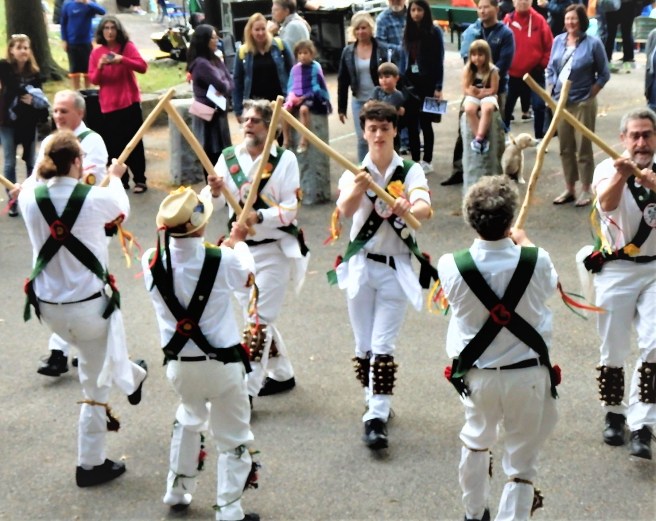
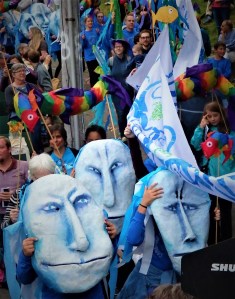
The Pinewood Morris Men continue a festive dance style from the late middle ages in rural England. The performers wear costumes specific to their troupe, including bells, and often wield sticks or handkerchiefs in their routines. This group frequently appears in Boston Revels’ events throughout the year. Here they are greeting concertgoers to last fall’s equinox RiverSing in the Herter Park amphitheater along the Charles River in Allston.

They sound like happy fireworks

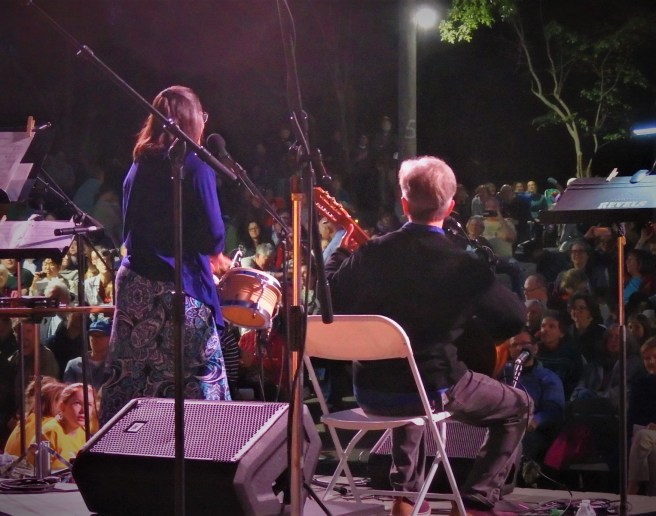
The street drum band aNova Brazil joined us last fall to help celebrate the cleanup of the Charles River two decades earlier. Here they are warming up for the Boston Revels’ equinox RiverSing last fall at the Herter Park amphitheater along the Charles River in Allston. They later fired up the procession down to the stage and performed several unbelievably complex and infectious numbers. They’re a hard act to follow, but we did it. Boston Revels hosts events throughout the year to enhance community through folk traditions.

Polycentric community adds up

With the release of Subway Visions, I’ve been returning to considerations of urban affairs. It’s not all New York City, either, even though the novel takes place there.

For me, the big city these days is Boston. I live an hour to the north – or northeast, more technically. I can even take the train in, as well as the hourly bus, which is quite comfortable and also links us to the airport. (You’d be surprised at the number of pilots and other airline personnel who are boarding from here.)

So we can go in for concerts or museums or dim sum on weekday mornings. We’re not exactly stuck in the sticks.

On the other hand, I live in a city of nearly 30,000 – the largest of a cluster of small cities that together form a larger population base to sustain our varied interests.

Portsmouth, 15 minutes to our south, is wealthier and more fashionable. It has probably as many restaurants per capita as Manhattan as well as several theater companies, the Music Hall, and art galleries.

The state university is ten minutes to our west, and about a third of its students rent apartments in our city. The school runs its own buses to serve them and anyone else who wants to pay to ride. Its library, of course, is a marvelous resource for independent writers and scholars.

In other words, I have no reason to feel deprived. Well, sometimes I wish the Harvard Book Store were closer or Symphony Hall. But I still have my choir in Watertown.

Looking at this has me recalling my mentor in political science, Vincent Ostrom, who coined the concept of “polycentric” to describe the overlapping jurisdictions that govern American polity. A city typically falls within a county, for instance, as well as a state and then the nation. Nowadays there may also be special districts to address things like water, pollution, or transportation needs.

As mayor of Baltimore, William Donald Schaefer took the concept in another direction by enhancing neighborhood identity and decision-making to revitalize a big city. Adjustments could be made in neighborhood settings even while having a central tax base, police and fire services, water and sewer system, and so on.

So my city has a much different identity and feel from Portsmouth or Durham or Rochester or Somersworth or the Berwicks over the state line in Maine. And yet we’re all conscious, even proud, of our identity as the Seacoast Region.

Do you see how these many circles begin to overlap, each adding to the richness we enjoy?

As the hippie phrase used to go, “Small is beautiful.” But, in this universe I’m describing, it doesn’t have to be confining or impoverishing, either.

For now, I do feel I have the best of both worlds.

Welcome spring!

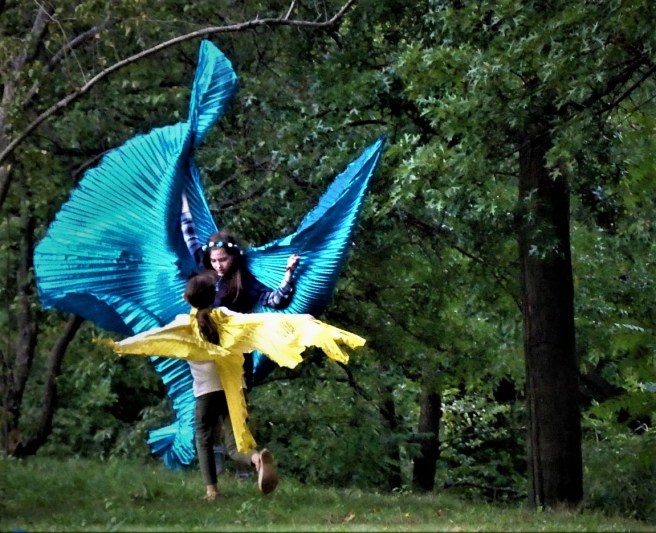
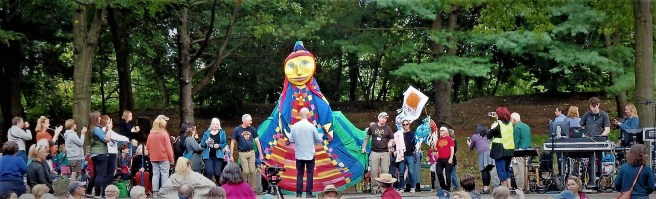
It’s not yet warm enough for New Englanders to return to the outdoors quite like this, but we’re feeling the stirrings. Many of the Boston Revels’ performances celebrate the changing seasons, and the annual Spring Sing concert just took place in the United Methodist church in Watertown, Massachusetts. This scene with Mother Goose preparing to float toward the stage is from last fall’s equinox RiverSing in the Herter Park amphitheater along the Charles River in Allston.
The kids in the procession were lots of fun. We had two excellent children’s choirs participating.

MAKING MUSIC TO WELCOME THE EQUINOX

Once again, I’ll be in the choir along the Charles River as part of a free concert to welcome the autumn equinox and to praise the extraordinary cleanup of the once noxious waterway on its way to Boston Harbor.

For its 15th annual RiverSing, Boston Revels is moving the family-friendly event upstream from Cambridge and into the Allston section of Boston on the other bank.

We’ll be performing on a Saturday night, rather than Sunday, and it is part of an ongoing series of performances the park hosts, so we’ll have more publicity support than usual for a one-off event in what’s otherwise simply a good place to sunbathe in season.

But the change also means we won’t have our usual gaudy parade down a congested street from Harvard Square to the makeshift stage beside the John W. Weeks Footbridge. That procession has always been glorious and joyfully chaotic, but greatly annoying to any number of drivers waiting to continue on the busy thoroughfare we were blocking. Not all of them are amused, believe me.

On the other hand, free parking won’t be scarce, either, and we’ll be on a permanent stage at the Herter Park amphitheater, which also includes seats for the audience rather than bring-your-own-chairs or blankets on the ground.

For me, it’s always been memorable. Imagine looking down from the back row and watching a pianist in the guest group with us and thinking, “He’s an incredible keyboardist” – and then hearing he plays in the Boston Pops Orchestra. Or singing behind Noel Paul Stuckey of Peter, Paul, and Mary. That’s even before the sunsets, which we get to see from the stage but are behind the audience. This year, it will be off to the side of everyone. Get the picture?

Join us tonight, if you can. For details, go to the Boston Revels website.