BACK AMONG THE LIVING

First, my apologies for not being, well, as present and active as I would have liked over the past five months. When it comes to blogging, most of my material has flowed from what I scheduled before the end of last year. I haven’t added fresh dispatches or participation much at other sites, and it’s showing.

It’s not what I intended.

Let me explain.

Shortly after the release of the Advanced Reading Copy of my newest novel, What’s Left, back in the first week of January, I found myself in the emergency room for what I thought would be more inconclusive tests, but, well, my real-life plot thickened. We’d just had a big snow, and I was hoping to be out in it on my cross-country skis for the first time that winter. But I was having what I thought was a breathing problem, one that several buddies in the medical profession had informally thought might be a walking pneumonia arising in a bug that made the rounds last fall.

The previous week, though, I’d finally gone in to have my primary care physician check that out. The good news, he said, was that my lungs sounded clear. But he also ordered X-rays, scheduled a stress test, and then, instead of his usual droll humor, said very firmly if this happened again I was to go straight to the ER to have it checked out while the symptoms were still present.

Six days later – and two days before my scheduled stress test – we had that big snow. The symptoms were back. Despite my reluctance to go to the ER, my wife and elder daughter insisted otherwise, and since said daughter had just driven into town, her car was already cleared off and warm. She dropped me off at the hospital.
Continue reading “BACK AMONG THE LIVING”

CHARACTER OR ACTION DRIVEN?

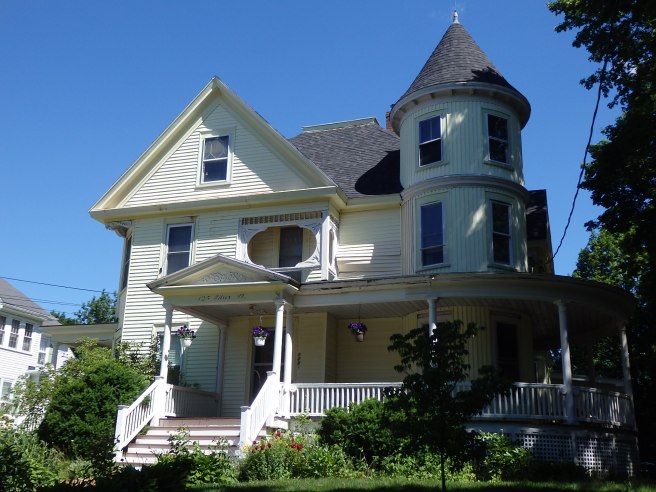
A large Queen Anne-style house with a distinctive witch’s hat tower something like this is the headquarters for Cassia’s extended family in my new novel, What’s Left. If only this one were pink, like hers.

A common question for novelists asks whether their book is driven primarily by the development of its characters or by the actions of its plot. It’s not one that had been front-and-center for me until my newest work began taking shape. For one thing, my previous fiction all falls under the category of Experimental, and, for another, I’ve usually been of a contrarian nature. Maybe the earlier stories were more event or episode driven than action propelled, and characters added whatever they had. As I’ll say, up till now. Or, as I might add, a journalist is more concerned about what’s happened than the motivations of the individuals involved.

My new novel, What’s Left, was initially envisioned as a kind of post-hippie history – an update flowing from the ending of my first published novel, in fact. But then it began turning into a different kind of history, going back further to her immigrant great-grandparents. Well, at that point the story could develop either way, based on the characters or their encounters. What clarified the direction for me was my decision to have her father vanish in an avalanche halfway around the globe, which precipitates her obsession to know just who he really was. And that made it character-driven.

As she discovered more about her father – and her colorful, extended family – I realized I wanted to know more about Cassia herself, starting with her reactions to the clues she was uncovering.  In the end, What’s Left is about her, told in her voice from age 11 into her early 30s. As for the history? It’s bound to be in her blood.

Continue reading “CHARACTER OR ACTION DRIVEN?”

DO THEY HAVE TO BE SYMPATHETIC CHARACTERS?

Carmichael’s, the restaurant her family owns in my new novel, has me looking more closely at others.

One of the conundrums I’m left with in my new novel, What’s Left: What if you don’t like her father, her deceased Baba, as she recovers him? (Or recovers from him.) Is it essential to your enjoyment of the story?

Or worse yet, what if you don’t like her?

Continue reading “DO THEY HAVE TO BE SYMPATHETIC CHARACTERS?”

AND NOW, FOR A COVER!

Thanks to everyone who responded to my earlier invitation for comments regarding a few possible covers for my newest novel.

The survey ended in mixed results and prompted some heated in-house discussion, ultimately sending me back to the drawing board for a more compelling design.

Just what do we want as a cover, anyway? Are people’s faces a help or a distraction? Does a jacket work best if it somehow reflects a scene in the story, as my earlier mock-ups attempted to suggest? Or is reaching for a less constrained, emotional reaction more effective?

What’s Left

As you see, I’ve opted for the later. Here the image invokes a sense of being broken out from a protected shell and falling through space. It’s also appropriate for a family that owns a restaurant – food being a theme running throughout the story. Will this cover encourage a browser to open the book to discover, in effect, just what happens to the yolk? Where it will land?

That, of course, is my goal. To see if it fits, go to Smashwords, where you can order your own Advance Reading Copy for free. The offer will expire after 90 days, when the first edition comes out at $4.95, so act now.

Your early reactions will be most welcome in preparing for that release.

NOTING A GLINT OR TWO

These field notes from religious aspiration and practice spring from a muse of fire. As much as Dr. Bronner’s bottle-label diatribes arose from a splash of water, at least when we read them, usually while showering or bathing.

A brief flash. Something that sparkles or shimmers. A half-seen motion, perhaps recollected later. Illumination. A beacon. A guide. A break in the night. Sometimes, this is something even the blind perceive. A word of truth. Prophecy or healing. A vision of eternal mysteries. A star or hint of coming dawn. And then, as James Nayler instructed: “And as thou followest the light out of the world, thou wilt come to see the seed, which to the world’s wisdom and glory is crucified” (Journal, 349). Everything is transformed and made new. Mind the Light.


~*~

DEVOLUTION AND RESURRECTION

Tat Ekam
that one thing

prakriti, pra = before
or kriti, creation
a sutra is only a note / a stitch / a knot

Wading into holy waters

to sink or be overwhelmed
decades later,

thunder
within
silence

returning to art
“keeps my feet on the ground”
carving wood and marble, “It’s so smooth”

these steps leading down to the water
in the sense water
is always below you
unless, that is, you’re in
up to your neck, as it were
some calm other than drowning

“We’re descended from lower-level gods
who mated with apes.”

Now outraged at other deities

next, we’ll encounter human brains
in tigers prowling along the street
all thanks to science.

Mine owners will be confined to the lands they’ve debauched / despoiled.
The Hidden Way –
Sometimes it’s Tao
Sometimes, passion
Sometimes, only a sunset
Or fog lifting

The saved love letters
become curled, black crumbling leaves
falling from the fire.

to UNBURDEN
AND MAKE NEW

first, burn all of the out-dated financial records,
then all of the old passionate drivel

that is, to MAKE FEW

as the Hidden Way
Is the route that opened
Through Glint’s own sea of reeds

Parting, at the base of mountains
she’s come through

a prayer of the earth, actually, of Seed
clearing, recentering

LIFT JESUS HIGHER

painted at the top
of a barn roof

Poem copyright 2017 by Jnana Hodson
For more, click here.

Poetry
Poetry

REEL, IF YOU WILL

What opens with a dance tune perchance deflects into the reaction to a blow or injury, to a fly fisherman’s reel, the canisters of a movie, or even a soaring eagle. These poems span experiences of touch and coupling, however chaste at times, and of flight and emerging lightness. To be light on one’s feet, then, and light-hearted in the end, if not a little dizzy.

~*~

EXTENDED FLOURISH

First, the snow a sheet of ice
shiny as cake frosting.

Then the Asian dental hygienist greets me:
“Sorry to make you waiting.”

Maybe it’s all in the skin.
A flourish we extend. A touch or care.

Excellence in a small thing, somewhere,
a note of gratitude or worship

placing everything in the larger context
of conception, especially through its monotonous stretches.

A few hours later, lavender mountains at sunset:
the Monadnocks, viewed from my studio window,

incredibly purple, even more than blue.
That night:

Sing. Dance. Fiddle. Doodle.
And away I go.

Poem copyright 2017 by Jnana Hodson
For more, click here.

Poetry
Poetry

SIMPLY LISTEN WITH HANDS 

People typically listen with their heads, attentive to logic and thought, or with their hearts, to feeling and insinuation. But there is also a frequently untapped ability to listen with one’s hands, as I recognized at a Susan Stark concert in Brunswick, Maine. There, two Quaker pastors from Kenya (themselves excellent, forceful singers) sat with arms flexed out before them, as if each held an invisible beach ball squeezed slowly. They were appraising the vibration of the room, the presence of Holy Spirit moving. This time, the current was plentiful and active. Try it, in public – at a governmental hearing, a poetry reading, a concert or play, a sporting event – and you, too, may observe how the sense of each occasion may differ. Watch a master carpenter or a first-rate baker, as well, to see how hands ponder a task, running ahead of mental comprehension. A musician often seems to hear music through the fingers, as if playing, even when no instrument is present. Perhaps a surgeon does the same with medicine.

These poems celebrate the movement of Spirit perceived through a Third Ear, between the hands. The tactile response. Here’s one:


~*~

TO USE TOOLS

Connect
four fingers and thumb
sometimes, double

into the fire, and out
a pot, a pan, or a skillet

with or without a lid
and its handle

extending to a blade
or straw, depending:

All the wonder of the work at hand
cooking, keeping house,
gardening, splitting wood –

to say nothing of the factory,
farm, boat, or mine –

hunting or warring –

Even basic parts we touch
with each other

Poem copyright 2017 by Jnana Hodson
For more, click here.

Poetry
Poetry

IN THE RHYTHM OF THE BOUNCY WALK

where dirty children
eluding prayers blasted from loudspeakers
everywhere
sell plastic necklaces

we all smelled like camels

leathery men resembling the caravan
each one swaying from a high perch
in a ship of the desert
will gallop
pulling between nostrils with a sharp yank

trusting the three eyelids of their beasts
with their very blood

humps of fat rather than water
devouring nothing for months

thorn-eaters
with efficient respiration
cud and three-section stomach

how many days, how many weeks
camel milk, as a staple

a winged, rank-odor harrowing pariah

~*~

            “don’t worry, we use many animals
and give them rest:
they’re all well fed, believe me”

to pull a plow, to turn an irrigation wheel, to draw water

to comb the wool
serve the meat

when you’re finished

Poem copyright 2017 by Jnana Hodson
For more, click here.

IN THE RECIPE FOR A MYSTERY NOVEL

Does a mystery novel have to revolve around a detective? Even a charming amateur? Or can it focus instead on the leading suspect?

In proposing a book with the working title, Dinner to Die For, I envisioned an anonymous restaurant critic who works for an independent television station. How to handle the visuals for each review would have posed an interesting challenge, something quite unlike the so-called Phantom Gourmet who has since become a popular staple on a New England cable news channel. He’s widely recognized on the street, for one thing.

Well, the novel never moved forward. This project was predicated on two collaborators, who eventually declined, however discretely.

Still, enough remained to slip into my newest book, Along the Parallel Tracks of Yin and Yang.

As a further twist, my biggest novel on the way is also about food and restaurants. This time, from the inside. And I promise, it won’t be a mystery.

~*~

Parallel Tracks
Parallel Tracks

For these stories and more, visit Thistle/Flinch editions.