Yeah, yeah, yeah, what do I know? Like I’m an expert on anything?

Through the period of my life right after college, I kept relocating every year-and-a-half to a new job and location. The shock provided more grist for my writing than I would have anticipated, but not the time to digest it.  Each round, I was just getting settled when I was interrupted and uprooted. That set me in four different states over six years at the beginning, followed by three more over the next ten. Altogether, that added up to 11 mailing addresses in seven states before I packed pack up for New England. No matter how adventurous I might find adjusting to the new environments, it was ultimately stressful. There were days I hardly knew where I was waking up. More emotionally difficult has been the way friendships fade over such distances.

As a writer who was also tackling the demands of a new job, I had little time to digest the fresh material, much less revise it, either as poetry or prose, especially if I wanted to dig beneath the surface.

As for my love life?

It’s a wonder I didn’t go loco.

Beware, the Romantic Cult of the Artist

Yes, we’ve admired madmen, especially those of a tragic sort via what I see as often incestuous works of art. You know, celebrations of other works of art or, especially, their creators.

In effect, there’s a question. Other works based on mythology, classical or Nordic, typically, face immortals who are still caught in some dimension of time – how else could they spawn children?

Turning the focus from flawed gods to the Immortal Artist, then, implicitly asks: Are madmen closer to God? Or filled with demons to be cast out, perhaps as artworks?

You know, the cliché history of poet suicides or pianist-composers who die at an early age or libertine actresses, that sort of tragedy, not always as a consequence of defying the gods, either. Think of all the poets in the core opera librettos – a shorthand for the librettist himself or the social commentator – as well as the composers or singers. It’s a long list.

Remember, too, in many Native cultures, there’s a special place for the madman as gateway to ancient wisdom or healing or a netherworld.

Admired madmen but also feared them. Just don’t get too close, even with a morbid curiosity.

Like the artist, they exist at the fringe of the village.

It’s implicit even in hymns about hymns and the raising of voices.

And also my speaking here as a fellow poet and novelist.

~*~

It’s hard to look beyond our own boundaries and explore the greater world beyond.

This is crucial, if we’re to engage others, in light of murder, rape, warfare, and other oppression and injustice around us. Is art really far from fostering imitation in life itself? Or is it rather for escape from any reality? Do we desire encounter or flight?

Earlier, I admired dazzling tricks and outward style, derring-do, and jests with fancy footwork. Shining surfaces and surreal images.

Over time, that’s changed.

My heroes have become more human and flawed, as well.

~*~

Throughout much of Friends’ history, many of the fine arts were offensive to the faithful; most painting, drawing, sculpture, fiction, theater, music, and opera were seen as superfluous vanities, engagements that took our attention away from worship. “We Quakers only read true things” is how one Friend expressed the matter when returning an unread novel to a neighbor. For a people who refused even gravestones, worldly adornments detracted from loving a heavenly Father with all their heart, mind, and soul, as well as loving one another as Christ had loved his/its followers.

Tertullian issued a related warning, in De Spectaculis, Latin circa 200 CE. Essentially: “The Author of truth loves no falsehood: all that is feigned is adultery in His sight. The man who counterfeits voice, sex or age, who makes a show of false love, anger, sighs and tears He will not approve, for He condemns all hypocrisy. … Why should it be lawful to see what it is a crime to do?” (Translation by Kenneth Morse)

As was recognized in Zen some centuries ago, when people started writing and singing and painting and acting from their spiritual practice, the flowering is already past its zenith. Nonetheless, we also know the power of the Zen-suffused works as they extended on to pottery, architecture, tea ceremony, even martial arts.

When I view Japanese and Chinese art, the Zen/Chan pieces jump out in their freshness from the well-schooled stream of traditional art.

Thus, with poetry or musical performance that knows living silence: a whole higher dimension. Necessity for revolution here. Transformation. Transfiguration. Transcendence. Transparency, too.

Is this a matter of like recognizing like spirit?

~*~

My real distrust of the celebration of the artist as a demigod comes in a plea for greater humility.

Yes, we work – as the poem Toltecatl, translated as “The Artist” by Denise Leverov details lovingly before countering with “The carrion artist: works at random, sneers at the people, / makes things opaque, brushes across the surface of things, / works without care, defrauds people, is a thief.”

The contrast is telling.

We’re hardly alone in work. Plumbers work, paying the price in their knees. Farmers work. Teachers work. Mothers, especially, work. Go on down the line, and admire all who do so with developed skill and intelligence and service. Who can say one field is truly superior the others?

~*~

I’m left wondering about a crossover identity of artist and priest, an expectation that the artist is expected to guide others into love or even the natural wonder around us.

It’s a fine line, between being a priest and a demigod. An inflated ego is a constant temptation, among others.

Still, how can I not love the movie “Amadeus”?

Who do you look to for inspiration?

How does the rest of the family face up to the challenge?

Family-run businesses present their own unique operating models.

Under the ideal version, the members have an understanding of each other and their mission along with a loyalty that’s unrivaled. The business is part of their identity. Each member of the family understands his or her abilities and place in the enterprise. Often, they learned the operation from childhood on, starting at entry level. For their employees, however, that can come at the price of exclusion and upward mobility.

Sometimes the organization is headed by a patriarch or matriarch with the authority to make and enforce difficult decisions. In this model resentments and perceived sleights can mount over the years before erupting. Or the family head may no longer fit the kind of executive the company needs at a particular stage of its growth; a founder, for instance, may have technical expertise but not the people skills for marketing or adapting to a changing market.

What have you seen or experienced?


When siblings and their spouses work together

My novel What’s Left includes reflections on a first generation of a family business dynamic, somewhat like one I also describe in passing in Nearly Canaan.

In reality, the model of a restaurant run by two brothers and their wives was one I observed in a small Midwestern city where I edited the local newspaper. In this case, their roots were Italian, not Greek, and the economy was essentially farming and two large factories, without a university or county seat to boost business.

Do you have any insights on ways siblings interact when they run a business together?


Room to welcome everyone

They definitely weren’t suburban. A big pink Victorian house suits Cassia’s colorful extended family in my novel What’s Left. And guests, even guests of guests, are typically welcome.

Have you ever been welcomed in a home like Cassia’s? How does it differ from yours?

~*~

Theirs also had a witch hat, something like the one here.

Why I love tracking the hip groove of the underground

The paperback cover …

My subways novel started out to be my big hippie tome, building on a metaphor of hitchhiking, which was ubiquitous for us, but the extended concept ultimately got to be too unwieldy for one book. The supportive details were stripped away for what’s become Daffodil Uprising and Pit-a-Pat High Jinks, leaving the metropolis altogether.

Spurred on by Richard Brautigan’s “Trout Fishing in America” with a dash of William Burroughs, the initial drafts played surrealistically in a tension between the wide-open roads of the countryside and the underground realms of the biggest cities.

Then, four or five years after taking up the project, I was pawing through a used books bin in the desert of Washington state and came across a 1915 engineering volume, “Building Subways in New York,” which included “Elevated Railway Steelworks.” I still have it. How on earth had it ever landed out there amid the sagebrush?

I had already lived in Upstate New York four hours from Manhattan, and nearly all of my friends, housemates, and lovers were from The City. That was followed by my residency in a yoga ashram two hours away in the Poconos, so yes, I had learned to ride the trains. (Nowadays, it’s mostly Boston’s a little over an hour south of me.)

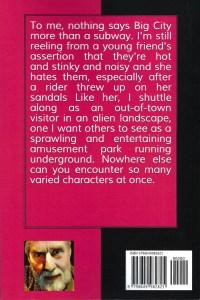
… and the back cover.

The original “Subway Hitchhikers” had a structure that ran like trains passing in opposite directions, which readers could find confusing rather than energizing. It also had a lacy air that reminded me of Robert Rauschenberg’s pop art “combines.” Gone, too, in the revisions is the protagonist’s hippie handle, substituting a more conventional nickname that better links this story to the others.

In the revised version, Subway Visions, there’s more focus on characters, plus new sections on Kenzie’s encounters of Tibetan Buddhism in a tenement near Greenwich Village as well as a graffiti artist known as T-Rex.

What’s evolved has a much straighter narrative and more arresting development, now linked to Kenzie’s ongoing life in the hills to the north. And elements of fantasy and heightened playfulness now augment the earlier surrealism.

I suspect I still have some classic coin tokens in my possession, somewhere.

Also on the plate

Why does the restaurant business sustain so many immigrant families? Just look at all our ethnic options in dining today, even in small cities. Not just Greek-American, like the one in my novel What’s Left.

What’s your favorite food stop? Is it run by a single family? Does it have an ethnic identity?

~*~

Look at all these Greek specialties!

Reasons I still love type on paper

Well, compared to ebooks and all this digital reading.

  1. I can caress it. Yes, even the texture and weight of the paper itself.
  2. Admire the spine on a shelf.
  3. Frame a page and mount it on a wall. (I’m thinking of a broadside, especially.)
  4. There’s marbling in some old editions, and end-papers. Nothing like that in ebooks.
  5. Underline and make notes as I read, enhancing the engagement.
  6. A sense of timelessness. Unlike a computer crash.
  7. Open an old book and there’s a special aroma. Hopefully not mold.
  8. Reading one works better at the beach, in full sunlight.
  9. Easier to find errors when correcting galleys or drafts.
  10. It really does feel finished.