In your circles, who’s most passionate about the Old Ways?
Would you call them conservative?
You never know what we'll churn up in cleaning a stall
In your circles, who’s most passionate about the Old Ways?
Would you call them conservative?
I got out before I was axed, but the next three interludes weren’t so fortunate. All ended with my head and heart served up to me on a plate, in terms of my career, yet somehow I always landed back on my feet.
The least time was when I allowed myself a self-imposed sabbatical in Baltimore in the mid ’80s, one of the smarter moves in my life. Putting those savings into a solid investment would have made much better sense than using them for a year of poverty existence writing, but I hoped if I could get published, my shift over to being an author full-time would be assured. I knew too many others who had put off their big dream till retirement but never been able to manifest it.
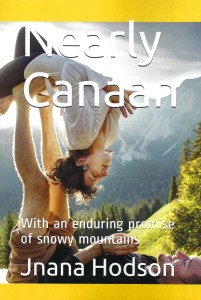
So I hunkered down over my keyboard, kept to a strict schedule, and amassed the bulk of two major fiction projects that now stand as Daffodil Uprising, Pit-a-Pat High Jinks, Yoga Bootcamp, Nearly Canaan and parts of The Secret Side of Jaya. There were also a few other blueprints that remain undeveloped. (As novels, the two boxes of manuscripts were truly too unwieldy, no matter how vibrant their contents.) “Subway Hitchhikers,” now embedded into Subway Visions, was already in place.
That year wasn’t all work, rest assured. I underwent some crucial personal growth and recovery. There were close friendships and time for reading. Mennonites and Brethren added to my Quaker practice. A writers’ group hosted upcoming Tom Clancy one evening, with his first book then being turned into a movie. I was learning to part-sing a cappella. We walked to Orioles games from one couple’s third-floor quarters.
Alas, my money started running out before I could land an agent or see a volume lined up for publication, and so it was time for me to move on. At least I had those precious drafts in hand – or more accurately, on computer diskettes. Even as raw material, they were full of details I’d never be able to recollect a decade or two later, much less in the distance of retirement. And with that, I was off for New Hampshire and a new life.
What became painfully clear was that newspapers weren’t the only part of the publishing world in serious trouble. So was the book trade. A few hot-shot agents replied that the book I’d pitched them deserved to be published but they couldn’t take on anything new, they were utterly baffled by what was happening as the number of houses handling fiction kept shrinking. Most agents didn’t even return the self-addressed stamped envelopes. (The jerks.) Even so, I kept revising, leading to the publication of “Subway Hitchhikers” as a trade paperback in 1990, followed by the hard reality of being “backlisted” and out-of-print when sales failed to materialize.

Still, I was hooked. All along, there was a flood of poetry that found its way into circulation and a few projects that seemed commercially viable, if only I could add the right co-author, one with creds. My years since Baltimore also included book-length new writing, mostly Quaker related, but again, print proved elusive – it is a small market, and the faith as a whole is filled with active writers.
So I was caught in a limbo until the emergence of ebooks, starting with my “Ashram” in 2006 as a PDF from pioneering PulpBits in Vermont and then my Smashwords entries beginning in 2013.
What I now realize how much free time and focus fiction demands. It is, as I’ve learned the hard way, so different from journalism, and not just in the ways I’d be confronting. When I was employed, I could deal with deep revisions of my Baltimore lode during my vacations and holidays, and do the routine polishing of its prose on my free days, but generating entirely new novels was out of the question until retirement, when I turned to creating “What’s Left.”
In short, most of the books of fiction now available under my name are the result of 35 years of labor, more or less. I’m glad I’ve lived long enough to push them on to completion.
One challenge in a large multi-generational story like What’s Left comes in managing first names. Many families customarily name babies in honor of grandparents, aunts, uncles, cousins, even the parents, but even with nicknames, that’s bound to create additional confusion for readers.
I skirt the issue by introducing names independent of any mention of family connection, perhaps justified with the break from the old country at the outset of their arrival in America and perhaps as a reflection of adapting new customs as well.
Pressed on the point I might respond that Stavros’ three sisters, who remain unnamed in the text, repeated earlier names. And then I wondered about Nicky, a generation later.
Does your family have naming traditions? What’s the pattern? Which names are most popular?
In my Freakin’ Free Spirits novels, Cassia’s father is a professional photographer who views the world in a unique spirit.
Now that digital technology has made taking pictures so easy and ubiquitous, everybody always seems to be holding their cell phones up for another shot.
Does anyone else miss the sound of the clicking shutter?
How do you find capturing photographic images affects the way you see events around you?
Despite growing up in the flat country of the Midwest, I’ve always been attracted to heights. The top of the tree in our backyard was mine alone. I remember taking the speedy express elevator to the top of the Carew Tower in downtown Cincinnati as a child and looking down on the ant-like people on the streets far below. And mountains have always loomed large in my imagination, later abetted by a few early visits to the Appalachians in Kentucky, Tennessee, and North Carolina. I even backpacked a week on the Appalachian Trail at age 12 as a Boy Scout with my primitive-camping troop.
By the time I returned to Indiana in the mid-’70s, I had also lived in the Allegheny foothills to the west of the Catskills in New York state as well as the Poconos in eastern Pennsylvania. I’d even ventured into New Hampshire to climb Mount Washington, the highest point in the Northeast. I thought I had a familiarity with mountains.
My next upheaval sent me west. The drive across the Great Plains and Rockies was a revelation, and the entry into the environs of my new employment came frankly as a shock. Neither my wife nor I was prepared for the arid, open desert where nearly everything, including its famed apple orchards, required irrigation. Forefront in my mind was Swami Lakshmy’s observation from her first visit to India, that every place she visited had its own unique vibration.
And yes, there were mountains, including the barren heights defining our valley as well as the eastern flank of the Cascade Range to our west and glacier-clad Mount Adams looking down on us from 50 miles away.
As I adjusted to the realities, everything was filled with wonder I came to love, as you will see in my novel Nearly Canaan, which started out being more about the distinct landscape than about fully considered characters.
My employment situation, meanwhile, provided its own fodder for what would emerge as Hometown News back in the Rust Belt. I never wanted to leave Pacific Northwest, for sure, but a new publisher at the newspaper made the situation intolerable. As I bailed out, along with the most of the rest of the management team, I entered a difficult period that added much to the newspaper tale, plus a divorce and broken engagement.
It’s always hard to come down from a mountain. A part yearns to hang there forever.
A huge challenge to family-owned businesses arises in the passing of one generation to another. The unanticipated death of the patriarch or matriarch in his or her prime can wreak havoc on the company, even if inheritance tax liabilities aren’t overwhelming. Sometimes the heir apparent isn’t the best option, not all of the heirs want to be part of the operation, or bitter rivalries emerge. Getting through the fourth generation, with a spreading number of family members and interests, can determine the fate of the enterprise. As I saw in the newspaper industry, most nameplates sold out to media chains at this point, losing much of their underlying local connection in the process.
Do you know of any businesses that fit this description?
Cassia’s uncle Barney welcomes street people to the back door of the family restaurant. Sometimes they’re invited to more than a free meal.
Do you know any businesses that have “back door” policies?
The second of my three times of stepping out of the news business came when Vincent and Elinor Ostrom invited me to return to Indiana to become the social sciences editor in their new Workshop in Political Theory and Policy Analysis. Vincent had been a wonderful mentor through my undergrad years, and the opportunity to work with them again was truly exciting. Besides, I was newly married and the move would allow my wife to continue with her college studies. It was a pretty heady undertaking all around.
We settled in at the edge of town, pretty much as I describe in Nearly Canaan. But having Indiana show up so much already in my fiction – Daffodil Uprising and What’s Left, especially – as I revisited this stage in my life, I looked around for a landscape with similar features and people, which I was surprised to find arising in the Ozarks. Now you know. In full candor, I have to admit I’ve never been in Arkansas or that swath of Missouri, even though my mother was born in St. Louis.
Two important things emerged for me personally during this sojourn. First was my shift from yoga to Quaker as my spiritual path. Second was my emergence as a poet, largely through a lively off-campus circle that was surprisingly free of academic influence. As a research associate, I could borrow books from the graduate library for unlimited periods, and so I had a shelf of small-press chapbooks at hand – what a luxury! And my interludes in the renowned Lilly rare-book library remain treasured, where I handled rare editions of Samuel Johnson’s Ramblers (1750-52, including a few coffee stains and pencil marks, presumably from their first readers) and Audubon’s original luxurious prints (all birds presented life-size, as if stunningly pressed into the pages) and fine-arts broadsides of Gary Snyder’s poems from the 1950s onward.
I found the academic life to be much to my liking. I’ve been asked since why I didn’t go on to graduate school and a professorial direction. My answers are muffled, beginning with the personal finance situation and the glut of doctorates already looking for tenure, at least in my fields of interest. I would have chafed at the internal politics, naturally. And then I came across Snyder’s reason for not continuing his own post-graduate degrees (at Indiana, when he made the decision) – he realized he could be a good professor or a good poet, but not both. I would later arrive at something similar when it came to the management track I pursued through the first half of my journalism career, as you’ll see.
Those of us in the Workshop had barely celebrated our getting the second phase of our major grant renewed, meaning I’d be staying in Bloomington another four years, when we were hit with the devasting news that the amount had been drastically slashed during an unanticipated realignment of the federal agency’s priorities. What it meant for me and my wife was packing up and moving on again.
The next opening felt like a ticket to Heaven.
It’s a fair question in my novel What’s Left.
Just what do we owe to our ancestors?
When a family-owned business has two siblings at the helm, how effectively they resolve conflicts – or ignore them – is crucial. As one well-known New England brother has said, he learned that family was more important than always being right. In their case, it worked. They even became TV stars in their ads. I suppose there were other corrective mechanisms behind the scenes or ones that would kick in later. We’ll see the biz school case study in time, no doubt. On the other hand, differences can also lead to lawsuits, the breakup of the company, even its sale to rivals, perhaps followed by a longstanding refusal to speak to each other. We’ve also seen those headlines.
Do you know of any businesses like this?
 Jnana's Red Barn