Lawrence Durrell’s “Justine.” Henry Miller’s “Nexus”; Gabriel Garcia Marquez’ “In Evil Hour”; Jack Kerouac’s “Desolation Angels”; Kurt Vonnegut’s “Deadeye Dick” and “Galapagos”; Richard Brautigan’s “So the Wind Won’t Blow It All Away”; Carol Rakoski’s “Ere-Voice”; Anne Tyler’s “Accidental Traveler” and “Earthly Possessions”; Hugh Nissenson’s “The Tree of Life” (interesting use of pioneer Ohio historical materials); Grace Paley’s “Later the Same Day” short stories; Italo Calvino’s “If on a Winter Night a Traveler” (this time, rather fascinating seems I’m finally able to read styles quite unlike my own part of that cleaning out I’m in); William Kennedy’s “Ironweed”; Laurence Sterne’s “Tristram Shandy”; Ray Bradbury’s “Dandelion Wine”; Hugh Prather’s “Notes to Myself” (late Sixties classic that seems so superficial these days); Marilyn French’s “The Women’s Room” (blames men for every problem, including mothers); Nena and George O’Neill’s “Open Marriage” (my wife had wanted me to be influenced by this what I see is that we HAD an open marriage, which is why it failed); Merle Shain’s “Some Men Are More Perfect Than Others” (more blame, this time from an upscale pre-Yuppie bubblehead); Paul Wellman’s “The Indian Wars of the West” (one of my ex’s left-behinds); “The Solution as Part of the Problem” (superficial Sixties Leftist education propaganda); Saul Alinsky’s “Rules for Radicals” what else?
Tag: Books
Venturing out on her own
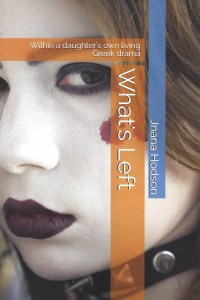
In my novel, What’s Left, Cassia becomes a rising executive with half of the country as her territory. The experience of growing up in the family restaurant gives her a head start over her colleagues, but she’s also much more vulnerable in a highly competitive, often hostile, financial world, than she’d ever been back home.
What are the biggest threats in being a woman in management? How would you avoid them?
~*~

Look for the witness in the work, too
Cinema critic Roger Ebert was talking of the importance of the witness in every movie and pointing to the places where the character appeared in the film under discussion, mostly in a lower corner. The comment flashed me to the reality of how often the hardest thing to see is what should be the most obvious. It’s not just the elephant in the room, it’s things we take for granted.
One way or another, all fiction is built on the observer, who is also to some degree an outsider or misfit, too. (If there are any exceptions, I’d love to hear them.) Four of my novels, for instance, were intuitively built around a photographer, a profession that makes Cassia’s father a well-trained witness. In turn, as she investigates his archives, she, too, becomes a witness, even before she starts commenting on his earlier life.
Of course, as a reader, you also become a witness. Or even a voyeur, as Camille Paglia has contended. It’s almost like every page is a microscope slide to be interpreted.
Curiously, I now see this also at play in a long-term non-fiction project in my life. Forty 40 years ago, seemingly by accident, I became involved in trying to uncover my father’s ancestry. I thought we were simply homogenous Midwesterners who had always been in Ohio from its beginning. What I discovered, though, was that one branch was – but German-speaking and largely akin to Amish. My name-line, however, was Quaker by way of North Carolina and its slaveholding culture. Both strands were outsiders to the larger society and also pacifist. It opened my eyes to alternative histories and to a recognition that stories don’t always have to resolve nicely – three people may record their memories quite differently, and maybe all three are true, if not factually accurate.
Oh yes, the research was often collaborative, with correspondence going and coming from others working on parts of the puzzle. It wasn’t always quite as lonely as drafting fiction or poetry.
To my surprise, as my novel What’s Left was taking shape, Cassia started assembling bits about her Greek-American grandparents, who had died before her birth, and then beyond to her great-grandparents, who brought the family to the New World. Like me, she found valuable clues in the surviving snapshots and formal portraits regarding their personalities, as she also did in the letters and other documents.
None of my ancestors came by way of Ellis Island, and on Dad’s side, they were all in this country by the time of the Revolutionary War. I once pondered doing a series of novels on them, but I’m still intimidated by the technical challenges – a realistic language they can speak and we can understand being high among them.
Witness, I might add, has an extra dimension in Quaker thinking. It’s not just what one sees or hears but how one lives. The goal is integrity, as in wholeness or consistency. Is that what others see in us or our lives and work? Or even as our goal and ideal, even when we fall short reaching for it?
Job skills could open up new worlds
Using skills and connections he acquires working in a shipyard in Greece, Aristotle relocates to Indiana in my novel What’s Left.
How did your grandfather wind up pursuing the work he did?
Maybe it simplifies things
In my novel What’s Left, Cassia’s great-grandmother and her sister marry two brothers. One is named Aristotle.
Do you know of any brothers in one family who marry sisters from another?
The role rides on conflicted feelings
Sitting down to compose a novel requires some bravado, an assumption or presumption, even outright arrogance, that you have something important to say and an ability to do it in an interesting way.
You know, balls, swagger, mojo. Go to a writers’ group and just listen. But it’s not all sheer ego-driven. For many, at least, there’s an ongoing tension between believing in our own talents and shielding ourselves from the nagging self-doubts. Even Stephen King has them. Remember, the practice of the craft is a solitary act, not a team sport. It gets lonely, especially in the absence of feedback or fans in the stands, whether they’re cheering or jeering. Sometimes, to your surprise, harsh criticism is easier to handle than any praise.
Unless you’ve been there, you have no idea how precious a voiced reaction can be in nurturing you. Those brief reviews and star ratings are important, not just for guiding others to certain books but for guiding you as an author in your practice. An astute reader picks up important elements that have slipped right over their creator’s consciousness. Please, please, please take a few moments to weigh in when you finish a volume. We all need confirmation that we’re not wasting our time – or yours. Best of all is the epiphany when we’re left feeling that someone finally “gets it,” actually understands what we’re about. Don’t be shy.
I recall giving a friend a booklet I’d written about the Quaker metaphor of Light. (By the way, in the first two centuries of the Society of Friends, the term was always Inward Light or some variant, never the Inner Light expressed today. It’s a crucial distinction.) When he finished, he thanked me, said the text had cleared up his understanding, and then added, “You write very well.”
Even after four decades in the words-on-paper business, I was taken aback, considering that he is, by any measure, an important American literary figure and a master of the language. It was like “welcome to the club,” the exclusive one with the dark paneling and Manhattan address. It was like a cup of fresh water in a desert. Within myself, I felt freed from the “hack writer” label so often applied to journalists from Dr. Samuel Johnson on.
Later, in an aside, he told me I was more of a poet than a novelist. Knowing his fondness for poetry, I took some comfort in the perspective, as well as some umbrage about the fiction part.
On reflection, I now have to agree on his assessment, at least as my novels stood then. He certainly helped my character Cassia press her case for the reworking of all my existing novels, as I did in the aftermath of What’s Left, where she’s the star.
There’s also that frightening moment in the gap between when a book’s been accepted for publication and when it actually comes out. We’re afraid someone’s going to somehow uncover our darkest secrets or that we’ll be shamed by some indiscretion or that we’re about to make an unforgivable transgression. Again, go to a writers’ group and listen … or even ask. If you’re an author, you think you’re somehow bonkers when you feel this, not knowing how much company you actually have.

I’m of the camp that hews to Bukowski’s regime of daily “butt time” at the keyboard, day in and day out, regardless of how inspired you might be feeling. Many days it’s a dry struggle, but on others something different and amazing blossoms. From my perspective, it’s when writing becomes a kind of prayer and you find yourself in a “zone” where things come together as if by magic and characters start dictating to you, if only your fingers can keep up with what your soul is hearing. It’s a dialogue with the Other, as in Muse, and you’re the mere scribe at her service.
It’s what happened when Cassia started dictating to me.
It’s not always at the keyboard, either. Sometimes it happens while you’re in the shower or on the throne next to it or swimming laps in the pool or commuting to work.
You can’t control this. Realistically, it happens when you’re not in control.
It happened to me at the finale of “Subway Hitchhikers,” which years later became the launch pad for “What’s Left,” where I had to make sense of what I’d been given, however intuitively.
Perhaps the best, well, I just had a phone call and lost the thread of thought. Maybe it wasn’t that important.
How do those mixed identities add up?
Like most of us, Cassia finds herself carrying a host of identities. She’s Greek-American, on one side, and Midwestern WASP, on the other. She’s been raised with both Tibetan Buddhist and Greek Orthodox religious influences. She’s a female, of course, and an entrepreneur. She’s part of a large extended family, a Hoosier, a bohemian, a college graduate, a devoted sister, a daughter. And that’s just for starters.
What are your most prominent identities? How do they shape your life?
As for that question, ‘Do you have a sister?’
In my novel What’s Left, Cassia’s great-grandfather and his brother marry two sisters. One is named Athina.
How do people in your circles discover each other as couples?
A baroque twist runs through my distilled expression
Samuel Johnson and his baroque constructions gave a big push to my literary ambitions after high school. Let me just say I’ve loved the clarity of Mozart from my adolescence on, and Bach and Handel have risen in my estimation in the years since. The brash English master fell right into that, though I now see again just how irreverent he was, despite all of his professed orthodoxy.
What it means it that I’m comfortable reading and writing certain kinds of complex sentences that are foreign to modern readers. Perhaps I should apologize? At least it’s not the only way I put sentences in line. Still, there’s a richness that’s missing in Hemingway and his progeny.
And here I am, drilled in the newspaper journalism Papa Ernie claimed was his inspiration. Think again. (Ernie? Makes me think of Pyle, and his big desk at the Indiana Daily Student, where I once worked.)
My wife has noted the dichotomy between my fondness for many Old Ways and the rule-breaking, experimental edge of my writing and thinking. She can point, for instance, to my fascination with the fiery writings of early Quakers in the mid-1660s placed in contrast to wild hippie extremes.
Are they really that different, though? I feel they enrich and deepen each other.
How tightly are they bound together?
Cassia and her brothers and cousins face a crucial decision. Do they continue to jointly hold the family business as a resource for future generations, requiring them to keep working for a living, or do they divvy up their shares and then live independently wherever and however they desire?
Put yourself in Cassia’s shoes.
How would your life be different if you didn’t have to worry about how you’d make ends meet? What would you dream of doing?
~*~

 Jnana's Red Barn