I’m having fun preparing PowerPoint presentations

In general, when it comes to new tech, I’m pretty much of a neo-Luddite. I prefer to stick to the tried-and-true rather than chasing after every new twist and trying to master it before it’s obsolete by the next wave.

I still haven’t stepped up to host a Zoom session, for heaven’s sake. And we’re definitely not E-Zpass users when it comes to highway tolls, either.

Preparing visuals to accompany my public presentations related to my new book, Quaking Dover, however, has me beaming.

The first leap was in learning to connect a laptop to a slide projector – you know, so folks could watch a slide show on a big white screen or a wall.

From that experience, I realized the shots really needed to be all of one size. Some pictures I was discussing ran off the screen, while others were too small. That led to the PowerPoint format.

My initial outing with PowerPoint was with the Whittier Birthplace Museum’s virtual lecture series back in January. There, I was amazed to discover how much I could enlarge a detail from a photo without having it pixilate. Individual signatures from a Quaker marriage document, for instance, could be displayed prominently. The size of the photo in hand wasn’t an issue, either. Up we go!

I’ve been at it again, this time for presentations at the Dover Public Library on March 22 and the Pembroke (Maine) Historical Society on April 18, as well as a third in July via the Falmouth Friends Meeting on Cape Cod. All will be streamed, by the way, if you’re interested in participating. (Do mark your calendars.)

It’s getting easier with each round, and I’m learning how to easily copy a PP slide from one production to another. Yay!

Fun? I’m finding it downright exciting. Hope you do, too.

‘It’s all fiction’

As my new book came together in its revisions, I began to feel some parallels to John Baskin’s 1976 New Burlington: The Life and Death of an American Village, a non-fiction opus based on what was then the new field of oral history.

The village he examined was largely Methodist and Quaker, the latter having come en masse from South Carolina as their rejection of living in a slave-holding countryside. In fact, when they relocated as a Quaker Monthly Meeting, they carried their treasured minute book with them and continued their records in Ohio.

His book became something of a classic and was even excerpted as a popular series in the Dayton Daily News.

While relying heavily on quotations from his sources, he did knit the interviews together with some heavy interpretation on his part. And here I was, becoming an active narrator in the action in my own work.

My book, as it stands, is heavily influenced by what I’ve learned writing fiction, in addition to my lifetime career as a newspaper journalist. I view the result as a story.

More to the point, when Quaking Dover came out, one longtime friend asked me if it was another novel. I bristled, I think, “No! It’s a history! Non-fiction!” While also thinking, “Didn’t you read the description? What did you miss?”

~*~

I am trying to remember the first time I mentioned Baskin’s book, probably in a Quaker circle in another part of the state, and hearing the response, “It’s all fiction.”

Huh? It seemed pretty solid to me, and the asides on Quakers were rather informative for a newcomer, as I still was then.

A decade or so later, visiting family back in Ohio, I ventured off to worship at the New Burlington Quaker church, which had rebuilt out by the highway after the village had been flooded by the U.S. Army Corps of Engineers.

At the close of the service, I was asked why I chose them rather than the more silent Friends in nearby Waynesville. Well, I had worshipped in that historic meetinghouse years earlier but, as I replied, I enjoyed visiting other branches of the Quaker world. And then I added, “Besides, I have the book.”

A moment of awkward silence struck the circle around me before the oldest person, a woman perhaps in her early 90s, softly pronounced, “It’s all fiction.” Obviously, they all knew what I meant by “the book.”

Oh? I was in no place to argue and accepted her verdict as literary criticism. In some ways, I took it as advice, not that anyone knew I, too, was a writer. Those of us in the news biz were already treading on thin ice in too many ways.

Still, as I retold the encounter to a reliable bud, he inhaled sharply and noted, “That’s strange. It’s the same thing Aunt Cecille said. Her words, ‘It’s all fiction.’”

Well, she did live in a town only a few miles up the road, one where the local Friends church had recently petered out. She, too, had Quaker roots and community creds.

~*~

As a journalist, I can relay one fine reporter’s observation that he knew he was on course with a controversial issue when he found both sides of the story were upset. Not that I want to go there. Still, I do know that we humans have a hard time accepting our own shortcomings and follies and that we view events through our own lenses.

I should add that Quakers, as a whole, write a lot. It’s a crowded field.

How crowded? The primary Quaker history journal takes this stand: if a book hasn’t been vetted by a peer review panel of historians, it’s taking a pass.

As they did on mine.
 

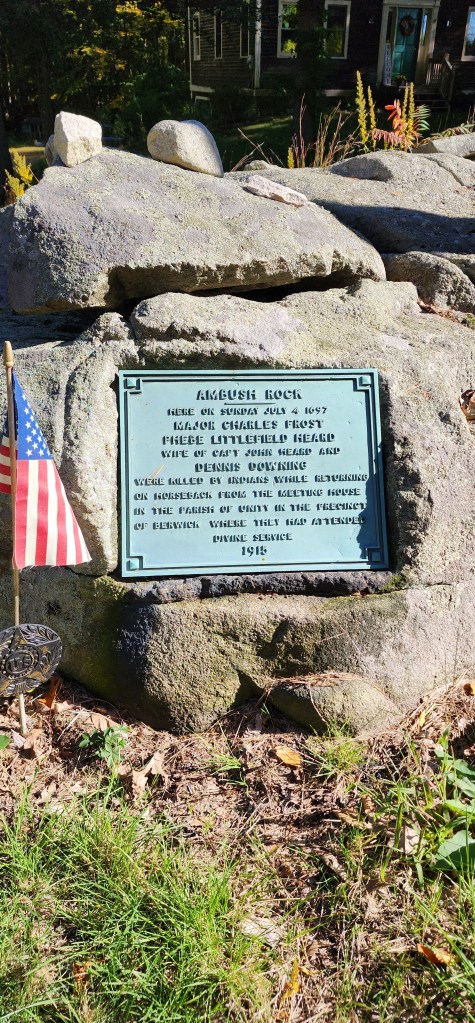
Ambush Rock

What the marker in Eliot, Maine, doesn’t mention is that Major Charles Frost and Dover’s Richard Waldron concocted the mock wargame that led to the hanging of Native men sent to Boston and the sale of about 350 Penacook women and children into slavery in the West Indies.

This was hardly an attack on an innocent party, then. The Natives waited years to extract revenge, and did it at a time and place that spared others.

My history Quaking Dover adds details.

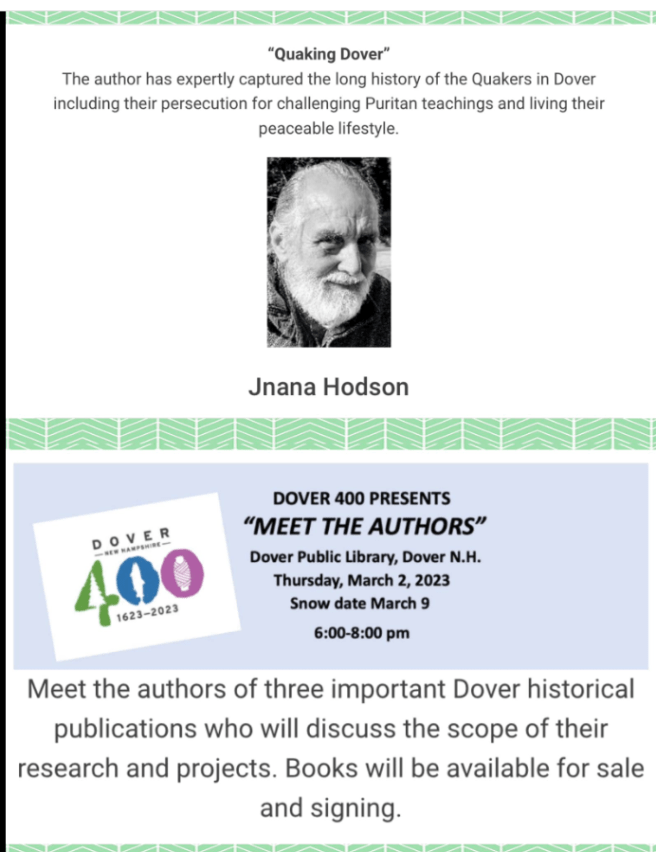
For me, it’s a big meet-an-author event

A program Thursday night at the Dover Public Library promises to be lively fun.

Hosted by Dover 400, the folks behind the year-long celebration of the town’s settlement 400 years ago, I’ll be one of three authors of new books about the community’s past. Each of us brings something different to the table, and I’m really looking forward to meeting the others, as well as an audience full of additional insights and angles.

The program will allow each of us to address some prepared questions and briefly discuss our book before turning into wider discussion and an audience Q-and-A.

Retired librarian Cathy Beaudoin, the unofficial (and unrivaled) Dover historian, will be moderating. As an aside, I do wish she’d write the big volume about the city’s textile mills and the ways they transformed the community. She’s already curated a comprehensive lode of entries you’ll find on the public library’s website.

As a handy book you can follow around town, J. Andy Galt contributes an updated set of neighborhood walks that were originally conducted by the Dover Heritage Group. As I’ve previously posted, the city is pedestrian-friendly and has quite a range of architectural styles. In many neighborhoods, every house you pass seems to possess a history, if you stop, look, and have a few tidbits of info in hand. From the directions to one of those walks, Dover Friends Meeting finally learned where our second meetinghouse, from 1720, had been moved and now sits as a private residence.

Former Woodman Institute trustee Tony McManus brings a newly published, wide-ranging collection of newspaper columns he’s written on local history, especially the people involved.

And I’ll be there looking at the early developments from the perspective of the Quakers, for decades the town’s biggest minority.

As a grand finale, there will be an opportunity to sign books we’ll have for sale and meet one-on-one with readers. I couldn’t do that with ebooks.

(The snow date is March 9.)

Facing some hard publishing decisions

As a commercial book venture, my Dover history would be considered marginal at best.

Quite simply, short of a breakout, it targets a tiny audience.

The city itself is small – a population of slightly more than 30,000. And while the surrounding area runs around a half-million, that’s still small by book publishing markers.

Additionally, my work focuses on the city’s second-oldest congregation, an even tinier potential readership. While that element opens another market of fellow Quakers around the globe, it’s still small.

As for history buffs? They have their niches.

At the outset, at least, any for-profit book publisher would see this as a high-risk, losing bet.

I am, of course, hoping Dover’s 400th anniversary this year will give it a bounce.

And, as a microcosm of a snarky, contrarian New England history, Quaking Dover just might entertain a wider reception.

I mean, how many people do you think would have been interested in covered bridges in Madison County, Iowa?

~*~

One commercial publisher specializing in local histories did take a look but quickly backed off. The editor didn’t like the first-person voice of my book, for starters, and got spooked by the fact this volume hadn’t been vetted by religious authorities.

A few others were simply looking for an author-subsidized co-publishing deal.

That returned me to the self-publishing world I found in ebooks and then, for paper editions, at Amazon’s Kindle Direct Publishing.

As much as I like ebooks, for reasons I’ve previously discussed here at the Barn, I very much felt this was one that needed to be available primarily in a hands-on physical book form.

While Amazon has no upfront costs for an author in its print-on-demand paperbacks, physical bookstores refuse to carry them because they would have to buy the volumes at retail and then add a markup to the price to cover their own costs. They rightly complain it puts them in an unfair position.

But then came the announcement that my ebook flagship, Smashwords.com, was merging with Draft2Digital, which specializes in producing print-on-demand. Both companies have arrangements with distributors and retailers, and both offer their services to writers for free.

The arrangement also gives me more flexibility in marketing and special sales opportunities.

In short, count me in. I’m truly proud of the result.

Check it out through your favorite bricks-and-mortar bookstore.

Yay! I’m now up on YouTube, too

My first-ever Zoom presentation is now available for streaming, thanks to the Whittier Birthplace Museum. The presentation on January 26, “Starting with a marriage certificate: Why Whittier was no stranger to Dover,” focused on the famed poet and abolitionist’s many connections to, well, my new book Quaking Dover.

For the full YouTube event, do take a look here.

John Greenleaf Whittier is hardly the central theme in the book, but for me, developing the topic for this show, along with the accompanying PowerPoint slideshow, another personal first, was fun.

If you’re a regular here at the Barn, you know I do lag behind on the tech front. One step at a time, right?

I didn’t expect an unusually itchy nose and scratchy throat resulting from our dry indoor air. So much for my up-in-the-corner-of-the-screen stage presence.

On top of that, with the PowerPoint up in front in me, I couldn’t see who was attending. Oh, well, I had my hands full anyway.

Earlier, behind the scenes, there was concern about a possible power outage on my end as unusually warm temperatures dropped below freezing amid heavy rain. We did have a contingency plan, just in case.

I’m so glad we didn’t need it.

How about a few more readers’ candid responses to my new book?

In case you’re wondering how things are going with Quaking Dover, here are some early reactions:

“The book purports to be merely a history of the Quakers at Dover, New Hampshire, but it is much more than that. It is a history of the beginning and spread of the Religious Society of Friends (aka Quakers) in the USA, the best exposition of their faith that I have read so far, a history of their persecution by the Puritans, and of the bloody conflicts between the Puritans and the native peoples. …

“Most of all, I had not previously been exposed to the reality of the Quakers’ faith, revealed in their own words. Jnana Hodson, himself a Quaker, has done extensive research in old records and journals and includes extensive quotations that bring the faith to life. Including their peaceful acceptance of persecution, their prudent approach to courtship and marriage and their belief in the work of the Holy Spirit in the heart.” – Bob Goodnough, Saskatchewan

(For his full review, visit his Flatlander Faith blog post of Dec. 12, 1922.)

~*~

“I enjoyed your conversational writing style – sharing the research that you did — and confidentially whispering (in your writing style), ‘This is what this finding means and how it should be interpreted.’ … To ascertain what really happened you checked primary documents, read previous accounts of Dover, New Hampshire – triangulated your sources and showed us readers how you reached your conclusion. A very enlightening read – well researched, well written.” – Joe Clabby, author of A History of Eastport, Passamaquoddy Bay, and Vicinity

~*~

“Love it!” – Susan Wiley, Sandwich, New Hampshire

~*~

“Deftly told. I really like your voice. It’s engaging, light, and easy to read.” – Jim Mastro, science fiction novelist

~*~

“An enjoyable book!” – Arnie Alpert, longtime peace activist

~*~

“A rich feast of a book.” – one of my favorite authors and fellow Maine resident

~*~

“I truly appreciate all the work and careful thought and interpretations you put into it.” – Canyon Woman, New Mexico

~*~

“I enjoyed your book very much. I particularly liked relearning about early life in Dover and surroundings, and was impressed by how much research you did to fill in details. Not only about the life of early Quakers and their trials and tribulations, but the connection they had to the rest of New and Old England. I did not understand how important the settlement of Dover was compared to Portsmouth, Exeter, and other towns.” – John Dawson, Lee, New Hampshire

~*~

“Thank you for writing this record of Dover Friends Meeting. The ‘Children of the Light’ had me on the verge of tears as I read it to Andrea.” – Harvin Groft, Berwick, Maine

~*~

Considering the play, ‘Mother Whittier’s Meeting’

In timing my book for Quaking Dover for the 400th anniversary of English settlement in town, I gave myself a deadline that ensured it would actually be done. Otherwise, I’d still be researching it.

In some cases, that meant I didn’t simply follow a conventional account but came to my own original conclusions. In others, post-publication findings confirmed in what I’ve deduced. Besides, in a period of Covid restrictions plus my own relocation to the other end of Maine, opportunities in the archives were limited.

One of the works I’m glad I waited to read until my own work was done is Henry Bailey Stevens’ three-scene play, Mother Whittier’s Meeting. It was premiered outside the Dover Friends meetinghouse on August 17, 1963, to mark what he thought was the 300th anniversary of the Quakers’ presence in town. As I now see, the celebration was four or five years late.

Had I read the play first, I might never have written my own take of the history. He covers the heart of the plot in 200-some fewer pages.

Stevens himself is an interesting character who turned up around the time that the Dover meetinghouse was reopened for regular worship in the 1950s. He was the head of the Cooperative Extension Service at the University of New Hampshire in neighboring Durham but also harbored a deep interest in both history and dramatic literature, as well as an ardent vegetarian and pacifist. He even penned a series of Quaker family profiles for Dover’s daily newspaper.

The play itself is what we’d call “talky” – more dialogue than action. There’s no dancing or sword-fight scenes, as it were. The central focus shifts between Meeting as the community and as the house itself, or even turns to Abigail Hussey Whittier herself. Not that you really notice as you follow along.

There are points I’d heatedly contest. The first meetinghouse, for instance, was most likely not a log cabin.

But then I feel like cheering when Annie Pinkham shows up as a character. Her mimeographed brief history contained tidbits that would otherwise be lost to oblivion. She had every reason to believe she’d be the last Quaker in town once she locked the meetinghouse door.

Not so, as things turned out.

As for Stevens? His play, published by Baker’s Plays in Boston, isn’t his only significant book-length publication. Finding those, though, can be a challenge.