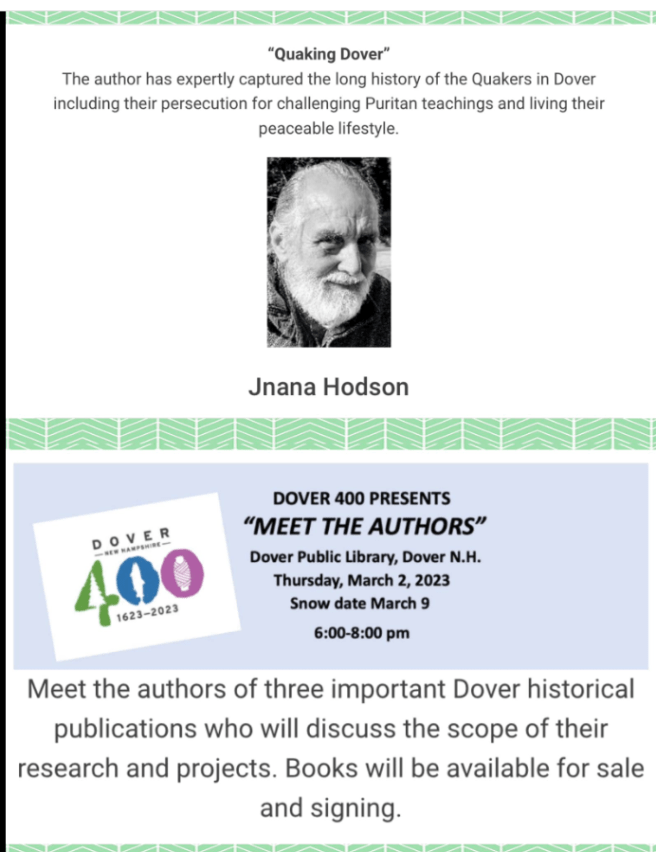
Here’s how the organizers of tomorrow night’s program are touting the event:
I’m so psyched!
You never know what we'll churn up in cleaning a stall
Here’s how the organizers of tomorrow night’s program are touting the event:
I’m so psyched!
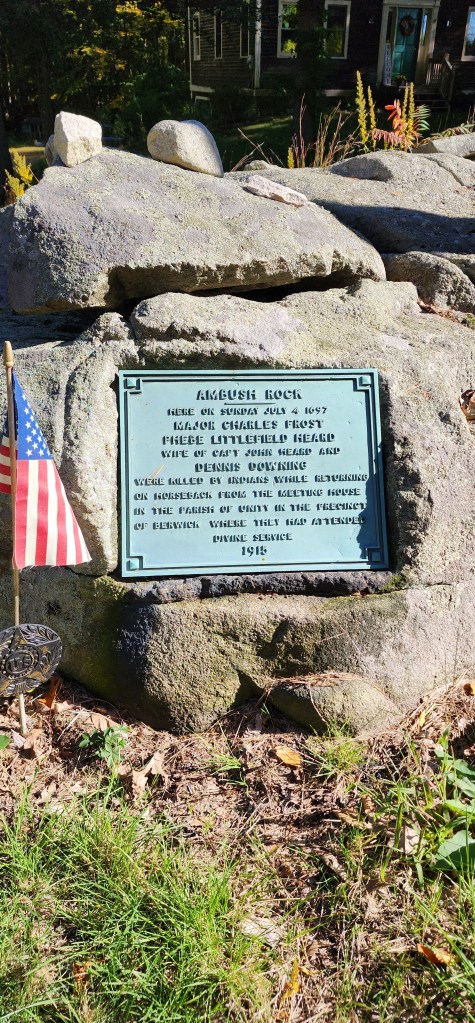
What the marker in Eliot, Maine, doesn’t mention is that Major Charles Frost and Dover’s Richard Waldron concocted the mock wargame that led to the hanging of Native men sent to Boston and the sale of about 350 Penacook women and children into slavery in the West Indies.
This was hardly an attack on an innocent party, then. The Natives waited years to extract revenge, and did it at a time and place that spared others.
My history Quaking Dover adds details.
A program Thursday night at the Dover Public Library promises to be lively fun.
Hosted by Dover 400, the folks behind the year-long celebration of the town’s settlement 400 years ago, I’ll be one of three authors of new books about the community’s past. Each of us brings something different to the table, and I’m really looking forward to meeting the others, as well as an audience full of additional insights and angles.
The program will allow each of us to address some prepared questions and briefly discuss our book before turning into wider discussion and an audience Q-and-A.
Retired librarian Cathy Beaudoin, the unofficial (and unrivaled) Dover historian, will be moderating. As an aside, I do wish she’d write the big volume about the city’s textile mills and the ways they transformed the community. She’s already curated a comprehensive lode of entries you’ll find on the public library’s website.
As a handy book you can follow around town, J. Andy Galt contributes an updated set of neighborhood walks that were originally conducted by the Dover Heritage Group. As I’ve previously posted, the city is pedestrian-friendly and has quite a range of architectural styles. In many neighborhoods, every house you pass seems to possess a history, if you stop, look, and have a few tidbits of info in hand. From the directions to one of those walks, Dover Friends Meeting finally learned where our second meetinghouse, from 1720, had been moved and now sits as a private residence.
Former Woodman Institute trustee Tony McManus brings a newly published, wide-ranging collection of newspaper columns he’s written on local history, especially the people involved.
And I’ll be there looking at the early developments from the perspective of the Quakers, for decades the town’s biggest minority.
As a grand finale, there will be an opportunity to sign books we’ll have for sale and meet one-on-one with readers. I couldn’t do that with ebooks.
(The snow date is March 9.)

As a commercial book venture, my Dover history would be considered marginal at best.
Quite simply, short of a breakout, it targets a tiny audience.
The city itself is small – a population of slightly more than 30,000. And while the surrounding area runs around a half-million, that’s still small by book publishing markers.
Additionally, my work focuses on the city’s second-oldest congregation, an even tinier potential readership. While that element opens another market of fellow Quakers around the globe, it’s still small.
As for history buffs? They have their niches.
At the outset, at least, any for-profit book publisher would see this as a high-risk, losing bet.
I am, of course, hoping Dover’s 400th anniversary this year will give it a bounce.
And, as a microcosm of a snarky, contrarian New England history, Quaking Dover just might entertain a wider reception.
I mean, how many people do you think would have been interested in covered bridges in Madison County, Iowa?
~*~
One commercial publisher specializing in local histories did take a look but quickly backed off. The editor didn’t like the first-person voice of my book, for starters, and got spooked by the fact this volume hadn’t been vetted by religious authorities.
A few others were simply looking for an author-subsidized co-publishing deal.
That returned me to the self-publishing world I found in ebooks and then, for paper editions, at Amazon’s Kindle Direct Publishing.
As much as I like ebooks, for reasons I’ve previously discussed here at the Barn, I very much felt this was one that needed to be available primarily in a hands-on physical book form.
While Amazon has no upfront costs for an author in its print-on-demand paperbacks, physical bookstores refuse to carry them because they would have to buy the volumes at retail and then add a markup to the price to cover their own costs. They rightly complain it puts them in an unfair position.
But then came the announcement that my ebook flagship, Smashwords.com, was merging with Draft2Digital, which specializes in producing print-on-demand. Both companies have arrangements with distributors and retailers, and both offer their services to writers for free.
The arrangement also gives me more flexibility in marketing and special sales opportunities.
In short, count me in. I’m truly proud of the result.

My first-ever Zoom presentation is now available for streaming, thanks to the Whittier Birthplace Museum. The presentation on January 26, “Starting with a marriage certificate: Why Whittier was no stranger to Dover,” focused on the famed poet and abolitionist’s many connections to, well, my new book Quaking Dover.
For the full YouTube event, do take a look here.
John Greenleaf Whittier is hardly the central theme in the book, but for me, developing the topic for this show, along with the accompanying PowerPoint slideshow, another personal first, was fun.

If you’re a regular here at the Barn, you know I do lag behind on the tech front. One step at a time, right?
I didn’t expect an unusually itchy nose and scratchy throat resulting from our dry indoor air. So much for my up-in-the-corner-of-the-screen stage presence.
On top of that, with the PowerPoint up in front in me, I couldn’t see who was attending. Oh, well, I had my hands full anyway.
Earlier, behind the scenes, there was concern about a possible power outage on my end as unusually warm temperatures dropped below freezing amid heavy rain. We did have a contingency plan, just in case.
I’m so glad we didn’t need it.
In case you’re wondering how things are going with Quaking Dover, here are some early reactions:
“The book purports to be merely a history of the Quakers at Dover, New Hampshire, but it is much more than that. It is a history of the beginning and spread of the Religious Society of Friends (aka Quakers) in the USA, the best exposition of their faith that I have read so far, a history of their persecution by the Puritans, and of the bloody conflicts between the Puritans and the native peoples. …
“Most of all, I had not previously been exposed to the reality of the Quakers’ faith, revealed in their own words. Jnana Hodson, himself a Quaker, has done extensive research in old records and journals and includes extensive quotations that bring the faith to life. Including their peaceful acceptance of persecution, their prudent approach to courtship and marriage and their belief in the work of the Holy Spirit in the heart.” – Bob Goodnough, Saskatchewan
(For his full review, visit his Flatlander Faith blog post of Dec. 12, 1922.)
~*~
“I enjoyed your conversational writing style – sharing the research that you did — and confidentially whispering (in your writing style), ‘This is what this finding means and how it should be interpreted.’ … To ascertain what really happened you checked primary documents, read previous accounts of Dover, New Hampshire – triangulated your sources and showed us readers how you reached your conclusion. A very enlightening read – well researched, well written.” – Joe Clabby, author of A History of Eastport, Passamaquoddy Bay, and Vicinity
~*~
“Love it!” – Susan Wiley, Sandwich, New Hampshire
~*~
“Deftly told. I really like your voice. It’s engaging, light, and easy to read.” – Jim Mastro, science fiction novelist
~*~
“An enjoyable book!” – Arnie Alpert, longtime peace activist
~*~
“A rich feast of a book.” – one of my favorite authors and fellow Maine resident
~*~
“I truly appreciate all the work and careful thought and interpretations you put into it.” – Canyon Woman, New Mexico
~*~
“I enjoyed your book very much. I particularly liked relearning about early life in Dover and surroundings, and was impressed by how much research you did to fill in details. Not only about the life of early Quakers and their trials and tribulations, but the connection they had to the rest of New and Old England. I did not understand how important the settlement of Dover was compared to Portsmouth, Exeter, and other towns.” – John Dawson, Lee, New Hampshire
~*~
“Thank you for writing this record of Dover Friends Meeting. The ‘Children of the Light’ had me on the verge of tears as I read it to Andrea.” – Harvin Groft, Berwick, Maine
~*~
In timing my book for Quaking Dover for the 400th anniversary of English settlement in town, I gave myself a deadline that ensured it would actually be done. Otherwise, I’d still be researching it.
In some cases, that meant I didn’t simply follow a conventional account but came to my own original conclusions. In others, post-publication findings confirmed in what I’ve deduced. Besides, in a period of Covid restrictions plus my own relocation to the other end of Maine, opportunities in the archives were limited.
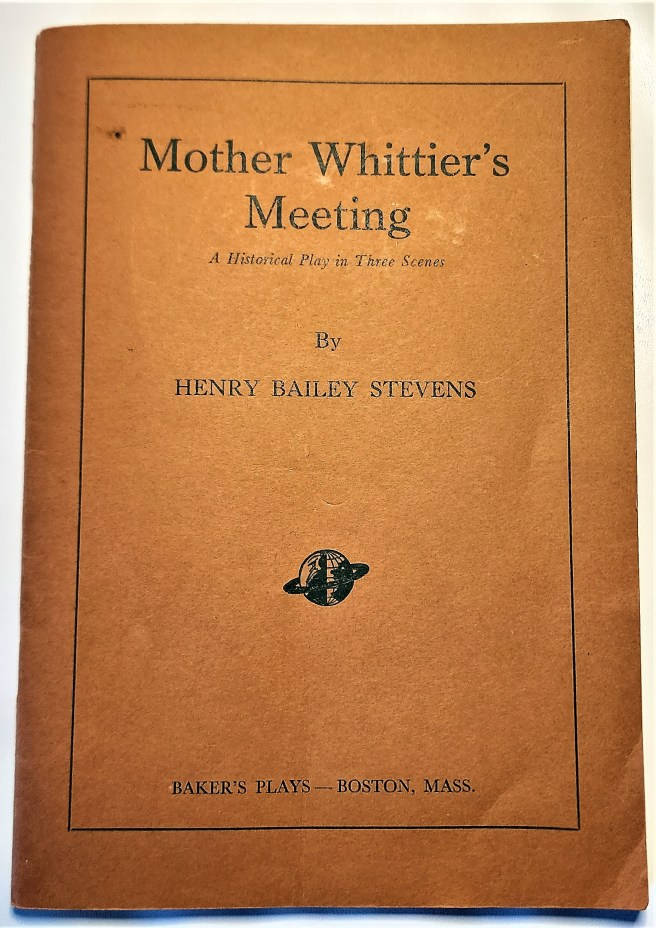
One of the works I’m glad I waited to read until my own work was done is Henry Bailey Stevens’ three-scene play, Mother Whittier’s Meeting. It was premiered outside the Dover Friends meetinghouse on August 17, 1963, to mark what he thought was the 300th anniversary of the Quakers’ presence in town. As I now see, the celebration was four or five years late.
Had I read the play first, I might never have written my own take of the history. He covers the heart of the plot in 200-some fewer pages.
Stevens himself is an interesting character who turned up around the time that the Dover meetinghouse was reopened for regular worship in the 1950s. He was the head of the Cooperative Extension Service at the University of New Hampshire in neighboring Durham but also harbored a deep interest in both history and dramatic literature, as well as an ardent vegetarian and pacifist. He even penned a series of Quaker family profiles for Dover’s daily newspaper.
The play itself is what we’d call “talky” – more dialogue than action. There’s no dancing or sword-fight scenes, as it were. The central focus shifts between Meeting as the community and as the house itself, or even turns to Abigail Hussey Whittier herself. Not that you really notice as you follow along.
There are points I’d heatedly contest. The first meetinghouse, for instance, was most likely not a log cabin.
But then I feel like cheering when Annie Pinkham shows up as a character. Her mimeographed brief history contained tidbits that would otherwise be lost to oblivion. She had every reason to believe she’d be the last Quaker in town once she locked the meetinghouse door.
Not so, as things turned out.
As for Stevens? His play, published by Baker’s Plays in Boston, isn’t his only significant book-length publication. Finding those, though, can be a challenge.
Join me online from the Whittier Birthplace Museum in Haverhill, Massachusetts, on Thursday, January 26, at 7 pm.
My presentation in their virtual lecture series via Zoom will explore the celebrated abolitionist and poet’s many connections to Dover, starting with an examination of his parents’ certificate of marriage in the Quaker meetinghouse in 1804. His mother grew up in the Dover Quaker community, and his Whittier uncle, Obadiah, was already living in town at the time of the wedding. In fact, Whittier Falls and Whittier Street weren’t named for the poet but his uncle and cousins.
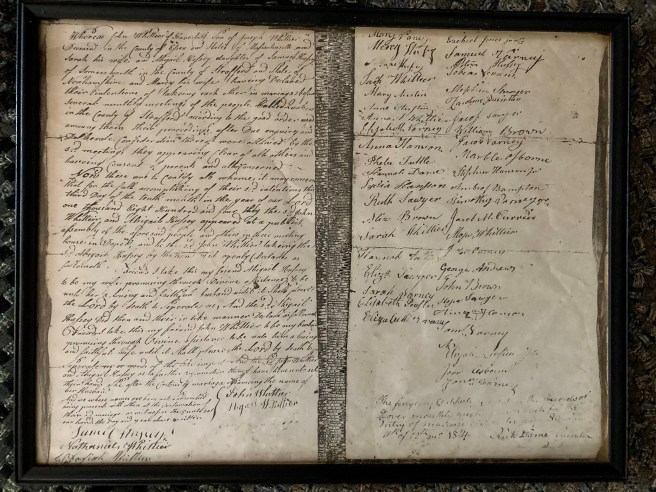
Once we’ve gleaned insights into seemingly quaint Quaker practices of the time, we’ll turn to the signatures of the witnesses – that is, all of the Friends in attendance – and learn about some of them, too, as well as a few who weren’t present but were still members of the Meeting living in a town to the west and definitely of interest.
And then it’s your turn to ask questions or make comments.
The event does require preregistration and a suggested donation of $10 per household. Go to whittierbirthplace(dot)org and click on Events to learn more.
Here’s hoping you can make it. Putting this together has been a blast.
Among other things, I would love to know more about the livelihoods of Dover’s Quaker families, especially as they evolved over the generations. How did they acquire new skills, for one thing, as the town went from being a fishing and shipbuilding center to timbering and sawmills and then milling in general, even before its emergence as a calico capital?
New England farming, of course, underwent its own permutations, especially after wool was displaced by cotton in the early 1800s.
As Dover shifted from a rural village with agricultural roots and fishing and shipbuilding to an industrial city depending on an immigrant workforce, the Quaker presence shrank to a mere thread. Even so, as I like to think, some of the Friends’ values continued in the descendants of the Meeting’s earlier members, even when the family was no longer Quaker.
Many had moved north or east in search of new farmlands, and others were about to head off to Minnesota and Iowa.
Dover Friends Meeting was already declining when the textile mills started changing the character of the community. Moreover, the new arrivals brought new churches and ethnic identities, and these are stories waiting to be told in the upcoming celebrations. I’ll be all ears.
As the ownership of the mills passed to out-of-town investors, the profits being generated in Dover prospered an upper crust elsewhere, most likely the famed Boston Brahmins. In contrast, Dover became a largely working-class neighborhood. The same can be said for the busy rail lines passing through town.
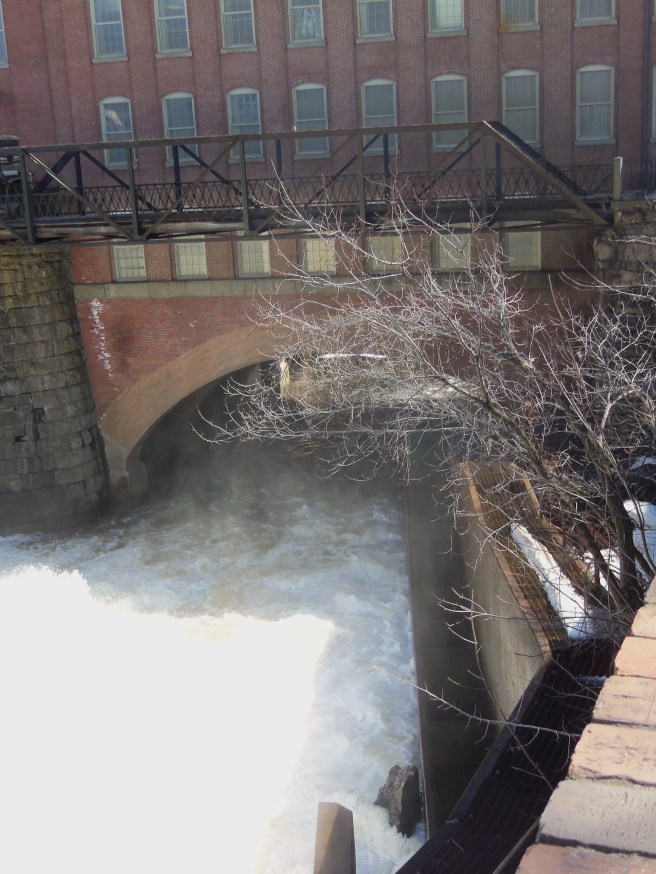
Although a visitor to Dover today would have no problem seeing the town’s character as New England, its identity today comes from the brick mills erected at the falls four-and-a-half or five miles north of the Hilton settlement. There is no town common, a wide green square surrounded by imposing Colonial houses and white church under a lofty steeple. The same can be said for neighboring Portsmouth, formed around the harbor, and Exeter, with the elite academy. Yes, there are the iconic church spires and rooster weather vane but not the central green common. Hampton, which remained largely agricultural, does have a tiny green, not that it would pasture a single horse.
As my new book and these blog posts note, David Hackett Fischer’s Albion’s Seed: Four British Folkways in America explains that the stereotypical New England arises in the customs and culture of East Anglia, the region of England that produced most of the Puritan migrants who shaped Massachusetts and Connecticut. He sharply counters that with the Quaker migrations from the Midlands into Pennsylvania, and from the Royalist cavaliers who predominated the Virginia planter society, as well as from the Borderlands people in northern England who share commonalities with the Scots-Irish settling the Appalachian spine from Georgia to Maine.
Fischer examines these complex workings in a set of specifics that include distinctive speech, architecture, geographic patterns of settlement, family, marriage, gender, sex, child-rearing, naming of children, attitudes toward aging, religion, magic, learning and education, food, dress, sports, work ethics and practices, use of time and recording, ideas of social order and institutions, authority and power, and more, including differing concepts of liberty and social restraint.
Quite simply, there was no generic Englishman. Even the dialects could prove incomprehensible when taken from one part of the country to the other.
While the new settlers to the Piscataqua settlement were primarily Puritans, imbued with its Protestant ethos, they were also overwhelmingly from Devon, with folkways quite distinct from their East Anglia brethren.
I suspect these contrasting folkways play a major, though previously undetected role, in the deep conflicts about to emerge in the seeming isolation along the Piscataqua as well as elsewhere in other pockets of New England.
Far from being a homogenous nation, Britain was a patchwork of many long-buried identities, some of them resurfacing in new guises. The country had never suffered an Inquisition, either, to suppress them. Its Christianity had been imposed from the conversion of the regional kings, whose subjects might publicly worship one way but another in private.
English Quakers, too, had never suffered the trials of sustained violence with New France and the Indigenous American tribes or racial slavery or a Revolutionary War, as their American coreligionists did, especially in New England. Little wonder the English Friends were baffled by the separations that ultimately divided Quakers in the New World.
It was a rich brew. And, frankly, still is.
~*~
Though Dover Quaker Meeting was reborn in the ’50s after a hiatus, its viability is challenged, but so is much more of contemporary American society. Besides, I’m not comfortable in considering the period as “history,” much less examining it systematically or comprehensively, though I tell what I can. Some early readers think it’s the best part of my book. I won’t argue.
I will say that our Quaker Meeting is a beautiful community, one I love dearly and invite you to experience.
As well as Dover.
~*~
Check out my new book, Quaking Dover, available in your choice of ebook platforms at Smashwords.com.
Welcome to the upcoming 400th anniversary.
 Jnana's Red Barn