No index and no footnotes

November is the month many amateur writers set out to draft a full novel within 30 days.

My book Quaking Dover is nonfiction, but with eight published novels, I can still sympathize.

I should have been suspicious when this book seemed to write itself, producing what one beta reader then sensed as not just stream-of-consciousness but a mind-dump.

Ouch!

Revising it, aiming at a more consistent, creative non-fiction tone, was much more torturous and required much more time and attention than I can calculate. Still, I have to admit the result feels satisfying. Just don’t make me do it again.

As a history book, it wound up with no index and no footnotes but instead focused on a community of people over time.

Well, the ebook edition can be easily searched for items. Not so with the paperback.

As for footnotes? Much of my research in the Covid outbreak was conducted online, not exactly a permanent source of information.

The effort did push me far beyond my journalism discipline, pushing me into the story as an active observer, not that I was comfortable with that.

But it seems to work, all the same.

Just how many new books are being published, anyway?

November is the month when a lot of amateur writers make a push to start and finish writing a novel. While I applaud the effort, I also question whether we need that many new manuscripts.

Again, definitive figures turn out to be elusive. Still, focusing on the United States, here’s what turns up:

  1. A conventional view places the output at 600,000 to 1 million new titles every year. That’s between 1,700 to 2,700 published every day – or more than 100 books an hour. Not all of it’s fiction, of course, not by a long shot. But if you’re writing, the competition is stiff.
  2. Another view puts the number at 4 million new books a year, three-quarters of them self-published. Under the radar, as it were.
  3. Hard cover and paperbacks account for just half of the books being sold in America. Ebooks get 36 percent, and audiobooks and “other” formats take up the rest. (When compared by the amount spent on each category, printed-on-paper editions skewer the picture.)
  4. A third of all ebooks are self-published.
  5. Two-thirds of the top-rated, self-published books are written by women, compared to just 39 percent of conventionally released books.
  6. The number of self-published books has increased by 264 percent in a five-year span.
  7. Of authors who released their first book in the last ten years, 1,200 traditionally published authors have earned $25,000 or more a year, compared to 1,600 self-published authors. That’s an eye-opener.
  8. The global publishing market is expected to grow at 1 percent a year, while the self-publishing market is expected to grow at 17 percent. I’m unclear if the figures are based on sales earnings or on the number of copies sold. Still, it’s a trend worth watching.
  9. Not every non-fiction book is read cover-to-cover.
  10. Fiction is for escape.

How many books do you read a year?

These days, it seems that everyone I meet has written a book. As an author myself, I’d much rather for everyone to have read a book in the past week. Or, gee, even a newspaper.

Trying to get solid figures on how much is being published or read is trickier than you might suspect. But to get us started, let me offer some findings, albeit with a grain of salt. And, to further complicate matters, I’m not exactly sure how the researchers are defining “book.” I’m assuming textbooks, instruction manuals, catalogs, and the like are excluded. But cookbooks? They’re big in our household. That said, in the United States:

  1. Readership averages four books a year.
  2. A quarter to a half of adults admit to reading no books.
  3. A typical bookworm, on the other hand, devours 14 a year.
  4. Non-fiction dominates over fiction, three to two.
  5. History, biography, and memoir are major sellers.
  6. Two-thirds of book readers are women, but they comprise 80 percent of the fiction audience. Some surveys suggest that women age 18-24 are the most frequent fiction readers.
  7. On the other hand, half of American book readers are over age 55.
  8. Romance is the best-selling fiction genre, accounting for a third of the books sold. Mystery, fantasy, and sci fi are also boffo.
  9. Fiction titles still dominate bestseller lists.
  10. Books aren’t just for readers. They’re also for collectors. And gift giving.


Can it really be a whole year since the book appeared?

Have to admit it’s been an exciting, though not exactly lucrative, past 12 months since Quaking Dover appeared in print. The 255-page volume is quite different from my earlier publications. It’s history, rather than a novel or poetry, and its tone and outlook pushed my journalism training in new ways. I’ve even come to see this as my major creative nonfiction opus.

Reader reaction has been enthusiastic, and the book’s perspective has challenged the conventional take on New England history and its impact on the rest of America.

Friends Journal magazine called it an “eminently well-argued and documented account,“ while others declared it “a rich feast of a book” or said “It’s like you’re speaking right to me! It’s not like a history at all!” or simply “enjoyed your conversational writing style.”

Unlike my novels, its publication led to a festive book-release party in the Dover Quaker meetinghouse, followed by other events – some of them with unique PowerPoint visuals – in Dover, New Hampshire; Haverhill and Cape Cod, Massachusetts; and Eastport and Pembroke, Maine. Ten in all, and all well received. Didn’t get to do that with the novels. I’ve even had strangers stop me in the street to tell me how much they like my reading. And creating the presentations and accompanying illustrations has been fun in a whole new way for me.

One thing that’s impressed me is the way this has connected with people. It’s about places they live in or have visited, about families and communities they know, about values they share. It’s more concrete than fiction but no less personal.

Overall, it’s sold close to the U.S. average of 200 copies a year. Considering that the book is, at its core, the story of a small congregation in a small city in a small state, I’ll take that as a good start.
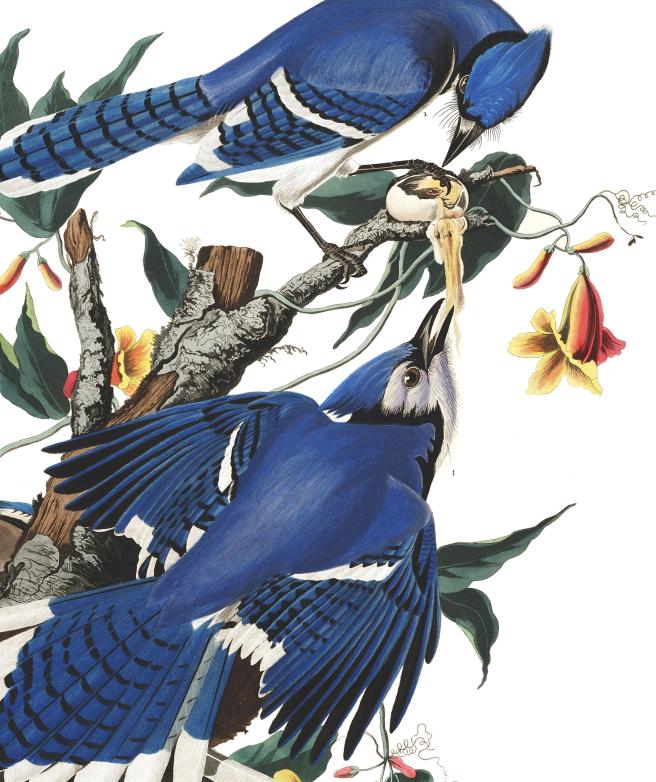
America’s most celebrated wildlife artist was a Frenchman

Or more accurately, the bastard son of a Frenchman in Haiti.

Yet, despite the iconic honor given his name, few have seen his legendary work in its full glory.

I’m speaking, of course, of John James Audubon, in the anglicized version of his name.

While I had viewed his work behind glass framing in art museums, nothing prepared me for my hands-on encounter with the four folio print volumes. That happened in Indiana University’s rare book Lilly Library when a librarian interrupted to ask if I would help her return two of the volumes to the cart so she could take them by elevator back to the stacks.

Yes, they really did need two people to move. As I’m seeing now, the books measured about 29½ inches by 39½, otherwise known as double elephant paper, the 435 prints being the same size as the original drawings.

We decided to take a peek and were both blown away. It was as if the birds had been pressed full-size onto the plate. You could actually see the veins in each feather. And that was, it turns out, a copy of the original. Oh, yes, and each species was presented full size, with some favored vegetation.

As for the color? Unbelievable. You have no idea how much is lost through any glass.

We both admitted it was too much for a single viewing.

Well, we had an acquaintance who was terrified of blue jays.

Now, for ten more facts.

  1. As an 18-year-old, Jean-Jacques Audubon was sent to Pennsylvania on a false passport to avoid conscription into Napoleon’s army.
  2. A feud originating during his research in Kentucky closed off American support for young Audubon’s work. Instead, his backing came from England, where subscribers underwrote the classic Birds of America.
  3. One bookseller claimed it would never succeed because the book took up an entire table to view and would render other volumes useless.
  4. A reduced-size two-volume collection, a gift from my younger daughter, has me appreciating the radical design and style of many of the images. There was no way, after all, to approximate the original color, yet any approximation opened other dimensions.
  5. He worked from actual specimens he had shot and killed, arranged in lifelike settings.
  6. He did create a controversy regarding the smell of turkey vultures, or what some of us call buzzards.
  7. Some of the birds he discovered remain a mystery.
  8. He’s known mostly by copies of copies or even additional copies, each time diluting the impact of the originals.
  9. He had nothing to do with the national Audubon Society or its Massachusetts and New Hampshire spinoffs.
  10. He’s buried in New York City.

When a painter writes poetry, too

I love the idea of artists who are inspired by other artistic fields. Too often, alas, they’re stuck in their own genre.

The term for what I’m discussing here is cross-disciplinary.

For example, I’m primarily a writer, lately of fiction as well as a poet, but I’m moved most intensely by classical music and then opera, jazz, folk, film, theater, and yes, painting and related visual fields. And I consider myself essentially a visual person?

Maybe you get the idea.

So a few months ago, I got news that a friend now living in California had a new book, Roots, Stones, & Baggage, and I assumed it was a catalog for his most recent gallery presentation. He is, after all, a marvelous painter, still active in his 90s.

What arrived in the mail was mostly his selected poems, revealing a whole other side of himself. They’re good, by they way. He respects craft. And there is a sampling of his paintings over the years, too.

I remember his reply during a Q&A at his gallery show opening at the Ogunquit Art Museum in Maine when he said he understood Blake’s poetry, something that left many dumbfounded. Think of understanding as gut-level rather than legalistic, OK?

The new booklet’s worth getting even for the wonderful introduction by his son, the celebrated novelist Jonathan Letham.

And the poet slash painter in question is Richard Brown Letham, still going strong.

If you missed my latest Zoom presentation

You can catch up with my insights on “Quaker Meeting as a nest for social justness” via YouTube, thanks to West Falmouth Friends on Cape Cod.

The event, the latest of the special presentations based on my book, Quaking Dover and the New Hampshire city’s 400th anniversary, was recorded and is now available.

Many thanks to all involved.

To see what transpired during the hour, click here.